

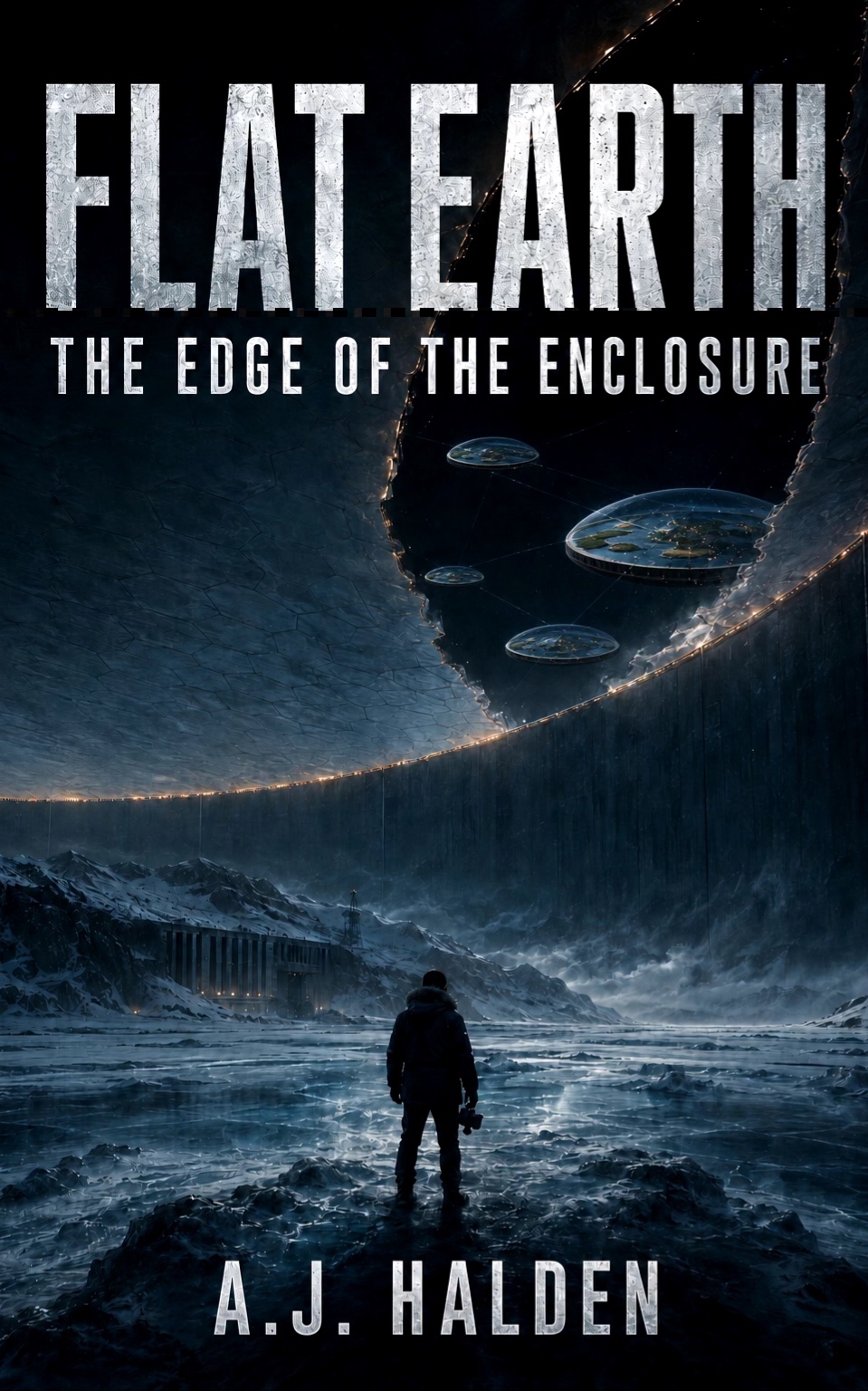
Flat Earth: The Edge of the Enclosure
The ultimate conspiracy is the world we thought we knew
by A. J. Halden
THE SKY IS A LIE. THE EDGE IS REAL. When a catastrophic disaster shuts down a remote hydroelectric dam in the Alaskan wilderness, investigative journalist Roy Rivera suspects more than structural failure. Classified images reveal armed blockades sealing the valley, while unmarked forces hunt anyone who survived. Inside the ruined facility, Roy finds Louis Ramirez, the dam’s former chief engineer, and evidence of an impossible discovery. Hundreds of feet beneath the mountain, excavation crews struck a seamless, indestructible barrier extending far beyond the reach of their instruments. With the help of Dr. Evelyn Howard, a blacklisted astrophysicist whose forbidden research destroyed her career, Roy uncovers a truth that challenges everything humanity believes about its world. The sky is manufactured. Earth is an artificial enclosure. And something beyond its walls has been watching. Pursued across the frozen wilderness by an elite mercenary strike team, Roy races to expose the secret before every witness is silenced. But as he closes in on the edge, he discovers the conspiracy may not have been created merely to control humanity. It may be the only thing keeping humanity alive. Now Roy must decide how much truth the world can survive before those guarding it erase him forever.
- Science Fiction
- Thriller
- Conspiracy Thriller
- Alien Contact
- Action Thriller
The Alaskan Exclusion Zone
The Anchorage airport smelled like jet fuel and wet carpet. Since the Knik River Dam story broke, the state emergency management office had converted a tourist-information booth beside baggage claim into a temporary press credentialing station. A laser-printed MEDIA CHECK-IN sign was taped crookedly across a photograph of Denali, and folding tables sagged under press packets, road-closure maps, and coffee that looked old enough to vote. Any reporter hoping to attend the state briefings, or get onto whatever controlled site tour they eventually offered, was supposed to register there first.
The woman behind the counter had two phones ringing, a printer blinking for attention, and the exhausted expression of somebody who had been answering the same six questions since dawn.
“Roy Rivera, Continental Wire Service,” I said, turning my credential toward her.
She barely glanced at the badge before typing my name into a spreadsheet and sliding a temporary media pass across the counter. Verification was clearly a problem for somebody on the next shift.
The badge was good work. It ought to be, considering what I’d paid for it.
I hadn’t worked for a wire service in six years. I hadn’t worked for anybody in six years, not since the Baton Rouge story cost me my marriage and half my Rolodex. But a fake badge opens doors a freelancer’s business card never will, and I needed doors open in Alaska.
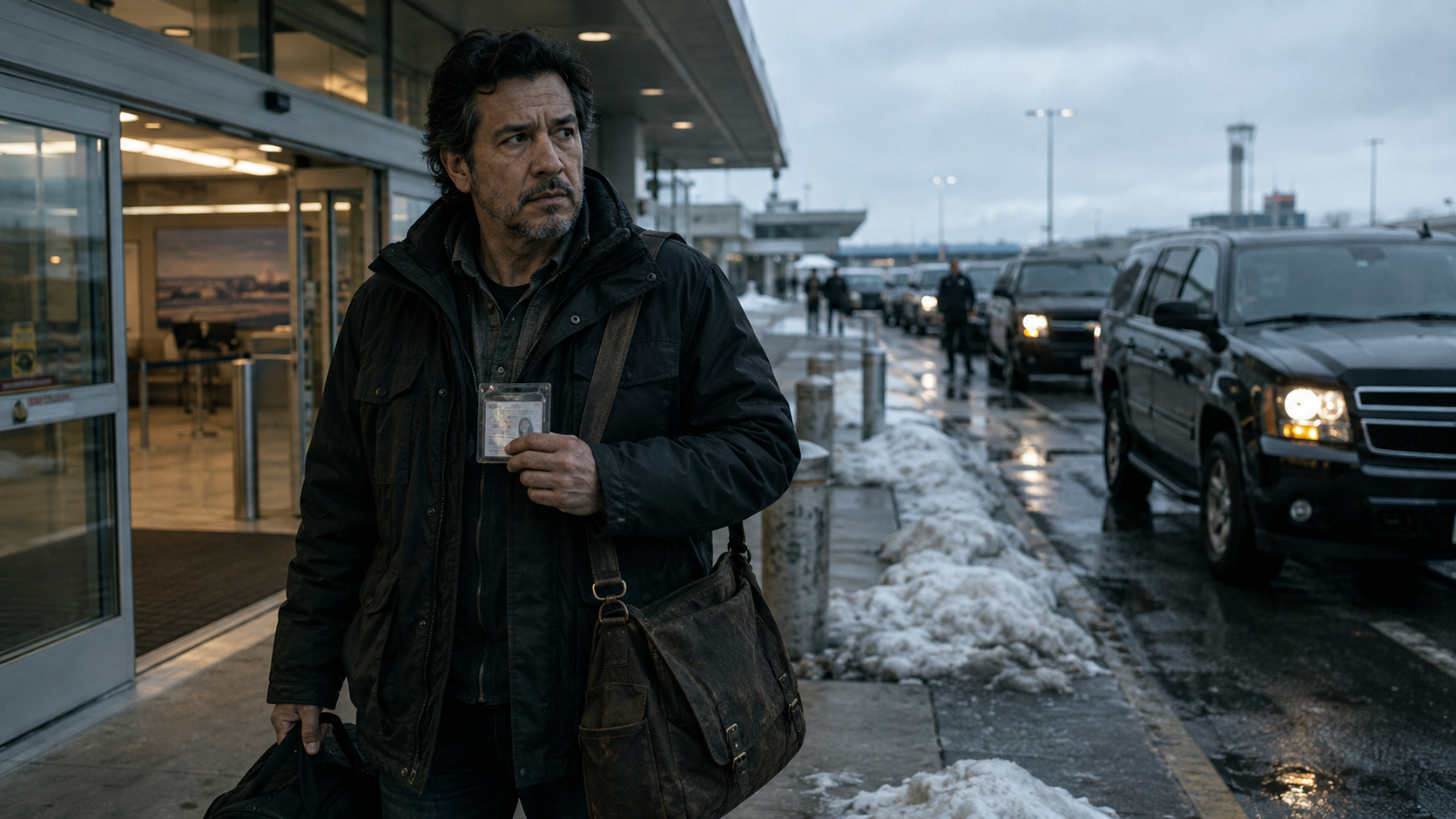
Outside baggage claim, the cold hit me like a flat hand to the face. Ten degrees, maybe less, with a wind that found every gap in my jacket. I stood there a second, letting my lungs adjust, watching a line of black SUVs idle at the curb with government plates and tinted glass. Nobody got in or out of them. They just sat there, running, like somebody was waiting on a call.
I rented a Ford pickup with oversized tires and a heater that worked too well, then drove to a motel on the edge of downtown that took cash and didn't ask questions. That was where Lillian's feed found me.
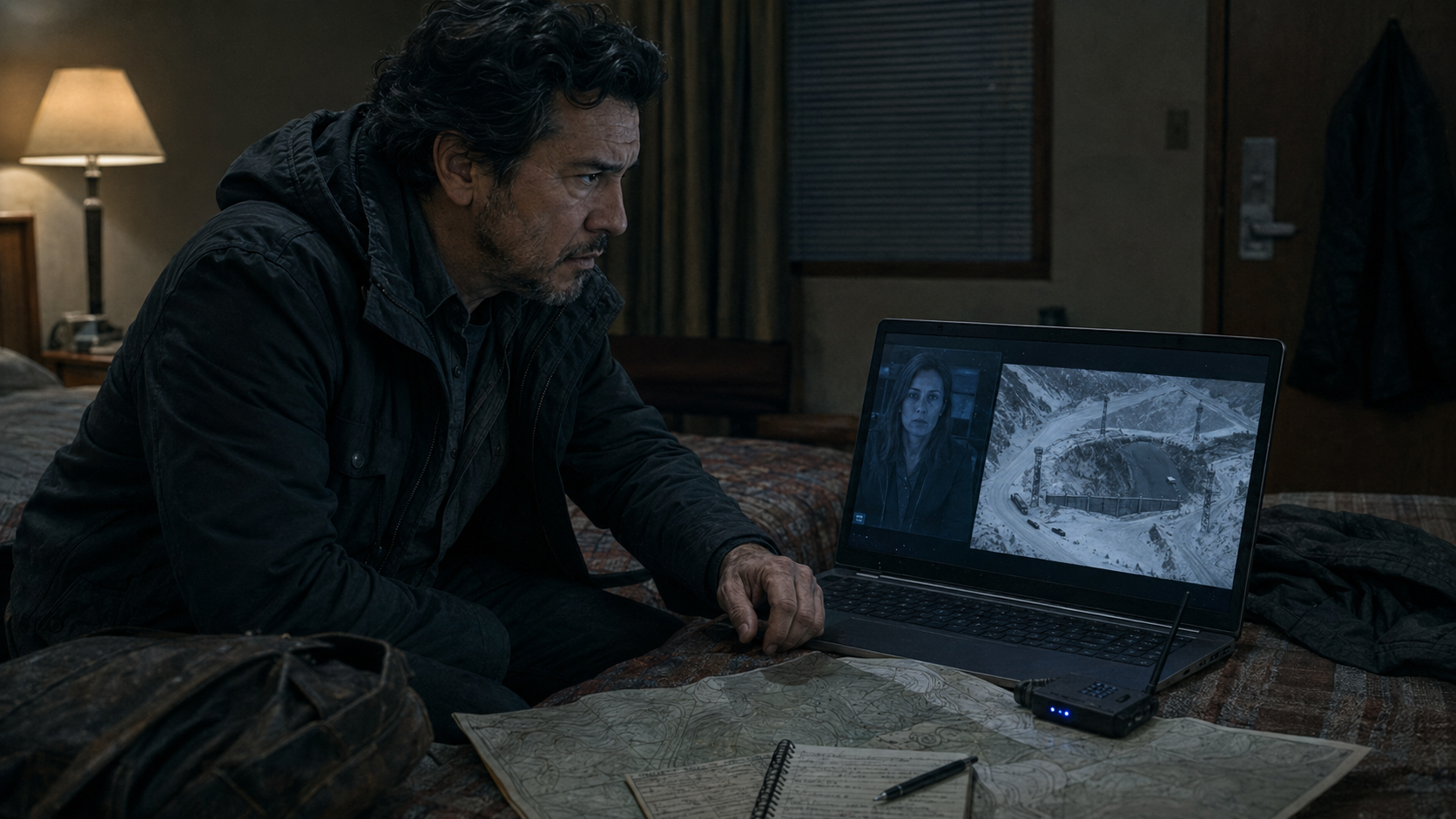
I set up the laptop on the bed, ran the signal through two relays she'd built for exactly this kind of conversation, and waited. Her face came up grainy, lit blue from her own monitor, somewhere in a Seattle office that never seemed to have windows.
"You look like hell," she said.
"I look like a man who flew coach next to a guy with a cold. What have you got?"
"I've got a story that isn't a story. Officially, the Knik River Dam had a subterranean collapse. Structural failure, cascading fault in bedrock they should've surveyed better before they built a hundred-and-forty-foot concrete wall on top of it. Three dead, six missing, site closed indefinitely for 'geological assessment.'" She said the last part with her fingers hooked in the air, quoting somebody's press release.
"And unofficially?"
She turned her screen. A satellite image filled my laptop, grainy but legible. A valley, snow-choked, ringed by a perimeter fence that hadn't been there in the last commercial pass six months earlier. Guard towers. Vehicles that weren't National Guard trucks or FEMA rigs, but something leaner, unmarked.
"This came off a commercial imaging satellite that got its feed scrubbed forty minutes after it passed over," Lillian said. "Somebody at the company noticed the gap and sold me the raw file before legal caught wind. Look at the towers."
I leaned in. Four structures, tall and skeletal, spaced around the valley's rim.
"Radar jamming," she said. "Or at least that's my source's best guess. Nobody puts up jamming towers to protect a broken dam, Roy. You put those up to keep something from being seen or being found."
"Emergency response teams don't wear unmarked uniforms either," I said, mostly to myself.
"There's your lede."
I asked her to send me everything, the images, the metadata, whatever she had on contractor call signs picked up over open channels. She said she'd already burned it to a drive and it'd be waiting through the usual dead drop by the time I hit the valley road. Then her face tightened, the way it did when she was about to say something she didn't want to.
"Roy. Whatever's up there, it's got federal money and private muscle both. That's not a combination that likes reporters."
"Never has been."
"I'm serious. Call me every six hours or I start making noise."
I told her I would, and I meant it when I said it, which didn't mean much given my history with promises like that.
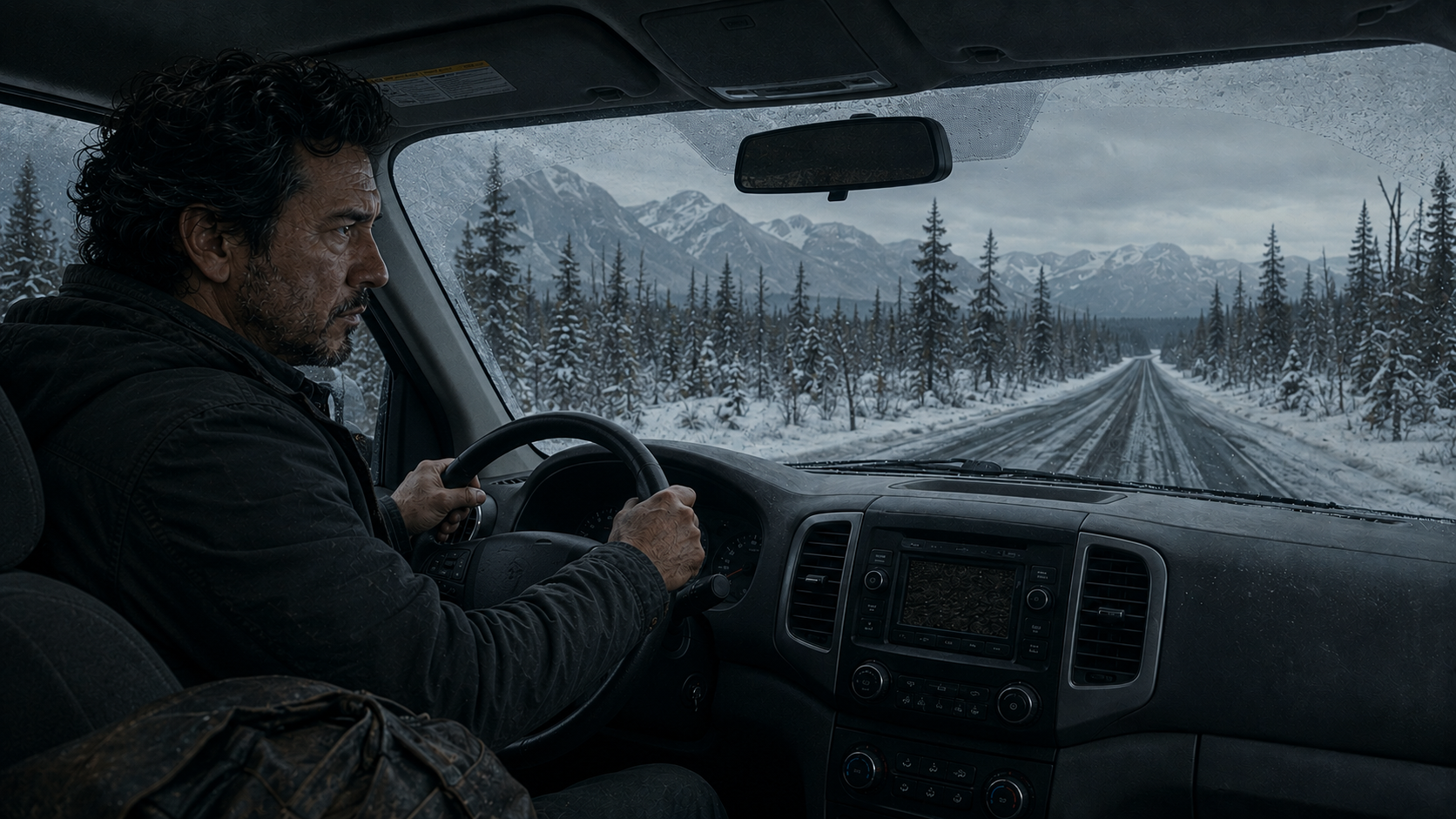
The drive north out of Anchorage took me through country that got emptier by the mile, black spruce leaning over the road under a crust of old snow, the Chugach range gray and indifferent in the rearview. Somewhere around mile sixty the radio lost its signal for good, and after that it was just the truck's engine and the tires chewing through slush.
The checkpoint came up faster than I expected, a gate arm across the road flanked by a shipping container that had been converted into a guard post. Two men stood outside it in white winter fatigues with no insignia, no unit patches, nothing that said Army or Guard or contractor. Just guns, good ones, slung low and ready.
I rolled down the window before they asked.
"Continental Wire," I said, holding up the badge. "Following up on the dam incident for a piece on rural infrastructure risk."
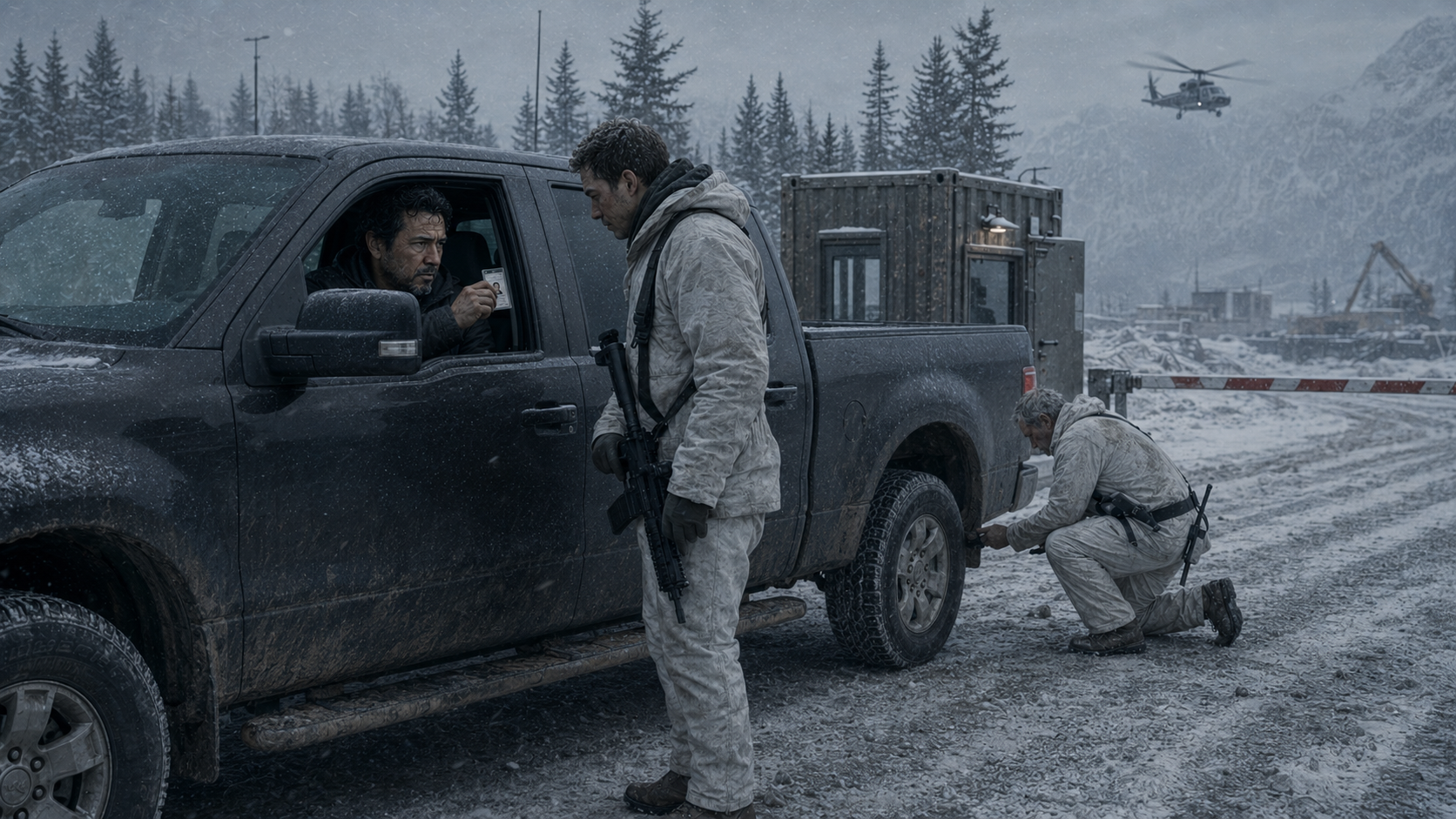
The nearer one, younger, with a face chapped raw from the wind, took the badge and studied it like he was reading a foreign language. "Road's closed past this point. Geological hazard."
"I heard. I've got clearance through the state DOT press office." I hadn't. I was banking on the fact that nobody up here would have a working line to check.
He looked at his partner, an older man with flat eyes who hadn't said a word yet and didn't now, just gave a small shake of his head that could have meant anything.
"You can't proceed past the outer marker," the younger one said. "This is as far as press goes."
"Copy that. I'll shoot some exteriors from here, get a few words from whoever's running point, and be out of your hair." I said it easy, like a man who'd said it a hundred times before, because I had.
He hesitated. Somewhere behind him, past the gate, I heard the low grind of heavy machinery, and past that, faint but unmistakable, the whine of rotor blades lifting off. Not medevac. Too fast, too clipped, like something built for cargo, not casualties.
"Wait here," he said, and walked the badge back to the container.
I sat there with both hands on the wheel, watching my breath fog the windshield, running numbers in my head. Emergency crews didn't need jamming towers. Geological surveys didn't need men with rifles standing checkpoint in a blizzard. Whatever had happened at that dam, it wasn't a structural failure. It was something somebody wanted buried twice.
The younger guard came back and handed me my badge through the window, along with a laminated slip. "Media staging is at mile marker forty-one. You don't cross this line again without an escort."
"Appreciate it," I said, and meant none of it.
As I pulled the truck around, I caught the older guard crouching near my rear bumper, quick and practiced, his hand disappearing under the wheel well for half a second before he straightened up and walked off like nothing had happened. I didn't need to check to know what he'd left there. A transponder, small enough to hide in a fist, broadcasting my position to whoever was watching this valley from somewhere warm and far away.
I drove the mile back toward the staging area until the checkpoint disappeared behind a stand of spruce, then I pulled off onto a logging spur half-buried in drift and killed the engine. If they were tracking the truck, the truck could sit there and freeze while I went in on foot.
I loaded my pack, checked the compass against the topo map I'd printed in Anchorage, and stepped out into snow that came up past my boot tops. The wind had picked up, driving flakes sideways, cutting visibility down to maybe forty yards. Somewhere out there, past the trees, past the fence, past the jamming towers and the men with no insignia, was a dam that the United States government wanted the world to believe had simply fallen down.
I started walking.
Unburied Secrets
The culvert mouth was barely wider than my shoulders, a concrete throat half-choked with ice, and I had to exhale everything out of my lungs to fit through the last two feet of it. Water hit me at the knees first, then the waist, black and so cold it felt like a solid thing closing around my legs. I'd read somewhere that a man has maybe ten minutes…