

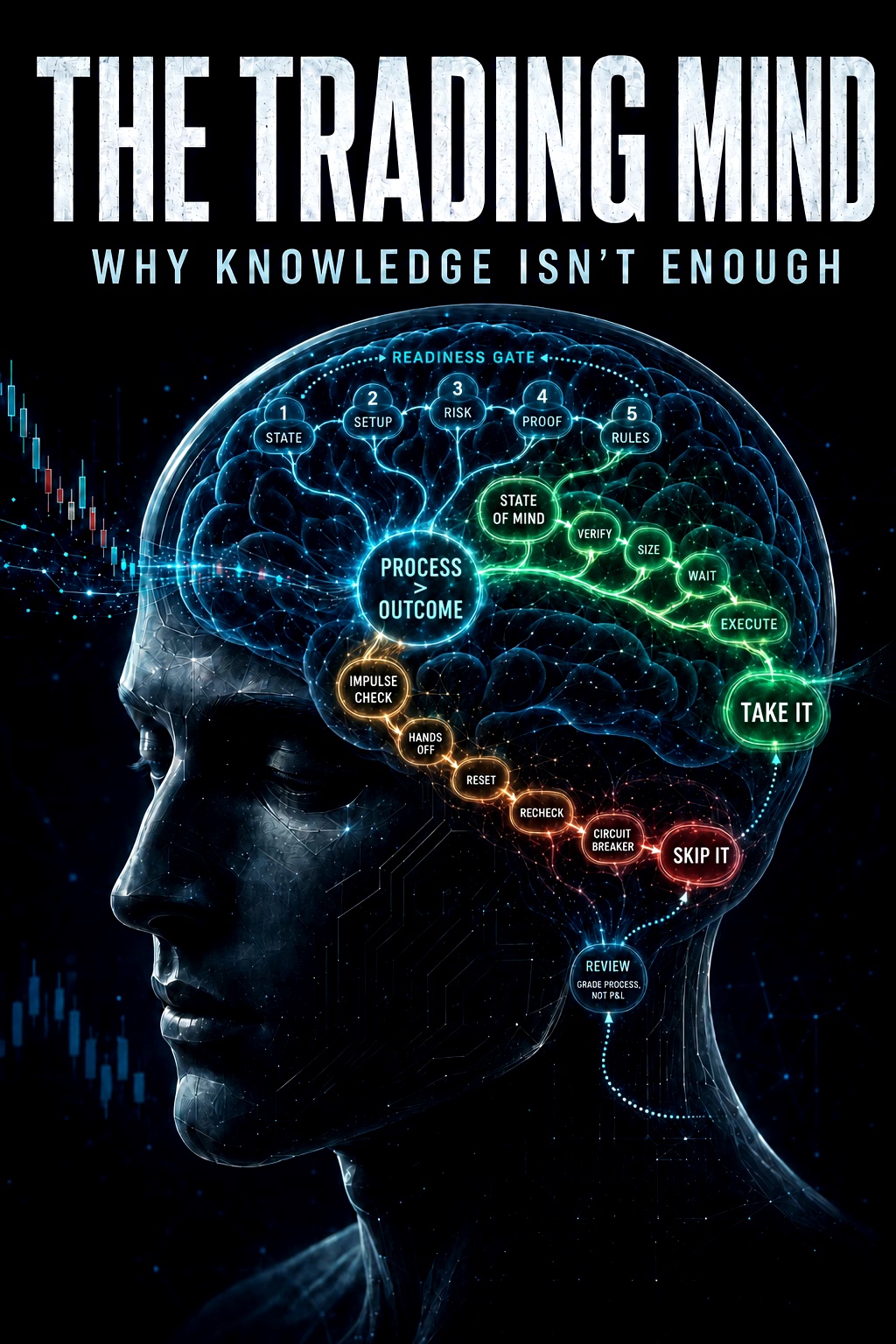
The Trading Mind
Mastering Emotional Discipline, Mathematical Edge, and Execution Under Pressure in the Markets
by A. J. Halden
The ultimate battle in the financial markets does not happen on the charts. It happens inside your mind. Every day, retail traders enter the arena armed with technical indicators and pattern recognition, yet the vast majority walk away broke. Why? Because market mastery has never been about predicting the future. It is about conquering fear, greed, FOMO, and revenge trading when real capital is on the line. In The Trading Mind, professional trader and risk strategist A. J. Halden pulls back the curtain on the psychological frameworks required for consistent profitability. Moving beyond simplistic mindset clichés, this definitive manual integrates the hard mathematics of expectancy and position sizing with deep behavioral science and market structure mechanics. Discover how to: • Eliminate impulsive decision-making through systematic risk control • Interpret institutional liquidity hunts rather than falling for retail traps • Treat execution like a high-stakes probabilistic poker game • Construct an ironclad personal trading constitution that protects your capital Whether you trade equities, futures, forex, or crypto, stop fighting the market and start mastering yourself. It is time to transform from an emotional gambler into a disciplined, compounding professional.
- Finance
- Self-Help
- Stock Market Investing
- Money Mindset
- Decision Making
- Emotional Intelligence
Why Smart Traders Go Broke
A trader I'll call Mark spent four months building a swing trading system on a demand and supply framework for the S&P 500 e-mini. He backtested it across three years of data. He forward tested it on a simulator for six weeks and posted a 61 percent win rate. When he finally went live with a small account, his directional calls kept landing. He caught a breakout in March, a pullback entry in April, a reversal off a key level in May. By his own count, he was right about where price was headed more than half the time. And yet, after four months of live trading, his account was down 14 percent.
Mark isn't unusual. He is, in fact, close to the median experience of a developing trader who has done real work on the analytical side of the business. He read the books. He studied the charts. He understood support and resistance, trend structure, and risk to reward ratios well enough to explain them to someone else. His problem wasn't that he didn't know where the market was going. His problem was what he did after he was right.
Two Different Games
There is a quiet assumption buried inside most trading education, and it is almost never said out loud: if you can correctly predict market direction often enough, profit will follow. This assumption is wrong, and it is wrong in a specific, measurable way that has nothing to do with luck or market conditions.
Trading is actually two separate skills stacked on top of each other. The first is analysis: reading price, structure, volume, and context to form a reasonable view of what is likely to happen next. The second is execution: doing the specific, disciplined, often uncomfortable things required to convert that view into money, and doing them the same way whether you're up for the week or down, whether you slept well or not, whether the last three trades worked or blew up in your face.
Analysis lives in your head. Execution lives in your hands, your fingers on the mouse or the phone screen, in the half second before you click "modify stop loss" or "close position." Analysis is intellectual. Execution is behavioral. You can be excellent at the first and mediocre at the second, and if that's the case, the market will not pay you for being smart. It will simply take your money more slowly and more painfully than if you had no edge at all.
This distinction is the foundation of everything else in this book. Every chapter that follows, on fear and greed, on position sizing, on reading market structure, on building a trading constitution, is really an extension of one idea: knowing what to do is cheap. Doing it, consistently, under financial pressure, is the actual skill you are being paid for.
What a 28 Million Trade Sample Actually Shows
A widely cited brokerage analysis, drawing on tens of millions of retail forex trades, found something that should unsettle anyone who thinks a positive win rate is the same thing as a profitable system. Across the sample, traders were directionally correct more than half the time. Their win rate, in other words, was north of 50 percent, which by itself sounds like a strong track record. If you flipped a coin and got heads 52 or 53 percent of the time, you'd feel good about your odds.
But the same traders, on average, closed winning trades after roughly 40 pips of favorable movement while allowing losing trades to run to roughly 75 pips before finally accepting the loss. Run the arithmetic and the problem becomes obvious. If you win half your trades at 40 pips and lose half your trades at 75 pips, your expectancy per trade is negative even though your win rate is above 50 percent.
Here's the simple version of that math. Say you place 100 trades. Fifty-two win at 40 pips each, for a gain of 2,080 pips. Forty-eight lose at 75 pips each, for a loss of 3,600 pips. Net result: negative 1,520 pips, despite winning more often than losing. Being right on direction 52 percent of the time didn't matter, because the size of the wins and losses was completely mismatched.
This is what traders in the industry sometimes call a negative asymmetry, though you don't need the label to understand the damage. You need only picture what actually happens inside a trader's mind at the two decision points that create it. When a trade moves into profit, a familiar anxiety kicks in. What if it turns around? What if I give this back? The trader takes the win at 40 pips, tells themselves they were "disciplined," and closes the position. When a trade moves against them, a different anxiety takes over. What if I close this and it turns out I was right all along? What if I just needed a little more room? The stop gets nudged. The loss is allowed to breathe. By the time the trader finally exits, at 75 pips instead of the 30 or 40 the original plan called for, they've quietly rewritten their own risk parameters in real time.
Notice what's happening here. The analysis was fine. In fact, the analysis was better than fine, since more than half of these trades were correctly read. The failure occurred entirely in the execution layer, in the moment of holding or closing, and it happened in exactly opposite directions for winners and losers. Winners got cut short by fear of losing an unrealized gain. Losers got extended by hope, denial, or the simple refusal to admit the initial idea hadn't worked.
This pattern shows up across markets and instruments, not just forex. Stock traders let losing positions turn from a paper loss into a "long term investment." Options traders hold a decaying position past their mental stop because "it still has time to work." Futures traders scratch winners at breakeven-plus-a-little because they've been burned by giving back gains before. The instrument changes. The behavior does not.
The Gym You Never Actually Walked Into
Imagine two people who both want to get stronger. The first reads twelve books on strength training, studies the biomechanics of the squat and deadlift, watches hundreds of hours of coaching videos, and can explain progressive overload, hypertrophy, and recovery science better than most personal trainers. The second person reads none of that. They walk into a gym three times a week, put a modest amount of weight on the bar, and add five pounds whenever they can complete every rep with good form.
After six months, which one is stronger?
The answer is obvious, and it's obvious because nobody confuses reading about a deadlift with performing one. The knowledge of proper form does not put muscle fiber under tension. Understanding the science of adaptation does not trigger the physiological process of adaptation. Only the repeated act of loading the bar and moving it does that.
Trading education has trained an entire generation of retail traders to believe the opposite is true in markets: that studying enough chart patterns, memorizing enough setups, and passing enough backtests is equivalent to being able to execute those setups when a real position, with real money attached, is open and moving against expectations. It isn't. Watching a hundred hours of technical analysis videos builds pattern recognition, which matters, but it does zero training for the specific muscle that has to fire when your account balance drops in real time and your stomach tightens and a voice in your head says just this once, give it a little more room.
That muscle, the one that lets you take a planned loss without negotiating with yourself, or take a planned profit without inventing a reason to stay in, only develops through repetition under actual stakes. Not simulated stakes. Actual ones.
Why Paper Trading Lies to You
Paper trading and demo accounts have a real, legitimate use. They let you test whether a strategy has a logical edge before you risk anything, and they let you build familiarity with a platform's order types and execution speed. What they cannot do, no matter how realistic the simulation, is replicate the psychological state of having your own money on the line.
The reason is simple and has nothing to do with willpower or character. Financial risk activates a different level of physiological and emotional response than a hypothetical outcome does, even when the numbers on the screen look identical. A trader can execute a demo strategy flawlessly for six straight weeks, following every rule to the letter, hitting every stop, taking every target, and then open a live account with the exact same strategy and watch their behavior fall apart within days. This isn't a character flaw. It's a completely predictable outcome of the fact that consequence changes behavior, and demo trading has none.
Think about the difference between rehearsing a difficult conversation in the shower and actually having it with the person across the table. You know your lines. You've said them fifty times in your head, calmly and clearly. Then the real moment arrives, the other person says something you didn't expect, your chest tightens, and half your rehearsed script disappears. The rehearsal wasn't wasted, but it wasn't the same event either, and it never fully prepares you for what the real moment does to your nervous system.
This is why a trader can have a demo account showing six months of consistent profitability and still go live and lose money in the first two weeks, not because the strategy stopped working, but because the trader executing it is, psychologically, a different person than the one who tested it. Paper trading proves a strategy can work. It does not prove you can execute it. Those are two separate questions, and conflating them is one of the most expensive mistakes a developing trader makes.
The 95 Percent Problem
If you surveyed a room full of struggling retail traders and asked them to write down their trading rules, most of them could do it accurately. Risk no more than 1 percent per trade. Cut losses at a predetermined level. Let winners run to a target or trail a stop. Don't add to losing positions. Don't trade the news. Most developing traders, by the time they've been in the market for a year or two, can recite a fairly sound rule set. The knowledge gap closes relatively fast.
What doesn't close, for the overwhelming majority, is the gap between knowing the rule and following it when a position is open, moving, and real. Ask that same room how many of them actually followed their own stated rules on their last ten trades, without exception, and the honest answers thin out fast. Most traders can tell you what discipline looks like. Far fewer can produce it on demand, under pressure, when the account balance is the thing changing in real time.
This gap is the reason trading education focused purely on strategy has such a poor track record of producing consistently profitable traders. You can hand someone a statistically sound system with genuine positive expectancy, and if they cut winners short and let losers run the way the traders in that 28 million trade sample did, the system's edge is irrelevant. The math of their behavior overrides the math of their strategy. Execution doesn't support the edge. It cancels it out.
The good news buried in this uncomfortable fact is that execution, unlike market prediction, is trainable in a very direct way. You cannot force the market to become more predictable. You can, with deliberate practice and honest tracking, close the gap between what you plan to do and what you actually do. That closing process is what most of this book is built around.
Exercise: The Plan Versus Execution Audit
Before you can fix an execution problem, you need to see it clearly, in your own numbers, not in a study about anonymous traders. This exercise is designed to give you that evidence.
The purpose is to compare what you intended to do on each trade against what you actually did, and to measure the size of the gap in concrete terms rather than vague impressions. Most traders believe they follow their plan more closely than they actually do. This exercise removes the guesswork.
You'll need your trading records from the last full month, meaning your broker or platform statement showing entries, exits, and position sizes, along with whatever notes, screenshots, or memory you have of your original plan for each trade. If you don't have detailed notes, do your best to reconstruct your intended stop and target based on the setup and your usual approach. Approximate is fine. Honest is required.
- List every trade you took last month in a simple table with five columns: entry price, planned stop, planned target, actual exit price, and reason for the actual exit.
- For each trade, calculate the planned risk to reward ratio (distance to target divided by distance to stop) and compare it to the realized risk to reward ratio (distance to actual exit divided by distance to stop).
- Mark each trade with one of three labels: executed as planned, exited early, or exited late.
- For every trade marked "exited early," write one honest sentence describing what you were feeling in the moments before you closed it. Fear of giving back profit, boredom, distraction, a headline, a gut feeling.
- For every trade marked "exited late," write the same kind of sentence. Hope that it would turn around, refusal to accept the setup had failed, anger at an earlier loss you were trying to recover.
- Total the pip, point, or dollar difference between your planned outcomes and your actual outcomes across the full month.
When you're done, look at the pattern rather than any single trade. Are your early exits and late exits roughly balanced, or do they skew heavily in one direction, the way they did for the traders in the 28 million trade sample? Is there a particular setup, time of day, or account balance condition where the gap tends to show up? Most traders find a specific pattern once they lay the numbers out this way, and the pattern is usually more consistent than they expected.
Pick one specific behavior from your audit to test changing over the next two weeks. Not five behaviors. One. If your data shows you consistently cut winners short after a certain point of profit, commit to a single, concrete rule, such as not touching the stop or target on a trade until it has either hit one of them or a predefined amount of time has passed. Track the results with the same table format and review it again in two weeks.
This audit is not a one time diagnostic. Return to it every month for the first year you use this book. The gap between plan and execution rarely closes on its own, and it rarely closes permanently. It shrinks with attention and tends to widen again the moment you stop paying attention to it.
Where the Real Work Begins
Mark's problem, once he ran this exact audit on his own four months of live trades, turned out to be almost identical to the pattern in the brokerage study. He was right on direction 58 percent of the time. He was cutting winners at roughly half his planned target and letting losers run to nearly double his planned stop. His analysis was never the issue. His hands were.
Understanding that distinction, between being right and being profitable, between analysis and execution, is the starting point for everything in this book, but it isn't the whole answer. Knowing that fear cuts your winners short and hope extends your losers doesn't automatically stop either one from happening. There are specific, identifiable voices in your head that produce these behaviors in the moment, and until you can name them and recognize them as they arrive, you'll keep fighting a problem you can't quite see. That's where we're headed next.
The Three Voices That Hijack Your Hands
A trader sits in front of two monitors watching a position that is up $340 on a $2,000 account. The setup called for a target of $600. Nothing about the chart has changed. Volume looks normal, the trend is intact, and the original thesis is still valid. But a thought arrives uninvited: take it now before it turns into nothing. The trader closes the…