

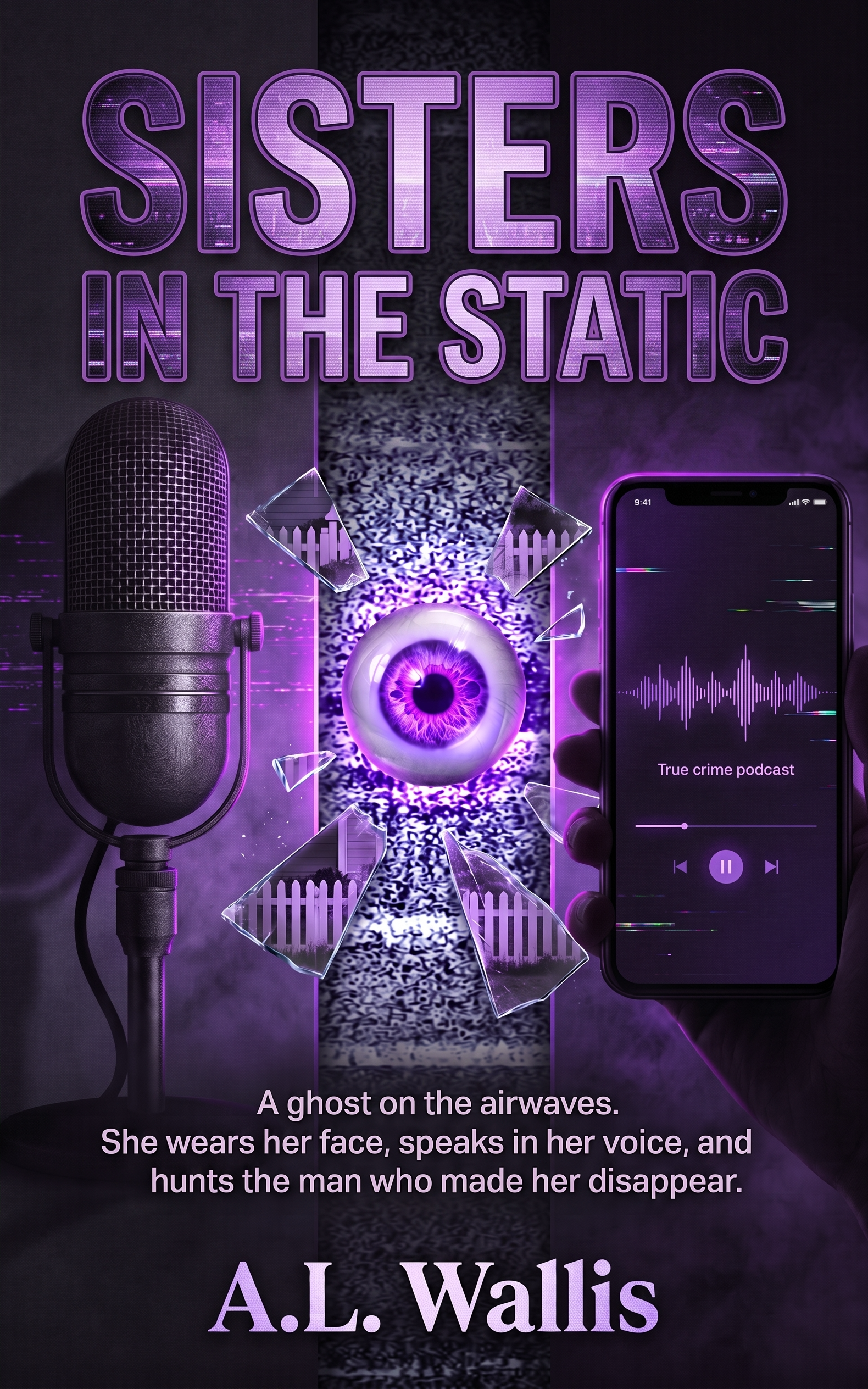
Sister in the Static
by A.M. Liddel
Amber Sterling-Wells is a ghost in her own life, a quiet teen who only speaks through her true-crime podcast, Signal in the Static. But when she sees a news report about Chloe Halloway—a missing girl who looks exactly like her—the story becomes personal. The police call Chloe a runaway, but Amber knows better. She's convinced Chloe was murdered by her stepfather, Grant Halloway, a man whose charm masks a predatory darkness. To catch a killer, Amber decides to become his victim. She transforms herself into Chloe’s twin, a plan that reveals a shattering truth: they weren’t just look-alikes; they were sisters separated at birth. Now, fueled by a primal bond and the gaze of millions of viral followers, Amber isn't just seeking justice—she’s seeking blood. As her real-time docuseries captivates the internet, Amber leads Grant down a psychological spiral, haunting him as Chloe’s living ghost. But as the line between the podcaster and the prey blurs, Amber discovers a trail of missing girls that suggests Grant is more dangerous than she ever imagined. In this lethal game of cat-and-mouse, Amber must decide how much of her own soul she is willing to sacrifice to make a monster die in fear.
- Young Adult
- Adventure
- Mystery
- Thriller
- YA Mystery
- YA Adventure
Static Signal
The static comes first. It always does. A hiss beneath the world, low and constant, like the room itself is breathing through broken teeth. I used to think it was just old equipment, tube amps and cheap cables doing what cheap cables do. Now I think it might be something else entirely. A frequency my brain tuned into a long time ago and never learned to tune back out.
I sat cross-legged on the floor of my closet, my recording booth, my confession box, whatever you want to call four walls of foam and blackout curtains that smelled faintly of dust and hot plastic. The microphone hung an inch from my mouth, its little pop filter like a halo I didn't deserve. Red light on. Waveform crawling across my laptop screen in jagged little mountains, the visual shape of a voice trying to sound like it belonged to someone who had her life together.
"Case file eleven," I said, and let the words settle before I kept going. "Tonight we're talking about a woman in Modesto who convinced her entire neighborhood she was dying of cancer for six years. Six years of casseroles and sympathy cards and a GoFundMe that funded a kitchen renovation. No chemo. No hospital records. Just a woman who understood that grief makes people generous, and generosity makes people stupid."
I didn't smile when I said it, though I probably should have. Sarcasm reads better with a smirk in your voice, and I had learned to fake one, the vocal equivalent of good lighting. My listeners liked their true crime with a side of wit, a little dark humor to cut the horror, like sugar rimmed around a poisoned glass. I gave it to them because it worked, not because I found any of it particularly funny. Human beings lying to get sympathy, human beings dying because someone wanted their house, their name, their silence. It was all just architecture to me. Motive, opportunity, cover story. A blueprint you could trace if you had the patience, and I had nothing but patience. Patience was the one inheritance nobody had to explain to me.
I finished the episode the way I always did, low and even, a doctor reading test results. "Remember, the truest stories are never the ones people tell you. They're the ones hiding underneath, waiting for someone bored enough, or broken enough, to go looking. This has been Signal in the Static. I'm Amber. Stay tuned to the noise."
I clicked stop. The waveform froze mid-breath, and for a second the silence in my closet felt louder than anything I'd just recorded. That was the trade I'd made a long time ago, somewhere around freshman year, when I realized that talking to a microphone felt safer than talking to a person. A microphone never got bored. It never looked at you like you were a specimen slide, something to be politely tolerated in a group project and then never spoken to again. It just listened, patient and dumb and perfectly obedient, and in exchange I gave it every part of myself I couldn't give anyone standing in a hallway.
I exported the file, dragged it into a folder labeled with a date and a number, one hundred and forty-two episodes now, stacked like bones in a drawer. Then I closed the laptop and let the dark of the closet fold over me for a moment before I crawled back out into my regular life, the one with fluorescent lights and bells that told you when to move.
High school hallways have their own kind of static, if you listen for it. Not silence, never silence, but a wall of noise so constant it becomes invisible, like living next to train tracks until you stop hearing the trains. Lockers slamming. Someone's speaker bleeding tinny pop through a backpack pocket. A laugh that was too loud because it wanted to be heard, wanted to prove that somebody, somewhere, found you funny.
I moved through it the way I always did, headphones seated over my ears like a diagnosis. Noise-canceling, the good kind, expensive enough that they were the one luxury I let myself want and get. They didn't play anything most days. That wasn't the point. The point was the visual language of them, the universal symbol for do not attempt conversation, this unit is offline. People read it the way animals read a raised hackle, and they gave me a wide, polite berth, the same berth you'd give a manhole with the cover half off.
Some girl I didn't know, blond ponytail, lanyard heavy with pins, bumped my shoulder near the science wing and said sorry without looking at me, already three steps gone before the word finished leaving her mouth. That was the whole of my social life most days. A collision and an apology, both accidental, both forgotten before either of us reached the next door.
I used to tell myself I minded. Freshman year, maybe, I minded. I used to sit in the bathroom stall during lunch and count ceiling tiles and wonder what was wrong with the wiring in me that made rooms empty out whenever I walked into them. By senior year I'd stopped asking the question, because I'd found a better one. What if nothing was wrong with the wiring. What if I was just built to receive a different frequency, one that had nothing to do with lunch tables and Homecoming committees, and everything to do with the frequency underneath all of it, the true one, the one that hummed beneath every polite lie a town told itself.
People weren't uninteresting to me. That's the part nobody understood, the part I never bothered explaining because explaining it made me sound worse than I already looked. People were endlessly interesting. Just not as people. As stories. As case files waiting to happen. Every classmate was a plot with a body count of zero, so far, and I catalogued them anyway, out of habit, the way some kids collect stamps. The boy in AP Bio who flinched every time a teacher raised their voice, filed under domestic pattern, possible. The girl who reapplied concealer in the exact same spot on her jaw every morning before first period, filed under something she's hiding, location: home. I never did anything with the files. I just kept them, the way you keep kindling, in case you ever need a fire.
By the time the final bell rang I'd spoken exactly nine words out loud all day, six of them to a teacher who asked if I'd finished my reading, three of them to myself in the bathroom mirror, testing how my voice sounded when nobody was listening for content, just for tone. I walked home the long way, past the drainage ditch that never quite dried out and the house with the collapsed trampoline nobody had bothered to haul away in two years, and I let the static hum low under my thoughts the whole way, comfortable as a heartbeat.
Home smelled like garlic and the particular sadness of chicken that had been in the oven forty minutes too long. My mother stood at the stove with her back to the door, shoulders pulled up around her ears the way they always were lately, like she was bracing for a blow that never quite landed.
"You're late," she said, not turning around.
"I walked the long way."
"You always walk the long way."
"That's because it's the only way that doesn't go past the Hendersons' dog."
She didn't laugh. She hadn't laughed at one of my jokes in longer than I could easily place, which said less about the jokes than it did about her. My mother, Carol Sterling-Wells, was a woman built entirely out of careful distances. She kept two feet between us at the dinner table even when the table only sat three feet across. She kept whole years of our history in a drawer I wasn't allowed to open, figuratively and, in the case of a certain locked filing cabinet in her closet, literally. I used to try the lock when I was twelve, patient the way I was patient with everything, and I never found the key, and I stopped looking somewhere around fourteen, filing it under a mystery not worth the effort. That was, in hindsight, the first case I ever gave up on. I wouldn't make that mistake twice.
We ate at the kitchen table with the television murmuring from the next room, the volume low enough that it existed more as texture than content, a second kind of static laid over the first. My mother asked about school in the flat, ritual way people ask questions they've already decided not to listen to the answers of, and I gave her the flat, ritual answers back. Fine. Nothing. The usual. Two people performing a conversation for an audience of nobody, going through motions worn smooth by years of repetition, like a prayer recited so many times it stops meaning anything and starts just meaning safe.
"You should try to make a friend this year," she said, somewhere around the point where the chicken had gone from dry to actively hostile. "Before you graduate. It might be good for you."
"I have listeners," I said. "Forty-one thousand of them, as of this morning."
"That's not the same thing, Amber."
"No," I agreed. "It's better. They don't ask me to make eye contact."
She didn't have a response for that, or maybe she had one and swallowed it along with the chicken, because that was the other thing about my mother. She swallowed things. Whole rooms of things, whole years of things, and something about the practiced way she did it, the ease of it, made me wonder sometimes what exactly it was that had taught her how.
I was rinsing my plate at the sink, half-listening to the television bleed through the wall, some anchor's voice doing that particular cadence local news reserves for missing children and city council budget cuts, equal parts urgency and boredom, when a name cut through the static and landed somewhere behind my sternum like a fishhook.
Chloe Halloway.
I don't remember deciding to walk into the living room. I remember being at the sink and then I remember standing in front of the television, water still running behind me, my mother saying something about the faucet that I didn't process into words. The screen showed a photograph, the kind local news always digs up, a school portrait with a blue gradient background and a smile that had clearly been coached into place by somebody standing just off camera.
The static in my head didn't hum anymore. It roared.
Because the girl on the screen had my face.
Not a similar face. Not the kind of resemblance you'd get from two girls who happened to share pale skin and dark hair, the kind people mention at parties before forgetting it entirely. This was my face, down to the small sharp angle of the chin, down to the particular hazel of eyes that I had spent seventeen years being told were unsettling, down to a faint asymmetry in the eyebrows that I'd only ever noticed myself, in mirrors, in bad lighting, in moments of vanity I usually punished myself for indulging. Someone had reached into my own reflection and pulled a stranger out of it and given that stranger a different last name and a missing persons flyer.
"Seventeen-year-old Chloe Halloway of Millbrook was reported missing by her family six weeks ago," the anchor said, her voice arranging itself into that careful shape reserved for tragedies that might not actually be tragedies. "Police say there is currently no evidence of foul play, and the case remains classified as a runaway. Anyone with information is asked to contact the Millbrook Police Department's tip line."
The segment lasted maybe forty seconds. Forty seconds, and then the anchor moved on to a story about a proposed roundabout, and the static in the living room resumed its usual, boring shape, my mother's voice somewhere behind me saying my name, once, twice, the way you'd say it to someone standing too close to a stove.
"Amber."
"I heard you," I said, though I hadn't, not really, not the words, just the tone underneath them, which had gone tight in a way I filed away automatically, out of habit, the way I filed everything. Concern. Or something adjacent to concern. Something with sharper edges.
"You're staring at the TV like it bit you."
"It's nothing," I said, and even as the words left my mouth I understood exactly how untrue they were, understood it the way you understand a held breath is about to become a scream. I turned off the faucet. My hands were shaking very slightly, a fact I noted the way I'd note evidence at a scene, clinically, without judgment. Interesting. File it.
I went upstairs before my mother could ask another question I didn't have an honest answer for. I didn't turn on my bedroom light. I sat down at my desk in the dark with my laptop screen the only source of illumination, a cold blue rectangle throwing shadows up my own face, and I opened a search bar and typed the two words that would end up rearranging the entire architecture of my life, though I didn't know that yet, not really, not with the part of me that still thought this was just a very good story.
Chloe Halloway.
The internet gave up its usual scraps at first. A social media profile gone quiet six weeks ago, the last post a photo of a lake at golden hour with a caption about needing a change. A local news article, barely three hundred words, that used the phrase troubled home life once and never again, like the reporter had been told to soften it, or had softened it themselves out of some instinct for self-preservation. A community Facebook group with forty-three comments, most of them prayer emojis and the kind of empty concern people perform in public so they can feel like they did something.
And photographs. God, the photographs.
I sat there scrolling through them with the particular stillness I reserved for autopsy reports, for crime scene photos, for anything that demanded I not flinch, and my own face looked back at me from every single one. Chloe at a school dance, hair curled the way mine never bothered to be, but the same widow's peak, the same small sharp chin tilted at the same slightly defensive angle. Chloe at what looked like a family barbecue, standing a few feet apart from the rest of the group in a way that read, to me, as a girl who had learned early how to make herself smaller in a crowd. Chloe laughing at something off camera, eyes crinkled in a way mine never did in photos because I never let anyone close enough to make me laugh like that.
It felt less like looking at a stranger and more like looking at a mirror that had learned to live a separate life without me. I kept waiting for the wrongness to announce itself, the thing that would let me relax back into the comfortable position of this is a coincidence, nothing more, move along. It never came. Every photo just deepened the hook already caught behind my sternum, pulling tighter with each new image, until I could feel my own pulse in my throat like something trying to get out.
I opened a blank document, the way I always did when a case started to matter, and I began to write, because writing was the only ritual I trusted to keep my hands from shaking the rest of the way apart.
Chloe Halloway. Seventeen. Millbrook, twenty-two miles from here. Last seen six weeks ago. Stepfather: Grant Halloway. Case classified as voluntary runaway, no evidence of foul play, quote unquote. Physical description: matches my own, almost exactly. Motive for departure: unclear. Family dynamic: unclear. Everything about her was unclear, a case built out of fog, and fog was exactly the kind of terrain I had spent three years learning to walk through blind.
Somewhere in the house below me, I heard my mother turn off the television, heard the particular creak of the third stair that always gave her away, heard her pause outside my door for a beat too long before continuing on to her own room. I didn't open the door. I didn't call out. I sat very still with my laptop glowing in the dark and let the static in my skull do what it wanted, which tonight was something new, something with teeth, a low relentless hum that didn't sound like broken wiring anymore. It sounded like a signal. Like something had finally found the right frequency and locked on.
I thought about the girls I'd covered before, the ones in case files one through one hundred and forty-two, and how easy it had always been to keep the clinical distance, the doctor's remove, the little joke at the end of the episode to remind everyone, myself included, that none of this actually touched me. I thought about how none of them had ever had my eyebrows. My chin. The particular hazel of my eyes that people always described as unsettling, like I was a doll somebody had wired wrong.
I opened my recording software again. Not for a full episode. Just a fragment, the kind of teaser I sometimes threw up between episodes to keep my numbers climbing, sixty seconds of something sharp enough to make a stranger stop scrolling. I didn't script it. I let the static in my head write it for me.
"Some cases," I said into the microphone, my voice lower than usual, closer to the mic than usual, "aren't just cases. Sometimes the story you're looking into is looking back. Millbrook Police say Chloe Halloway ran away. I say the truth doesn't run, it gets buried. And sometimes, if you're very unlucky, or very lucky, depending on how you look at it, the girl in the file has your exact face."
I cut the clip there, before I could say anything truer than that, and I sat in the dark listening to the low hum of my own machine cooling, and somewhere underneath it, patient as ever, the static, waiting to see what I'd feed it next. I uploaded the clip before I let myself think twice about it, captioned it with three words and nothing else: she looks like me.
Then I closed the laptop, and for the first time in longer than I could remember, I didn't feel like a ghost haunting my own bedroom. I felt like something had finally, finally noticed I was there.
Double Exposure
The sky over Riverview looked like it had been left out in the rain too long, gray going soft and swollen at the edges, the kind of color you get when a bruise stops being purple and starts negotiating with yellow. I drove with both hands on the wheel and my podcast recorder riding shotgun, propped against the cracked vinyl of the passenger seat li…