

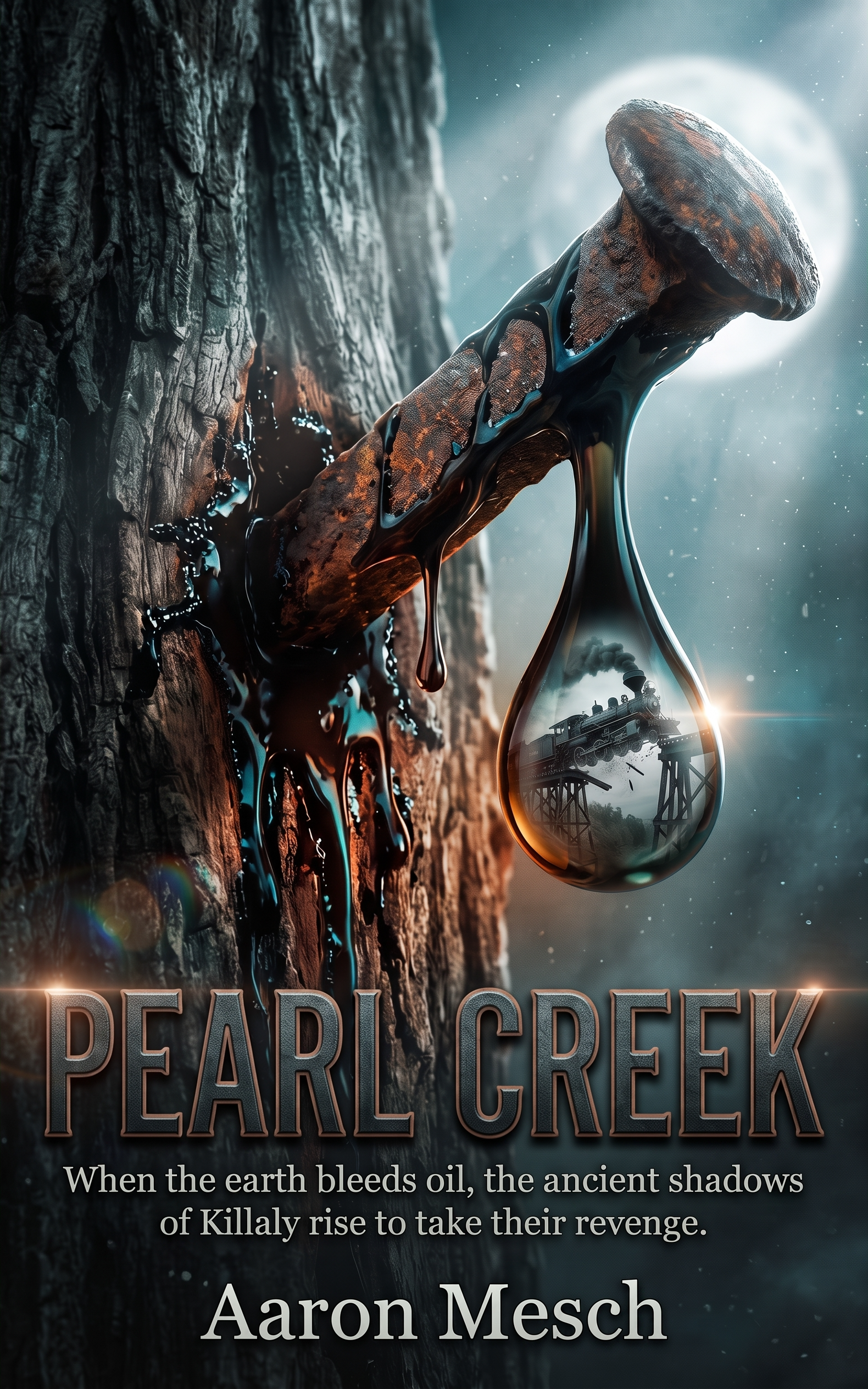
Pearl Creek
When the earth bleeds oil, the ancient shadows of Killaly rise to take their revenge.
by Aaron Mesch
Some secrets are buried deep for a reason. Austin Mesch arrived in Killaly, Saskatchewan, expecting a quiet family holiday and a chance to research a forgotten 1910 train disaster. He didn't expect the clocks to stop at midnight. He didn't expect the impenetrable fog that swallows the town whole. And he certainly didn't expect the oil boom to awaken a hunger that has waited a century to be fed. As the drilling rigs pierce the earth, they disturb more than just soil. An ancient, vengeful force—the Scion of the Coulee—is rising, weaving together rotting timber, rusted iron, and the restless spirits of a hundred lost souls. These are the Wood-Kin, and they are coming for the town that forgot them. With his family in the crosshairs and the local shaman warning of a total ecological reckoning, Austin must confront a terrifying truth: the past isn't just history; it’s a living monster. To survive the night, he must uncover the original burial maps and face the physical manifestation of a century of sins. In Killaly, the oil isn't the only thing being pumped to the surface. The reckoning has arrived, and it's made of wood, wire, and wrath.
- Thriller
- Paranormal
- Horror
- Cat & Mouse
- Survival Thriller
- Stalker Thriller
01) The Edge of the Coulee
The highway had given up its asphalt two miles back, dissolving into a corrugated washboard of grey gravel that shook the steering wheel of the station wagon until Austin Mesch’s palms went numb. The air inside the cabin had grown heavy, carrying a distinct, greasy weight that forced its way through the air conditioning vents. It was a smell that didn’t belong in the open sweep of the Canadian prairies. It was the sharp, yellow stench of sulfur, layered over the damp, sweet rot of crushed pine needles and wet earth. It clung to the back of the throat, oily and persistent, like a penny held under the tongue.
Beside him in the passenger seat, Abbie had stopped looking at her phone. Her fingers were curled tightly around the plastic grab handle above the door, her knuckles showing pale against her tanned skin. In the backseat, the quiet was too thick, too deliberate. Eleven-year-old Leo was staring out his window with a vacant, sullen intensity, his headphones draped around his neck like a collar, while seven-year-old Maya clutched her stuffed rabbit to her chest, her small face pressed against the glass. Nobody was talking. The vast, flat horizon of Saskatchewan, which had stretched out in every direction for the last six hours like a green and gold ocean, was beginning to buckle. The road was dropping down, descending into the northern rim of a massive, shadowed coulee that looked like a deep, jagged scar carved into the earth by a dull blade.
They passed the perimeter sign first. It was a sheet of rusted iron bolted to two telephone poles, the stencil letters faded but still legible: Welcome to Killaly. Population 412. Someone had spray-painted a thick, black line through the number, and underneath, in sloppy, dripping block letters, someone else had written: 700+ AND DRILLING.
Austin slowed the car as they crossed the municipal boundary. The transition was immediate, jarring, and entirely devoid of grace. Ten years ago, when Abbie’s grandmother had first started sending letters about the town’s decline, Killaly had been on the verge of disappearing from the map entirely, its Victorian clapboard homes slowly collapsing into their own cellars, its main street a corridor of boarded-up windows and wild mustard grass. Now, it was a monstrous, half-formed hybrid. The old, grey-wood bones of the original settlement were still there, but they had been violently retrofitted with the glittering, industrial jewelry of an oil boom.
On either side of the gravel road, giant yellow excavators stood like predatory insects, their hydraulic arms raised against the sky. Massive flatbed trucks, caked in grey mud and carrying stacks of thick, black pipeline sections, roared past them in the opposite direction, kick-starting storms of dust that completely obscured the windshield for seconds at a time. The air hummed with a low, sub-audible vibration, a deep-throated rumble that came from the diesel generators powering the new temporary housing camps on the edge of town. These camps were clusters of identical, white-walled trailers, surrounded by chain-link fencing and bright orange plastic orange snow barriers. In the gaps between the trailers, pools of black, iridescent runoff sat stagnant in the ditches, reflecting the pale afternoon sun like spilled ink.
"It’s so loud," Abbie said, her voice dropping into the quiet space between the passing of two trucks. She didn't look at Austin. She was watching three men in bright, high-visibility orange vests and hard hats who were standing outside a temporary trailer office. One of them was holding a clipboard, while the other two pointed toward the dark line of trees that rose along the northern lip of the coulee. "Grandma never mentioned any of this in her letters. She said it was quiet here. She said you could hear the wind through the rye from three miles away."
"The boom only hit its stride eighteen months ago, Abbie," Austin said, his voice measured, analytical. He kept his eyes on the road, navigating around a deep pothole filled with oily water. "Logan Sappara’s outfit, the regional energy syndicate, they found a deeper shelf. Deep-earth drilling. It brings people. It brings money. You can't expect a town to choose starvation over a paycheck."
"This doesn't look like money," Abbie murmured, her brown eyes tracking a decaying Victorian house with a wraparound porch. The wood was a beautiful, weathered silver, but the front yard had been bulldozed to make room for a gravel parking pad, where two massive Ford F-350s were parked, their bumpers caked in thick, dark clay. "It looks like an occupation."
Austin didn't argue. He knew the look of an extraction town. He had spent the last fifteen years traveling across the continent, digging through the historical refuse of mining camps, logging settlements, and railroad junctions. He knew that when men rushed into a place to tear something out of the ground, they didn't care about the skin they left behind. But he wasn't here for the oil. Or rather, he was only here for the oil because of what the drilling was shaking loose from the past.
In his leather satchel, resting on the floorboard between his feet, were the photocopied manifests of the Canadian Pacific Railway, dated August 1910. One hundred souls. A hundred Cree men, women, and children, packed into the wooden boxcars at the rear of a freight train, locked from the outside, their names registered only as numbers on a ledger that had been officially lost in a fire three days after the derailment off the old trussel bridge. The railroad company had blamed a faulty brake line and a sudden summer storm. The local historical records, what few remained, spoke of a tragedy that had been buried as quickly and deeply as the victims themselves. For Austin, the trussel bridge was the white whale he had been chasing through archives from Ottawa to Denver. The oil boom was merely the catalyst that had finally brought him here, providing the perfect cover of a family holiday to visit Abbie's grandmother, Evelyn, while he finally got his boots on the ground.
He turned the station wagon onto Main Street. The contrast here was even more pronounced. On the left side of the street, the old brick post office, built in 1904, stood with its windows dark, its decorative cornices crumbling onto the sidewalk below. On the right, a brand-new, prefabricated steel structure housed a twenty-four-hour convenience store and a diesel depot, its bright LED lights casting a harsh, artificial glare over the dirt road even in the middle of the afternoon. A group of young men in grease-stained work pants stood outside the entrance, clutching energy drinks and cigarettes, their eyes tracking the station wagon’s out-of-province plates with cold, incurious stares.
"Is that where Great-Grandma lives?" Maya asked from the back, pointing a small, sticky finger toward a narrow, two-story house at the far end of the street, where the town began to dissolve back into the wild brush of the coulee.
"That's it, sweetie," Abbie said, her tone instantly shifting, softening as she turned her head to look back at her daughter. "The yellow one. See the wrap-around porch? That’s where your mom used to hide her mud pies when she was your age."
The rental house sat on a small rise, separated from the encroaching gravel of the road by a patch of yellowed, un-mowed grass. It was a Victorian structure, built during the first wheat boom at the turn of the century, its yellow paint peeling in long, curling ribbons like sunburnt skin. The roof sagged slightly over the front porch, and the windows were high and narrow, reflecting the pale, washed-out blue of the Saskatchewan sky. It was a house that looked as though it had spent fifty years trying to sink quietly into the earth, only to be rudely awakened by the vibrations of the heavy machinery half a mile away.
Austin pulled the car into the dirt driveway. The moment he cut the engine, the silence that rushed in to fill the void was almost physical. It wasn't a peaceful silence. It was heavy, thick, and colored by the distant, rhythmic thump-thump-thump of the oil rigs working the northern ridge—a sound so low and deep that Austin felt it in the soles of his feet rather than his ears.
He got out of the car, the dry air immediately catching in his throat. The smell of sulfur was stronger here, drifting up from the deep hollow of the coulee just behind the property line. He walked around to the trunk, his boots crunching loudly on the gravel, and began unloading their bags.
"Austin," Abbie said, standing beside the passenger door, her head tilted slightly as she looked toward the dense treeline that marked the edge of the northern woods. "Do you hear that?"
"Hear what?" he asked, hoisting a heavy canvas suitcase onto his shoulder.
"Nothing," she whispered. Her brown eyes were wide, scanning the thickets of poplar and jack pine that crowded the edge of the property. "That's just it. There are no birds. No crows, no sparrows. Nothing. It's five o'clock in July, Austin. The woods should be deafening."
"They're probably put off by the diesel engines," Austin said, gesturing toward the ridge where the steel derrick of an oil rig rose above the trees like a skeletal finger. "Animals don't like the vibration. They'll come back once the drilling crews move to the next sector. Come on, let's get the kids inside and get settled. Your grandmother’s nurse said she’d have the key under the red planter on the porch."
Abbie didn't move for a long moment, her eyes still locked on the dark green wall of the forest. The trees stood remarkably still. Despite the light breeze that was kicking up dust on the road, not a single leaf in the poplar grove seemed to stir. They looked frozen, carved out of green stone. "It feels wrong," she said, her voice barely carrying over the distant, mechanical thumping. "It feels like the whole place is holding its breath."
"It’s just travel fatigue," Austin said, though he felt a brief, cold prickle of gooseflesh on his arms that had nothing to do with the temperature. "The drive was too long. Go on inside. I’ll bring the rest of the bags up."
He watched her lead the kids up the wooden steps of the porch, her movements cautious, her hand resting protectively on Maya's shoulder. Once they were inside, the screen door clicking shut behind them with a dry, wooden snap, Austin stood alone in the driveway. He reached into his pocket and pulled out his camera—a heavy, professional-grade digital SLR with a high-zoom lens. He didn't take a picture of the house. Instead, he turned his back to the building and walked toward the rear of the property, where the grass gave way to a steep, rocky descent into the coulee.
The ground here was treacherous, covered in loose shale and thick clumps of wolf willow. As he descended, the light began to change, the bright afternoon sun blocked out by the steep walls of the ravine. Down here, the air was cold. It was a damp, subterranean chill that smelled of rotting leaves, wet clay, and something old and metallic, like rusted iron left in a cellar.
Austin navigated the narrow path, his camera strap swinging against his chest, until he reached the bottom of the coulee. The floor of the ravine was wide, carved out thousands of years ago by a glacial river that had long since dwindled to a narrow, sluggish creek known as Pearl Creek. But Austin wasn't looking at the water. His eyes were fixed on the massive, jagged shapes that rose from the creek bed like the ribs of a buried beast.
The old trussel bridge had once been a marvel of early twentieth-century engineering, a towering wooden and iron span that allowed the coal trains to cross the deep coulee. Now, it was a ruin of black, charred timber and twisted metal. Massive support beams, some of them three feet thick, lay half-submerged in the mud, their surfaces blackened by the fire that had consumed the wreckage in 1910. The iron rails themselves had been warped by the heat of the crash, bent into grotesque, serpentine shapes that poked out of the earth like broken teeth, pointing toward the sky.
Austin felt a familiar, cold thrill hum through his veins. He lifted the camera, adjusting the aperture for the dim light of the coulee. Through the viewfinder, the ruined bridge took on a stark, skeletal quality. He began to move slowly through the wreckage, his boots sinking into the wet, black mud near the creek’s edge. He took shots of the massive iron bolts that had sheared clean off during the derailment, their surfaces pitted with deep rust. He photographed the charred support pillars that still stood, rising twenty feet into the air like the pillars of a ruined temple.
As he stepped closer to one of the main support timbers, his foot caught on something hard beneath the mud. He stumbled, catching himself against the rough, blackened wood of a fallen beam. The wood was cold. Unnaturally so. Even through his heavy leather hiking gloves, the chill of the timber seeped through, a sharp, biting frost that made him pull his hand back with a sudden jerk.
He looked down at his feet. A small, jagged piece of wood was protruding from the black muck, about six inches long. It was completely charred, its surface cracked into the classic 'alligator skin' pattern of wood that had been subjected to extreme heat. Yet, as Austin reached down and picked it up, he had to suppress the urge to drop it. He took off his glove and touched the bare wood with his fingertips. It was like touching dry ice. The summer heat of July was thirty degrees Celsius, but this fragment of wood was freezing, so cold that a faint, ghostly wisp of vapor seemed to rise from his skin where he touched it.
He frowned, turning the fragment over in his hand. It was remarkably heavy for its size, dense and solid, as if the charcoal had been compressed under immense pressure or infused with something heavy. He brought it close to his face. It didn't smell like charcoal. It smelled of pine resin, damp earth, and a faint, sweet scent that reminded him of raw copper. He slipped the freezing wood into the side pocket of his cargo pants, the cold immediately radiating through the fabric against his thigh like a coin of ice.
He walked deeper into the ruins, his eyes scanning the mud for other anomalies. Near the center of the crash site, where the creek pool widened, he noticed a strange pattern in the water. The current of Pearl Creek was slow, almost stagnant, but around the submerged iron rails, the water was swirling in tight, miniature eddies, as if something were drawing it down into the mud. He stepped closer, raising his camera to focus on the pool, when he saw the monument.
It was situated on the far side of the creek, half-hidden by a thick growth of wild roses and chokecherry bushes. It was a modest slab of grey Saskatchewan granite, erected in the late 1920s by the municipal district, its surface covered in a green film of lichen and dirt. Austin crossed the shallow creek, his waterproof boots splashing in the cold water, and pushed the thorny branches aside to read the inscription.
In Memory of Those Who Perished in the Great Derailment of August 14, 1910.
Underneath the heading was a list of names. Austin’s eyes ran down the columns. He knew these names by heart from his research. James Sterling, engineer. Robert Vance, fireman. Thomas Cole, brakeman. There were twelve names in total, all of them railway employees or first-class passengers who had been riding in the forward sleeper cars. At the bottom of the list, a brief, single sentence was carved in smaller, shallower letters:
And nineteen others whose names are known only to God.
Austin’s jaw tightened. "Nineteen," he muttered to himself. He reached into his leather satchel, which he had left resting on a dry boulder near the creek, and pulled out his folder of research materials. He opened the heavy paper folder, revealing the high-resolution scans of the original railway manifests he had obtained through an archivist contact in Winnipeg. These weren't the official, sanitized records that had been presented to the provincial inquiry. These were the internal cargo ledgers of the Canadian Pacific Railway, marked with the company’s private seal.
According to the official monument, there were twelve identified dead and nineteen unidentified. A total of thirty-one casualties. But Austin’s fingers traced the columns of the private manifest. At the very end of the train, behind the coal cars and the freight crates, the ledger listed three additional wooden boxcars. They were designated under a cargo code: C-100-IND.
The code was a cold, bureaucratic euphemism. Austin had spent months deciphering the company's internal shorthand. IND stood for Indigenous. The number 100 wasn't a weight or a shipment value. It was a head count. A hundred Cree laborers and their families, being moved from the northern reserves to the southern railway camps, locked inside the windowless boxcars to prevent them from slipping off the train at intermediate stops. When the trussel bridge collapsed, those three boxcars had been the first to plunge into the deepest part of the coulee, crushed beneath the weight of the steel coal cars that followed them down. They had been buried in the mud, their deaths completely omitted from the public record, their bodies left to rot in the dark water of Pearl Creek to protect the railway company from a massive financial liability and a public relations disaster.
As Austin looked from the paper to the granite monument, he felt a cold weight settle in his stomach. The nineteen "unidentified" names on the stone were a lie, a token gesture to cover up the disappearance of an entire community. The monument didn't mention the boxcars because, as far as the official history of Saskatchewan was concerned, those hundred people had never existed.
He noticed something else on the manifest scans—something he hadn't fully analyzed before. In the margin next to the C-100-IND designation, there were series of hand-written numbers and letters, scribbled in faded red ink by a long-dead freight master: 14-B-9, Sec 4, Pit 2. Underneath, a single word had been written twice and then aggressively crossed out with thick ink lines: RECLAIMED. RECLAIMED.
Austin traced the letters with his thumb. It wasn't a standard railway shipping code. It looked more like a survey coordinate or a burial plot map. He needed to find the original land survey maps of the coulee from 1910, the ones that had been drawn up before the crash and the subsequent cover-up. He knew those maps existed, but they weren't in any public archive. They had been classified, held in the private vaults of the railway company, and later, presumably, bought up by the energy conglomerate that now held the drilling rights to the area.
A sudden, sharp sound shattered the silence of the coulee.
It was the sound of a dry branch snapping, loud and distinct, coming from the thick, overgrown slope of the northern ridge. Austin froze, his hand still resting on the paper manifest. He listened, his breath catching in his throat. The low, rhythmic thumping of the oil rigs was still there, but beneath it, he heard a different sound. A heavy, wet rustling, like something large and awkward moving through the dense chokecherry bushes.
"Hello?" he called out, his voice sounding thin and small against the steep dirt walls of the ravine. "Is someone up there?"
There was no answer. The rustling stopped instantly. Austin stared up at the slope, his eyes straining to pierce the deep shadows beneath the thick canopy of jack pines. The trees up there were dense, their trunks growing close together, their lower branches tangled in a thick carpet of dead needles and grey moss. The shadows were remarkably dark, almost black, even though the sun had not yet set.
He felt a sudden, intense prickle of heat on the back of his neck, the unmistakable sensation of a gaze fixed upon him. It wasn't the casual look of a curious passerby. It was a heavy, predatory focus, a pressure that seemed to hum in the very air around him. He raised his camera, using the powerful zoom lens to scan the treeline. He swept the lens slowly across the dark spaces between the pines, looking for the bright orange of a worker's vest or the dull brown of a deer’s coat.
For a brief, heart-stopping second, the lens focused on a shape about fifty yards up the slope. It was a vertical mass, darker than the surrounding trunks, but its texture was wrong. It didn't look like bark. It looked like a tight, twisted column of rotting wood, rusted metal wires, and dry, grey moss, shaped vaguely like the torso of a towering figure. Near the top of the mass, where a head should have been, there was only a hollow, jagged cavity, but as Austin adjusted the focus, he could have sworn he saw two faint, pale points of light reflecting deep within the darkness of the hole.
He blinked, his finger freezing on the shutter button. The image in the viewfinder seemed to shimmer, the details blurring as if seen through a layer of heat haze. He lowered the camera, rubbing his eyes. When he looked back up, the shape was gone. There was only a thick jack pine, its trunk slightly twisted, its branches hanging low over the path.
"Get a grip, Mesch," he muttered, his voice tight. He shook his head, pack his camera back into his satchel, and quickly folded his papers. The air in the coulee had grown noticeably colder, and the smell of sulfur had deepened, turning into a thick, choking reek that made his eyes water.
He scrambled back up the steep path, his boots slipping on the loose shale, his heart hammering against his ribs with a sudden, irrational urgency. He didn't look back at the ruined bridge, but as he reached the top of the ridge and stepped back onto the dry grass of the rental house yard, the cold weight of the charred wood in his pocket seemed to throb against his leg, a silent, freezing reminder of what lay buried in the dark.
The interior of the house was warm, smelling of lemon polish, old paper, and the faint, sweet scent of Abbie’s lavender hand cream. The contrast was a relief, but it didn't entirely wash away the cold grease of the coulee that seemed to have settled on Austin’s skin.
He found Abbie in the kitchen, a large, high-ceilinged room with yellow-painted cupboards and a linoleum floor that had worn down to the grey backing in front of the sink. She was standing by the window, her hands wrapped around a mug of tea, looking out at the narrow strip of backyard that ended abruptly at the edge of the ravine. The kids were in the living room, the low murmur of a television program drifting through the arched doorway.
"Did you find what you were looking for?" she asked without turning around. Her voice was quiet, carrying a thin edge of exhaustion that Austin recognized all too well.
"The ruins are still there," Austin said, setting his heavy leather satchel on the wooden kitchen table. He began taking out his camera and his notebooks, organizing them with his usual, methodical neatness. "More intact than I expected, actually. The mud in the creek bed has preserved some of the timber. I took some good reference shots."
Abbie turned slowly, leaning her back against the counter. She looked smaller in the dim light of the kitchen, her chestnut hair pulled back into a loose braid, her brown eyes dark with a shadow of worry that had been growing ever since they crossed the Saskatchewan border. "Austin, we need to talk about this."
"About what?" he asked, his tone carefully neutral as he began wiping down the lens of his camera with a microfiber cloth.
"About why we’re really here," she said, her voice dropping to a whisper so the kids wouldn't hear. "You told me this was a holiday. You told me we were coming here so I could help Aunt Sarah clear out Grandma’s house, and so the kids could see where I grew up. But you’ve spent the last three weeks buried in those railroad manifests, and the first thing you do when we arrive is run down into that ditch with your camera."
Austin stopped wiping the lens. He looked at her, his blue eyes steady, analytical. "Abbie, the derailment in 1910 is the key to understanding this entire region. A hundred people died down there. A hundred Cree who were completely erased from the historical record because a rail company didn't want to pay damages. That’s not just an urban legend. That’s a historical crime. If I can find the original maps, if I can prove where they were buried—"
"And what then?" Abbie interrupted, her voice rising slightly before she caught herself and lowered it again. "You write an article? You publish a book? Austin, look around you. This town is changing. It's violent, it's loud, and those oil rigs... they're shaking the ground. I felt it when I was putting Maya’s clothes in the dresser. The floorboards were vibrating. It’s not healthy. It’s not safe for the kids."
"It’s just industrial noise, Abbie," Austin said, his voice firm, patient, the tone he used when he was trying to dismantle her 'gut feelings' with logic. "The drilling is deep, but it’s localized. It’s not going to hurt anyone. And as for my research, it’s a job. It’s what I do. You knew that when we married."
"This is different," she said, shaking her head, her hand moving to touch the small silver cross she wore around her neck. "It’s not just the noise. The air is wrong. Did you smell it down there? It smells like something died and was left to rot in a hot car. And the dogs... when we drove past the mechanic's shop, there were three of them under the porch, just staring. They weren't barking. They were terrified, Austin. Animals know when something is coming."
"They're reacting to the diesel fumes and the heavy trucks," Austin insisted, though the memory of the frozen wood in his pocket and the strange, vertical shape in the treeline flashed through his mind. He pushed the thoughts away, locking them behind his analytical firewall. "It’s a classic displacement response. The local fauna is being disrupted by the sudden industrial footprint. It’s entirely natural."
"You always have an explanation," she said, her tone bitter as she turned back to the window. The sun was finally dipping below the horizon, and the sky had turned a bruised, violent purple, the color of a fresh welt. The silhouettes of the jack pines on the northern ridge stood sharp and black against the fading light, looking like a row of spears. "But you weren't here when I was a kid, Austin. I remember this place. It was empty, yes, but it was clean. The woods were... they were wild, but they weren't angry. Now, it feels like the trees are leaning over the house. It feels like they're trying to see inside."
Austin walked over to her, placing his hands on her shoulders. Her muscles were tight, knotted with a tension that had been building for days. "We're here for two weeks, Abbie. That's it. Once we get your grandmother's affairs sorted and I get the data I need from the local registry, we'll go. I promise. Just give it a few days."
She didn't answer, but she didn't pull away either. They stood together in the darkening kitchen, watching the first lights of the oil rigs flicker on along the ridge. The derrick lights were a harsh, cold white, cutting through the purple twilight like tiny, artificial stars. Beneath them, the deep, rhythmic thump-thump-thump of the drills seemed to grow louder as the night air cooled, a heavy, mechanical heartbeat that vibrated through the glass of the windowpane against Abbie's forehead.
By nine o'clock, the kids were asleep in the small, wood-paneled bedrooms on the second floor. Austin sat at the heavy oak table in the dining room, the light from a single brass lamp casting a warm, circular glow over his papers. The rest of the house was dark, save for the faint, blue glow of the television in the living room where Abbie was reading a book.
He reached into his pocket and pulled out the fragment of charred wood he had found in the coulee. He set it on a clean sheet of white paper in the center of the lamp's light. In the warmth of the room, the wood should have warmed up, but when Austin touched it, it was still freezing, its surface covered in a thin, microscopic layer of frost that had formed from the humidity in the air. He picked up a magnifying glass, leaning close to examine the grain.
The wood was pine, likely white pine, which was common in the region a century ago. But the cellular structure of the wood had been altered. Under the magnification, the tiny, tubular cells of the wood fibers looked blown out, ruptured from the inside as if they had been subjected to an intense, sudden pressure rather than a gradual fire. And there was a dark, greasy residue clinging to the deeper cracks—not charcoal soot, but a thick, black substance that had a faint, iridescent sheen under the lamp. It looked remarkably like crude oil, but it was thicker, stickier, and didn't evaporate when exposed to the air.
He pulled out his laptop and opened his database of the 1910 derailment. He pulled up the official report of the provincial coroner, Dr. Arthur Vance, which had been filed three months after the accident. The report was remarkably brief, only four pages long, and listed the cause of death for the twelve official victims as "massive trauma consistent with railway impact." But at the very bottom of the final page, there was a handwritten note in the margin, written in the same hurried, scratching hand as the freight master's manifest:
The flesh of the unrecorded shows a strange petrifaction. The wood of the cars is cold to the touch. The water of the creek does not wash the black grease from their skin. We have buried them deep in the silt of Section 4, but the mud is thin, and the weight of the steel is heavy. Pray the earth holds them.
Austin stared at the screen, his fingers hovering over the keyboard. "The flesh shows a strange petrifaction," he repeated, his voice a quiet whisper in the empty room. "The wood of the cars is cold."
He reached out and touched the charred fragment again. The frost on its surface was thicker now, a delicate, white pattern of ice crystals that seemed to be spreading across the white paper like a frozen web. He felt a sudden, sharp chill run up his arm, a coldness that seemed to penetrate deep into his bone, making his hand shake. He pulled his fingers back, his heart skipping a beat.
The low, mechanical thumping of the oil rigs outside seemed to change its rhythm. The steady, hypnotic beat grew suddenly erratic, a jagged, skipping sound that vibrated through the floorboards of the old house. Austin stood up, walking to the narrow window that looked out toward the front yard.
The street was empty. The harsh LED lights of the convenience store half a mile away were flickering, casting long, jumping shadows across the dirt road. But it was the horizon that caught his attention. The bruised purple of the twilight had vanished, replaced by a deep, velvety blackness that seemed to swallow the light. Along the northern ridge, where the oil derrick stood, a thick, white wall of fog was beginning to roll down the slope.
It wasn't a normal prairie fog, which rose slowly from the damp ground in warm weather. This fog was fast, heavy, and remarkably dense, rolling down the ridge in thick, tumbling waves like a slow-motion avalanche. It swallowed the trees first, the dark shapes of the jack pines disappearing one by one into the white gloom. Then it reached the edge of the town, flowing over the gravel road and around the trailers of the work camp, extinguishing their lights like a cold hand smothering a candle.
Austin watched, his breath fogging the windowpane. The fog was moving toward the house, a silent, white wave that seemed to carry its own coldness. As it drew closer, the distant, rhythmic thumping of the oil rigs grew muffled, distant, as if the sound were being choked by the density of the air.
He felt a sudden, sharp prickle on the back of his neck. He turned around, his eyes scanning the dark corners of the dining room. The brass lamp on the table was still burning, but its light seemed smaller, dimmer, as if the darkness in the room were pressing in against the glass bulb.
From the hallway, the grandfather clock—a heavy, dark oak relic that had belonged to Abbie’s great-grandfather—began to chime. It was a slow, deep sound, marking the hour of midnight. One. Two. Three.
Austin stood frozen, counting the chimes. On the twelfth stroke, the heavy iron pendulum inside the clock cabinet gave a sudden, metallic clank. The ticking stopped. The silent space that followed was absolute. The low hum of the refrigerator in the kitchen cut out. The blue glow of the television in the living room vanished with a soft, static pop. The entire house went dark, save for the pale, weak circle of light from the brass lamp on the table, which was rapidly fading as the battery in the emergency power backup began to drain.
"Austin?"
Abbie’s voice came from the doorway, thin and sharp with fear. She was standing in the shadows, her hand clutching her knit sweater to her chest, her eyes wide as she looked at the dark windows.
"The power must have gone out," Austin said, his voice tight as he reached for his flashlight on the table. He clicked the switch, the powerful LED beam cutting through the darkness of the dining room, illuminating the thick dust motes floating in the air. "The rigs probably overloaded the local grid. It happens in boomtowns. The infrastructure can't handle the load."
"It’s not just the power," she whispered, stepping into the room. She pointed toward the window. "Look at the fog."
Austin turned the flashlight toward the glass. The white wall had reached the house. It was pressing against the windowpanes, a thick, milky substance that looked almost solid, like wet plaster. The light from his flashlight didn't penetrate the fog; it simply bounced off the white surface, casting a blind, white glare back into the room.
And then, beneath the floorboards, the vibration started again.
It wasn't the rhythmic, mechanical thumping of the oil rigs. This was a deeper, more organic movement, a slow, grinding shudder that made the plates in the kitchen cupboards rattle against one another. It felt like something massive was shifting deep within the earth, a great weight turning over in its sleep.
From the second floor, a sharp, terrified cry shattered the silence of the house.
"Maya!" Abbie gasped, turning and running toward the stairs, her boots loud on the wooden steps.
Austin followed her, the beam of his flashlight bouncing wildly off the yellow-painted walls of the stairwell. As they reached the upper landing, the cold was intense. The air up here was freezing, their breath turning to thick, white plumes of steam in the light of the flashlight. The smell of sulfur was overwhelming now, sweet and rotting, mixed with the sharp, resinous scent of wet pine.
They burst into Maya’s bedroom. The little girl was sitting upright in her bed, her blankets pulled up to her chin, her small face pale and wet with tears. She was staring at the window, her finger pointing toward the glass.
"There's a man," she sobbed, her voice shaking. "There's a man in the tree. He's looking at me."
Austin pushed past Abbie, his flashlight beam cutting across the room to the window. Outside, a massive poplar tree grew close to the side of the house, its branches brushing against the glass. The fog was thick here, a swirling, white soup that obscured everything beyond the glass. But as the flashlight beam hit the window, Austin froze.
There was a shape in the branches. It was positioned about ten feet off the ground, right outside the second-story window. It was a vertical mass, darker than the surrounding wood, its surface textured like rough, blackened bark. But as the flashlight beam illuminated the shape, Austin saw that it wasn't a branch. It was a limb—a long, jointed arm made of twisted, grey timber and rusted, braided steel wire, ending in five long, jagged fingers that were resting flat against the glass of the windowpane.
The fingers were moving. Slowly, deliberately, they were scraping against the glass, a soft, dry sound like a dead leaf dragging across stone. Screeech. Screeech. Screeech.
"Austin," Abbie whispered, her voice barely a breath as she pulled Maya out of the bed and held her tight against her chest. "Oh my god, Austin, what is that?"
Austin didn't answer. He took a step closer to the window, his analytical mind fighting a desperate, losing battle against the evidence of his own eyes. The physics of the shape didn't make sense. The weight of the limb should have snapped the slender poplar branch it was resting on, but the branch wasn't bending. It was as if the entity had no weight, or as if the tree itself were part of the creature's body.
He raised the flashlight, focusing the beam on the center of the mass. Through the white swirl of the fog, he saw a head—a bulbous, irregular shape made of rotting wood and compacted grey soil, with deep, vertical cracks running down its surface like the split bark of an old oak. In the center of the face, where eyes should have been, there were two hollow, jagged cavities. Deep within those holes, two pale, cold points of light were glowing, shifting slowly as the creature tilted its head to look directly at Austin.
The mechanical, rhythmic chugging sound he had heard earlier in the coulee suddenly echoed through the room. It didn't come from outside. It seemed to vibrate from the very glass of the windowpane, a low, grinding sound like rusted train gears turning under immense pressure. Chug-chug-chug-chug.
Austin felt a cold, paralyzing terror grip his chest, a sensation so intense it made his throat tighten. It was the "stalker" entity Henry Whitefeather had warned the town about, the manifestation of the forgotten dead, awakened by the deep-earth drills that had punctured the ancient burial site beneath the old bridge. It wasn't a ghost. It was something physical, something made of the very earth and wood that had consumed the hundred souls in 1910, fueled by a century of silence and the toxic runoff of the modern oil wells.
The creature’s jagged fingers tightened against the glass. A long, thin crack appeared in the center of the pane, a silver line that branched out like a frozen spiderweb. The sound of the cracking glass was loud, a sharp, icy snap that broke the paralysis holding Austin's limbs.
"Get out of the room!" he shouted, his voice cracking with a sudden, raw panic. "Abbie, take Maya and Leo and go downstairs! Now!"
He didn't wait to see if she obeyed. He stepped forward, his eyes locked on the window as the crack in the glass widened, a tiny hiss of freezing air whistling through the gap. The smell of sulfur and wet pine rushed into the room, so thick and cold it felt like a physical blow.
He reached into his pocket and pulled out the fragment of charred wood he had found in the coulee. As he held it, the wood seemed to react to the presence of the creature outside. The frost on its surface began to melt, turning into a thick, black oil that dripped onto his hand, burning his skin with a sudden, blistering heat that was the exact opposite of its previous coldness.
The creature in the tree stopped scraping. Its pale, glowing eyes shifted down to Austin's hand, focusing on the dripping black oil. It let out a sound—a low, grinding rasp that sounded like a heavy iron door dragging across a concrete floor. It was a sound of recognition. A sound of claim.
Austin backed away, his heart hammering a frantic, erratic rhythm against his ribs. He knew, with a sudden, terrifying clarity, that his skepticism had been a shield made of paper. The history he had come to document wasn't dead, and it wasn't interested in being recorded in a book. It had returned, and it had found him.
He turned and ran from the room, the sound of the windowpane finally shattering behind him in a sharp cascade of falling glass, followed by the heavy, wet rustle of something dark and ancient dragging itself over the sill into the house.
02) Pressure and Pay Dirt
The steel platform of Sappara Energy Drill Site 4 did not merely vibrate; it bucked like an animal trying to throw a rider. Underneath the metal grating of the derrick floor, the ground was emitting a sound that defied the physics of machinery. It was a high-pitched, metallic shriek, a grinding of rock and steel that rose above the deafening roar o…