

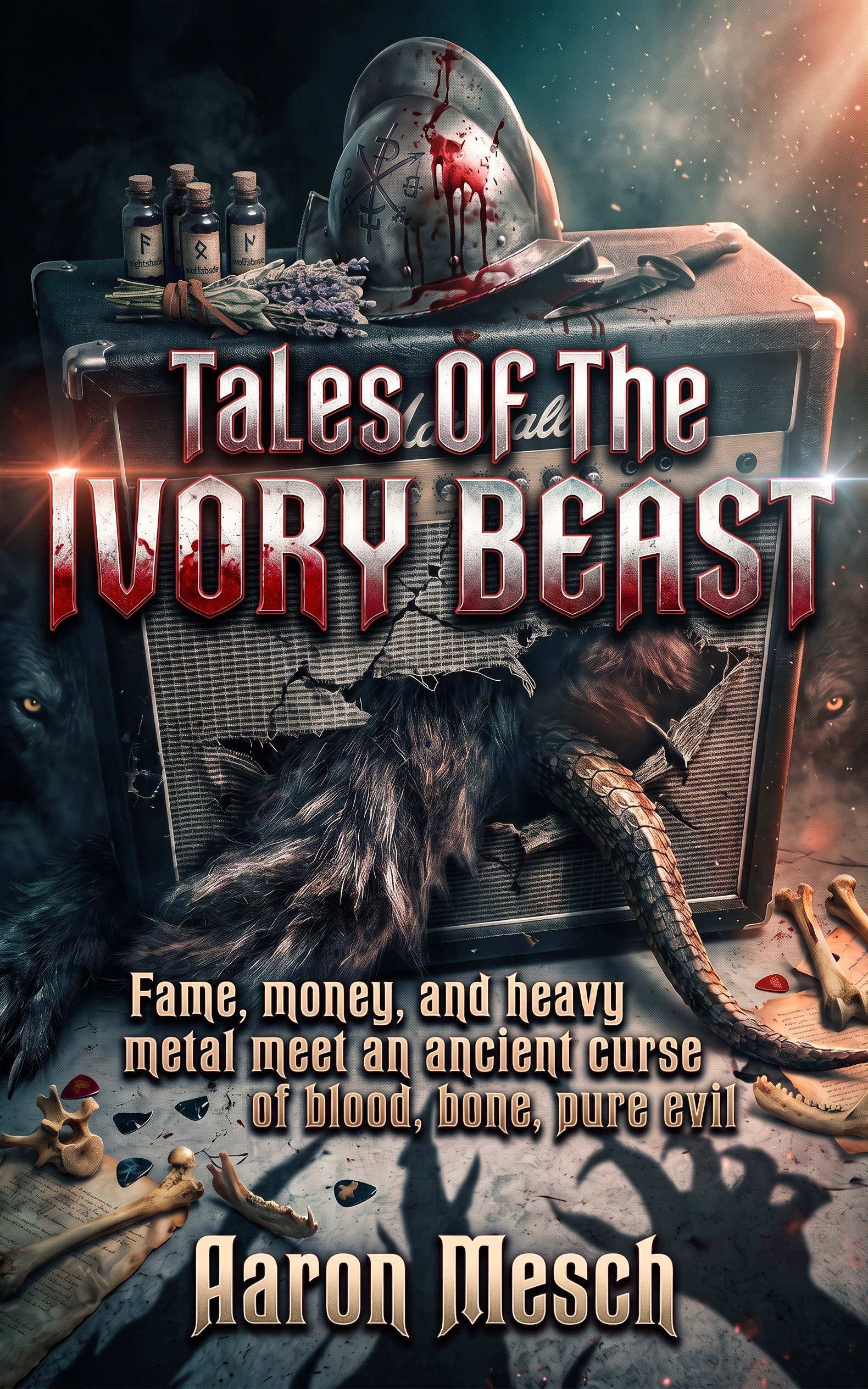
Tales Of The Ivory Beast
Fame, drugs, and heavy metal meet an ancient curse of blood, bone, and pure evil
by Aaron Mesch
In 1996, Ivory Beast is the biggest heavy metal band on the planet. But behind the pyrotechnics and screaming fans, lead singer Aaron Michael is losing his mind. Fueled by cocaine and rockstar excess, he is haunted by the image of a wolf-headed monster staring back at him from the dressing room mirror. Even worse, a trail of gruesome murders follows the tour from city to city, leaving a wake of carnage that manager George Wolff can barely cover up. As the 'Running Wild' tour heads toward a final, explosive show in Hammerville, the band’s dark history begins to surface. What started in 1989 as a quest for fame was actually the fulfillment of an ancient blood pact. Centuries ago, a witch named Abagail Wolff summoned the beast Fenris and a legion of undead Iron Men to avenge her fallen coven. Now, that curse has reached its boiling point. When the lights go down and the music starts, the arena becomes a slaughterhouse. As undead soldiers storm the crowd, Aaron and guitarist Jason Leonard must confront the terrifying truth: they aren't just playing monsters on stage—they are becoming them. Tales Of The Ivory Beast is a high-octane journey into the heart of a supernatural war where the encore might be the end of the world.
- Thriller
- Paranormal
- Horror
- Psychological Thriller
- Action Thriller
- Revenge Thriller
The Beast in the Glass
The fluorescent lights overhead didn't just hum; they buzzed with a low, wet vibration that rattled the base of Aaron Michael’s skull like a rusty drill. The air inside the Phoenix Arena dressing room smelled like a tomb that somebody had tried to cover up with cheap pine cleaner, stale sweat, and the sour scent of warm bourbon bubbling out of his own skin. He stood over the porcelain sink, both hands braced against the stained edges, his knuckles white and bleeding through a layer of dried dirt and old grease.
His chest heaved. Each breath felt like swallowing crushed glass. For three days, time had lost its corners. There was no day, no night, no schedule—only the endless, white-hot line of cocaine laid out on laminate counters, the clink of glass bottles, and the roar of fifty thousand heads screaming his name through the concrete floors of arenas from Denver to Arizona. His heart was knocking against his ribs in a ragged, uneven double-beat. Thump-thump. Thump-thump. It felt too fast, too heavy, like an engine running without oil, grinding its own iron into dust.
Aaron lowered his head and squeezed his eyes shut. The concrete floor beneath his heavy leather boots seemed to sway, tilting on a greasy axis. He could feel the bass vibrating through the deep foundation of the stadium—the opening act was wrapping up their set, their low-end subwoofers sending shockwaves through the pipes behind the wall. The plumbing groaned in response. A steady drip fell from the chrome faucet, clicking against the drain like a countdown clock.
He turned the cold water tap all the way to the left. The pipe shrieked, an old metal screech that made the hair on his arms stand up, and then a hard spray of greyish desert tap water rattled into the basin. Aaron didn't hesitate. He cupped his filthy hands together, dunked his face straight into the freezing stream, and held it there. The cold hit him like a physical blow, shocking the air straight out of his lungs. He gasped, swallowing a mouthful of warm chlorine and heavy minerals, but he didn't pull back. He needed the pain. He needed the ice to cut through the greasy, heavy fog that had settled behind his forehead since they crossed the state line.
He stayed submerged for five seconds, ten seconds, listening to the muffled roar of the crowd echoing through the steel plumbing. They sounded like animals out there. Not people. A massive, single-bodied beast pacing back and forth behind the concrete barricades, waiting to be fed.
When he finally pulled his face out of the sink, water cascaded off his jaw, soaking the collar of his faded black silk shirt. He didn't wipe his eyes. He let the water stream down his nose, dripping off the point of his chin into the dirty basin. He breathed through his mouth, his tongue tasting the sharp, metallic tang of the cocaine dripping down the back of his throat. His nose was raw, burning like he’d snorted liquid lye.
He reached for the mirror to push himself up, but his fingers slipped on the slick glass. He exhaled a long, shuddering sigh, shaking his wet head like a dog, and slowly lifted his eyes to look at his own face.
The reflection looking back at him wasn't Aaron Michael.
The glass was cracked, a long spiderweb fracture running diagonally from the top left corner down to the edge of the brass frame, splitting the image down the center. But the split didn't account for what was standing on the other side. There were no pale cheekbones, no smeared black eyeliner, no hollowed-out eyes framed by greasy black curls. The face in the frame was broad, thick-skulled, and covered in a coarse, filthy pelt of snow-white fur that bristled with static. The nose was flattened into a long, leather-black snout, the nostrils flaring wide as they drew in a wet, heavy breath. The mouth was pulled back in a silent, violent snarling posture, revealing rows of yellowed, serrated teeth—canines the size of railroad spikes, slick with strings of clear, viscous saliva that hung down over a dripping black jaw.
And the eyes. They weren't blue. They were the cold, luminous yellow of a dying flare, fixed directly onto Aaron’s pupils with a clear, starving intelligence.
Aaron froze. The air in his throat turned to stone. The water kept running from the tap, rattling the chrome, but the sound was suddenly muffled, drowned out by a deep, wet chest-growl that resonated from inside the mirror itself. The monster’s chest puffed out under the white fur, broad shoulders rising until they seemed to fill the entire square of the vanity light frame.
It’s the bender, Aaron thought, his hand twitching against the edge of the sink. It’s the cut. It’s whatever the hell that kid in Albuquerque sold Jason in the dark alley behind the bus. It’s just a flashback. It isn't real.
He blinked hard, shutting his eyelids tight, waiting for the chemical fire in his optic nerve to clear. He counted to three under his breath—one, two, three—and opened them again.
The white wolf was closer. Its snout was inches from the glass now, its wet, black nostrils quivering as if it could smell the fear radiating off Aaron's damp skin. A dark, thick drop of blood gathered at the corner of its left jowl, hung suspended for a fraction of a second, and then splattered against the inner surface of the mirror—leaving a dark red smear on the inside of the glass.
The creature opened its jaws wide, showing a throat that was dark, deep, and smelled of warm iron and rotten gut. A wet, guttural roar burst from its throat, shaking the frame.
Aaron didn't think. The panic took over his limbs, a cold, primitive instinct that burned straight through the liquor and the blow. He pulled his right arm back, pulling his fist into a ball, and drove his knuckles straight into the center of the monster’s nose.
The sound of shattering glass was like a gun going off in the small tile room. Mirrors don't just crack when you hit them with enough force—they disintegrate, sending long, dagger-like shards flying outward while the rest buckles inward like ice breaking over a black pond. Aaron’s fist went straight through the backing board, punching into the hollow dry-wall behind it with a dull, heavy thud.
Pain shot up his forearm, sharp and clean, cutting through the chemical numbness. Shards of silvered glass rained down into the wet porcelain basin, tinkling against the metal drain. He stood there, gasping for air, his hand buried wrist-deep in the wall, his heart hammering against his ribs like a trapped bird.
He slowly pulled his arm back out. The jagged edges of the broken mirror bit into his leather sleeve, tearing the fabric, but he didn't feel it yet. He stumbled backward until the back of his thighs hit the cheap laminate table where his guitar cases were stacked. He slid down slightly, his knees shaking so hard he had to grab the edge of an road case to keep from hitting the floor.
In the broken frames left on the wall, there was no white wolf. There was only his own pale, hollowed-out face reflected in dozens of small, disjointed triangles of silver. He saw ten different versions of his own left eye, wide and bloodshot; ten versions of his own trembling, blue-tinged mouth. His right hand was dripping dark, thick blood onto the white tile floor, the drops making a steady plink-plink-plink sound as they hit the ground.
Before he could draw another full breath, the heavy steel door of the dressing room flew open, slamming against the drywall with a force that made the light fixtures rattle. The lock didn't break—it had been pushed open by someone who didn't care about locks.
George Wolff filled the doorway.
He was a big man, built like an iron safe wrapped in a six-thousand-dollar Italian suit that looked like it had been slept in for three days straight. His gray hair was slicked back, showing a scalp that was red from steam and high blood pressure. His thick mustache was damp with sweat, and his sharp blue eyes swept the room like a pair of searchlights, taking in the empty bourbon bottles on the coffee table, the white powder dusted across the surface of the guitar amplifiers, and finally, the broken mirror and the blood pooling around Aaron’s boots.
George didn't look shocked. He didn't look concerned. He looked like an accountant who had just found another line item he was going to have to lie about on his tax return.
He stepped into the room, his expensive leather loafers crunching through the glass shards on the floor, and slammed the heavy door shut behind him. He reached out with one thick hand and threw the brass deadbolt into place. The smell of high-grade Cuban cigar smoke and stale bourbon came into the room with him, heavy and thick enough to wipe out the smell of the pine cleaner.
"You gotta be kidding me, Aaron," George said. His voice sounded like two concrete slabs grinding together over gravel. It was low, raspy, and carried the quiet, absolute authority of a man who had spent thirty years buying people out of jail cells and morgues. "Five minutes. The house lights go down in five minutes, and you’re in here playing fucking handball with the bathroom furniture?"
"George..." Aaron’s voice was a ragged whisper. He tried to raise his bloody hand to point at the wall, but his fingers felt heavy, thick, and unresponsive. "There was... something in the glass. It wasn't me. It was—"
"I don't give a fuck if the Pope was in the glass," George snapped, stepping over a puddle of warm water and grabbing Aaron by the collar of his black shirt with both hands. He yanked the singer up off the edge of the road case, bringing Aaron's face within six inches of his own. George smelled like breath mints and old tobacco. "Look at me. Look at my eyes, you little shit."
Aaron tried to focus, but the light overhead seemed to pulse, expanding and contracting with every beat of his own heart. The room felt hot, suffocatingly hot, like someone had turned up a furnace under the floorboards.
"There's twenty-one thousand people out in that room," George growled, his grip tightening until the cheap silk of Aaron's shirt tore along the shoulder seam. "They’ve been sitting in ninety-degree heat for three hours. They’ve been buying twelve-dollar beers and flipping off the security guards. If you don't walk out through that tunnel in three minutes, they aren't going to demand a refund, Aaron. They’re going to burn this fucking building to the ground. They’re going to drag the amps into the street and turn the tour buses upside down."
"I can't... I can't think, George. My head is... it's splitting open," Aaron stammered, his chin dropping toward his chest. His right hand hung at his side, blood running down his middle finger and dripping off the nail. "Call Jason. Tell him to play an instrumental set. Tell him I’m sick."
"Jason is currently in his dressing room trying to scratch his own skin off with a wire brush because he thinks he's got shingles," George said, his voice dropping into a cold, lethal register that was far worse than his shouting. He let go of Aaron’s shirt, shoving him back against the wall hard enough to knock a framed gold record off its nail. It hit the floor with a dull plastic clatter. "Wayne is drunk, Terry hasn't said a word in three hours, and the venue manager is standing by the stage door with four state troopers because somebody found another girl behind the dumpster in the loading bay with her neck torn out."
Aaron’s head snapped up. "What?"
George’s blue eyes narrowed into small, hard slits. He pulled a yellow linen handkerchief out of his breast pocket and began systematically wiping glass dust off the knuckles of his left hand. "You heard me. Same shit as Salt Lake. Same shit as Denver. Somebody’s leaving trash along the interstate, Aaron, and the cops are starting to notice that the map of the murders looks remarkably like the back of our tour shirt."
"That... that wasn't us," Aaron breathed, his chest heaving. "We were on the bus. We were playing cards—"
"I don't care who it was," George said, thrusting his face back into Aaron's space. "What I care about is that Messassano Records has three million dollars wrapped up in the publishing rights for Running Wild. I care about the fact that I’ve spent the last six months keeping your name out of the police blotter in four different states. And I care about the contract you signed in Hammerville in 1989."
George pulled a heavy, gold-plated signet ring off his middle finger and pointed it like a gun at Aaron’s chest.
"You don't get to be sick," George spat. "You don't get to have a breakdown. You don't get to see monsters in the plumbing. If you don't walk out on that stage and sing 'Bite Your Tongue' until your lungs burst, I’m calling the legal department in New York before the last amp is loaded. I will freeze every royalty check from here to Tokyo. I will take your house in the hills, I will take your cars, and I will leave you with nothing but the clothes on your back and the warrants waiting for you in Utah. Do you understand me?"
Aaron looked down at his own right hand. He was barely listening to the threat about the money—money hadn't felt real since 1992. What was catching his eye was his own skin. The cut on his knuckle wasn't bleeding red anymore; it was oozing a dark, thick fluid that looked almost black under the harsh light. And the nails... the fingernails on his index and middle fingers weren't cracked from the glass. They were thick, curved, and had lengthened by a quarter of an inch, turning a dull, yellowish gray at the tips, like the talons of a hawk.
His skin felt tight, too small for his hand, as if the bones underneath were thickening, expanding, pushing outward against his flesh.
"Aaron!" George barked, reaching out and slapping him hard across the left cheek. The sound was like a whip cracking in the small room. "Answer me, you piece of shit!"
The pain didn't make Aaron shrink back. It did something worse. It touched a dark, oily trigger somewhere deep in his stomach—a well of cold, blind rage that surged up through his ribs with the speed of a flash fire. A thick growl vibrated in the back of his throat, so low and heavy that George actually took a step back, his blue eyes widening for a fraction of a second as he looked at the singer’s jaw.
"Don't touch me," Aaron hissed. His voice didn't sound like his own anymore—it was gravelly, wet, carrying a strange double-resonance, like two people speaking at the same time through the same throat. "Don't you ever fucking touch me again, George."
George swallowed, his thick mustache twitching, but his shark-like instincts took over before fear could set in. He pulled a roll of white athletic tape out of his jacket pocket and threw it at Aaron’s chest. It hit the singer’s ribs and fell into his lap.
"Wrap your fucking hand," George said, his voice lower now, almost a whisper, though the venom was still there. "Wrap it tight so you don't bleed all over the wireless mics. Those things are two grand a piece. You’ve got sixty seconds before Patrick comes to fetch you. If you aren't at the stage stairs when the intro tape starts, I’m pulling your points from the publishing deal. All of them."
George turned on his heel, grabbed the handle of the door, and yanked it open. The roar of the crowd came surging through the gap like a wall of water—twenty thousand voices chanting: IVORY! BEAST! IVORY! BEAST!
The manager stepped out into the hallway and slammed the heavy door behind him, leaving Aaron alone in the wreck of the bathroom.
Aaron sat there for a long moment, listening to the chant. IVORY! BEAST! It didn't sound like a name anymore. It sounded like an order.
His hand was throbbing with a dull, rhythmic ache that matched his pulse. He picked up the roll of white athletic tape with his left hand. His right hand felt clumsy, stiff, the fingers curling inward like claws that didn't want to open all the way. He grabbed a dirty hand towel off the rack, tore a thick strip off with his teeth—his molars felt strange, sharp, grinding against each other with a dry, ceramic click—and wrapped it tightly around his bleeding knuckles. Then he took the athletic tape and bound the cloth down hard, pulling the white adhesive tight until his hand was completely encased, looking like a crude boxing glove.
He stood up. The movement was fast—faster than it should have been. He didn't feel the weight of his own body anymore. The tiredness that had been dragging him down for three days hadn't vanished; it had been crushed under a massive, surging wave of adrenaline that smelled like ozone and burnt hair.
He walked toward the door, his boots crunching through the shattered remains of the mirror. On the table near the doorway, there was a small silver compact mirror that belonged to one of the backup singers who had been there earlier in the afternoon. Aaron stopped, reached out with his wrapped hand, and picked it up. He held it up to his eyes.
In the tiny circle of glass, his own blue eyes were gone. In their place were two small rings of bright, sulfur yellow, the pupils reduced to thin, black vertical slits that contracted as he stared at his reflection.
He dropped the compact. It shattered against the concrete floor.
"Get on stage," he whispered to himself. His voice sounded like stone scraping over stone. "Just get on stage."
The hallway behind the stage was a long, cavernous tunnel of bare concrete and yellowing paint, lined with thick, black sound cables that ran along the floor like squirming snakes. The air here was even hotter than in the dressing room, thick with the smell of cheap pyrotechnic gunpowder, warm beer, and the collective body heat of twenty thousand people packed into the steel bowl above.
Aaron walked down the center of the corridor, his head down, his towel-wrapped right hand tucked into the pocket of his leather jacket. Every sound was too loud. The distant hum of the main PA system didn't sound like music; it sounded like an electric saw grinding into bone. He could hear the distinct sound of a plastic cup cracking under someone's shoe thirty feet away. He could hear the click of a lighter at the far end of the load-in bay. He could hear the frantic, high-pitched heartbeat of a young production assistant who was scurrying past him with a clipboard pressed against her chest.
Thump-thump-thump-thump. Her heart was running at a hundred and twenty beats a minute. Aaron didn't have to turn his head to look at her; he could smell her—the sharp, copper scent of her blood, the sweat under her arms, the lavender soap she had used that morning. It was intoxicating. It made his mouth water with a deep, liquid hunger that made his stomach twist into a hard knot.
"Ten seconds to intro, Aaron," Patrick Riley shouted, stepping out from behind a rack of flight cases. The head roadie looked like he hadn't slept since the band left Los Angeles in May. His faded denim vest was covered in gaffer tape and tobacco ash, his thinning sandy hair was plastered to his forehead with grease, and his deep-set eyes were darting back and forth between the stage door and the electrical panels like he expected the building to collapse at any second.
Patrick had a roll of black electrical tape stuck onto his forearm and a heavy crescent wrench swinging from his belt. He looked at Aaron’s face, then down at the white mass of athletic tape wrapped around his right hand, and his jaw twitched violently.
"Jesus, Aaron," Patrick muttered, leaning in close so the two security guards standing near the double doors couldn't hear him. He smelled of WD-40, menthol cigarettes, and stale coffee. "What did you do now? The monitors are already buzzing like a nest of yellowjackets. Channel four is throwing ground hum every time Jason stepped on his lead pedal during soundcheck. The whole rig feels... wrong tonight, man. The air’s heavy. It’s bad luck. We shouldn't be playing this town. Hammerville was bad enough, but this place..."
"Shut up, Patrick," Aaron said. He didn't look at the roadie. He kept his eyes fixed on the black curtain at the end of the tunnel.
"I’m just saying," Patrick jittered, his fingers pulling nervously at the fringe of his vest. "I found three dead dogs in the alley behind the load-in dock this afternoon. Big ones. Torn wide open like something wanted the marrow out of their ribs. The venue guys said it was stray coyotes, but coyotes don't leave tracks that big, Aaron. I seen tracks like that before. In '89. Back by the creek behind the old rehearsal space—"
Aaron grabbed Patrick by the shoulder with his wrapped hand. Even through the thick layers of cotton and tape, his fingers bit into the roadie’s collarbone with a force that made Patrick gasp, his eyes going wide with sudden pain.
"Don't talk about '89," Aaron said. His breath hit Patrick’s face—hot, sour, smelling of iron and old bile. "Don't ever talk about '89."
Patrick swallowed hard, his Adam's apple bobbing up and down in his wiry neck. He nodded once, quickly, his twitchy energy instantly draining into pure, cold fear. "Okay. Okay, man. Just... watch the pyro on the opening chord of 'Running Wild.' The pots are loaded heavy tonight. Stage left is running hot."
Aaron let go of him. Patrick took two fast steps backward, almost tripping over a bundle of feeder cable, and disappeared into the shadows behind the monitor desk like a rat diving under a floorboard.
Aaron turned back toward the stage curtain. Two security guards—huge, broad-shouldered men in navy blue shirts with 'EVENT SECURITY' printed in cracked white vinyl across their backs—stood on either side of the heavy vinyl drapes. They were supposed to be watching the crowd, but as Aaron approached, both of them turned to look at him. Their faces were pale under the dim red exit lights.
They could smell it too. They didn't know what it was, but as Aaron walked between them, both men stepped back, their hands instinctively dropping to their belts where their flashlights and nightsticks hung. They didn't offer a high-five; they didn't say 'Have a good show, man.' They just stared at him with wide, watchful eyes, as if a large, unchained predator had just walked into the room.
Aaron ignored them. He pushed through the heavy slit in the black curtain and stepped out onto the iron stairs behind the main speaker stacks.
The noise hit him like a physical blow. It was no longer a roar; it was a wall of sound—a deafening, thirty-thousand-watt storm of screams, whistles, and the thunderous stamping of forty thousand heavy boots against the concrete tiers of the arena. The house lights were down, leaving the vast interior of the stadium in a murky, blue-tinted darkness illuminated only by thousands of yellow Bic lighters held high in the air, flicking like fireflies in a swamp.
The air was thick with the grey, sweet haze of cheap weed, the sour stench of spilled draught beer, and the heavy, humid heat of twenty thousand bodies pressed together against the iron barricades. The heat was immense, rising off the floor in visible waves that made the distant exit signs shimmer and distort.
Aaron stood on the metal landing, four feet above the main stage level. Below him, the rest of the band was already taking their positions in the semi-darkness, moving like ghosts through the thick blue stage fog that rolled out from the machine near the drum riser.
To his left, Jason Leonard was standing near his wall of Marshall amplifiers. The guitarist’s silhouette was thin, angular, almost skeletal under his leather vest. He was holding his vintage black Les Paul by the neck, his right hand twitching violently as he adjusted his guitar strap. Jason didn't look at the crowd. He was staring down at his own bare left forearm, his thumb furiously scratching at a patch of dull, greyish skin that looked like dried river mud under the purple stage lights. He scratched so hard that thin red lines of blood were appearing through the dirt, but he didn't seem to notice. He just kept scratching, his teeth bared in a tight, soundless grimace.
On the high drum riser at the back of the stage, Wayne Leonard sat behind his massive double-bass drum kit—a monster of chrome and black hardware that looked like an iron fortress. Wayne was already soaked in sweat, his long brown hair hanging over his face as he tapped his sticks together in a frantic, forty-five-degree rimshot. One-two-three-four. One-two-three-four. His face was red, his eyes glassy and vacant from half a bottle of cheap vodka he’d downed in the tuner room twenty minutes ago.
And to the right, standing quietly near the bass rig, was Terry Vogel. Terry didn't look sweaty. He didn't look nervous. He stood perfectly still in his high-collared black leather coat, his long, lank blonde hair hanging straight down around his pale face like a shroud. His white-blue eyes were fixed on Aaron as the singer came down the stairs. Terry didn't smile, but his mouth pulled back slightly at the corners in a dark, knowing expression that made Aaron’s ribs tighten.
Terry reached down and hit the low E string on his bass guitar. The sound wasn't a note; it was a sub-sonic punch that rattled through the floorboards, shaking the dust out of the rafters fifty feet above them. The crowd roared in response, a massive, collective shriek that seemed to shake the very foundations of the arena.
Aaron walked toward the center of the stage. Every step felt heavy, deliberate, as if his feet were made of lead, yet at the same time, his muscles felt light, spring-loaded, filled with an unnatural, terrifying power. He reached the mic stand—a heavy, custom-built iron pole wrapped in steel chain. He wrapped his left hand around the cold metal.
The lights didn't come up immediately. There was a pause—a long, tense ten seconds where the arena hung in total darkness, save for the blue glow of the amp tubes and the red standby lights on the monitor boards.
In that darkness, Aaron’s senses flared out, expanding beyond the perimeter of the stage. He could hear everything. He could hear the low, wet breath of a girl in the front row, her chest pressed flat against the steel barricade, her heart beating at a terrifying rate. He could hear two guys in the upper deck arguing about a fifty-dollar bag of weed. He could hear the click-clack of the security guards’ radios in the vomitories under the stands. He could hear the deep, rhythmic thump-thump of twenty thousand hearts beating together, creating a single, massive pulse that filled the entire building.
And then he heard the growl again.
It didn't come from the speakers. It came from inside his own head, right behind his ears—a deep, wet, carnivorous rumble that rose up through his throat, demanding to be let out.
Feed, the voice didn't say, but the thought was there—a thick, black liquid instruction that filled his brain. Feed on them.
A sudden explosion of bright white light shattered the darkness as four giant flash-pots at the front of the stage went off simultaneously, shooting thirty-foot columns of orange fire into the air. The heat hit Aaron’s face like an open oven door, singeing the loose hair around his neck.
The crowd went insane. The wall of noise was so loud it was no longer sound—it was pressure, a wave of displaced air that flattened his shirt against his ribs.
Jason struck the opening chord of "Bite Your Tongue"—a jagged, razor-sharp wall of distorted iron that tore through the 100-watt speakers like a chainsaw through frozen meat. Wayne’s double-bass drums kicked in a second later, a machine-gun rhythm that vibrated through the heels of Aaron's boots.
Aaron leaned into the microphone. He opened his mouth to sing the opening line—a song he’d sung a thousand times in three hundred different cities—but the words didn't come out.
What came out was a long, soaring, metallic howl that started deep in his chest and tore through his throat like liquid fire. It wasn't rock and roll. It was a hunting call—ancient, starved, and full of a cold, mythic rage that had nothing to do with 1996 or Phoenix or Messassano Records.
The sound hit the high, arched ceiling of the arena, bounced off the corrugated steel beams, and came raining back down on the crowd like a spray of hot lead.
For a fraction of a second, the crowd didn't cheer. They froze. A sudden, instinctual chill swept through the front twenty rows, five thousand kids looking up at the center of the stage with wide, uncertain eyes, their hands lowering slightly from the air as if they had just realized that the thing standing under the white spotlights wasn't a rock star at all.
Aaron didn't care. He looked out over the sea of faces, his sulfur-yellow eyes reflecting the harsh white glare of the overhead cans. He raised his wrapped right hand into the air, the white athletic tape stained with dark, oozing blood under the lights, and clenched it into a fist.
The stage lights shone down on him like a full, silver moon in a dead sky, and as Jason’s guitar roared into the main riff, Aaron knew one thing with absolute, terrifying clarity:
He wasn't going to survive this tour. And neither was anyone else in the room.
The song surged forward like a runaway freight train derailed on a steep grade. Jason’s guitar work was sloppy, wild, driven by a desperate, frantic energy that made his fingers blur across the rosewood neck. He wasn't playing the song anymore; he was fighting his instrument, his left hand twitching so hard between chords that he kept hitting dead notes that screamed through the high-end horns like wounded birds.
Aaron paced the front edge of the stage, his boots coming down within inches of the monitors. Every time he moved, the white stage lights followed him, casting long, monstrous shadows against the drum riser behind him. In those shadows, if anyone had been looking closely, the silhouette didn't match the man—the shoulders were too high, the head too broad, the ears tapering upward into long, pointed grey tufts that twitched at every crash of the cymbals.
"Bite your tongue until the blood runs cold!" Aaron roared into the mic, his voice a guttural scrape that tore his vocal cords to ribbons. "Say your prayers to the silver and the gold!"
In the third row, a young guy with long brown hair and a faded Ivory Beast shirt was screaming the words back at him, his face red, his eyes wild with hero worship. Aaron looked straight down at him. Through the thick smoke and the blinding glare of the footlights, Aaron could see the boy’s carotid artery pulsing under his skin—thump... thump... thump—a hot, thin tube of life that was running less than three feet away from his own jaws.
Aaron’s tongue felt thick, dry, raspy like sandpaper against the roof of his mouth. He wanted to reach down over the monitors, grab the kid by his jean jacket, yank him over the iron barricade, and—
A sharp, stinging pain shot through his left shoulder. He stumbled backward, his hand letting go of the mic stand with a metallic clatter that echoed through the monitors. He looked over his shoulder.
Terry was watching him. The bassist hadn't missed a note, his fingers moving over the heavy steel strings with a cold, mechanical precision that sounded like an iron clockwork engine. But his face was turned toward Aaron, those ghostly blue eyes wide, fixed on the singer’s shaking shoulders with a expression of hungry anticipation.
Terry leaned toward his own microphone, his voice adding a thin, sibilant backing vocal that sounded like wind blowing through dry corn husks: "Thy will be done... thy will be done..."
It wasn't the lyric to "Bite Your Tongue." It was from the second album—the track they hadn't played live since the show in Salt Lake City where the stagehand had fallen thirty feet into the lighting rig.
Jason heard it too. He stopped mid-solo, his hands freezing on the fretboard, creating a horrifying burst of high-pitched feedback that made twenty thousand people cover their ears at once. He stared across the stage at Terry, his eyes wide with a mixture of terror and utter confusion.
"What the fuck are you doing, Terry?" Jason yelled over the noise, though without his mic, his voice was swallowed instantly by the roaring crowd.
Wayne kept playing behind them, his heavy boots hammering the bass drum pedals like a pair of iron pistons, his head bobbing up and down in a mindless, drunken rhythm. He was lost in his own fog, blissfully unaware of the thin, black air that was settling over the front of the stage.
Aaron grabbed the mic again, his knuckles turning white through the bloody tape. He had to finish the set. He had to keep singing. If he stopped—if the music stopped—he knew the thing inside his skull would tear its way out through his skin right here under the white lights, in front of twenty thousand witnesses and fifty security guards with guns.
"Run wild!" Aaron screamed, his chest expanding as he threw his head back toward the steel rafters. "RUN WILD!"
As he hit the final high note of the chorus, a single shard of glass—left behind in the seam of his leather sleeve from the broken dressing room mirror—bit deep into his forearm. The blood came hot and fast, soaking through his sleeve, dripping down his wrist, and hitting the hot steel casing of the footlights.
Where the blood hit the metal, a small, thin wisp of grey steam rose into the air, carrying a smell that wasn't copper, wasn't human—a smell like dry earth, crushed hemlock, and four-hundred-year-old iron rust.
Out in the darkness of the arena, far beyond the range of the spotlights, down in the deep concrete tunnels where the water pipes ran and the drain covers led into the city’s storm sewers, something answered.
It wasn't a roar. It wasn't a scream. It was the dull, heavy, rhythmic clatter of iron boots striking wet concrete—a hundred metal heels marching in perfect, terrifying unison through the dark, coming up toward the light of the floor.
Aaron stopped singing. He dropped the microphone. It hit the wooden deck of the stage with a heavy thud, rolling toward the edge, picking up the low, wet sound of his own heavy breathing through the monitor speakers.
He turned his head toward the darkvomitories at the sides of the arena floor. The stage lights were blinding, but his yellow eyes could see straight through the glare, straight into the blackness of the tunnels.
They were coming.
George Wolff was standing by the monitor board stage left, his six-thousand-dollar suit looking grey under the work lights, his arms crossed over his thick chest, his sharp blue eyes fixed on the house lights. He saw Aaron drop the mic and took two furious steps forward, his mouth opening to scream another threat about the contracts, the royalties, the publishing points.
But the words died in George’s throat.
Because the air in the Phoenix Arena had suddenly turned freezing cold. The sweat on the back of twenty thousand necks turned to ice, and from the drain covers under the soundboard, thin wisps of black, greasy fog began to rise, smelling of rot, salt, and ancient blood.
Aaron stood at the edge of the stage, his right hand wrapped in bloody cloth, his ears twitching as he heard the first iron sword sliding out of its leather scabbard in the dark under row 112.
The show was over. The hunt had begun.
Evidence of the Kill
The stink of the city morgue was always the same, no matter what zip code you were in. It was a sour cocktail of high-grade formaldehyde, industrial bleach, and the faint, sweet undercurrent of scorched copper that always hung around dead meat. Gloria Sandoval pulled the collar of her worn leather jacket up around her chin and stepped through the d…