

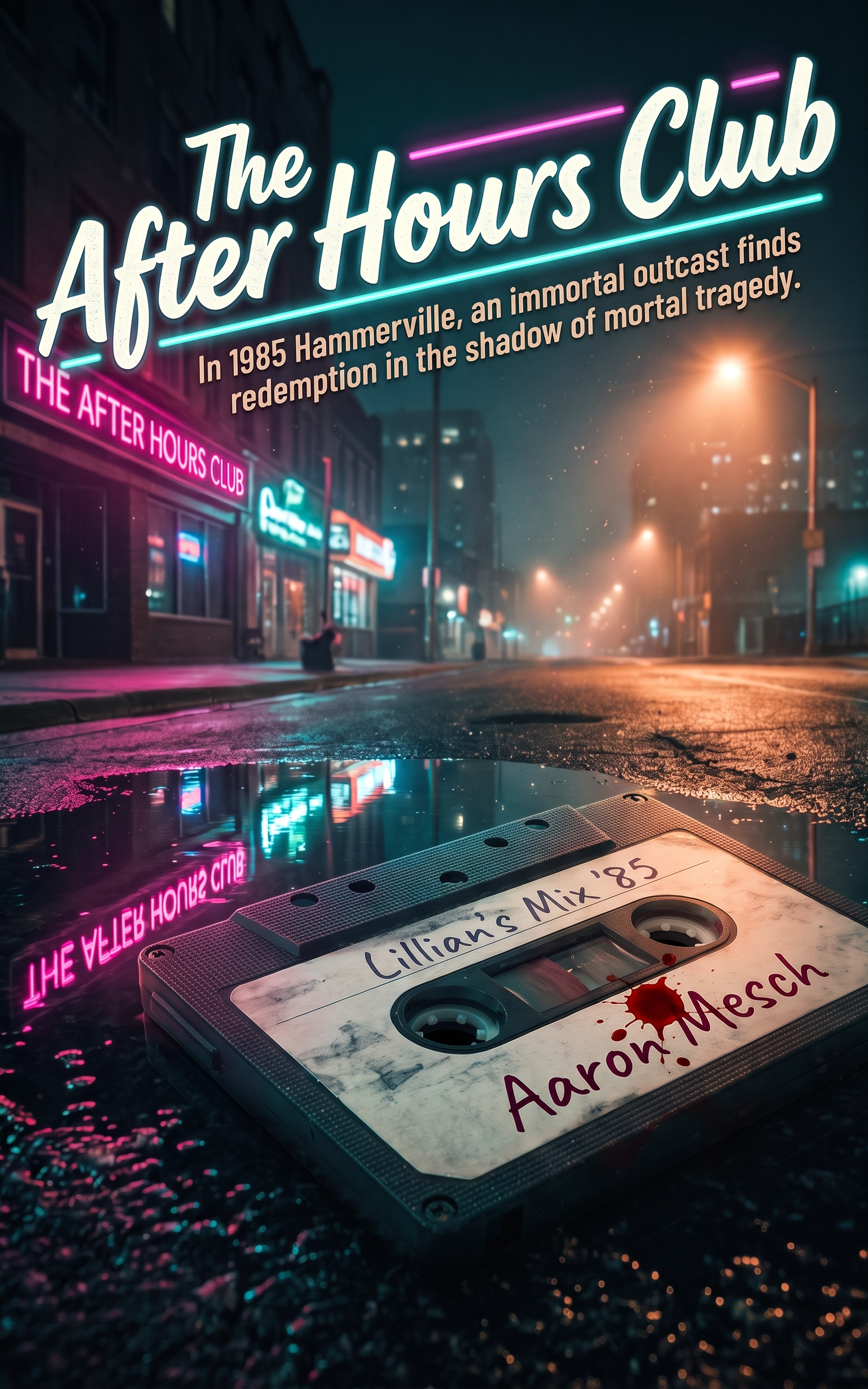
The After Hours Club
In 1985 Hammerville, an immortal outcast finds redemption in the shadow of mortal tragedy.
by Aaron Mesch
Hammerville, 1985. Neon lights bleed into damp neon alleys, but for Orban "Org" Gilewicz, the darkness offers no sanctuary. An ancient vampire burdened by four centuries of existence, Org harbors a harrowing secret: he is a carrier of the devastating AIDS virus. Driven by overwhelming guilt over the mortal lives he has unwittingly destroyed, he forsakes his aristocratic bloodline to scavenge sewer rats in the shadows. His bleak exile is shattered when he meets Lillian Garrick, a sharp-witted street artist living with the same fatal diagnosis. Unafraid of Org’s terrifying nature, Lillian offers him something he hasn't felt in centuries: genuine human connection. As their fragile world deepens, Org’s former coven marks him as a liability that must be exterminated, sparking a violent war across the city’s underground scene. Flanked by unlikely allies, Org must protect Lillian as her health declines. But as the final twilight approaches, he faces a choice that transcends his immortal hunger. Aaron Mesch delivers a haunting, heart-wrenching dark romance about love, mortality, and the ultimate price of grace.
- Paranormal
- Horror
- Romance
- Vampire
- Vampire Horror
- Paranormal Romance
Shadows in the Alley
The rain in Hammerville did not fall so much as it settled, a heavy, grease-slicked mist that clung to the brickwork and rusted fire escapes of the downtown grid. It tasted of sulfur, diesel fumes, and the low, rot-heavy breath of the river three blocks south. In the narrow gap between Fifth Street and the freight tracks, the darkness was absolute, preserved like something spoiled inside a sealed jar.
Orban Gilewicz crouched on a ledge of crumbling masonry six feet above the standing water of the alley floor. He did not move. He had not moved for forty-five minutes. The cold of the damp stone had long since soaked through the faded velvet of his longcoat, settling deep into bones that had stopped generating their own warmth four hundred years ago. Beneath the sodden fabric, his frame was a cage of visible ribs and sharp joints, the once-broad shoulders now looking like coat hangers beneath dark cloth. His dark hair, pulled back into a tight knot at the nape of his neck, leaked thin rivulets of oily water down his spine.
He pulled his breath in through his nose, slow and silent, deliberately ignoring the stench of the alley to focus on the faint, rhythmic scratching coming from behind an iron intake grate near the water line.
It was a fat one. He could hear the heavy, wet drag of its belly against the concrete pipe, the frantic, small-hearted pulse running at four hundred beats a minute. A sharp, hot scent drifted out with the steam of the sewer flue, mud, sour grease, and the thin, iron tang of rodent blood.
Org closed his eyes. The ice-blue irises, bright even in the pit of the alley, hid behind pale lids. Deep in his throat, a dry muscle twitched. The hunger was not a sharp pain anymore; it had passed through sharp pain weeks ago, settling into a dull, hollow ache that sat behind his breastbone like a pocket of lead. It made his fingers tremble where they braced against the wet brickwork. It made his vision blur at the edges, fringing the neon glare from the main street in greasy halos of yellow and pink.
He reached down with his right hand. His fingers, long and tipped with nails that had turned thick and gray like horn, moved without a sound. He did not use his speed. He had stopped using the gifts of his lineage months ago, burying them under the weight of his own disgust. Speed was for hunting. Speed was for the high-ceilinged parlors of the coven, for the sudden, graceful drop onto an unsuspecting shoulder in the velvet darkness behind the opera house or the back rooms of high-end speakeasies. Here, in the sewer mud, speed was an insult to the filth he had chosen.
His hand slipped into the dark mouth of the flue.
The rat did not even have time to squeak. Org’s fingers closed around its middle, squeezing just hard enough to trap the ribs without crushing the soft organs inside. He hauled it out into the gray mist, bringing it up to his chest in a single, fluid motion.
The creature writhed, its wet tail whipping against his forearm, its small yellow teeth clicking uselessly against his calloused thumb. Its heartbeat was a tiny, panicked hammer against his palm.
Org looked at it. In the dull reflection of a sodium street lamp three alleys over, the rat’s eyes were small black beads of absolute, unthinking terror. It did not know what he was. It only knew the trap of his hand.
"Forgive me," Org whispered. His voice was a dry rasp, the words falling with the awkward, formal weight of an accent learned in seventeenth-century Warsaw and refined in the cold courts of Vienna. "You are clean, at least. You carry only the rot of the earth."
He opened his mouth. His fangs, long and needle-sharp, extended with a small, wet click against his lower lip. He brought the writhing body to his chin and sank his teeth into the thick scruff behind its ears, puncture points driving straight through hair and skin into the cold artery beneath.
The blood was thick, lukewarm, and tasted faintly of copper and stagnant ditch water. It rushed into his mouth not with the hot, heady rush of a human vein, which was like drinking spiced wine heated over an open hearth, but like thin, sour soup. It lacked life. It lacked the light that made a soul burn against the back of his throat. It was grease and panic and salt.
He swallowed. His throat worked rhythmically, the muscle contracting against the foulness of it. He squeezed the creature’s ribs, milking the last sluggish drops from its tiny heart until the twitching in its legs stopped entirely and the tiny hammer in its chest went still.
When it was done, he did not drop the carcass into the water. He held it for a moment, feeling the coldness settle into the fur, before laying it carefully on a dry ledge out of the rising tide. It was a stupid habit, a remnant of a man who had been buried under four feet of polish soil before the steam engine was ever dreamed of, but he could not bring himself to leave the tiny corpse floating in sewage.
He wiped his mouth with the back of his sleeve, dragging the dark velvet across his pale lips until the dark smear of rat blood was gone. His tongue felt coated in grease. His stomach, twisted into a tight knot, accepted the small offering with an angry, gurgling churn, demanding more, demanding the hot, thick flood that he had forbidden himself to ever touch again.
Org leaned his head back against the brickwork and let his eyes close once more.
The guilt came instantly, as it always did when the physical ache of starvation receded even a fraction. It was an old companion now, thick and heavy, settling over his lungs like damp wool. He saw their faces in the dark behind his eyelids. Julian, with his bright, laughing eyes and the yellow silk shirts he loved to wear to the underground dances on Seventh Street. Clara, whose neck had tasted like lavender water and skin warm from the midday sun. They were gone. Not turned into the cold immortality that Quentin boasted of, but rotted from the inside out, their bodies wasting away into bone and fever while the doctors in the public wards shook their heads and pulled the sheets over their hollow faces.
He had done that to them. He, who had thought himself an elevated predator, a creature of refined tastes who took only what he needed and left his lovers with nothing more than a faint dream of dark velvet and low music. He had been carrying a poison in his veins, a invisible pestilence that did not touch his own undead flesh but turned his touch into a death sentence for every mortal he lay with.
When the realization had hit him, two years ago in a sunless room above a bakery, he had broken his sword, burned his trunk of old silk, and walked out into the rain. He had not returned to Quentin’s coven. He had not touched a human skin since.
A cold drop of rain hit his eyelid. Org opened his eyes, the light returning to them with a dull, blue flicker. He needed to move. Standing still allowed the memory to assemble itself into too clear a picture, and if he looked too closely at Julian’s hollow cheeks, he would lose what little sanity he had managed to patch together from the gutters.
He dropped from the ledge, his scuffed leather boots hitting the wet cobblestones with a soft, dull thud that made no splash. He adjusted the lapels of his longcoat, pulling the worn velvet close around his neck to hide the pale hollow of his throat, and set off toward the bright, ugly glow of the lower district.
***
The After Hours Club sat in the belly of an old brick warehouse that had once stored grain before the shipping docks moved three miles downriver. It had no sign, no neon beer lights in the windows, and no carpet on the concrete stairs that led down from the street level. Only a heavy steel door painted dull black, with a small brass grate at eye level that stayed closed until two in the morning.
Above ground, Hammerville in 1985 was dying the slow, loud death of the Rust Belt, but down here, under the pavement, it was where the city’s unmoored souls washed up when the bars on the main strip turned off their taps and shoved the drunks onto the sidewalk.
The rain was coming down harder now, turning the alley behind the club into a shallow creek of dark water and floating cigarette butts. Org stayed in the recess of an iron fire escape across from the rear exit, his back pressed against the corrugated iron of a grain silo wall. He liked this spot. The ventilation fan from the club’s kitchen blew out steam that tasted of stale grease, spilt draft beer, and wet wool, a wall of human scent that was coarse enough to drown out the sharper, more dangerous smells of fresh blood that occasionally drifted up from the door below.
Through the heavy iron door, whenever someone stepped out to spit or vomit into the alley, the music escaped in loud, jagged bursts. It was high-energy, mechanical noise, all thumping electronic baselines and cold synth keys that rattled the iron stairs above his head. A new kind of music for a new kind of misery. Org didn't hate it, but it sounded to him like iron boots marching across dry tin.
The rear door opened with a heavy iron clatter, and Maurice Ashcroft stepped out into the mist.
The bartender was a thick man, broad through the shoulders and thick around the waist, built like an iron stove that had seen forty years of hard coal. He wore a grease-spotted apron over a grey flannel shirt, his sleeves rolled up to reveal forearms covered in thick, salt-and-pepper hair. A cigarette hung from the corner of his wide mouth, the red tip glowing brightly in the dark alley every time he took a drag.
Maurice didn't look up at the fire escape. He didn't look down the alley toward the tracks either. He just stood there under the small tin overhang above the door, breathing out gray smoke that mingled with the gray rain, his heavy mustache dripping water down onto his chin.
"You're leaking wet up there, Org," Maurice said, his voice like gravel being dragged across a driveway. He didn't turn his head. "You're going to rust them antique buttons on your coat."
Org didn't move from the shadows. "The buttons are brass, Maurice. They do not rust. They merely turn green."
"Same difference," Maurice grunted. He dropped the cigarette butt into a puddle, where it died with a tiny hiss, and immediately reached into his coat pocket for another one from a blue paper pack. "You've been sitting on that iron grate for three nights running. The alley cats are getting nervous. They think you're taking their work."
"The cats are welcome to the large ones near the drain," Org said quietly. "They have more courage than I."
Maurice spit into the gutter and struck a wooden match against the brickwork. The yellow flame illuminated his wide, flat nose and the deep lines etched around his eyes. He was fifty, maybe fifty-two, but he looked like he had been born behind a bar with a wet rag in his hand and a cold cup of coffee at his elbow.
"Got a bad batch of beer tonight," Maurice said, puffing the match out and throwing the stick into the water. "Distributor sent the kegs from the bottom of the vat. Tastes like iron and wet cardboard. The kids don't care, long as it's cold and it gets them through till six in the morning."
"Youth is remarkably tolerant of bad wine," Org remarked.
"It ain't wine, it's Milwaukee trash," Maurice said. He turned his heavy head slightly, his small, dark eyes catching the glint of Org’s coat in the darkness. "You coming in, or are you going to stay up there looking like a church gargoyle until the sun comes up?"
"I am fine here."
"You look like hell, Org. Even for you. Your cheeks are sunken so far I can see your teeth through your skin."
"I have been... dieting."
Maurice made a short, wet sound in his throat that might have been a laugh if there had been any humor in it. "Yeah. Dieting. That's what they call it when the rat population drops by half in the Fifth Ward. You're an idiot, you know that? A ancient, high-and-mighty idiot."
"It is my concern, Maurice."
"It's my alley," the bartender snapped back, though his voice stayed low, barely carrying past the dripping eave. "And I don't like blood-drinkers starving themselves on my back steps. It's bad for business. Looks like I don't pay my staff."
"I do not work for you."
"Then get down here and drink some soda water or something. You're giving the brickwork a bad name." Maurice turned back toward the heavy steel door, his thick hand resting on the iron latch. "She's inside."
Org went rigid. His fingers tightened on the iron rail of the fire escape until the rusted metal groaned under the pressure. "Who?"
"The girl with the sketchbook," Maurice said, his tone dry and flat again. "The one with the boots and the hollow eyes. She’s been in the corner booth since midnight. Hasn't ordered a thing except tap water with lime. Her cough sounds worse than last week, Org. Sounds like a dry wood saw hitting a knot."
Org didn't answer. He didn't have to. Maurice knew he was listening with every nerve in his cold body.
"I don't ask questions about what you do out here," Maurice continued, his hand squeezing the latch down. "And I don't ask where she gets those marks on her arms. But she's sitting in my back booth, and the crowd from the steel mill is getting rowdy near the pool table. If you're going to watch her like a ghost, you might as well do it where it's dry."
The heavy iron door swung open, letting out a sharp blast of drum machines and thick tobacco smoke. Maurice stepped inside, leaving the door unlatched just an inch, a strip of yellow light cutting through the black water on the alley floor.
Org stayed still for three long heartbeats, or what would have been heartbeats if his chest still moved on its own. Then, with a motion so silent it didn't even displace the mist around him, he dropped to the ground and walked through the light into the warm, damp dark of the club.
***
The After Hours Club smelt of stale beer, cloves, damp wool, and the sharp, iron scent of forty people sweating under low-wattage colored bulbs. It was a long, low-ceilinged room with exposed brick walls that had been painted black ten years ago and were now flaking off in gray scales. At the far end, a small DJ booth elevated on milk crates spewed out a thick wall of dark wave music that vibrated through the floorboards into Org's boots.
He kept to the shadows near the coat rack, his long coat pulled tight around him, his ice-blue eyes scanning the room over the heads of the dancing patrons. They were young, mostly, dressed in ripped denim, leather jackets covered in steel studs, and thick black eyeliner that ran down their cheeks in the humid air of the room. They danced with a strange, frantic gravity, stomping their heavy boots against the concrete floor as if trying to break through to the cellar beneath.
Org ignored them. His eyes shifted toward the back wall, where the wooden booths were dark and narrow, recessed into old archways that had once held grain chutes.
She was there.
Lillian Garrick sat alone in the last booth, her small frame half-swallowed by an oversized vintage sweater of thick, salt-and-pepper wool that looked three sizes too big for her narrow shoulders. Her hair, cut short and jagged in a feathered raven style that was popular among the girls who hung around the art school on Fourth Street, caught the faint blue glow from a neon sign behind the bar. Her face was very small, very pale, her skin so translucent that Org could see the faint blue tracery of veins beneath her temples even from fifteen feet away.
She had a worn leather sketchbook open on the wooden table in front of her, held down by a thin, pale hand with nails bitten down to the quick. In her right hand, she held a stub of charcoal, her fingers moving in quick, violent strokes that made sharp, scratching sounds over the bass pounding from the speakers.
Org focused his hearing, shutting out the roar of the music, the ice clinking in glasses behind the bar, the laughter of three men by the cigarette machine. He looked for the sound he had learned to recognize over the past three weeks.
There it was.
Her heart. It was small, light, and quick, like the heart of a bird trapped in a basket. But beneath the rhythm, there was a wet, heavy rattle, a soft, rasping friction in her chest that accompanied every shallow breath she took. It was the sound of something failing, of tissues losing their grip on the air, of a body slowly, quietly surrendering to an enemy inside its own blood.
It was the same sound he had heard in Julian’s small apartment two springs ago. The same soft, dry whistle in the throat that no medicine could fix.
A knot of cold rage tied itself in Org’s throat. Not rage at the world, or at the disease that was eating this girl alive from the inside, but at the absolute, helpless irrelevance of his own existence. He was a monster, a creature of legend that could tear an iron door off its hinges or walk through a hall of blades without flinching, and he could do nothing for the rattle in her chest except stand in the dark and listen to it run out of steam.
Lillian didn't look up from her page. She drew with a strange, furious focus, her thumb smudging the black dust across the tooth of the paper. On the wooden table beside her sat a glass of water, long melted, with a pale wedge of lime sinking to the bottom.
Org moved two paces closer, stepping behind a heavy timber pillar that supported the ceiling beam. He could see her drawing now. It was not the dancers or the bar or the bright neon signs. It was a drawing of a window, high up and narrow, with thick iron bars across the glass and dark rain running down the outside in heavy streaks. In the center of the frame, barely visible behind the black lines of the charcoal, was a small, round shadow that looked like a bird with its wings folded tightly against its ribs.
She paused, her charcoal hovering over the page. Her shoulders shook with a sudden, silent spasm, and she brought her left hand up to her mouth, pressing the oversized sleeve against her lips to muffle a cough.
The sound was low, terrible, and wet. It rattled in her throat for several seconds before she managed to draw a ragged breath back into her lungs. When she pulled her arm away, she didn't look at the cuff of her sweater. She just laid her hand flat on the table, her fingers trembling slightly against the rough wood, and closed her eyes until the spell passed.
Org’s hand twitched inside his coat pocket. He wanted to step forward. He wanted to sit down across from her, to take those narrow, cold fingers in his own dead hands and tell her... what? What could a four-hundred-year-old corpse tell a dying street artist in a basement bar in Ohio?
I am cursed too, he would say. I carry the same quiet death in my blood, though it does not kill me. I am the shadow that walks behind the thing that is eating you.
He stayed behind the pillar.
Near the middle of the room, three men stepped away from the pool tables. They were thick-necked men from the freight yard down by the river, smelling of old grease, cheap whiskey, and cold sweat. Their clothes were work-stained, their faces red from four hours of heavy drinking in the warm room. One of them, a broad-shouldered man with a greasy red cap pulled low over a forehead covered in pox scars, turned his head toward the back booths.
He saw Lillian sitting alone.
Org watched as the man’s eyes narrowed, his tongue running over his upper lip as he nudged his companion with a heavy elbow. They said something to each other over the roar of the music, a wet, low laugh passing between them, before the man in the red cap detached himself from the group and swayed toward the back wall.
Org’s eyes went dark, the light in his blue irises shrinking to two cold points of pin-prick intensity.
The man reached the booth and leaned his heavy hands on the edge of the wooden table, overhanging Lillian’s sketchbook by an inch. His shadow fell across her drawing, blocking out the light from the neon sign.
"Hey, pretty thing," the man said. His voice was thick, wet with alcohol, carrying over the synth beat with an ugly, booming confidence. "You look like you're about to fall into that book. You need some company to keep your eyes open?"
Lillian didn't look up immediately. She finished a line on the side of the window frame, her charcoal making a soft zip-zip sound against the paper, before she raised her head.
Her dark eyes were very large in her thin face, framed by dark circles that looked like bruises under her pale skin. She looked at the man’s red cap, then down at his thick, red-veined hands on her table, her expression flat, bored, and entirely devoid of fear.
"I'm working," she said. Her voice was surprisingly dark, a raspy, smoky low register that sounded like she had spent her life talking over bad radio static. "And your stomach is dripping grease on my paper."
The man’s smile twitched, his thick eyebrows pulling together in a sharp line. "Ain't very polite, are you? I'm just offering to buy you a real drink instead of that tap water you've been nursing for two hours. A girl like you shouldn't be sitting in the dark by herself. People might think you're sick or something."
"I am sick," Lillian said simply, her charcoal moving back to the page. "And I'm busy. Go back to your friends before you spill something."
The man’s face went dark. He didn't move away. Instead, he reached out a thick, calloused hand, his fingers stained with machine oil, and grabbed Lillian’s left forearm, squeezing through the thick wool of her sweater.
"Now hold on a minute, little lady," he barked, his voice dropping into that dangerous, heavy tone that drunks use when they realize they aren't being taken seriously. "I was being nice to you. You don't gotta be a bit—"
"Hey!"
The sound came from behind the bar. Maurice was standing with a wet glass rag in one hand and a heavy wooden bung-starter in the other, his broad face set in a hard, flat glare that could have stopped a truck. He was leaning over the wood, his forearms thick as oak posts.
"Leave the girl alone, Miller," Maurice shouted over the music. "I told you twice last week about botherin' the folk in the booths. Get back to the pool table or get your coat and get out."
The man in the cap—Miller—turned his head, his teeth bared in a wet snarl. "Mind your own damn business, Ashcroft! She's just sitting here—"
"It is my business when you're grabbing my customers," Maurice said, stepping around the end of the bar with the heavy wooden mallet held loosely at his side. "Let go of her arm."
Miller didn't let go. His thumb dug deeper into the soft flesh of Lillian’s arm, his face turning red with the stubborn, stupid pride of an embarrassed drunk. Lillian didn't cry out. She didn't pull back. She just looked down at his thick fingers on her sweater with a cold, detached disgust, as if a large beetle had landed on her coat and she was waiting for someone to brush it off.
"She's coming with me for a air-out," Miller growled, yanking her sideways so hard that the sketchbook slid off the table and hit the concrete floor with a flat thup.
Lillian gasped, the sound thin and dry in her chest, her small combat boots scraping against the floorboards as she tried to catch her balance.
Maurice took two quick steps forward, lifting the mallet, but he didn't reach the booth.
He didn't have to.
Org stepped out from behind the timber pillar.
He didn't run. He didn't fly. He simply stopped being behind the post and started being in the middle of the hallway, moving with that absolute, horrifying lack of friction that belongs only to things that do not have to drag breath or bone through the air. One second the space between the booth and the hallway was empty; the next, a wall of cold, dark velvet and pale skin was standing six inches from Miller’s shoulder.
The air temperature around the booth dropped five degrees in an instant. The smell of cold sewage and damp earth drowned out the thick grease of the bar.
Miller turned his head, a curse dying in his throat as his eyes met Org’s face.
Org did not raise his hands. He did not growl. He simply looked down at the man from his full six-foot-two height, his longcoat hanging around his gaunt frame like funeral drapery. His face was entirely devoid of color, the skin stretched so tight over his high cheekbones that he looked like a statue pulled from a flooded vault. But his eyes—his eyes were wide, bright, and utterly blue, burning with an ancient, predatory focus that had nothing to do with the 1985 Hammerville streets or the cheap alcohol in Miller’s belly.
"Remove your hand," Org said.
The voice was soft. It did not carry over the music for the rest of the club, but to Miller, standing three inches away, it sounded like a iron plate falling onto stone. It had the dry, dead resonance of a open vault in winter.
Miller froze. His fingers stayed locked on Lillian’s arm for one second, two seconds, his brain trying to make sense of the thing standing beside him. The velvet coat smelled of wet dirt. The pale face didn't have a single pore, a single line of sweat, or a single drop of blood beneath the skin. It was the face of something that had been under the earth for a long time and had only come up because it was annoyed by the noise.
"I... I said—" Miller began, but his voice cracked, slipping into a high, thin whistle.
Org moved his hand. It was a small movement, barely four inches, his long, gray-nailed fingers coming down to rest on Miller’s wrist. He didn't squeeze. He didn't have to. He simply applied the smallest fraction of the pressure he used to break the necks of sewer rats.
Miller let out a wet, strangled squeak. His hand opened instantly, his fingers flying back from Lillian’s sweater as if he had touched a red-hot stove pipe. He staggered back three steps, his boots slipping on the beer-slick floor, his face going from dark red to a dull, sickly gray in the space of a single breath.
"Out," Org whispered.
Miller didn't look at Maurice. He didn't look at his friends by the pool table. He looked at Org’s eyes, saw the cold, blue light that didn't belong to any electric bulb in the city, and backed away down the hallway, his hands raised in front of his chest like a child trying to ward off a dog. He hit the swinging doors to the street level with his shoulder, jammed them open, and vanished up the stairs into the rain without looking back once.
The back corner of the club went very quiet.
Maurice stood three feet away, the wooden mallet still held in his thick fist. He looked at Org, then down at Miller’s discarded beer glass on the table, and let out a long, slow whistle through his teeth.
"Well," Maurice grunted, lowering the mallet. "That saved me four bucks on a broken chair. Thanks, Org."
"He will not return tonight," Org said. He did not look at Maurice. His eyes were fixed on the floor at his feet, where Lillian’s sketchbook lay open near his scuffed boots.
Maurice looked between the two of them, his heavy mustache twitching once. He wiped his hands on his apron, took two steps back toward the bar, and grabbed the wet rag from the counter. "I got a fresh pot of coffee coming up," he said, his voice flat and neutral. "Don't break nothing in the booth."
He walked away, leaving the shadow of the archway to the two of them.
Org stayed where he was, his longcoat hanging still around his knees. His heart was not beating, but a strange, dark pressure was building behind his ribs, a sensation he hadn't felt in so long he had forgotten its name. Fear. Not for himself—there was nothing in this room that could hurt him—but for the small, pale creature sitting three feet away.
He picked up the sketchbook.
His long fingers were very careful, touching only the dry edges of the paper so he wouldn't smudge the charcoal work. He turned it over and held it out to her, his head turned slightly away so she wouldn't have to look directly into his face.
"Your book," he said softly. "It was not damaged."
Lillian didn't reach for the book immediately. She sat back against the high wooden bench, her small hands tucked into the oversized sleeves of her sweater, her dark rimmed eyes watching him with an intensity that made Org’s skin prickle under his coat.
There was no horror in her face. There was no panic, no frantic reaching for a purse or a coat, no wild backward scramble like the one Miller had just executed. She looked at his pale cheekbones, at the dark hair tied back with a leather string, at the faded velvet lapels that had seen the court of a Polish king three hundred years before her mother was born.
She looked at him the way she looked at the window in her sketch: as if he were something that was simply there, like the rain or the rust on the iron pipes, and there was no point in shouting at it.
"You're very cold," she said. Her voice had that same dark, dry rasp, like dry leaves being swept across concrete. "I could feel it from over here when you grabbed his arm. Like someone opened a refrigerator door."
Org held the book out an inch further. "I am... not well-suited for warm rooms."
"No kidding," she said. She reached out and took the sketchbook from his hand. Her fingers brushed against his knuckles for half a second. Her skin was warm—too warm, bright with the faint, persistent fever that sat in her blood—and her touch felt to Org like a hot iron applied to cold meat. He pulled his hand back into his coat pocket so quickly his sleeve whistled in the air.
Lillian didn't laugh. She set the book on the table and smoothed the page with her palm, her dark eyes still fixed on his face.
"I've seen you before," she said, leaning her chin on her hand. "Out in the alley by the grain bin. You were standing on the fire escape in the middle of a downpour without an umbrella. I thought you were a coat somebody hung up on the rail to dry."
"I was merely... observing," Org said. His formal cadence sounded absurdly heavy in the narrow booth, surrounded by the smell of stale beer and electronic music, but he had forgotten how to speak any other way.
"Observing what? The rats?" She let out a short, sharp sound that was almost a laugh, followed instantly by a tiny, dry cough that she checked with her hand. "There's better entertainment in town, stranger. Though the admission price is usually higher than a wet coat."
"I require very little entertainment," Org said. He took one step back, his boots finding the dark edge of the timber pillar. "I apologize for the disturbance. The man was... coarse."
"The man was an idiot," Lillian said flatly. "They're thick as flies around here after midnight. You get used to brushing them off, or you stop coming out." She looked down at her drawing, her fingers tracing the charcoal bars of the window. "Thanks, anyway. My arm would have been blue tomorrow if you hadn't stopped him."
"He will not touch you again," Org said.
"I know," she said, looking back up at him. Her gaze was steady, fearless, and so deeply tired that Org felt a strange, cold ache in his jaw. "You scared the grease right out of him. I don't think I've seen a six-foot mill hand turn that shade of yellow since the plant shut down its second furnace."
Org didn't answer. He couldn't. The smell of her skin—warm, feverish, and tainted by the sharp, metallic tang of the sickness inside her veins—was reaching him now. It was not the scent of prey. It was the scent of a house that was quietly burning down from the inside while the rain fell on the roof.
It pulled at him with a dark, terrible weight. Not hunger—he felt no desire to sink his fangs into her neck, no dark urge to drink the fevered water of her life—but something far worse. Sympathy. Recognition. The terrible, suffocating feeling that he was looking at his own mirror, separated only by four hundred years of useless immortality and a few yards of dark velvet.
"You should go home," Org whispered. "The night is wet, and... your chest is cold."
Lillian smiled. It was a small, bitter turn of her dark lips that didn't reach her eyes, but it made her look very young for a moment, like a girl who had found a joke at the bottom of a very long, dark well.
"Home's two rooms above an auto body shop on Ninth," she said, picking up her stub of charcoal again. "It smells of grease and cold radiators. At least Maurice has heat, and the music drowns out the noise in my head." She tapped the charcoal against the paper. "Sit down for a minute, stranger. You're blocking my light anyway."
Org froze. "I cannot."
"Why not? Legs don't work?"
"I am... dangerous to you," he said, the words coming out dry and hard, stripped of all polish. "You do not know what I am."
Lillian looked at him for a long, quiet moment. The music from the DJ booth hit a low, grinding synth pulse that vibrated through the salt shakers on the table. She looked at his pale hands, at the dark velvet of his coat, at the high, sharp cheekbones that had never seen the Ohio sun.
"I know you're not with the health department," she said, her voice dropping into a dark, dead-level cadence that made Org’s dead heart hitch in his ribs. "And I know you're not buying anything. That makes you about the safest thing in this room, as far as I'm concerned."
She gestured with her chin toward the empty bench across from her.
"Sit down, pale man. Or go back to your fire escape and freeze. It's all the same to me."
Org stood in the blue glow of the neon sign, his shadow long and thin against the flaking black paint of the wall. He looked at her face, at the small, defiant chin raised against the dark of the room, and he knew that if he sat down, if he took a seat in that wooden booth, he would be stepping off the ledge he had maintained for two long, hungry years.
He was a carrier of death. He was a creature that brought the grave to everything he touched.
He turned his head toward the door.
"I must leave," Org whispered.
He didn't wait for her to answer. He didn't look back at the sketchbook or the glass of tap water with its melting lime. He turned and walked down the back hallway, his velvet coat brushing against the brickwork, his movements fast, silent, and desperate.
He pushed through the heavy steel door into the rain, the cold air hitting his face like a wet towel, and vanished into the black mud of the alley before the latch had even clicked shut behind him.
***
The alley was empty now, save for the dark water running down the concrete channels toward the river. Org didn't climb back to his fire escape. He walked. He moved through the narrow gaps between the warehouses, his boots making no sound on the wet stones, his mind a gray storm of memory and fear.
He saw Julian’s face again. Then Clara’s. And then, layered over them like a grease pencil drawing on glass, he saw Lillian’s dark eyes looking up at him from the wooden booth, entirely devoid of fear, entirely accepting of the dark room she had been left in.
He stopped under a broken street lamp two blocks from the club. The yellow bulb above him flickered twice, buzzing like a dying wasp, before going out entirely, leaving him in the thick, wet blackness of the freight corridor.
Org pulled his hands from his pockets and looked at them. In the dark, they were pale, almost luminous, the nails gray and dry. They were the hands of an ancient predator that had been preserved in salt and rot while the world built iron bridges and electric lights around him.
"We are both living on borrowed time," he whispered to the rain, repeating the words he had heard her say to herself when she didn't think anyone was listening in the dark of the back hallway.
He closed his eyes, and for the first time in forty years, Orban Gilewicz felt the cold drops on his face not as a nuisance, but as a punishment he was no longer sure he could bear alone.
The Free Clinic
The yellow brick facade of the municipal building on Ninth Street was streaked with soot that thirty years of Ohio rains had failed to wash away. Near the alley entrance, where the basement stairs dipped three feet below sidewalk level, a rusted enamel sign hung by a single screw, its blue lettering faded to the color of skim milk: St. Jude’s Commu…