

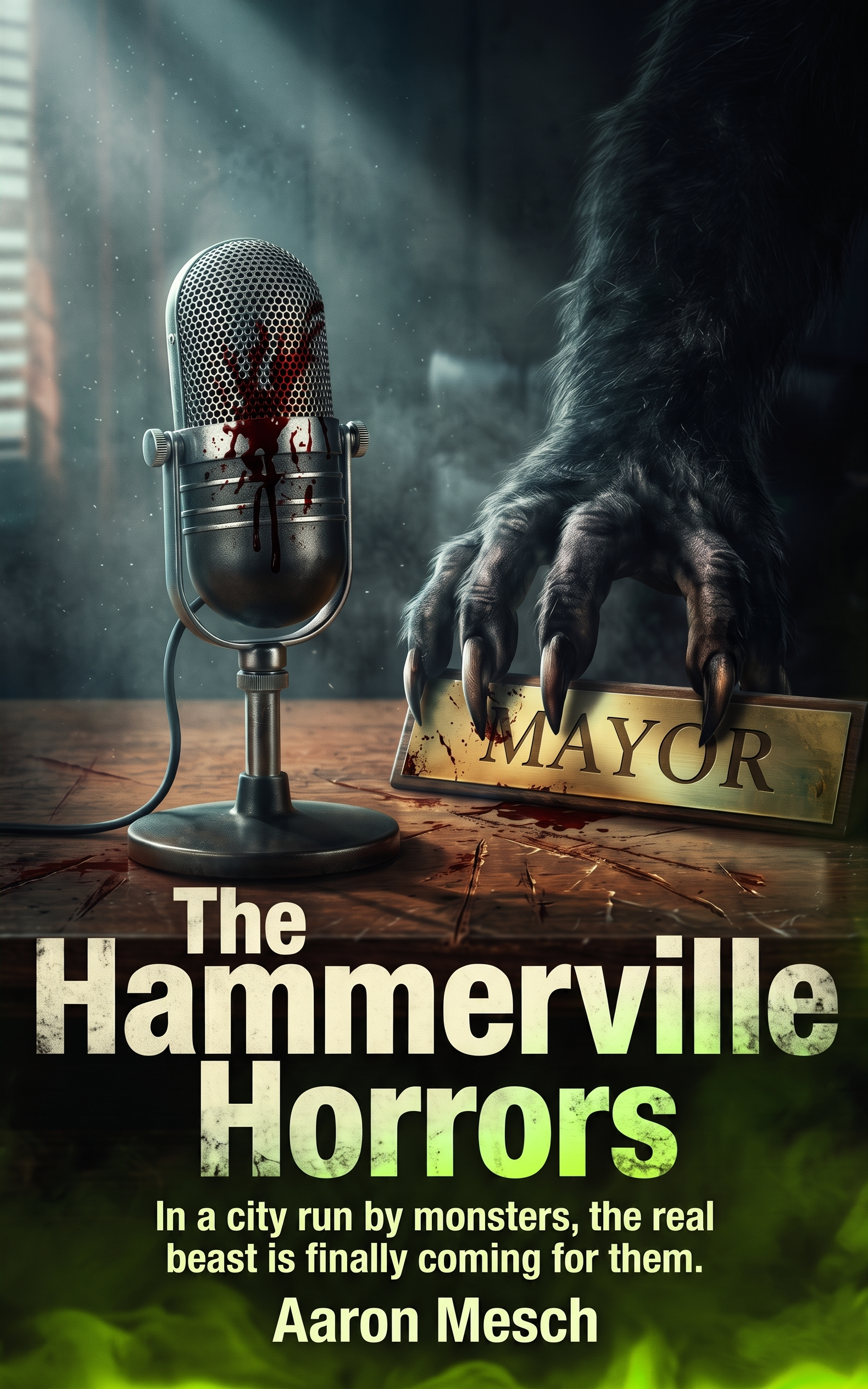
The Hammerville Horrors
In a city run by monsters, the real beast is finally coming for them.
by Aaron Mesch
Hammerville, Saskatchewan, is a city built on secrets, sin, and the iron-fisted rule of Mayor Terrance Hammer and Sheriff 'T-Bone' Splinter. By day, they control the streets; by night, they record 'The After Hours Club,' a twisted podcast where they laugh about their crimes and the 'assets' they’ve dumped in the local swamp. Their corrupt empire feels untouchable—until the girls in their lucrative prostitution ring start turning up in pieces. Madame Sass is desperate as her workers are slaughtered, and the only honest cop left, Detective Adam Thorne, senses something far more primal than a standard serial killer is stalking the shadows. A researcher named Samantha Vance went missing two years ago, and now something has returned from the wetlands with fur, fangs, and a thirst for vengeance that no bribe can satisfy. As the moon rises over Hammerville, the human predators who thought they were at the top of the food chain are about to realize they are nothing but prey. It’s a brutal showdown between organized evil and supernatural fury, where the bloodiest beast of all will claim the final word. In this urban hellscape, the swamp is finally giving back what the mayor took.
- Thriller
- Paranormal
- Horror
- Science Fiction
- Psychological Thriller
- Action Thriller
01) The After Hours Club
The air in the spare bedroom of the penthouse condo was a stagnant yellow soup of expensive Cuban tobacco, sour whiskey sweat, and the synthetic ozone of a high-end air purifier that had long since surrendered to the sheer volume of smoke. It was a room designed for storage, but Terrance Hammer had never been a man to let square footage go to waste, especially when it could be converted into a soundproofed sanctuary for his own voice. He sat behind a custom-made mahogany desk that looked far too large for the space, his massive frame swelling against the seams of a charcoal pinstripe suit. His silver hair, shellacked into a perfect, immovable wave, gleamed under the harsh red glow of the recording sign.
"You have to understand the fundamental mechanics of local government, T-Bone," Hammer said, his voice a deep, gravelly rumbling that vibrated the heavy condenser microphone suspended inches from his nose. He paused to take a long, wet drag from a Cohiba Behike, the cherry glowing like a miniature furnace in the dim room. "The average voter is a sheep. They don't want to know how the pasture is fenced, and they certainly don't want to see the slaughterhouse. They just want their grass green and their driveways plowed. But every now and then, you get a black sheep who thinks he’s a wolf. You get a guy like Councilman Douglas."
Across the desk, Sheriff James "T-Bone" Splinter let out a sharp, nasal wheeze that passed for a laugh. He was leaned so far back in his leather swivel chair that his head nearly touched the acoustic foam padding on the wall behind him. His lanky body was clad in a khaki uniform that looked as though it had been dragged through a dusty ditch, the silver star on his chest tilted at a lazy, mocking angle. A wooden toothpick hovered in the corner of his mouth, shifting from left to right as he spoke.
"Ah, yes. The honorable Councilman Douglas," Splinter sneered, his thin fingers lightly tapping the grip of his holstered service weapon in a rhythmic, nervous cadence. "The champion of fiscal responsibility. The man who looked at the blueprints for the new multi-million-dollar sports complex and actually had the balls to ask where the municipal bonds were going. He wanted to audit the concrete contracts, Terrance. The concrete! I mean, who the hell questions the concrete in Saskatchewan? It is a sacred tradition."
"Exactly," Hammer chuckled, a wet, rattling sound in his chest that devolved into a brief coughing fit. He washed it down with a heavy pour of thirty-year-old Macallan from a crystal decanter, not bothering with ice. "The man was a public nuisance. He had this righteous, trembling look in his eyes, like he was Jimmy Stewart in that old movie. He stood up in the council chambers and started talking about the taxpayers. I almost felt sorry for him. Almost. But then I remembered that his wife’s family owns three dry-cleaning franchises in the south end, and his twenty-two-year-old mistress was currently living in a condo that I happen to own through three different shell companies."
Splinter leaned forward, the toothpick dropping to his lower lip. "And that is where the magic of local law enforcement comes in, folks. For those of you listening at home on the dark web, this is what we call a multi-agency coordination. We didn't just break the man. We dismantled him like an old Chevrolet."
"Tell them what you did with the car, T-Bone," Hammer said, his small, calculating blue eyes crinkling at the corners. He loved this part. The podcast, which they had lovingly dubbed "The After Hours Club," was their private confessional, a digital trophy room where they could display the pelts of their enemies to an anonymous audience of sickos, high-society criminals, and degenerate gamblers who paid a premium subscription fee in cryptocurrency. It was a weekly reminder that in Hammerville, they were the law, the jury, and the executioners.
"Well, you see, Councilman Douglas was very proud of his Lexus," Splinter said, gracing the microphone with a wet smack of his lips. "A pristine, midnight-blue sedan. He parked it in the municipal lot every Tuesday. So, I had one of my boys on the night shift do a little proactive patrolling. We found a very unfortunate, very anonymous tip that led us to believe the vehicle was being used to transport controlled substances. And wouldn't you know it? When we popped the trunk, there was a duffel bag containing three kilograms of high-grade methamphetamine. It was a miracle of modern policing."
"And the beauty of it," Hammer interjected, pointing his thick, ring-adorned finger at Splinter, "is that the car wasn't just impounded. Under the civil asset forfeiture laws—laws that I personally lobbied to expand, by the way—the city seized the vehicle. We didn't even wait for a trial. We sold it at a municipal auction forty-eight hours later to a scrap metal dealer who owes me twenty grand in back-taxes. Douglas was still trying to find a lawyer while his leather seats were being shredded in a compactor."
"But we didn't stop there," Splinter chuckled, his acne-scarred face twisting into a grotesque grin under the red light. "The man still had his dignity. He was going to fight the charges. He was going to go to the local press. So, I had to do a little domestic welfare check. We paid a visit to his mistress. A lovely girl. Very cooperative once she realized that her student loans could be paid off, or she could spend the next five years in a provincial correctional facility for conspiracy to distribute. We got her to sign a very detailed affidavit about the councilman's... let’s call them unusual bedroom preferences. The kind of stuff that involves latex, dog collars, and a very specific brand of peanut butter."
Hammer roared with laughter, his heavy stomach bouncing against the edge of the mahogany desk. He slapped his hand down, nearly spilling his scotch. "The look on his face when we slid those photographs across the table during the closed-door executive session. Oh, God. His skin went the color of skim milk. He didn't even speak. He just signed the resignation papers, packed his little leather briefcase, and took a leave of absence to spend 'more time with his family' in Alberta. The stadium project passed the next morning with a unanimous vote. That, my friends, is how you build a city."
The room fell into a brief silence, filled only by the low hum of the recording equipment and the distant, muffled sound of traffic from the streets of Hammerville four floors below. The city was a sprawling, grey monument to industrial decay and political opportunism, nestled on the edge of the vast Saskatchewan wilderness. It was a place where the winter wind cut through you like a razor blade, and the summer heat turned the surrounding wetlands into a breeding ground for mosquitoes and dark secrets. To the average citizen, Hammerville was a tough, blue-collar town. To Terrance Hammer and T-Bone Splinter, it was a personal ATM that never ran out of cash.
"We had another little logistical issue this week, didn't we, T-Bone?" Hammer asked, his tone shifting from boisterous amusement to a colder, more professional register. He leaned forward, the shadows catching the deep folds of skin beneath his chin. "A certain labor representative who was getting a little too curious about the municipal waste management contracts. Especially the ones involving the north swamp disposal site."
Splinter’s demeanor hardened slightly. He took the toothpick out of his mouth and tossed it into a half-empty can of warm soda on the desk. "Yeah. Gary Vance. A real man of the people. He was convinced that the city was illegally dumping industrial run-off and medical waste into the wetlands. He kept talking about the water table, the wildlife, the long-term ecological impact. He even had a little clipboard with water samples."
"A clipboard," Hammer repeated with a sneer. "The weapon of the weak. What happened to Gary, Sheriff?"
"Well, Gary took a little late-night field trip to the swamp to gather more evidence," Splinter said, his voice dropping to a conspiratorial whisper that made the audio levels on the soundboard spike. "He thought he was being very sneaky, creeping around the reeds with his flashlight and his rubber boots. But the swamp is a dangerous place, Terrance. The ground is soft. If you take a wrong step, you can sink right into the muskeg. And once you go down in that black muck, the pressure of the water and the mud just seals you in like concrete."
"It’s a tragedy," Hammer said, though his small eyes danced with malice. "A terrible, outdoor accident."
"An absolute tragedy," Splinter agreed. "We found his truck parked on the access road. No sign of struggle. Just a man who went for a walk in the dark and forgot how to swim. Of course, we had to do a very thorough search of his home and his union office to see if he left any other... clutter behind. We managed to find all of his notebooks, his hard drives, and his little water samples. We disposed of them in accordance with municipal environmental protocols. Which is to say, we threw them in the same hole we threw Gary."
Hammer leaned back, taking another slow sip of his scotch. "The swamp is a very useful asset to this administration. It doesn't ask questions. It doesn't write articles for the daily paper. It just digests. We've put a lot of history into those bogs over the last ten years, T-Bone. It’s like a filing cabinet for our administrative errors."
"And the drawer is always open," Splinter added, laughing his shrill, irritating laugh. "We've got a Code 4 on half the union reps and drug dealers who tried to cut into our margins. The local fish are fat, Terrance. Very fat."
Hammer smiled, but it was a cold, empty expression that didn't reach his eyes. He had built this empire from nothing. Twenty years ago, he was just a sleazy strip club owner, blackmailing local politicians with hidden cameras in the VIP booths. Now, he was the mayor. He owned the police force, the city council, the real estate development firms, and the largest human trafficking and drug distribution network in the province, managed by the icy, efficient Madame Sass. He was untouchable. He was the king of a kingdom of mud and bone.
He reached out and tapped the red button on the digital recorder, cutting the feed. "And that is a wrap for episode eighty-four, folks. Keep your heads down, pay your taxes, and remember who keeps the lights on in this town."
The red light died, leaving the room illuminated only by the dull yellow glow of a single desk lamp and the amber embers of Hammer's cigar. The sudden silence in the room was heavy, almost suffocating. The jovial, sociopathic camaraderie of the podcast evaporated instantly, replaced by the grim, transactional reality of their partnership.
Splinter stretched his long arms, his joints popping with a sound like dry twigs snapping. "Good show today, Boss. The subscribers are going to love the Douglas story. We'll make a killing on the premium feed this week."
"We need the cash flow, James," Hammer said, his voice losing its theatrical boom and settling into a flat, dangerous rasp. He reached into his pocket and pulled out a gold-plated smartphone, checking his messages. "The concrete costs for the stadium are actually over budget, and the boys in Vancouver are getting impatient about their cut of the transit hub development. If we don't start pouring the foundation by next month, they're going to start asking where their investment capital went."
"The capital is right where it belongs," Splinter said, leaning his elbows on the desk. "In our offshore accounts and your re-election fund. Don't worry about Vancouver. They know we're the only game in town. If they try to bring in their own people, they'll find out just how deep the swamp really is."
Before Hammer could respond, his phone began to vibrate violently in his hand, the screen flashing with a private, encrypted number. He frowned, his thick brow furrowing. He only gave this number to three people, and none of them were allowed to call him during his recording sessions unless the world was coming to an end.
He swiped the screen and pressed the phone to his ear. "I told you never to call this line, Selina."
"We have a problem, Terrance," a voice replied. It was Selina Sanguine, known to the underworld of Hammerville as Madame Sass. Her voice was usually a marvel of cold, aristocratic precision—a flat, unshakeable instrument that could negotiate a human trafficking shipment or a political bribe without a single tremor. But tonight, there was a thin, sharp edge of panic in her tone, like a hairline crack in a sheet of ice.
Hammer’s grip on his scotch glass tightened. "What kind of problem? Did the Mounties finally get a warrant for the warehouse?"
"No," Sass said, her breath coming in short, shallow gasps through the receiver. "It's not the police. It's one of my girls. Chloe. She's gone."
Hammer let out a wet, dismissive sigh, his tension immediately draining away, replaced by deep irritation. "For Christ's sake, Selina. You called me on the secure line because a hooker decided to take a vacation? They do that. They get high, they pack their bags, and they hop a bus to Edmonton. Replace her. You have three dozen more waiting in the queue."
"You don't understand," Sass snapped, her voice rising slightly, a rare display of emotion that made Hammer sit up a little straighter. "Chloe was my top earner this month. She was reliable. She had a high-profile client list, including two of your city commissioners. She didn't just walk away. She left her purse, her money, her phone, and her car. Her apartment was unlocked. And there was... there was blood, Terrance."
Hammer glanced at Splinter, who was watching him with a sudden, sharp intensity. The sheriff’s hand had stopped its nervous tapping on his gun grip.
"How much blood?" Hammer asked, his voice low.
"A lot," Sass whispered. "But it wasn't just the blood. The scene... it was wrong. The back door was torn off its hinges. Not jimmied, Terrance. The wood was splintered into toothpicks, and the steel deadbolt was bent like a paperclip. And there were... there were marks on the floor. Deep gouges in the hardwood. Like some kind of animal had been inside. But the smell... oh, God, the smell."
"What did it smell like?"
"Like a wet dog," Sass said, her voice trembling now. "A wet dog and rotten meat. I have my people there now, trying to clean up the mess before the neighbors call the regular patrol, but we need the sheriff. We need to know who did this. If someone is targeting my girls, it’s going to ruin the business. The other girls are already terrified. They're refusing to go out on calls."
Hammer chewed on his cigar for a long, silent moment, his mind working through the implications. A dead girl was a nuisance. A missing top earner was a financial loss. But a crime scene that looked like a bomb had gone off, right in the middle of his territory, was a direct threat to his authority. If some rival gang from the south was trying to muscle in on the prostitution ring by terrorizing the workers, it had to be met with immediate, overwhelming violence.
"All right," Hammer said, his voice cold and commanding. "Calm down, Selina. Get your people out of there. Don't touch anything else. I'm sending T-Bone over right now. He'll handle the scene, and we'll find out who did this. If it's the locals, we'll make an example of them. If it's outside talent, they'll find out that Hammerville doesn't tolerate independent contractors."
"Just hurry," Sass said, and then the line went dead.
Hammer slowly lowered the phone, his face set in a grim mask. He looked across the desk at Splinter, who was already standing up, his tall, lanky frame casting a long, skeletal shadow against the yellow wall.
"What's the word?" Splinter asked, his toothpick forgotten as he adjusted his gun belt.
"Madame Sass has a missing girl. Chloe," Hammer said, standing up as well, his massive bulk towering over the desk. He walked to the window, looking out over the dark, rain-slicked streets of the city. "Sass says the apartment was torn apart. She thinks it's a message. She mentioned animal marks, a broken door, and a smell. Probably some meth-head who got too violent, or a rival outfit trying to scare us."
Splinter scoffed, a mean, sharp sound. "A meth-head. I'll break his legs and throw him in the swamp before the sun comes up. He'll be giving Gary Vance company by morning."
"Do it quietly, James," Hammer warned, not turning around. "We have too much on the line right now with the stadium. The last thing we need is a sensationalized murder investigation drawing the attention of the provincial authorities. If the media gets wind of a serial killer or a gang war in the red-light district, the developers are going to pull their funding. Take care of it. Clean up the scene, find the girl's body, and put the fear of God into whoever did this."
"You got it, Boss," Splinter said, tapping his chest where his silver star sat. "I'm on it. I'll call you when I have a name."
The sheriff turned and walked out of the room, the heavy oak door clicking shut behind him. Hammer stood alone in the smoky room, the silence settling back down like a heavy blanket. He walked back to his desk, poured himself another finger of scotch, and drank it in a single, burning gulp. He was a man who didn't believe in ghosts, or monsters, or divine retribution. He believed in money, power, and lead. But as he looked out the window at the dark outline of the Saskatchewan wilderness creeping up on the northern edge of the city, he felt a strange, cold prickle of unease at the base of his neck. It was a sensation he hadn't felt in thirty years. It felt like being watched.
He shook his head, muttering a curse under his breath, and extinguished his cigar in the crystal ashtray. He was the mayor. This was his city. There was nothing in Hammerville that he didn't own, and nothing he couldn't destroy.
***
The night air outside the condo building was cold and damp, carrying the sharp, metallic tang of coming rain and the low, heavy scent of the nearby wetlands. Splinter stepped out of the lobby, pulling his collar up against the chill. His patrol car, a blacked-out Ford Explorer with custom police packages, sat idling in the private alleyway behind the building. He walked toward it, his boots clicking on the wet asphalt, his eyes scanning the dark shadows of the alley out of habit. He was a man who lived in the dark, and he knew that the dark was full of eyes.
He climbed into the driver's seat, the heavy door shutting out the damp chill of the night. He put the car in drive and pulled out of the alley, the tires splashing through shallow puddles that reflected the amber glow of the streetlights. He didn't turn on his sirens or his lights. He didn't need to. In this part of town, his vehicle was a known predator, and the locals knew to clear the path when they saw the blacked-out SUV cruising the avenues.
As the vehicle turned onto the main strip, heading toward the red-light district on the south side of the city, the camera of the night seemed to shift, drawing back into the deep, impenetrable shadows of the alleyway he had just vacated. The darkness there was absolute, untouched by the orange glare of the municipal lighting. But inside that darkness, something moved.
It was a slow, deliberate movement, a shifting of weight that was entirely silent. The air in the alleyway grew thick, the faint scent of diesel exhaust and garbage suddenly overpowered by a rich, primal odor—the sharp smell of ozone, wet fur, and the metallic copper tang of fresh blood. Two points of light ignited in the deepest recess of the shadows. They were not human eyes. They were wide, wild, and burned with a brilliant, predatory amber glow, reflecting the distant taillights of the sheriff's vehicle as it disappeared around the corner.
A low, vibrating rumble started deep in the chest of the thing in the shadows, a sound that was less a growl and more a physical vibration that rattled the loose gravel on the alley floor. It was a sound of immense, restrained power, a promise of violence that had been waiting for two years to find its way home. The wolf was in the city, and the hunt had officially begun.
02) Asset Management
The tires of the blacked-out Ford Explorer crunched over wet gravel and broken glass as Sheriff James "T-Bone" Splinter pulled into the narrow alleyway behind The Velvet Lounge. Rain fell in a thin, cold mist, turning the neon sign above the club’s entrance into a red and purple smudge against the heavy Saskatchewan sky. The air here smelled of sta…