

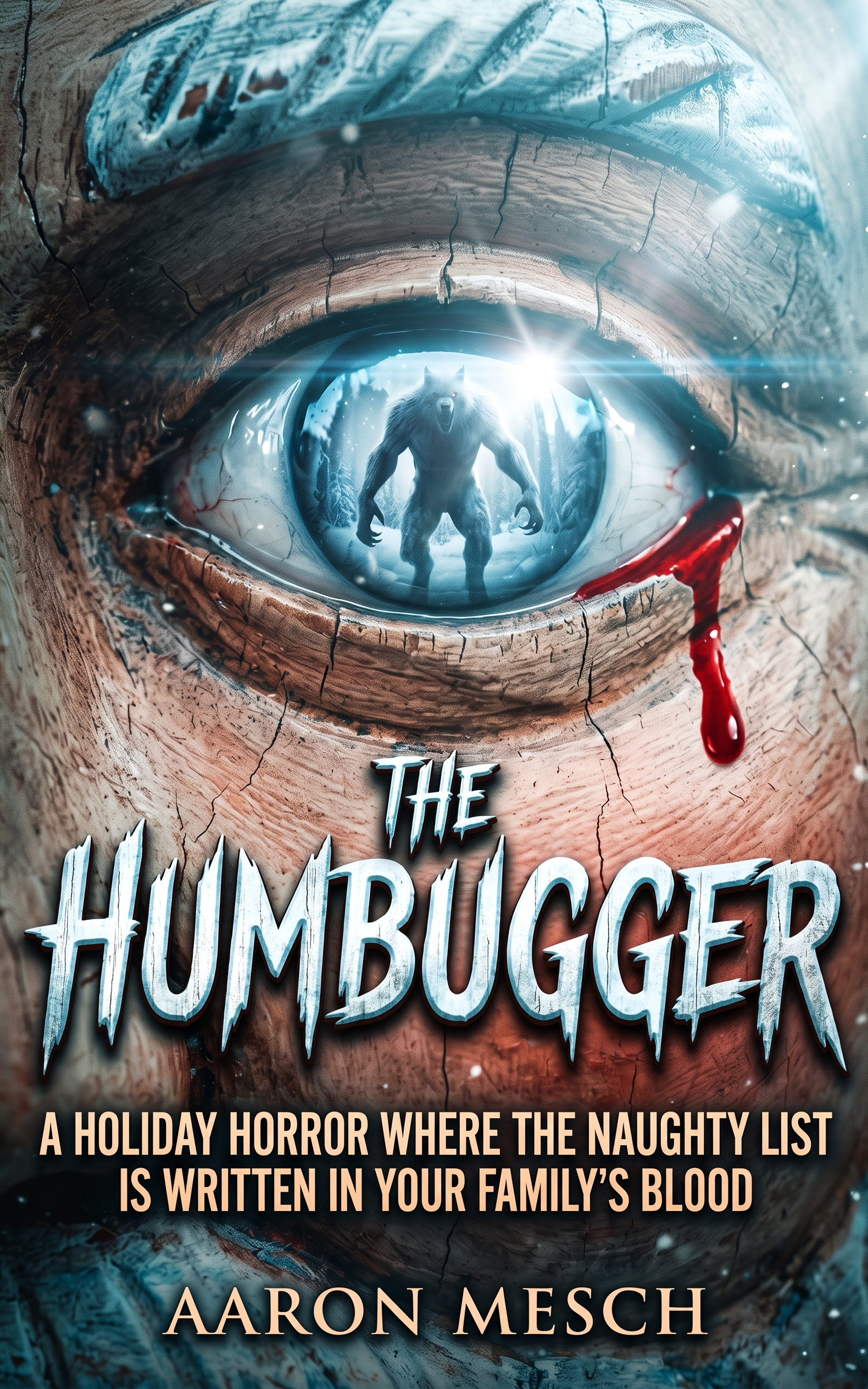
The Humbugger
A holiday horror where the naughty list is written in your family's blood
by Aaron Mesch
Some traditions are better left dead. For ten years, Samantha Rose believed the nightmare was over. Her father, Arthur Wagner, claimed he had destroyed the Humbugger—a sixteen-inch mahogany Santa Claus statue that had terrorized their family for generations. But as Samantha returns to the snow-choked town of Hammerville to settle her father's estate, she discovers that evil doesn't die; it only waits. The Humbugger has returned, and it isn't coming for cookies. Armed with a razor-tipped whip and a centuries-old grudge, the wooden effigy is hellbent on erasing the Wagner bloodline once and for all. But the doll is only the beginning. A local coven, led by a ruthless socialite, is using the Humbugger as a vessel to bridge the gap between worlds. Their goal? To resurrect Fenris, the Ivory Beast—a monstrous werewolf familiar bound to a witch from 1594. Trapped in a supernatural blizzard, Samantha must team up with her estranged father and a skeptical local cop to survive the night. In a brutal showdown against a tiny killer and a towering beast of fur and silver, Samantha will learn that some family legacies are a death sentence. This holiday season, nobody is safe from the whip.
- Thriller
- Paranormal
- Horror
- Psychological Thriller
- Action Thriller
- Cat & Mouse
Homecoming in the Cold
The train brakes shrieked against icy steel, a high, metallic scream that cut straight through the glass and rattled Samantha’s teeth. Outside, the world was a dull, washed-out grey, the kind of grey that felt less like a color and more like an absence of life. Hammerville sat buried under a sky the color of dirty lead, surrounded by pine trees that looked black and dead under the weight of wet snow. She pulled her leather jacket tighter around her shoulders, her fingers tracing the stylized sun tattooed into the sensitive skin of her inner wrist. A reminder of light, of reason, of a world that made sense. Right now, looking out at the rusted tin roofs and decay of her hometown, she needed the reminder.
The passenger car gave a final, violent lurch and came to a halt. A hiss of pressurized air escaped from beneath the carriage, melting a small patch of grime on the platform edge. Samantha stood, hoisting her duffel bag over one shoulder. Her combat boots thudded heavily against the metal floorboards as she walked toward the narrow door. When it folded back, the cold hit her like a physical blow. It was a cruel wind, sharp with the salt of frozen earth and the acrid bite of woodsmoke from chimney flues that hadn't been cleaned in decades. It burned her throat on the first breath, making her cough into her sleeve.
The platform was almost deserted. A single station agent in an oversized grease-stained parka stood near the luggage cart, his face obscured by a woolen scarf wrapped tightly around his chin. He didn't offer a greeting. He didn't even look up as her boots crunched into the thin layer of salt and packed ice covering the wooden planks. Hammerville hadn't changed, except to grow older and more worn down. Ten years ago, the iron lampposts along Main Street had carried bright red banner flags for the holidays. Today, those same posts were rusted spindles, their banners torn to black ribbons that whipped silently in the gale.
Samantha lowered her head against the squall and walked toward the small, concrete rental kiosk near the station exit. The agent inside was a teenager with pimples along his jawline who barely looked nineteen, let alone old enough to rent a sedan. He handed over the keys to a bruised-looking grey Ford with a missing hubcap without saying a single word, pointing a thumb toward the snow-dusted parking lot behind the fence.
The sedan’s engine turned over with a wet, grinding cough before catching. Exhaust billowed white and dense in the rear-view mirror as she threw the gearshift into drive. The heater kicked on, blowing a lukewarm gust of dust and stale air into her face. She adjusted the mirror, catching sight of her own hazel eyes. They looked tired. Four years of modern criminal psychology textbooks and long shifts in quiet university libraries hadn't quite erased the shadow that lived behind her retinas. She had spent half a decade convincing herself that logic was a weapon, that every dark alley contained only men with broken minds, not monsters with wooden heartwood. Coming back here was an exercise in proof. She was going to settle her father’s estate, clear out the clutter, sell the house, and prove to herself once and for all that Arthur Wagner was just an ill man who had traded his sanity for a ghost story.
She turned off the main road onto the old county highway. The pavement quickly gave way to gravel, packed down beneath a layer of ice that made the tires hum a low, continuous pitch. The pine trees crowded close to the lane here, their heavy boughs arching overhead until they blocked out what little grey light the afternoon offered. It was like driving down a throat. Snow swirled in dizzying patterns across the windshield, catches of white static caught in the yellow beams of her headlights.
The iron gates of the Wagner estate were wide open, their hinges locked in place by thick icicles that hung down like crooked teeth. A hand-painted sign that read PRIVATE PROPERTY was barely legible beneath a skin of frost. Samantha slowed the car, turning up the long, winding drive. The tires slipped once, twice, spraying slush into the brush before catching traction again. Through the thick wall of falling snow, the house loomed into view.
It was a massive, sprawling Victorian structure, its dark clapboard siding stained almost black by decades of damp weather. Wrap-around porches sagged under the weight of drifted snow, and the tall, narrow windows stared out at the yard like empty eye sockets. A slate roof crowned the structure, spiked with iron finials that pierced the heavy sky. The house looked less like a home and more like a mausoleum built to hold a secret that refused to stay dead. It felt cold from fifty yards away.
Samantha parked the rental near the steps, leaving the engine idling for a moment while she looked up at the second story. Her father’s vehicle—an ancient, rust-eaten Ford F-150—was parked in the gravel turnaround, covered in a three-inch blanket of fresh snow. That was wrong. Arthur had been explicit in his short, terse letter three days ago. He was supposed to meet her at the station. If not at the station, he certainly should have cleared the drive. He was a man of precise, almost obsessive routine. He didn't leave his truck sitting in the cold to gather snow unless something had gone very wrong.
She killed the ignition. Silence dropped over the car like a heavy wool blanket, thick and suffocating. The only sound was the distant, rhythmic creak of an old oak branch scraping against the third-story gables.
She stepped out of the car, her boots sinking ankle-deep into the powder. The air felt heavy, saturated with a strange, oily stillness that made the tiny hairs on the back of her neck stand up. She hauled her bag out of the back seat and walked up the front steps, each riser groaning under her weight. The front door was heavy oak, reinforced with thick iron bands that her father had installed fifteen years ago after the first "break-in." She reached for the brass handle. It was unlocked. It swung inward with a low, dry whine, revealing the dark hall beyond.
"Dad?" her voice was smaller than she wanted it to be. It flattened out against the dense air inside the house, swallowed instantly by the high ceilings and thick wallpaper.
No one answered. The hall was swallowed in deep shadow. She reached for the light switch beside the jamb and flipped it. Nothing happened. The circuit breaker was either tripped or the storm had brought down the line somewhere down the county road. She pulled a small flashlight from her coat pocket, clicked it on, and swept the narrow beam down the corridor.
The interior smelled wrong. It wasn't just the smell of an old house that had been shut up against the winter—the dry rot, the damp wool, the dust. There was an undercurrent of something sharp and resinous, like freshly cut cedar mixed with the bitter, sour stench of crushed pine needles that had begun to rot in a cellar. The cold inside was different than the cold outside. Out in the yard, the wind moved; it was alive. Here, the cold was stagnant. It felt like stepping into an icebox that had been closed for fifty years.
"Arthur?" she called again, walking deeper into the house. The beam of her flashlight flickered across the walls. The wallpaper was a faded damask pattern, water-stained near the baseboards. Portions of it had been scraped away in long, vertical strips, as if someone had been searching for something hidden behind the plaster.
She passed the dining room. The long mahogany table was empty, covered in a thin skin of grey dust. In the corner, a tall grandfather clock stood dead, its pendulum frozen mid-swing. The air was so cold her breath bloomed in dense, white clouds before her face, lingering in the beam of light like ghost smoke.
She turned down the central hall toward the parlor, where her father had kept his desk. The door was half-open. She pushed it with her foot, the wood scraping against the warped floorboards. The room was a disaster. Hundreds of sheets of paper were scattered across the carpet like fallen leaves. Books with yellowed pages and cracked leather bindings lay open on the side tables, their margins filled with her father’s cramped, frantic handwriting in red ink.
Samantha set her bag down near the armchair and knelt beside the desk. She picked up a handful of loose papers. They were covered in diagrams—hand-drawn maps of the local woods, genealogical trees that stretched back to the late sixteenth century, and long passages translated from Old High German. Across the top of one page, in bold, shaky strokes, her father had written a single name over and over until the ink had bled through the parchment: THE HUMBUGGER.
She let out a short, dry laugh that sounded harsh in the quiet room. "Still at it, Arthur," she whispered to the empty space. "Ten years and you couldn't let it go."
She picked up another page. It was a newspaper clipping from 1914, yellowed and fragile, detailing the mysterious disappearance of three children from a farm three miles north of Hammerville. Beside it was a printout of an old woodcut depicting a tiny, twisted figure holding what looked like a knotted rope or a whip, standing over a kneeling figure in the snow. Her father had drawn heavy black circles around the hands of the figure, drawing small arrows toward tiny, razor-like protrusions attached to the leather straps.
It was classic delusional fixation. As a psychological profile, it was textbook: a traumatized mind creating an elaborate, supernatural narrative to rationalize a personal tragedy or a cognitive break. Her father had lost his wife, lost his standing in the community, and instead of accepting that the world was random and cruel, he had spent a decade building a pantheon out of sixteen-inch carved wood and ancient folklore. It was easier to fight a monster than to admit you were broken.
She tossed the papers back onto the desk. A sudden draft swept through the parlor, making the candle flames—if there had been any—flicker. The loose sheets on the floor rustled, shifting slightly against the floorboards. Samantha stiffened. The wind outside hadn't picked up; she couldn't hear it against the heavy shutters. Yet the air in the room moved, cold and dry, smelling again of that bitter, rotting pine.
Then she heard it.
It was a sound so soft she almost mistook it for the settling of the floorboards or the contraction of the frozen beams overhead. A quick, dry shhhk-shhhk-shhhk. Like fingernails drag across heavy parchment. Or claws dragging through drywall.
She held her breath, her eyes scanning the dark corners of the parlor. The sound stopped the moment she moved her head. Silence returned, heavier now, pressing against her eardrums with an almost painful density.
"Mouse," she said aloud, her voice tight. "Just a rodent in the lath."
She picked up her duffel bag and walked out of the parlor, her flashlight beam cutting a yellow swath through the hall. She headed toward the stairs that led to the second floor, where her old bedroom was located. Every step on the wooden risers produced a sharp, metallic creak that echoed up into the dark well of the house. The air grew colder as she climbed, each breath burning her lungs like swallowed glass.
Her childhood room was at the far end of the upper corridor. The door was closed. She reached out, her fingers cold against the iron latch, and pushed it open. The room was exactly as she had left it five years ago when she cleared out her things for college. The white iron bed frame was bare, its mattress stripped and covered in a plastic sheet. A small bookshelf held a few forgotten textbooks and a porcelain horse with a broken ear. The air in here was even colder than the hall, so freezing that a thin glaze of frost had formed on the inside of the windowpanes, obscuring the view of the yard below.
She dropped the duffel onto the bare mattress with a heavy thud. Dust rose in the flashlight beam, dancing lazily in the frigid air. She unzipped the bag and began pulling out her clothes—thick wool sweaters, extra pairs of socks, a small leather-bound notebook she used for her own research. She needed to focus on the task. Find the deeds, check the safe in the basement, sign the power of attorney documents if Arthur had left them, and get out of Hammerville before the snow buried the roads entirely.
Shhhk-shhhk-shhhk.
Samantha stopped. Her hand hovered over the zipper of her bag. The sound was back. It wasn't coming from the ceiling or the floor. It was coming from the south wall—the wall directly behind the headboard of her bed.
She turned her flashlight toward the wall. The wallpaper here had a pattern of pale blue roses, faded to grey by time. Nothing moved. The surface was flat and solid. But as she watched, the sound shifted. It moved six inches to the left, then stopped. It sounded like something very small, with very hard points, dragging itself through the narrow space between the interior lath and the exterior pine siding.
"Hello?" she called out, feeling foolish. "Arthur?"
The scratching paused. Then, with a sudden, jerky rhythm, it started again, moving rapidly upward toward the molding near the ceiling. Shhhk-shhhk-shhhk-shhhk. It was fast—too fast for a rat. It had a strange, wooden cadence to it, like wooden pegs being tapped against hollow timber.
Samantha took three steps toward the wall, her boot heels clicking on the bare floor. She raised her hand, her knuckles white, and tapped twice on the wallboard. "Get out of there."
Instantly, three sharp knocks answered her from the exact spot she had touched. Tock. Tock. Tock. Solid. Precise. Not an echo. A response.
A cold jolt ran down her spine, pooling in her stomach like lead. Her heart gave a sudden, hard thump against her ribs. "Okay," she muttered, stepping back. "Okay. That’s a pipe. Thermal expansion."
She backed away from the bed, keeping the beam of her flashlight fixed on the blue roses. The scratching began again, but this time it wasn't staying in the south wall. It moved along the junction where the wall met the ceiling, traveling with an impossible, fluid speed toward the door. Shhhk-shhhk-shhhk. It passed directly over her head. She swung the light up, the yellow beam catching only the cracked plaster and old paint peeling in long strips.
The sound reached the north wall, then dropped vertically toward the baseboard near the doorway. It was following her. Every time she took a step, the sound shifted, positioning itself so that it remained precisely six feet away from her, hidden behind the lath and plaster.
Samantha pulled her leather jacket tighter around herself, her breathing coming faster now, thin white plumes of moisture puffing into the dark. "This is ridiculous," she said, her voice shaking slightly despite her best efforts. "It’s old wood. It’s the storm."
She walked briskly out of the bedroom, her boots striking the floorboards with loud, deliberate thuds to drown out the noise. But as she moved down the upper hallway, the scratching followed. It was in the floor now, directly beneath her feet. Shhhk-shhhk-shhhk. It kept pace with her stride, pausing when she paused, accelerating when she accelerated. It felt as if something small was crawling through the joists right beneath the soles of her boots, separated from her skin by only two inches of aged pine.
She reached the top of the stairs and stopped. The hallway below was pitch black, a deep, swallowing void that her flashlight barely dented. The smell of rotting pine was stronger here, thick enough to make her nostrils sting. She looked down at the dark landing, then back toward her room. Nothing was there. Just the quiet, freezing air and the faint sound of her own rapid breathing.
She lowered her light toward the window at the end of the second-story hall. The glass was covered in heavy frost, but the lower pane was clearer, where the heat from her hand had briefly melted a circle through the ice when she had passed it earlier. She walked toward it, driven by a sudden, desperate need to see the outside world—to see the grey light, the snow, anything that belonged to the rational world she had left behind in the city.
She looked down into the yard.
The snow was falling heavier now, long white ribbons drifting through the dark pines. Her rental car sat where she had left it, its grey roof covered in a fresh layer of white. The entire lawn was a smooth, unbroken blanket of snow, stretching from the porch steps to the tree line sixty yards away.
Except for the center of the lawn.
Standing near the old stone well—a small, dark shape against the vast white expanse—was a figure. It was small, no taller than a man’s knee. It wore a coat the color of dried blood, trimmed with dirty, matted wool that looked like the fleece of a winter-starved sheep. A tall, conical cap rested on its head, tilted slightly to one side. It stood perfectly still, facing the house, its shadow cast long and thin across the snow by the faint glow of the car's remaining tail light.
Samantha’s throat locked. Her fingers tightened around the flashlight until the metal bit into her palm. She squeezed her eyes shut, counted to three, and opened them again.
The figure was gone.
The space near the well was empty. There was no rustle of snow, no sound of movement over the wind. But the snow was no longer smooth. Leading away from the well, in a straight, impossibly neat line toward the front porch, was a track of small, deep depressions. Tiny, boot-shaped prints, no larger than three inches long, pressed clean into the fresh powder. There were no incoming tracks. They simply began at the well and marched with terrifying purpose straight toward the steps of the house.
Samantha’s breath hitched. A heavy, physical weight seemed to settle onto her shoulders, a pressure so dense it felt as if the ceiling itself were lowering toward her skull. The hair on her arms stood up, prickling under her leather sleeves. The sensation of being stared at was so intense it felt like a cold blade pressed against the back of her neck.
Behind her, inside the hall, three feet away from where she stood, came a small, wooden sound.
Tock. Tock. Tock.
Samantha turned, her flashlight beam swinging wildly through the dark. The hall was empty. The doors to the empty rooms stood half-open like slack jaws. But down at the far end, near the stairs, a single, dried pine needle drifted down from the dark molding near the ceiling, settling softly onto the floorboards.
She didn't run. Her training—her four years of repeating that fear was a physiological response to misinterpretation—held her feet to the floor for five long seconds. But her fingers were shaking so violently that the beam of the flashlight danced across the damask wallpaper like a frantic eye. The silence in the house had changed. It wasn't empty anymore. It felt full, crowded with an intent that was sharp, focused, and ancient.
She began to descend the stairs, her boots taking two steps at a time now. The wood groaned under her weight, the sound harsh and metallic in the frozen air. Halfway down, she stopped again. The air in the lower hall was thicker now, smelling so strongly of old cedar and copper that it left a greasy taste on the back of her tongue.
"Arthur?" she called out again, but her voice was a dead thing, dropping to the floor without resonance. "If you're down here... if this is some kind of sick..."
She didn't finish the sentence. On the small side table near the front door, where her father had always kept his keys, something was sitting. It hadn't been there when she walked in fifteen minutes ago. The dust on the table surface had been disturbed, swept aside in a small, circular patch.
It was a piece of wood. A small, splintered shaving of mahogany, no longer than a matchstick, curling up from the dark varnish of the table. Beside it was a single, tiny droplet of liquid that hadn't yet frozen. It was dark, almost black in the yellow light of her beam, thick and glistening.
Samantha reached out, her hand moving against her own will, her index finger hovering a fraction of an inch above the stain. She could feel the faint heat radiating from it—a strange, unnatural warmth that didn't belong in this dead house. It smelled of sulfur and wet dog hair.
A sudden, heavy thud sounded from the kitchen down the back hall—the sound of a heavy cast-iron skillet falling from its hook and smashing onto the floorboards. It was followed immediately by the rapid, fluttering sound of dozens of small wooden points skittering across the linoleum, like a hundred teeth dropped on ice.
Samantha didn't look back. She lunged for the front door, her hands slapping against the cold iron hardware. The latch was stiff, frozen fast by the air, but she threw her shoulder against the heavy oak with a muffled grunt. The wood gave way with a loud crack of breaking ice, and she tumbled out onto the porch into the blinding, freezing grey of the afternoon storm.
The wind screamed around the gables, whipping her hair across her face as she scrambled down the steps. She slipped on the second riser, her knee slamming into the ice-covered wood, but she didn't feel the pain. She forced herself up, her combat boots churning through the deep snow as she sprinted toward the grey sedan.
She tore the driver’s door open, threw herself inside, and slammed it shut, instantly hitting the lock buttons. The central locking mechanism engaged with a series of sharp, metallic clicks that felt entirely inadequate against the vast, white silence of the property.
Her hands were trembling so badly she could barely get the key into the ignition. On the third try, the metal bit into the slot. She twisted it. The engine cranked—once, twice, a sluggish, freezing whine—then roared to life. She slammed her foot onto the gas pedal, throwing the gearshift into reverse. The tires spun on the ice, spraying gravel and slush against the underside of the floorboards, before catching traction and pulling the car backward down the long drive.
She kept her eyes locked on the front porch through the sweep of the windshield wipers. The front door of the Wagner house remained wide open, a black, rectangular hole in the grey facade. Standing on the top step, right where the snow met the porch floorboards, were the tiny boot prints. They didn't move. They didn't lead inside. They simply ended at the threshold, two small, dark notches in the white skin of the world, waiting.
Samantha pulled out onto the county road, the tires screaming as they grabbed the asphalt, and didn't look back until the tall pines swallowed the house whole.
The car’s heater blew lukewarm air onto her face, but she couldn't stop shivering. Her inner wrist burned, the skin beneath the sun tattoo throbbing with a dull, rhythmic pulse that matched the fast, panicked beat of her heart. She looked down at her right hand on the steering wheel. Her knuckles were white, her skin blue from the cold.
And on the sleeve of her leather jacket, clinging to the dark hide near the cuff, was a single, small pine needle. It wasn't green. It was black, dry as ash, and smelled of cedar and old blood.
She flicked it off her arm onto the floorboard, her mouth dry, her mind racing through four years of diagnostic criteria, searching for a name for what she had just seen—a delusion, an auditory hallucination brought on by cold and emotional stress, a stress response to her father’s abandonment. But the words felt thin, paper-dry and useless against the cold truth that was currently sitting in the floorboard of her car.
Hammerville hadn't changed. It had just been waiting.
The road ahead was a grey ribbon disappearing into the white static of the blizzard. She turned off the county highway toward the town square, her mind fixing on one single, concrete detail: the police station on Main Street. Ryan Foster was there. Ryan was real. He had a gun, a badge, and a brain that didn't care about centuries-old Germanic folklore. He was logic in a blue uniform, and right now, she needed logic more than she needed air.
She pressed her foot deeper into the accelerator, the engine whining as the sedan plowed through the rising drifts. Behind her, deep in the dark woods that lined the road, the pine branches bowed down under the weight of the snow, their black needles scraping together in the gale with a sound that sounded terrifyingly like laughter.
The drive into town felt longer than it should have. The storm had intensified, the wind driving the snow in horizontal sheets that plastered the front windshield until the wipers could only clear two small, triangular arcs of glass. The streetlights along the outer limits of Hammerville were dark, their bulbs shattered or their wiring dead. The houses she passed were set far back from the road, dark shapes buried in drifts, no lights showing in any of the windows. It was only four in the afternoon, but the sky had collapsed into a bruised, purple night that seemed to draw the cold deeper into the earth.
When she finally pulled up to the curb outside the Hammerville Municipal Building, the sedan’s engine gave a final, wet hiccup and died. She sat for a moment in the dark car, listening to the metal of the engine block contract with sharp, ticking sounds. The heater stopped blowing, and within seconds, her breath was visible again, hovering before her face in the dark cabin.
She grabbed her bag, shoved the car door open against the wind, and stepped out into the blizzard. The town square was a wasteland. The old gazebo in the center of the park was choked with six feet of snow, its wooden decorative railings cracked and hanging like broken ribs. Across the street, the windows of the general store were boarded up with plywood, fresh spray paint scrawled across the wood in dark red letters: CLOSED TILL SPRING.
She ran up the concrete steps of the police station, her boots crunching through the salted slush. The glass double doors were thick, reinforced with wire mesh. She grabbed the handle and pulled. The door swung open with a muffled chime, and she stepped into the small, overheated lobby.
The air inside smelled of stale coffee, floor wax, and damp wool. A single radiator in the corner clanked and hissed, spitting small jets of steam against the yellow plaster wall. Behind the high counter, sitting at a desk littered with incident reports and empty paper cups, was Ryan Foster.
He looked older than she remembered. His hair was cropped short, his shoulders broader under the navy blue uniform shirt, but he had the same square, dependable jaw and the small, faded scar on his chin from high school. He was staring at a computer monitor, his brows furrowed in concentration, his hand hovering over a half-eaten sandwich.
When the door chime rang, he looked up, his hand going instinctively toward his belt before he recognized her. His hazel eyes widened, and he stood up so fast his chair rolled backward against the filing cabinet with a loud thud.
"Sam?" he said, his voice flat with surprise. "What the hell are you doing here?"
Samantha stood in the middle of the lobby, her leather jacket dripping melted snow onto the linoleum floor. Her hair was damp, plastered to her forehead, and her face was pale, her cheeks flushed bright red from the wind. She looked at him—at his solid, uniform chest, at the heavy service weapon in its leather holster, at the neat, orderly stacks of paper on his desk—and for a second, she couldn't speak. The words felt too big, too crazy, too impossible to drag up her throat.
"Sam?" Ryan stepped around the counter, his boots clicking on the floorboards. He reached out, his hand hovering near her shoulder as if he were afraid she might break if he touched her. "Are you okay? You look like you just saw a..." He stopped himself, his mouth tightening into a thin line.
"My car died," she said, her voice dry and thin. "The heater gave out."
"Your dad’s place?" he asked, his eyes searching her face. "Is Arthur with you?"
"He’s not there," she said. She walked over to the radiator, her fingers unzipping her jacket with numb, awkward movements. She held her hands out over the hissed iron, letting the warm air hit her frozen skin. "He wasn't at the station. He wasn't at the house. His truck is covered in three inches of snow, Ryan. He’s been gone since yesterday at least."
Ryan let out a long breath, rubbing the back of his neck. "Yeah. That sounds like Arthur. He hasn't been into town in three weeks, Sam. Not since the first frost."
"He left the front door wide open," she said, turning to face him. Her hazel eyes were sharp now, fixed on his with a desperate, probing intensity. "The house was dead cold. And there were... the papers in his parlor..."
"The folklore stuff?" Ryan sighed, stepping back toward his desk. "Sam, your dad’s been filing reports with us for six months. Weird stuff. He called three times last week claiming someone was cutting down his pine trees along the south boundary. Said they were leaving 'signs.' I went out there on Tuesday. There was nothing. Just some broken boughs from the ice storm."
"It wasn't just papers, Ryan," she said, stepping away from the radiator. Her voice was dropped low now, urgent, cutting through the hum of the overhead fluorescents. "There was something in the walls."
Ryan froze, his hand resting on the wooden counter. He looked at her for a long second, his expression shifting from concern to something cooler, more professional. The cop face. "In the walls? Like a squirrel? Old houses get red squirrels in the insulation this time of year, Sam. They make a hell of a noise."
"It moved," she said, her chest heaving slightly under her sweater. "It followed me from room to room. It was... it knocked back when I tapped on the drywall."
Silence fell over the small lobby, broken only by the rhythmic clank-clank-clank of the steam radiator. Ryan didn't laugh. He didn't smile. He just stared at her with those steady, literal-minded eyes, his brow furrowed.
"Sam," he said gently, taking a step closer. "You've been driving for eight hours in a blizzard. You went into a house where you haven't lived in five years—a house where your mother died, where your dad has been losing his mind for a decade. Your mind is playing tricks on you. It’s the storm. It’s stress."
"There were footprints in the yard," she hissed, her fingers clenching into fists. "Tiny boots. No track coming in. Just starting at the old well and walking straight toward the front porch. I saw them, Ryan. I saw them from the second-story window."
Ryan’s expression didn't change, but his shoulders tightened. He looked down at the floor, then back up at her. "Okay," he said, his voice soft, the tone you use with someone standing near the edge of a high ledge. "Okay. Let’s sit down. I’ll get you some coffee."
"I don't want coffee!" she snapped, her voice cracking in the quiet room. "I want you to come out there with me. I want you to check the house. Arthur is missing, Ryan. He might be hurt. He might be out in the woods."
"I can't leave the station right now, Sam," he said, pointing a finger toward the radio console behind his desk. "The main line to the county seat is down. Half the power grid in the west precinct is blown out. We’ve got three trees down on Route 9 and a jackknifed tanker near the lumber yard. I'm the only unit on duty until eight tonight."
"Ryan, please," she said, the sarcasm and defense mechanisms slipping away, leaving her voice raw. "Something is wrong with that house. Something is... wrong with this town."
Ryan looked at her for a long moment, his eyes softening. He reached across the counter and laid his large, warm hand over her icy fingers. "Look at me," he said firmly. "You're safe here. Arthur is probably down at Reyes's place. You know how he gets when he starts researching—he goes down to the Historical Society and locks himself in the basement with Louis for three days at a time. He’s done it before."
Samantha stopped. "Louis Reyes?"
"Yeah," Ryan said, releasing her hand. "The old curator. Arthur’s been spending half his time down there lately. Louis told me last week they were working through some old land deeds from the 1600s. I’ll call the Society on the landline. If Arthur’s there, I’ll have Louis bring him over."
He walked behind the counter, picked up the black plastic receiver of the station landline, and dialed a three-digit extension. He held it to his ear, his eyes fixed on the front window where the snow was slamming against the glass in heavy sheets.
Samantha turned back toward the radiator, her heart still hammering against her ribs like a trapped bird. She looked at her inner wrist—at the stylized sun tattoo, its lines neat and dark against her skin. Logic, she reminded herself. Reyes is a historian. Arthur is obsessed with history. He’s at the library. He’s not dead in a ditch. He’s just an old man with a library card and a broken mind.
"No answer at the Society," Ryan said, dropping the receiver back onto the cradle with a heavy clack. "Line’s probably down from the ice. But Louis lives in the apartment right above the archives. He doesn't go anywhere in a storm like this."
"I'm going down there," Samantha said instantly, pulling her jacket back over her shoulders.
"Sam, it’s six blocks through four feet of snow," Ryan said, frowning. "Your car is dead."
"Then I’ll walk," she said, her combat boots already moving toward the double doors. "I'm not sitting in this lobby waiting for the lights to go out."
"Hold on," Ryan grunted, grabbing his heavy wool police coat from the rack near the door and throwing it around his broad shoulders. He grabbed a heavy three-cell Maglite flashlight from his desk and slid it into his belt loop. "I'm not letting you walk around Hammerville alone in a blizzard. If the chief asks, I'm doing a precinct sweep."
He pushed open the door, stepping out into the howling gale. Samantha followed close behind him, the freezing wind instantly cutting through her clothes, but the presence of his heavy, blue-clad frame beside her felt like a shield. They walked down the center of Main Street, their boots sinking deep into the untracked powder. The town was entirely black now—no house lights, no neon store signs, no streetlamps. Only the vast, white roar of the storm and the two narrow beams of their flashlights cutting through the dark like yellow knives.
The Hammerville Historical Society was housed in a two-story red-brick building that had once been a bank in the late nineteenth century. Its high, narrow windows were dark, protected by heavy iron grilles that looked like security bars. A steep flight of stone steps led up to the double oak doors, which were carved with intricate, geometric patterns that had been worn smooth by a hundred years of rain and snow.
Ryan took the steps two at a time, his flashlight beam sweeping over the snow-covered landing. "Louis!" he yelled, his voice swallowed instantly by the wind. He reached the top and pounded three times on the thick wood with his gloved fist. "Louis! It’s Foster! Open up!"
No one answered. The wind whistled through the iron grilles of the lower windows, a high, thin sound like a pipe organ playing a single, endless note.
Ryan tried the handle. It was locked tight. He pulled a key ring from his pocket—the master set for the town’s municipal buildings—and sorted through them until he found a long, brass skeleton key. He slid it into the lock, turned it with a heavy, metallic thunk, and pushed the door open.
They stepped inside, slamming the heavy door behind them against the gale. The sudden quiet was deafening. The air inside the Historical Society was thick, dry, and warm—heated by an old oil furnace in the basement that seemed to be the only thing in Hammerville still working. It smelled of old paper, vinegar, leather binding, and the sweet, heavy scent of floor wax.
"Louis?" Ryan called out, his flashlight beam bouncing off the high glass display cases that lined the central hall. Inside the cases, dark artifacts sat on velvet pads—19th-century farm tools, rusted iron horseshoes, yellowed photographs of stern-faced men in high collars, and glass jars containing preserved seeds.
Samantha walked down the central aisle, her boots leaving wet, dark prints on the faded Oriental rug. The building felt old, but unlike her father’s house, it felt preserved, curated, safe. Books were arranged in neat, vertical rows on tall oak shelves that stretched to the ceiling. A rolling library ladder sat near the rear, its brass wheels dull with age.
"In the back," a voice said from the shadows near the research desks.
Samantha jumped, her hand going to her wrist. Ryan swung his flashlight toward the source of the sound.
Louis Reyes was standing beside a long mahogany reading table, a heavy silver candlestick in his hand. The flame flickered wildly in the draft from the front door, casting long, jumping shadows across his thin, weathered face. He was in his early sixties, thin and stooped, wearing a worn corduroy blazer with leather elbow patches over a grey wool vest. His white hair was wild, sticking out in wisps around his wire-rimmed spectacles, which sat crooked on his sharp nose.
"Ryan," Louis said, his voice dry and scratchy, like dry leaves tumbling down a street. He adjusted his glasses with a trembling finger, his eyes shifting past the officer to lock onto Samantha. "And... my goodness. Samantha Rose. You've grown. You have your mother’s chin."
"Louis," Samantha said, stepping forward. "Is my father here?"
The old archivist looked at her for a long, silent moment. The candle flame bounced in his pupils, making his eyes look huge behind the thick lenses. He didn't answer immediately. Instead, he turned and set the heavy candlestick down on the table, next to a pile of massive, leather-bound folios that lay open, their pages covered in dense, hand-written Latin and German script.
"Arthur is not here, my dear," Louis said softly, his voice dropping an octave. "Arthur hasn't been here since yesterday morning."
"Where did he go?" Ryan asked, taking a step closer, his hand resting casually on his leather belt. "His truck is at the house, Louis. The front door was wide open. Sam was worried."
"He went to the ridge," Louis said. He didn't look at Ryan; his eyes stayed fixed on Samantha, full of a strange, scholarly pity that made her blood run cold. "He went to check the markers. He was sure the ground was softening, despite the frost. He said... he said the salt lines had broken at the north boundary."
"Salt lines?" Ryan spat, shaking his head. "Jesus, Louis. You're encouraging him? The man is sick. He needs help, not more of these goddamn fairy tales."
"They are not fairy tales, Officer Foster," Louis said with sudden, sharp precision. His thin voice held a cold, academic authority that made Ryan stop mid-stride. "They are history. History that this town has spent three hundred years trying to cover up with gravel and pine trees."
Louis reached down and turned one of the massive folios toward them. The yellowed page was covered in an intricate copperplate engraving from the late sixteenth century. It depicted a small, dense village surrounded by a high wooden stockade. Beyond the stockade, in the black woods, stood three figures: a tall woman in a black cloak holding a wooden staff, a massive, dog-like beast with pale, white fur standing on its hind legs, and at her feet, a tiny, knee-high figure in a pointed cap, its arms raised toward the village walls.
Samantha stepped up to the table, her hazel eyes scanning the Latin text beneath the image. Her four years of university hadn't included sixteenth-century occult Latin, but she recognized the dates. 1594.
"Abagail Wolff," Louis murmured, his finger tracing the carved lines of the cloak. "The coven leader who brought the old ritual from the Black Forest to the settlement that would become Hammerville. She didn't come alone. She brought her familiars. The spirit bound to the ivory beast... and the carven vessel."
"The vessel," Samantha whispered, her voice barely audible over the hum of the radiator in the corner.
"The mahogany effigy," Louis said, turning his face toward her. The candlelight caught the thick wire rims of his glasses, obscuring his eyes in white glare. "Sixteen inches of seasoned wood, carved in the image of the old winter gift-giver—the Pelznickel, the fur-clad Nicholas. But it was no gift-giver. It was a conduit for her spite. A vessel built to hunt down the bloodlines of those who betrayed her to the magistrates."
"This is crazy," Ryan said, though his voice lacked conviction now. He looked around the dark library, at the high shelves that seemed to lean inward toward the candle, as if the thousands of dead pages were listening. "Louis, she’s traumatized. Arthur is missing. We don't need a history lesson about witches."
"Your father didn't destroy it ten years ago, Samantha," Louis said softly, ignoring Ryan entirely. "He thought he did. He burned the chapel, he smashed the physical vessel into splinters, he buried the heartwood in silver wire beneath the cellar floorboards. But you cannot kill a curse by breaking the wood. You only release the spirit back into the earth... where it waits for someone to carve it a new home."
Samantha reached out, her hand touching the margin of the open book. The paper was dry, brittle, cold as stone. "Why now?" she asked. "Why after ten years?"
"Because the bloodline came back," Louis said simply. He looked at her wrist, at the stylized sun tattoo peeking out from beneath her leather cuff. "The entity cannot complete the tether without the blood of the line that bound it. Arthur’s blood is thin, old, poisoned by fear. But yours..." He paused, his mouth twitching slightly. "Yours is fresh. Clear. It is the final key."
A sudden, violent crash exploded from the front of the building.
The heavy oak front doors—the ones Ryan had locked with the skeleton key—were slammed inward with a force that sheared the heavy iron deadbolt clean out of the frame. The doors burst wide, splintered wood raining across the entry rug as a massive gust of snow and howling wind roared into the central hall, extinguishing Louis’s candle instantly.
Darkness plunged over the library, absolute and suffocating, saved only by the narrow, bouncing beams of Ryan’s Maglite and Samantha’s flashlight.
"Freeze!" Ryan screamed, his service weapon clear of its holster before the dust had even settled, his two-handed grip dead-stable as he aimed down the central aisle toward the shattered doorway. "Police! Put your hands where I can see them!"
Nothing stood in the open doorway. Only the grey, swirling static of the blizzard, blowing five-foot drifts of snow across the rug, covering the velvet-lined display cases in a skin of white powder.
Then, from the darkness high above their heads—from the narrow walkboards of the second-story book stacks—came a sound.
Shhhk-shhhk-shhhk.
It was fast, fluid, a wooden skittering that traveled along the dark pine railings with terrifying speed. It passed directly over Ryan’s head, moving toward the rear of the library where the ancient folios lay open on the mahogany table.
Samantha swung her flashlight up. The yellow beam cut through the swirling dust and snow, catching a split-second glimpse of something moving along the top shelf. It was small—knee-high—clad in a dark, stained red coat that looked like rotten velvet. A pair of tiny, white-bearded jaws snapped shut in the light, and two eyes—not human eyes, but cold, polished glass spheres that caught the beam—flashed a dull, terrible crimson.
In its right hand, it held a small, knotted length of black leather, tipped with tiny, gleaming points of rusted steel that clicked against the wooden shelves as it ran.
"Ryan!" Samantha shrieked, grabbing his arm and pulling him backward toward the heavy mahogany desk.
A high, thin screech—like rusted iron scraping across glass—echoed through the high ceilings of the library. The small figure dropped from the top shelf, falling twelve feet through the dark with impossible grace, its tiny boots landing on the mahogany reading table with a sharp, heavy THUD that cracked the three-hundred-year-old wood straight down the center.
The candle holder clattered to the floor, rolling away into the dark. In the beam of Ryan’s Maglite, the sixteen-inch figure stood tall, its red cap tilted, its wooden face carved into a wide, frozen grimace of grotesque holiday cheer. Its small, carved hands were white, tipped with razor-sharp brass nails, and the dark coat it wore was stiff with old, dried blood.
"What the fuck is that?" Ryan screamed, his finger tightening on the trigger of his Glock.
"Don't look at the eyes!" Louis’s voice rose from the darkness behind them, shrill with terror. "Don't look at the glass!"
The tiny wooden figure raised its small, leather-wrapped whip. The dark straps uncoiled with a dry, snake-like hiss. With a movement so fast it blurred in the yellow flashlight beam, the whip snapped through the air—a sharp, metallic CRACK that split the cold air of the library like a rifle shot.
The glass of the heavy display case six feet behind Ryan shattered into ten thousand glittering pieces, showering the floor in crystal sharp splinters.
Samantha pulled her leather jacket close, her hazel eyes locked on the tiny, red-clad monster standing on the broken table. The skepticism, the textbooks, the four years of rational psychological explanations vanished from her mind, stripped away by the raw, primal reality of the dark room and the blood-stained whip.
The Humbugger was real. It was here. And the night had only just begun.
The Empty Trunk
The dark timber stairs groaned under Samantha’s boots as she ascended toward the third-floor attic. Each step felt heavier than the last, the air growing progressively colder and thicker with the sharp, resinous stench of ancient pine and dusty copper. Her flashlight’s yellow beam sliced through the darkness, illuminating thick cobwebs that hung li…