

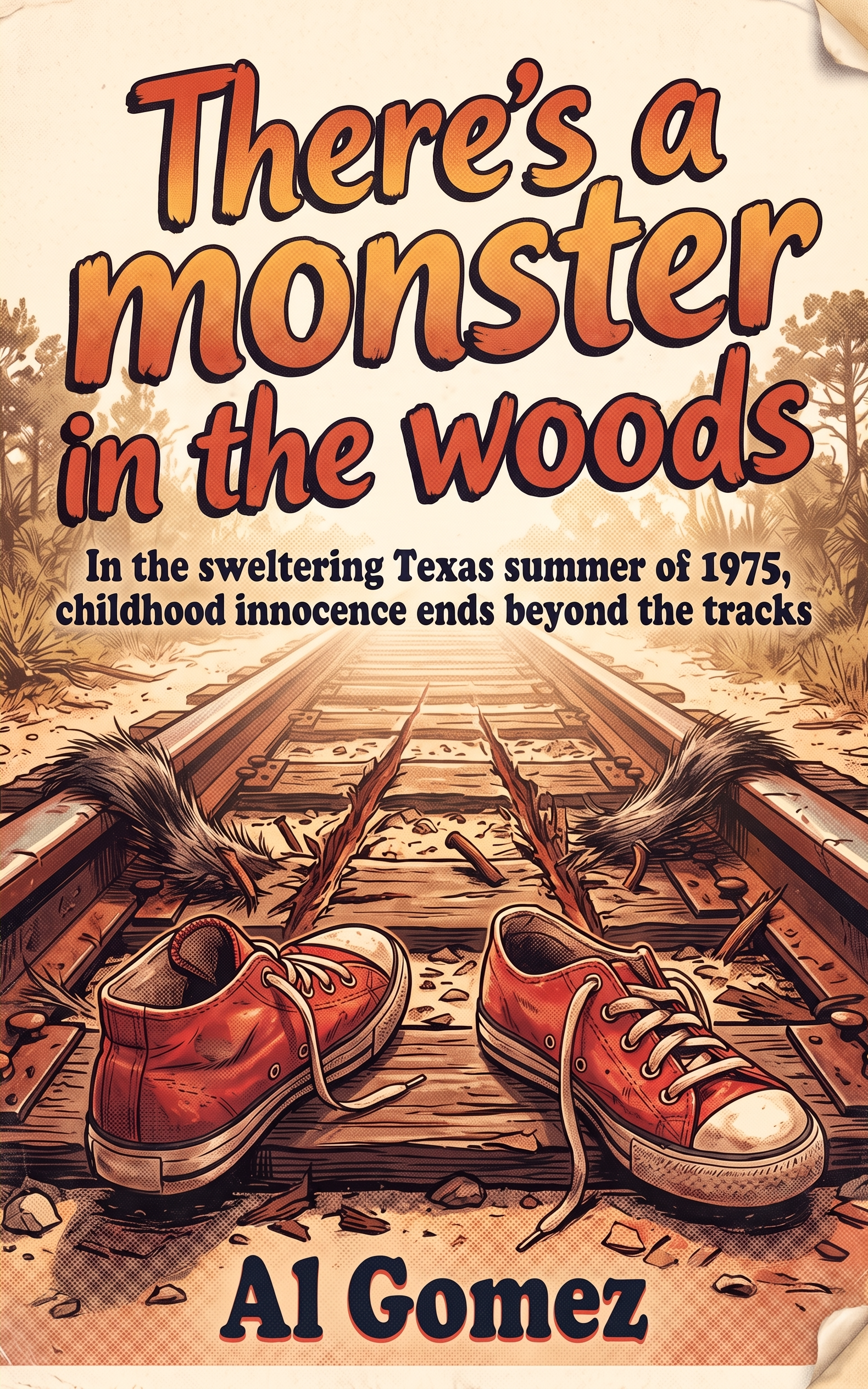
There's a monster in the woods
In the sweltering Texas summer of 1975, childhood innocence ends beyond the tracks
by Al Gomez
Rockdale, Texas, June 1975. The air is thick with suffocating heat, the drone of cicadas, and whispers of something savage lurking across the Missouri Pacific railroad tracks. Twelve-year-old Junior already has his hands full navigating his estranged father's tense visit while fiercely protecting his adventurous little brother, Jimmy. But when mutilated livestock and unnerving claw marks appear along the forbidden woodline, summer boredom turns into a daring quest. Joined by four neighborhood boys fueled by restless bravado, Junior and Jimmy cross the sun-baked rails into the impenetrable pine scrub. What begins as a boyish adventure swiftly unravels into sheer terror. Deep inside the sweltering thicket, they uncover evidence of an apex predator far deadlier than any ghost story. As twilight gathers and long shadows swallow the woods, the boys find themselves relentlessly hunted toward a collapsed trestle over a jagged ravine. To survive the night, they must face down the beast that stalks them and the fragile boundaries of youth itself. Heartfelt, chilling, and vividly nostalgic, There's a monster in the woods is an unforgettable coming-of-age adventure about brotherhood, courage, and the monsters that lurk in the shadows of memory.
- Literary Fiction
- Adventure
- Coming of Age
- Southern Fiction
- Small Town Drama
- Exploration
Baking Steel and Whispers
The heat came first, before the light even settled proper over Rockdale, and by eight in the morning it had already turned the air into something you could almost see, something that shimmered above the tin roofs and the dead St. Augustine grass like a held breath. I sat on the porch steps and watched my father load his suitcase into the trunk of his rental sedan, a gray Buick that looked out of place against our gravel drive, too clean, too much like something from Houston or Dallas or wherever it was he lived now.
He didn't say much. He never did. He folded his good shirts over his arm and laid them flat like he was tucking in a child, and I watched him do it because I didn't know what else to do with my hands or my eyes. Five years since he'd gone, and here he was for three days, smelling like Aqua Velva and cigarettes, calling me "son" in that clipped way that never quite landed right.
"You're the man of the house now, Junior," he said, not looking at me, tightening the trunk latch. "Look after your brother."
I nodded because that was easier than anything I might have said. The screen door banged behind me before I could feel sorry for myself too long, and Jimmy came tearing out onto the porch in his oversized striped shirt, both fists closed around something, his hazel eyes lit up like the Fourth of July.
"Junior, look, look at this," he said, and opened his hands to show me a fistful of cicada husks, brittle and hollow, clinging together like dead leaves. "I found a whole nest of 'em out by the fence line. And Junior, I seen something. This morning, before you woke up. Something big, moving through the trees past the tracks."
"You didn't see nothing," I said, though I said it soft, the way you talk to a dog that's already spooked.
"I did too. It knocked clean through Mr. Kessler's fence wire like it wasn't nothing. I heard it snap from all the way at the creek."
Our father shut the trunk with a hard clap of metal and looked over at us both, and for a second I thought he might come sit on the steps and ask Jimmy more about it, might laugh the way fathers in movies laughed, might do something. Instead he checked his watch and said he had to get back on the road sooner than he'd planned, something about beating the traffic through Waco, something about a meeting Monday he couldn't miss. He hugged Jimmy quick and hard. He shook my hand like I was already a grown man and not a boy who'd turned twelve in April. Then the gray Buick pulled out of the drive and down Ackerman Street, and the dust settled behind it, and just like that we were on our own for the day, same as most days, only heavier somehow, like the house itself had let out a breath.
I didn't cry. I want that understood. I just watched the road a while after the car had gone, and Jimmy watched me watching, and neither one of us said anything about it.
"Come on," I told him. "Let's go see what Brian's doing."
We walked the gravel road with the sun already flattening everything white, past the Nelsons' dead garden, past the ditch where the grass had gone the color of a paper sack. Brian and Britt were out by the Millers' old fence post, Brian kicking gravel with the toe of his sneaker and Britt sitting cross-legged in the shade whittling a stick of cedar down to a fine point with his pocketknife, curls of pale wood dropping into his lap.
"Hey, Junior," Brian said, and then he caught sight of Jimmy's fistful of cicada shells and grinned that crooked, chipped-tooth grin of his. "What's all this, Jimmy, you playing with bugs again?"
"I ain't playing," Jimmy said. "I seen something out past the tracks this morning. Big as a cow, moving through the pines. Tore clean through Kessler's fence."
"Tore through the fence," Brian repeated, laughing loud enough that a mockingbird took off from the fence post. "Prob'ly just old man Kessler's bull got loose again. You're gonna wet your pants over a dumb cow, Jimmy."
"It wasn't no cow. It moved wrong. Cows don't move like that."
"Cows don't move like what? You're nine years old talking about how cows move."
Jimmy's face went red and his mouth started working before any words came out, the way it did when he was fixing to cry out of pure frustration, and I was about to step between them when Britt spoke up without even looking up from his knife.
"Leave him be, Brian. You know good and well Kessler's fence has been down since before the Fourth. Man never fixes anything unless my stepdaddy does it for him." He flicked a curl of cedar off his knee. "Something's been getting into the stock lately, though. My uncle Delbert lost two goats last week over by the river bottom. Coyotes, probably. Or a big cat come down from the hill country on account of the drought."
"See," Jimmy said, brightening some. "I told you it wasn't nothing normal."
"I didn't say it wasn't normal," Britt said, flat and even, the way he always talked, like he was reading off a grocery list. "Coyotes are plenty normal. Just hungry ones."
Brian rolled his eyes and spat into the dirt, but he didn't say anything more, and I figured that was as close to a truce as we were going to get. We started walking again, the four of us, toward the tracks, because that was where the day always ended up taking us whether we planned it or not, like the rails had some kind of pull.
Andy caught up to us before we made the crossing, running full out with his shirt untucked and a folded stack of newspaper clippings clutched against his chest like it might blow away in wind that wasn't even blowing.
"Y'all gotta see this," he said, out of breath, his face shiny with sweat. "My daddy gets the Cameron Herald, and there's been stuff happening all over the county. Two weeks now. Look."
He held out the clippings, damp at the edges from his hand. Britt took them first, squinting at the smudged print while he kept his knife moving on the cedar out of habit.
"Cattle found torn up out past Gause," Andy said before Britt could even finish reading. "And a dog missing from a farm on Highway 79, and Mrs. Yarbrough's hogs, three of 'em, found dead with the fence just ripped open like paper. It's been going on since the middle of the month. It ain't just one story. It's a pattern."
"Coyotes don't rip fences," Britt said, but there was something less certain in the way he said it now, and I noticed it even if he didn't want me to.
"It ain't coyotes," Andy said. "My daddy said the game warden come out and looked at the Yarbrough hogs and didn't have nothing to say about it. Just packed up and left. That don't sound like coyotes to me. That sounds like somebody don't want to say what it really was."
Brian snorted. "It sounds like you readin' too many funny books, Andy."
"I ain't making it up. It's in the paper." Andy's voice cracked a little, and I felt for him, the way his eyes darted around like he expected something to come charging out of the ditch weeds right then. He was scared plain through, and trying so hard not to show it that it showed all the more.
We reached the crossing where the Missouri Pacific line cut through the scrub, the steel rails throwing back the sun so hard it hurt to look at them straight on. Heat came up off the ballast in waves you could watch move, like water. And there, sitting on an overturned bucket near the signal post, was Ricky, sweating through his chambray shirt, watching us the way he always seemed to watch everybody, like he already knew what we were fixing to do before we did it.
"Y'all stay on this side," Ricky said, not even standing, his voice low and rough as gravel underfoot. "Ain't safe over yonder right now."
"Why not?" Jimmy asked, still clutching his cicada shells.
Ricky looked past us, across the tracks, to where the pines stood up dark and close together, a wall of green-black that swallowed the light whole just a few yards past the tree line. "Drought's pushed things out of the river bottom that don't usually come this far up," he said. "Things get hungry, they get bold. Best you boys remember that."
"What kind of things?" Andy asked, leaning forward, his clippings still in his hand.
Ricky's watery gray eyes moved to Andy, then to me, and he didn't answer right off. He took his time, the way he always did, like words cost him something to spend. "Kind you don't need to go looking for," he said finally. "Just stay on this side of the rail."
I looked across the shimmering steel to the timber beyond, to the place where the heat made the tree line waver like it was breathing, and something cold moved through me despite the sun beating down on my neck. Jimmy pressed close to my side without either of us saying anything about it, and for once he didn't argue or ask another question. He just stood there, his cicada shells forgotten in his hand, staring same as me at the dark wood across the tracks, waiting to see if it would stare back.
Across the Creosote Line
We met behind the old icehouse a little after noon, when the sun sat dead center over Rockdale and even the shade had gone the color of scorched paper. The icehouse hadn't held ice in twenty years, not since the Sanders family shut it down, and the tin roof ticked and groaned in the heat like something alive and suffering. Brian was already there w…