

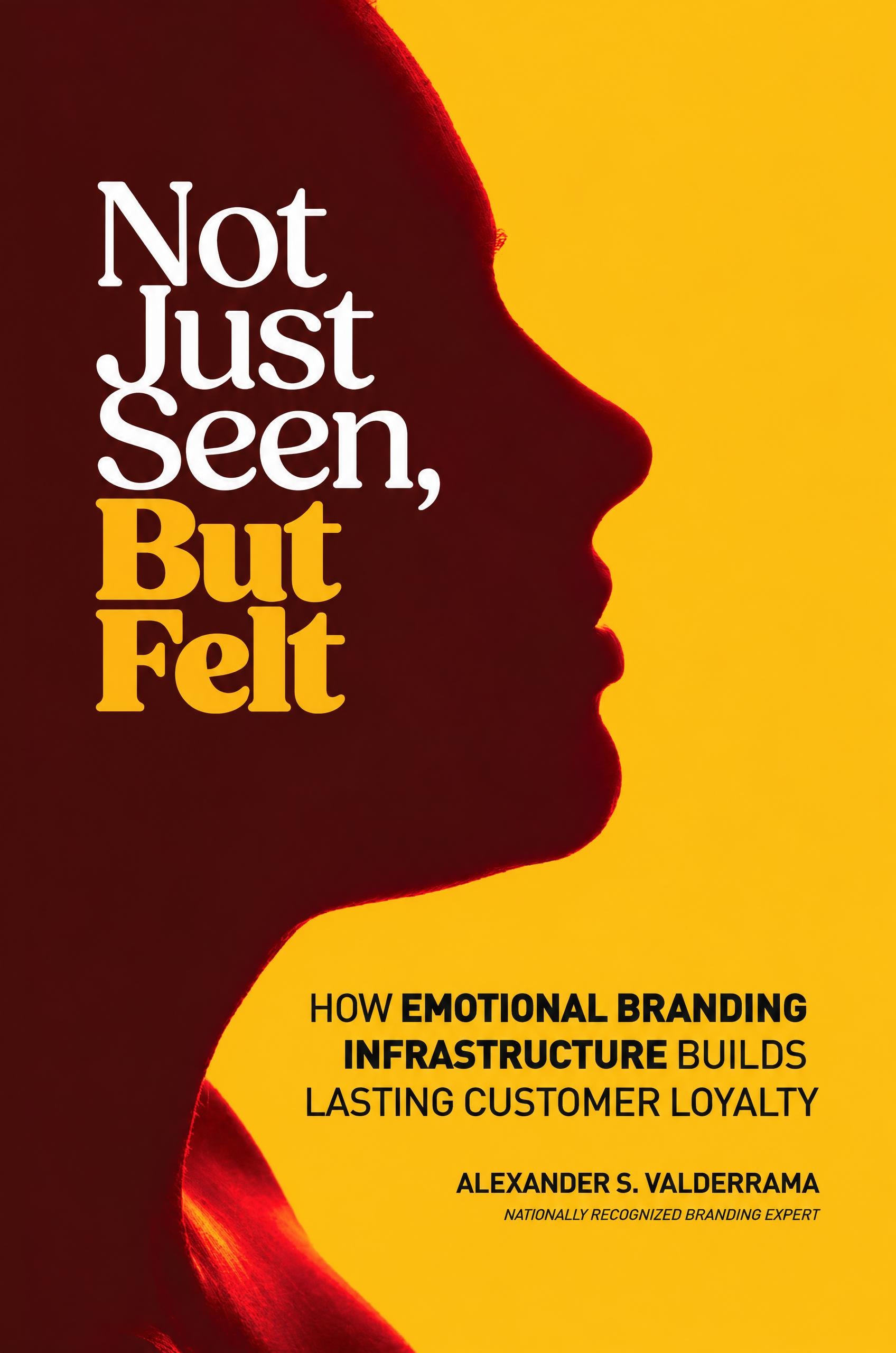
Not Just Seen, But Felt
The Emotional Branding Infrastructure That Turns Customer Experience into Lasting Loyalty
Not Just Seen, But Felt The Emotional Branding Infrastructure That Turns Customer Experience into Lasting Loyalty Your customers recognize your brand. They see your advertising, visit your website, interact with your employees, and encounter your products and services. But do they feel connected to you? In a marketplace crowded with competing messages, familiar brand names, and increasingly sophisticated technology, attention is no longer enough. Customers can recognize a brand without trusting it, understand its value without preferring it, and purchase its products without feeling any lasting connection. The difference lies in how a business makes people feel. In Not Just Seen, But Felt, brand and growth executive Alex Valderrama explores how neuroscience, psychology, and behavioral science can inform a more meaningful approach to brand building. He introduces the Emotional Branding Infrastructure, a framework for turning emotional connections from a marketing objective into a system that guides how an entire business operates. You will discover how to: Understand the emotional needs, motivations, and identities that influence customer decisions. Create brand stories that connect with customers' real lives and aspirations. Align employees, leadership, operations, and customer experience around a clear emotional promise. Use sensory experiences and meaningful touchpoints to strengthen brand recognition and memory. Build authenticity, measure emotional resonance, and protect customer trust when things go wrong. Turn emotional connection into a foundation for customer loyalty, advocacy, and sustainable growth. This is not simply a book about creating better marketing. It is about building a better business around the people it serves. The goal is not simply to be seen. It is to be felt.
- Business & Entrepreneurship
- Science & Technology
- Educational & Academic
- Self-Help
- Marketing & Sales
- Business Strategy
Introduction
The return to the human center as a competitive edge
I have spent decades in boardrooms, strategy sessions, research reviews, brand audits, creative workshops, and many corporate rebranding efforts with some of the most recognized companies in the world. Across those years, I have seen several major recessions, market shifts, accelerating innovation, and increasingly complex consumer expectations. I have worked with organizations of immense scale and alongside companies still working to shape their identity, including work connected with major Fortune 500 brands such as IBM Watson Health, Microsoft, and Wells Fargo, and also with a wide range of growth-oriented businesses navigating change, expansion, and relevance in competitive markets.
Through all of it, one truth has remained remarkably stable.
People do not place their trust in brands simply because a message is echoed repeatedly. They do not remain loyal because a product is functional, because a campaign is visible, or because a company has mastered the mechanics of promotional campaigns. Those things matter, and they always will. Yet beneath every metric, every click, every conversion, and every quarterly report lies a far more consequential question:
"How does a brand make people feel, and what emotional meaning does it leave behind?"
That question is the foundation of this book.
For most of modern business history, branding was seen primarily as a visual or verbal symbol. It was all about the logo, the color scheme, the catchy tagline, or the clever campaign. It was tied closely to advertising reach and market recognition. In many companies, branding lived in the visual assets and messaging, while marketing focused on communicating value, sales worked on closing deals, operations handled delivery, and leadership aimed for growth. Each of these parts often did its job well, but they didn’t always feel perfectly in sync with each other.
What was frequently missing was a deeper understanding that a brand is not simply what a company says about itself. A brand is what a human being comes to feel, remember, expect, and believe after repeated encounters with that company.
That difference is not semantic. It is strategic.
Over the past several decades, the practice of branding has evolved from presentation to perception, from awareness to meaning, and from communication to relationship. In the early eras of mass marketing, customer reach carried extraordinary power. If a company could dominate attention, it could shape preferences. The business growth itself created legitimacy. Familiarity could be mistaken for attachment. Consistency in media placement often mattered more than emotional consistency in lived experiences.
Embrace change.
Cable fragmented audiences. The internet decentralized information. Online search shifted power to the consumer. Social platforms opened a constant feedback loop between brands and their audience. Mobile technology collapsed time and space. Ecommerce transformed the path to purchase. Data systems made behavior increasingly measurable. Performance marketing brought precision and accountability. Marketing technology expanded the ability to personalize communication. And now artificial intelligence is reshaping the speed, volume, and sophistication with which content, insight, and interaction can be produced.
Each of these developments has delivered real advantages. Each has made business more agile in some respects. Each has also made the competition more crowded, more noisy, and more emotionally demanding.
"Today, a brand may be visible everywhere and still mean very little."
A company may generate enormous amounts of content and still fail to create trust. A leadership team may know more about customer behavior than at any point in history and still misunderstand what actually drives attachment.
This is where many branding strategy efforts begin to fracture.
Organizations become highly efficient at automating and scaling outputs, but not always at building resonance. They master business tools before mastering meaning. They improve audience targeting before improving coherence. They accelerate communication before clarifying identity. They automate responses when the deeper opportunity is to build emotional relationships.
"I do not say this as a critic standing outside the discipline. I say it as someone who has spent a lifetime inside it."
I have seen companies invest heavily in advertising while under-investing in emotional clarity. I have watched teams celebrate major spikes in engagement while subtle trust erosion was taking shape beneath the surface. I have seen brand strategies that looked compelling in presentations but failed in practice because the customer experience did not confirm the brand promise. I have also witnessed extraordinary business transformation when leaders stopped asking how to market more aggressively and started asking how to matter more deeply to their customers.
That is the turning point.
The future of branding does not belong to organizations that merely communicate more. It belongs to organizations that understand the human emotions of their customers on the other side of the communication. It belongs to companies that recognize every purchase, every interaction, every message, and every moment of service is interpreted not only through logic, but through emotion, memory, and context, that is sincerely felt.
In other words, the future of branding belongs to those who return to the human center as a competitive advantage.
From traditional branding to an emotional branding infrastructure
The story of how brands develop and adapt is fascinating because it is still being written. Over time, I have watched branding evolve from a discipline focused primarily on recognition into a strategic business function focused on relevance, relationships, and ultimately, emotional connection. This evolution did not happen overnight. Each stage emerged in response to changes in technology, culture, consumer behavior, and the growing complexity of the marketplace. Understanding these stages matters because Emotional Branding Infrastructure is not a rejection of traditional or modern branding. It builds on what came before while taking the role of the brand much further.Traditional branding: made us recognizable
Traditional branding was largely built around recognition and controlled communication. Companies controlled most of the conversation. They communicated with customers through one-way, mass-market channels such as newspapers, magazines, billboards, radio, television, direct mail, packaging, and print advertising. The objective was relatively straightforward: create awareness, establish recognition, communicate a value proposition, and persuade people to buy. The visual identity was often at the center of the effort. The logo, colors, typography, packaging, advertising, and tagline were designed to create a recognizable presence in the marketplace. The messages themselves tended to emphasize functional benefits: price, quality, performance, convenience, features, and availability. If the product worked well and the company communicated its advantages effectively, the assumption was that customers would respond. Customers were largely receivers of information. Companies spoke, and customers listened.Trust was built primarily through what the company said about itself and the consistency of its products and communications. The brand lived largely in mass advertising, packaging, and other communications the company controlled. But the marketplace began to change. Information became easier to access, and competition increased. Search costs declined. Consumers gained more choices and more ways to compare products. Simply being recognizable was no longer enough. A brand could be known without being preferred. It could be visible without being meaningful. And it could communicate a promise without necessarily delivering an experience that supported it.
Modern branding: made us relevant
Today, the majority of businesses are here. The rise of digital technology has fundamentally changed the relationship between brands and customers. Communication was no longer primarily one-way; customers could respond, review, recommend, criticize, share, compare, and create their own content. Social media, search engines, online communities, review platforms, influencers, mobile technology, and digital commerce gave customers an unprecedented voice.Modern branding evolved in response. The focus shifted from simply being recognized to being relevant. Brands needed to understand their audiences more deeply and participate in ongoing conversations rather than simply broadcast messages. Customer experience became increasingly important. So did authenticity, transparency, purpose, personalization, community, and cultural relevance.
A brand was no longer experienced only through an advertisement. It was experienced through a website, social media post, sales conversation, customer service interaction, product, mobile app, store, employee, delivery experience, online review, and countless other touchpoints.
The challenge became consistency in the brand message. If marketing promised one thing but customer service delivered another, the brand experience fractured. If a company claimed to care about its customers but made decisions that suggested otherwise, customers noticed. If employees did not understand or believe the brand promise, they could not consistently deliver it. Modern branding therefore expanded the role of the brand from a communications tool into a broader customer experience system. That was a significant evolution. But there was still a fundamental limitation. Many organizations were managing touchpoints without fully aligning the operational business behind them. They were making the brand consistent across channels, but consistency alone does not create connection. A brand can look consistent everywhere and still feel meaningless. That is where the next evolution begins.
Emotional branding infrastructure: made us feel
"Emotional Branding Infrastructure" takes the branding evolution one step further.
It begins with a simple but profound idea - If a business wants customers to develop lasting emotional relationships with its brand, the brand emotion cannot live only in marketing. It has to live throughout the business. This is the fundamental difference.
Traditional branding asks - How do we make people recognize us?
Modern branding asks - How do we remain relevant and create a consistent experience across customer touchpoints?
Emotional Branding Infrastructure asks - What do we want customers to feel about us, and how do we build the entire organization to consistently create that feeling? That changes the role of branding completely.
We will delve into this much deeper throughout this book.
Every part of the organization has a role. Marketing and advertising are only two pieces of the system. The evolution in branding with research and neuroscience discoveries has led us to this phase of emotional brand strategy. This is why I have termed it the Emotional Branding Infrastructure. The infrastructure is the underlying system that makes something possible and sustainable. In the same way that a building depends on an underlying structure that customers may never see, an emotionally connected brand depends on an underlying business infrastructure that consistently produces the desired emotional experience. That infrastructure extends across the entire organization. It includes leadership, culture, employees, product development, operations, sales, marketing, customer experience, technology, customer service, policies, processes, communications, and every other internal or external function that can influence how a customer experiences the brand. The goal is not to make every department behave identically. The goal is to make every department understand the emotional promise of the brand and contribute to delivering it in its own way.
Traditional branding made brands recognizable.
Modern branding made brands relevant and connected across experiences.
Emotional Branding Infrastructure makes the desired brand emotion part of how the entire business operates.
The ultimate goal is not simply to be seen. It is to be felt.
From market share to meaning
There was a time in business when scale and distribution could compensate for weak emotional depth. Shelf presence could create momentum. Media dominance could create a sense of inevitability. Repetition could build familiarity that functioned almost like loyalty.
That era is over.
Consumers today live in a state of persistent brand exposure. Thousands of advertising signals compete for their attention every day. Their inboxes are full. Their feeds are full. Their search results are full. Their senses are saturated. In such an environment, visibility alone no longer secures preference. It may secure a momentary glance. It may create a brief impression. But the brands that earn a place in people’s lives do something far more enduring.
They create meaning.
Meaning is what turns recognition into relevance.
Meaning is what transforms a mere transaction into a long-term relationship.
Meaning is what allows a brand to survive comparison, competition, and commoditization.
When a brand acquires emotional meaning, it becomes easier to remember, easier to trust, and easier to choose. People begin to experience it not simply as a provider of goods or services, but as a source of need, reassurance, identity, aspiration, belonging, confidence, and relief. This is when branding moves beyond market activity and enters the emotional senses.
That shift has enormous implications for leaders.
It means that brand building is not only the work of external company communication. It is also the work of internal brand alignment. It means that the quality of the customer experience is not separate from the brand strategy. It is the proof of the brand strategy. It means that a company cannot claim one emotional position while repeatedly delivering another. The human mind is always comparing promise to experience. When the gap becomes too wide, trust begins to weaken.
For this reason, emotional branding is not a cosmetic layer applied to a business model. It is not superficial sentiment added to a campaign after the strategic work is done. It is a disciplined approach to building brands that can form durable, emotionally encoded relationships with the people they serve.
To understand how that happens, we must begin with a more basic truth about humans.
People do not experience the world as detached analysts. They experience it as individuals who use cognition to interpret, justify, organize, and sometimes defend what they feel.
This is why two brands offering similar products at similar prices can produce radically different levels of customer loyalty.
This is why a customer may remain with a brand after a mistake if trust has already been established, while abandoning another brand after a minor disappointment if that deeper emotional bond does not exist.
This is why certain brand names carry emotional weight, while others remain generic.
This is why branding, at its deepest level, is a matter of human connection.
The great misunderstanding in modern marketing
One of the most persistent misunderstandings in marketing is the assumption that rational persuasion is the primary engine of decision-making. Features matter. Price matters. Convenience matters. Evidence matters. They are important and often decisive at the surface level. But they do not tell the full story of why people choose, why they return, why they advocate, or why they resist.
People often explain their decisions in rational language because rational language is socially acceptable and cognitively available. It sounds credible. It sounds intelligent. It provides a coherent narrative. Yet many of the underlying forces that determine choice between competing brands begin before conscious explanation takes shape. These underlying forces emerge from emotional appraisals of safety, risk, familiarity, reward, fit, and meaning.
A brand that feels trustworthy will often be judged more favorably, even when competing features are close.
A brand that evokes confidence can reduce perceived complexity.
A brand that signals belonging can become part of a person’s self-story.
A brand that triggers uncertainty or inauthenticity can lose the relationship long before a customer can fully articulate why.
This is not irrationality in the simplistic sense. It is human cognition that is functioning as it has always functioned. The emotional brain evaluates preferences quickly.
For marketing professionals and business leaders, this demands a broader understanding of brand strategy. If we build only for conscious evaluation, we miss the systems that govern felt experience. If we optimize only for efficiency, we may unintentionally remove the very cues that create comfort, warmth, trust, and recognition. If we focus only on immediate acquisition, we may neglect the emotional conditions that sustain lifetime customer value.
The strongest brand and marketing strategies understand that their role is not simply to deliver information. Their role is to shape emotionally meaningful experiences that the mind can encode as relevant, coherent, and worthy of trust.
Why this matters more in the age of artificial intelligence
It is impossible to write about branding today without addressing artificial intelligence and soon to be super intelligence.
We are entering a new era in which organizations can generate content at scale, synthesize market data rapidly, automate interactions, personalize messaging, accelerate creative development, and model consumer behavior with remarkable speed. AI is not a passing novelty. It is a structural shift in how work will be done, how communication will be produced, and how marketing systems will operate.
This change is real. It is significant. It is already altering many companies and their strategic brand disciplines.
Yet every major technological shift brings with it a dangerous illusion. The illusion is that better tools automatically create better customer relationships.
They do not.
AI can help produce marketing content, but it cannot determine on its own what is emotionally true.
AI can improve customer segmentation, but it cannot decide what a brand should stand for in human terms.
AI can accelerate ideation, but it cannot replace wisdom, empathy, moral judgment, or lived strategic experience.
AI can predict patterns, but it cannot feel the cost of betrayal, the weight of trust, or the power of belonging.
The more content the market produces, the more discerning people become about what feels authentic.
The more advertising is personalized, the more important it becomes that the emotional experience behind it is coherent.
The more synthetic communication fills the environment, the more valuable genuine human resonance becomes.
The rise of AI does not diminish the importance of emotional branding; it magnifies it.
In a world where almost any company can generate polished content, quick visual assets, and seemingly intelligent interactions, the true differentiator will not be technical fluency alone. It will be the ability to create emotionally credible relationships. The future will favor brands that combine technological innovation with human depth. Efficiency will matter. Intelligence will matter. Speed will matter. But none of them will compensate for a brand that feels shallow, inconsistent, opportunistic, or emotionally disconnected from the people it claims to serve.
AI will change many things.
It will not change the fact that people still want to feel understood.
It will not change the fact that trust is still earned through consistency.
It will not change the fact that meaning cannot be mass-produced without intention.
It will not change the architecture of the human nervous system, where emotions are hard-wired.
And that brings us to the heart of this chapter.
The human brain was never built for brands, yet it bonds with them
Think about this. No one is born wanting a particular airline, bank, technology platform, retail experience, or healthcare provider. We are not biologically designed to crave logos. We are not evolutionarily wired to seek taglines. And yet, over time, many people form deep attachments to certain brands. They defend them. They recommend them. They forgive them. They identify with them. In some cases, they feel enormously betrayed when those brands change, drift, or disappoint.
Why does that happen?
It happens because brands, when we experience them repeatedly and coherently, can become associated with emotional outcomes the brain learns to value and trust.
A parent who feels reassured by a healthcare brand during a frightening moment does not remember only the information provided. That parent remembers the feeling of being calmed.
A business leader who relies on a technology partner during a crisis does not remember only the features. That leader remembers the restoration of confidence.
A customer who feels seen, respected, and understood in a service interaction does not remember only the transaction. That customer remembers the emotional quality of the exchange.
When those experiences are repeated, a pattern forms. The pattern becomes an expectation. Expectation becomes trust. Trust becomes attachment.
This is not magic. It is not manipulation. It is the natural and behavioral result of how the human brain assigns emotional value to repeated experiences.
At the center of this process sits a set of interconnected neural systems, often referred to collectively as the limbic system. Though the term is sometimes used loosely in popular conversation, it remains a helpful way to describe the networks involved in emotion, memory, motivation, salience, and relational significance. These systems help determine what really matters, what feels safe, what should be remembered, and what should be approached or avoided.
This is where branding becomes far more than communication.
A brand that consistently evokes relief, confidence, belonging, aspiration, or security is not simply sharing a message. It is participating in emotional learning.
A brand that repeatedly creates confusion, distance, tension, or disappointment is also participating in emotional learning, although not in the way that it intends.
The limbic system does not respond primarily to what a company claims. It responds to what an experience signifies and makes them feel.
That distinction is essential.
The limbic system and the emotional logic of brand attachment
To understand emotional branding, we must understand a basic principle of neurobiology. The brain is constantly evaluating the environment for significance. In rapid and mostly nonverbal ways, it asks questions such as these:
- Is this safe?
- Is this familiar?
- Is this rewarding?
- Is this threatening?
- Does this fit what I need?
- Does this support who I believe myself to be?
- Should I move toward this or away from it?
These questions are not asked in sentence form, of course. They are embedded in perception, sensation, memory, and affective appraisal. Much of this work occurs quickly before conscious reflection fully organizes it into language. By the time a person says, “I trust this brand,” “This company just feels different,” or “Something about this doesn't sit right with me,” a great deal of emotional processing has already taken place.
It is important to remember that within the limbic system, several functions are especially important for branding.
Emotional salience
The brain does not remember everything equally. It does an amazing job of prioritizing what seems important. Emotion substantially increases the significance of the experiences. Interactions that create tension, relief, delight, belonging, pride, or anxiety are more likely to be encoded in our minds much stronger than emotionally neutral interactions.
For brands, this means that emotional tone is not secondary to memory. It is one of memory’s strongest organizing forces.
If a company creates moments that feel meaningful, the brand is more likely to be remembered.
If those moments are repeated, the emotional association becomes more durable.
If the emotional association is coherent across many touchpoints, the brand gains psychological weight.
Associative memory
A brand's meaning is not stored in a neat, isolated box. Meaning is built associatively. A brand name becomes linked with prior feelings, prior outcomes, prior expectations, prior symbols, and prior experiences.
This is why a single visual cue, sound, phrase, or experience can trigger a much larger emotional response than its surface content would suggest. The cue is activating an associative network.
When a brand has spent years signaling confidence, reliability, or innovation through consistent experience, even a small encounter can reactivate those associations.
When a brand has a history of confusion or inconsistency, the same principle applies. The emotional residue remains available.
Reward and anticipation
Part of emotional bonding involves learned anticipation. When people come to expect a rewarding or reassuring outcome from a brand, they begin to approach that brand with reduced friction. The brain starts predicting value before the full experience unfolds.
This is one reason why trusted brands lower perceived decision difficulty. The customer is not starting from scratch. The emotional system has already formed an outcome.
That outcome is powerful. It can influence attention, interpretation, patience, and loyalty.
Threat detection and trust
For brand development, trust is not a vague abstraction. It is deeply connected to the reduction of uncertainty and the lowering of perceived threat. When a brand feels coherent, transparent, competent, and consistent, it reduces the brain’s need for defensive vigilance. When a brand feels unpredictable, manipulative, or misaligned, the opposite occurs.
This is one reason why even a small misstep in tone, behavior, or experience can have great consequences. Our minds are highly sensitive to cues of inconsistency. A single moment that suggests deception, indifference, or misalignment can completely disrupt the emotional construct of the relationship.
In branding terms, trust is often lost faster than it can be built because the systems that protect us are designed to respond quickly to possible threats.
Identity and social meaning
Brands do not live only in personal perception. They also function in many social spaces. People use brands, consciously and unconsciously, to express affiliation, aspiration, taste, status, ethics, and belonging. Some brands become part of the way individuals communicate who they are, who they are becoming, and where they believe they belong.
This means that emotional branding is not only about private feeling. It is also about personal identity and social belonging. A brand that aligns with a person’s values or desired self-perception can take on significance far beyond the functional category it occupies.
The limbic system is deeply involved in this process because identity itself is emotional. Belonging is emotional. Exclusion is emotional. Pride is emotional. Shame is emotional. Recognition is emotional. Brands that enter these territories do so with great power and great responsibility.
A brand is a pattern of felt experience
One of the simplest and most important truths in this field is this: a brand is not a message. A brand is a pattern of felt experiences.
The communication matters because it can shape expectations.
The visual design matters because it can shape perception.
The brand strategy matters because it can shape direction.
But the relationship is built through experiences.
Now consider how this works in practice. A company declares that it stands for care. Yet its customer service feels rushed, its interfaces are confusing, its language is cold, and its follow-through is inconsistent. The stated value may be care, but the felt pattern is indifference.
Another company declares that it stands for innovation. Yet every interaction introduces unnecessary complexity, and the customer leaves feeling uncertain, unsupported, and fatigued. The stated value may be innovation, but the felt pattern is anxiety.
A third company says less. It simply shows up clearly, behaves consistently, solves problems with empathy, and leaves the customer feeling more capable and more secure after each interaction. Over time, this brand develops real emotional equity because its pattern of felt experience is consistent and coherent.
This is what separates symbolic branding from emotional branding.
Symbolic branding manages representation.
Emotional branding manages what is felt.
The first can attract attention.
The second can build attachment.
The executive implication
For business leaders, this perspective changes the role of the brand entirely.
Brand is not a department.
Brand is not a campaign.
Brand is not a visual identity package.
Brand is not a slogan.
Brand is a trust system.
It is the cumulative emotional interpretation of how the brand behaves across all events.
This means brand strategy cannot be delegated exclusively to marketing while the rest of the enterprise operates independently of the brand promise being made. If emotional bonding is created through repeated patterns of experiences, then every function matters. Product matters. Service matters. Culture matters. Hiring matters. Leadership language matters. Sales behavior matters. Response time matters. The quality of an apology matters. The ease of use matters. The follow-up matters. Silence matters.
In my experience, some of the most expensive mistakes companies make occur when they believe branding can compensate for operational incoherence. It cannot. Creative excellence may momentarily elevate the customer's perception. Media investment may temporarily amplify brand awareness. But when the customer experience contradicts an emotional promise, the nervous system quickly registers the mismatch. The customer may not always be able to describe it verbally with technical precision, but the overall feeling remains. Something does not align. Something feels off. Something cannot be trusted.
By contrast, when an organization aligns its internal emotional brand with its external promise, the brand gains enormous force. The customer experiences not just communication, but confirmation. This is one of the deepest roots of loyalty.
Why build an emotional branding infrastructure?
Some leaders hear the phrase emotional branding and assume it refers to sentimentality, soft messaging, or aesthetic visual warmth. That is a narrow and often misleading interpretation.
Emotional branding is not about making every touchpoint inspirational.
It is not about forcing heartwarming narratives into categories where they do not belong.
It is not about abandoning logic or substance.
It is not about decorating a weak strategy with emotional language and content.
Emotional branding infrastructure is the disciplined practice of understanding which feelings drive trust, relevance, and preference for your customers, then building a coherent business system that repeatedly delivers those feelings through authentic experiences. Additionally, integrating this into every single facet of your business is also critical.
For some brands, the dominant emotional need may be reassurance.
In others, it may be confidence.
In others, it may be empowerment, dignity, momentum, pride, or belonging.
The task of the business leader is not to manufacture emotion generically. The task is to understand which emotional outcomes matter most to the people you serve and why.
This requires intense research, interpretation, and corporate strategic maturity. It requires listening beyond stated preferences. It requires recognizing that customers often describe their functional needs while behaving according to their emotional ones. It requires understanding the current cultural environment in which meaning is made. And it requires the humility to accept that a brand cannot declare its emotional role unilaterally. It must earn that role through lived emotional experiences.
My own journey to this work
I did not arrive at these convictions through theory alone. I arrived at them through decades of studying and observing the gap between what organizations intend and what people actually feel.
I have watched leadership teams devote immense energy into articulating their communication while underestimating the interpretation.
I have seen companies with very strong offerings struggle because their emotional signals were scattered or nonexistent.
I have seen promising brands stall because they were speaking in capabilities language when they needed to speak to human stakes.
When company leaders start connecting their brand positioning closely to the emotional core of what they do, things tend to click into place. Communication naturally becomes clearer because the true essence of the brand becomes more obvious. Customers tend to have a better experience because they understand the emotional promise behind the brand a bit better. And internally, the culture often gets more aligned because everyone finally has the words to describe what the brand is really trying to bring to the lives of its customers. It’s like everything falls into place when you connect those dots.
This is one reason I have remained deeply committed to the human aspect of branding. It is not an optional perspective. It is the center of my work.
As markets become more complex, the need for human clarity increases.
As tools become more sophisticated, the need for emotional wisdom increases.
As businesses execute faster, the need for human trust becomes even more urgent.
What's next?
The premise is simple, though its implications are profound.
Brands become powerful when they are encoded not only in awareness, but also in emotion, memory, and identity.
That encoding should not be accidental. It should be shaped by how the human brain processes trust. Trust is reinforced through consistency. It is weakened through contradiction. It is intensified by experience.
In the chapters that follow, we will examine this process with precision. We will look at how emotional meaning is formed, how trust is built across repeated interactions, how memory shapes preference, and how leaders can intentionally create brand systems that align with their customers' needs.
We will also return again and again to the limbic system. Not as a metaphor, but as a crucial framework for understanding why people bond with brands, why they remember, why they attach, and why they sometimes walk away. We will explore the role of emotional salience, associative learning, pattern recognition, identity relevance, and how we feel safe in the formation of brand relationships.
For now, however, the essential transition is this:
- Branding is no longer adequately understood as the management of logos and images. It must be understood as the management of how a brand is felt.
- Marketing is no longer adequately understood as the delivery of messages. It must be understood as the shaping of emotional consequences through brand experiences.
- And leadership is no longer adequately understood as the oversight of growth metrics alone. It must also include stewardship of trust, coherence, and human connection.
When we understand this, emotional branding becomes easier to see for what it really is. It is not a trend, a creative preference, or a decorative layer added to strategy. It is a response to the way people naturally sense, feel, and make meaning out of their experiences. It is a response to our natural human senses.
- People remember what moves them.
- People trust what feels coherent to them.
- People return to what makes them feel more secure, more capable, more understood, or more connected to who they are.
The limbic system is central to this reality because it helps determine what is emotionally important and what is worthy of retention. It influences how our experiences become memory, how our memory becomes expectations, and how our expectations become attachments. A brand that understands this can move beyond random interruptions and into solid relationships. A brand that ignores it may continue to communicate, but it will struggle to endure.
This is why the next stage of our exploration and curiosity must go beneath the surface of superficial data points, boring capability descriptions, weak brand expressions, and into the evidence-based science of emotional branding.
Because if we are to understand how brands truly live in the minds of people, we must first understand how people feel, remember, and bond.
This is where Emotional Branding Infrastructure begins.
The Great Branding Disconnect
Visibility and emotional bondingEvery day, I see organizations spend millions of dollars in a frantic bid to make their brands more visible.Yet in my advisory work, I repeatedly encounter some of the world’s most recognizable names quietly losing ground to competitors operating with smaller budgets, quieter campaigns, and far fewer impressions.Reco…