

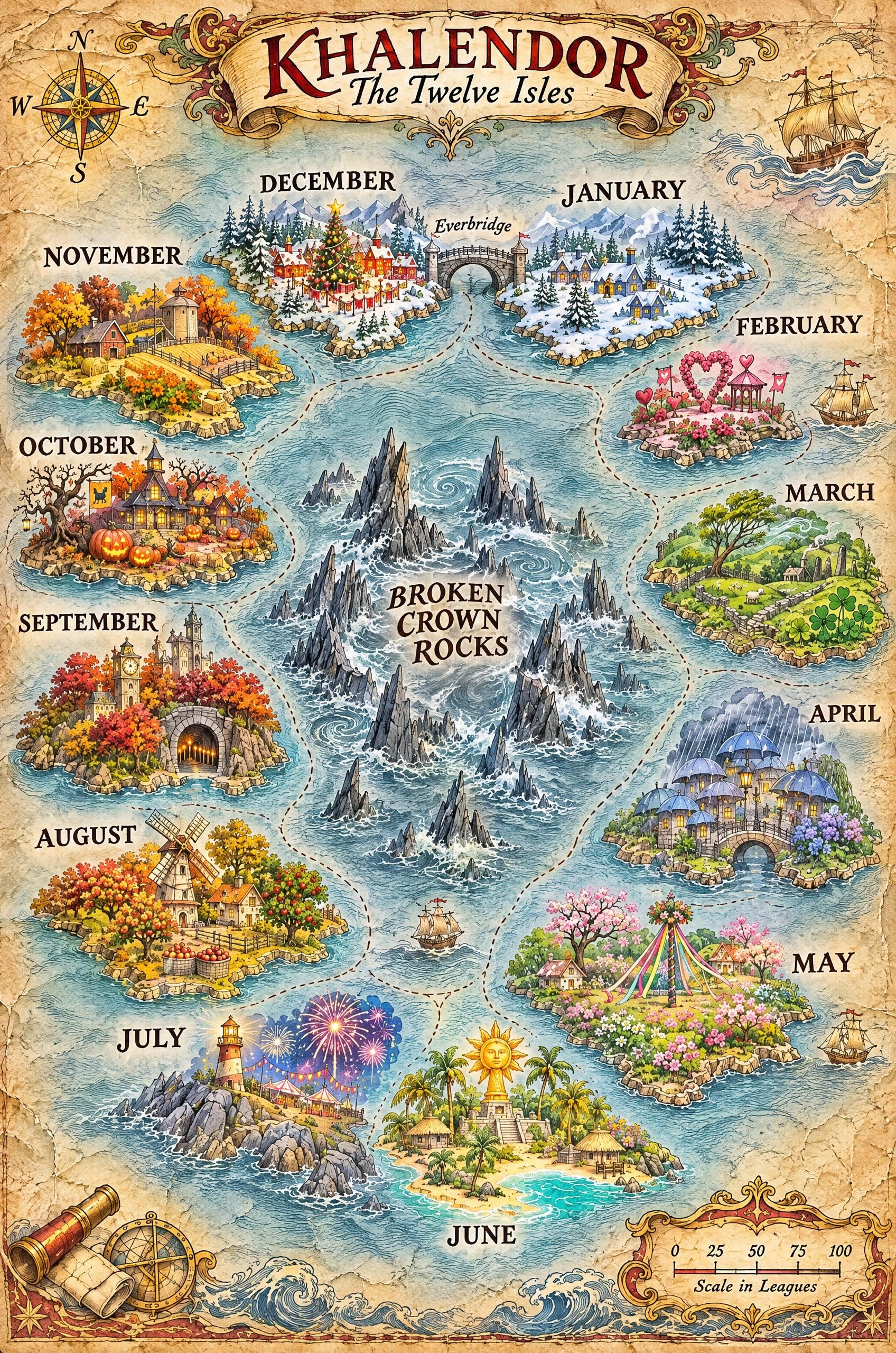
Khalendor
Twelve Islands, Twelve Hidden Tokens, and One Boy's Journey Through Time
by Amity Carrasco
Twelve-year-old Noko has always dreamed of sailing the open seas like his uncle, the respected captain of a grand merchant ship. Life on the snowy Isle of January is peaceful, but Noko yearns for true adventure across the realm of Khalendor—a ring of twelve magical islands where every shore embodies a different month of the year. When school break arrives, his uncle invites him aboard for a grand voyage around the circular archipelago. On their very first night under starlit skies, his uncle shares an old legend: the hidden Temple of Time, a place whispers say holds the secrets of the entire realm. To unlock its ancient gates, Noko must uncover twelve mystical tokens scattered across every island, braving seasonal festivals, vibrant cultures, and untamed lands. But piecing together the map reveals a truth far greater than finding a lost landmark—a destiny that will test his courage and shape the future of time itself. Khalendor is a wondrous middle grade fantasy quest packed with high-seas voyage, captivating worldbuilding, and the thrill of discovery.
- Child Books
- Fantasy
- Adventure
- Middle Grade Fantasy
- Middle Grade Adventure
- Quest Adventure
January
Snow had been falling over the Isle of January for three days straight, leaving the whole island smelling of woodsmoke and pine sap and the particular cold, clean air that only came right before a big storm cleared out. Noko barely noticed it anymore. He had grown up with snow the way fish grow up in water, and this morning he had far more important things on his mind than weather.
His bedroom took up the whole top floor of the house, a space his father had once used for storing extra barrels before Noko was old enough to beg for it as his own room. Every wall was covered in paper. Maps of the twelve islands, hand-copied from the atlas in his father's study. Maps he had invented himself, filling in harbors and mountain ranges for islands he had never once set foot on. A detailed chart of January's coastline hung above his bed, its edges soft and furred from being rolled and unrolled so many times.
Noko sat cross-legged on the floor with his newest map spread in front of him, a half-finished drawing of the sea route between January and February. He had the general shape right, he was fairly sure, from the old captain's log his father kept in the shop. But the little islands scattered along the strait, the ones sailors called the Thimbles, he was guessing at. He chewed on the end of his pencil and squinted at the page as if it might tell him whether he'd gotten it right.
"Noko." His mother's voice came up through the floorboards. "If you are not downstairs in five minutes, I am eating your breakfast myself."
"Coming!" he shouted back, and did not move for another full minute, because he realized the shape of Thimble Three was wrong and needed to fix it immediately or he would think about nothing else all day.
School had let out for the holiday two days earlier, and most of the kids on his block had spent that whole time building snow forts and arguing about whose fort would survive the first snowball war of the season. Noko had helped build one fort, thrown exactly six snowballs, and then gone home to work on his maps, because in four days, if everything went according to plan, he would be looking at real islands instead of ones he had copied out of books.
His uncle was coming. Captain Mako's ship, the Merry Gale, was due into January's harbor any day now, and when it arrived, Noko was going with it. Not for a few hours. Not for an afternoon of looking around the docks. For an entire trading voyage around the calendar islands, the whole loop, start to finish, and then back home before school began again.
He had been waiting for this for what felt like his entire life, though in fairness, his entire life was only twelve years long.
He rolled up the map carefully, tied it with a bit of string, and set it with the others in the wooden crate by his window, the one that used to hold salted fish and now held only his collection. He thumped down the stairs two at a time, because his mother's threats about breakfast were not always jokes.
The January Trading House took up the bottom floor of their home and spilled out into a long storefront that faced the harbor road. Noko's grandparents had built it, and his father had grown up sweeping its floors the same way Noko now did on weekends, though Noko swept dust into little piles and then get distracted drawing maps of the piles before disposing of them.
The shop smelled like pine tar, salt, and the dried citrus peel his mother hung in bundles from the rafters to keep the air sweet through the long winter. Shelves ran along both walls, stocked with coils of rope, folded wool blankets, tins of preserved fish, bottles of lamp oil, and crates of things that had come from other islands entirely: spiced sugar from somewhere warm, bolts of cloth dyed colors January's sheep never grew, little carved toys that smelled faintly of cedar.
His father stood behind the counter, tallying figures in a ledger with the stub of a pencil. Tomas was not a large man, not like his younger brother, but he had the same broad hands and the same way of tilting his head when he was thinking hard about something.
"There he is," his father said without looking up. "I was beginning to think you'd mapped yourself into another dimension."
"I was fixing the Thimbles," Noko said, sliding onto the stool behind the counter. "I had Thimble Three too far east."
"Terrible," his father said. "A full disaster. However will the merchant fleets recover."
Noko's mother appeared from the back room carrying a plate of warm bread and a bowl of something orange and steaming that smelled like ginger and oranges both at once. Her name was Alinor, and she ran the trading house's accounts with a precision that made the island's other merchants a little nervous to haggle with her.
"Eat," she said, setting the plate down in front of him. "You'll need your strength if you're going to spend the whole morning staring out the window for your uncle's ship."
"I wasn't staring out the window."
"You were staring out the window yesterday for four hours."
"That was different. Yesterday I thought I saw a sail."
"It was a fishing boat."
"It could have been a very small merchant ship."
His father laughed into his ledger, making his mother press her lips together to keep from smiling, a habit whenever she tried to stay stern and failed.
The bell over the shop door jingled, and a gust of cold air rolled in along with a customer bundled so thoroughly in scarves that only his eyes showed. He unwound himself enough to reveal a broad, weathered face and a grin missing one front tooth.
"Morning, Tomas. Alinor." He set a small wooden crate on the counter. "Got a delivery of citrus from the southern crew docking today, thought you'd want first pick before the festival crowds clean it out."
"Perfect timing, Dillon," Noko's mother said, already peering into the crate. "We'll need extra for the shared pot tonight."
Noko leaned over to look. The crate held oranges, small and bright, the kind that only grew on the warmer islands and had to travel a long way to reach January's cold shores. He thought about the merchant ship that had carried them, about the captain who had loaded them below decks and sailed them north through colder and colder water until they arrived here, in his family's shop, still smelling faintly of someplace sunny.
"Somebody had to sail those all this way," Noko said, mostly to himself.
"That they did," Dillon said, catching it anyway. "Dangerous work too, this time of year. Ice forms where you don't expect it. I don't envy the captains who make that run in winter." He winked at Noko. "Course, your uncle's never minded a little ice."
"Is his ship in yet?" Noko asked, too quickly.
"Not yet, lad. But the harbor master says the signal flags went up on the lookout tower an hour ago. Something's coming in from the south."
Noko was off the stool before his mother could tell him to finish his breakfast, which she did anyway, uselessly, to his back as he pulled on his coat.
"I'll eat it when I get back!" he called, and the door jingled shut behind him before she could answer.
Outside, January's harbor town was dressed for the Festival of First Lights, and even in his hurry, Noko couldn't help but slow down to take it in. Every rooftop wore a crust of clean snow, and strung between the buildings were ropes of paper lanterns, unlit as yet but waiting, each one painted with a different wish someone in town had written for the year ahead. The town square had its great woodpile stacked and ready for the evening bonfire, the one the whole island would gather around once the sun went down.
Noko had seen the festival eleven times already, but it never quite looked the same twice. This year, someone had strung evergreen boughs along the harbor railing and tied bells to them that chimed softly whenever the wind moved through. Two girls from his school were helping their grandmother set out little clay lamps along the front step of their house, the kind filled with oil that burned through the night without going out, a tradition some of the island's families had brought generations ago from a warmer land far across the sea and kept faithfully ever since.
Down near the docks, where ships from other islands tied up to trade before the festival crowds thickened, Noko spotted a cluster of strangers unloading crates from a boat with unfamiliar rigging. One of them, a woman with a bright yellow shawl wrapped over her coat, was arranging small bundles of sugarcane and sesame candies on a cloth spread over an overturned barrel.
"You're early for the harvest trade," Noko said, because he could never resist talking to anyone new who came through the harbor.
The woman looked up, amused. "Harvest trade's not for a few months yet, little sailor. We're here for the lights. Pongal starts for us soon, back home, and some of us like to mark the turning of the year twice. Once for the sun, once for the harvest." She held out a piece of candy. "Try it. Sesame and jaggery. Good for a cold morning."
Noko took it and found it sweet and a little smoky, nothing like anything his mother made in the shop. "Why twice?" he asked. "Doesn't the year only turn once?"
"Depends who you ask," she said, and laughed at his face, which must have shown exactly how unsatisfying he found that answer. "The sun doesn't care what calendar you use, child. It turns when it turns. We just have more than one reason to celebrate it."
Farther along, a group of men were building a smaller bonfire of their own, separate from the main square's, and singing something with a quick, clapping rhythm that made Noko's feet want to move whether he told them to or not. An older man noticed him watching and waved him closer.
"Lohri fire," the man explained, before Noko could even ask. "We light ours a little early and a little separate, so my grandchildren remember where it comes from. Longest night's behind us now. Figured that deserved its own flame." He tossed a handful of something into the fire that made it crackle and pop and smell faintly of roasted nuts. "Your island's festival is a kind one. Room enough in it for all of ours."
Noko thought that was probably true, though he had never really thought about it before. The Festival of First Lights had always just been his festival, the one his family lit lanterns for every year, and it had never occurred to him that other people folded entirely different fires and foods and songs into the very same night, the same way January's harbor folded ships from a dozen different places into the very same water.
He wanted to ask more, but a sound cut through the square turning every head on the harbor at once: three long blasts of a ship's horn, unmistakable, echoing off the snowy hills behind the town.
"That's him," Noko said out loud, to no one in particular, and ran for the water.
By the time he reached the end of the main pier, half the town seemed to have gathered there too, which was ordinary enough when Captain Mako's ship came in. The Merry Gale rounded the point under full sail, her hull painted a deep green that stood out sharply against the gray winter water, and as she drew closer, Noko could already make out the shape standing at the bow, both arms thrown wide like he meant to hug the whole harbor at once.
"JANUARY!" Mako's voice rolled across the water, booming enough that gulls scattered off the pilings. "Your favorite ship has returned, bearing cinnamon, silk, and at least one extremely overdue apology to the harbor master for last spring's unfortunate incident with the fish barrels!"
Laughter went up along the dock. Somewhere behind Noko, the harbor master, a thin, serious woman named Petra, muttered something that sounded like, "He still owes me for that," but she was smiling when she said it.
The ship eased alongside the pier, ropes flew, and the crew moved with the easy efficiency of people who had done this a hundred times before, tying off, dropping the gangplank, calling greetings down to friends among the dockworkers. And there, coming down the plank with a gait far steadier than his round shape would suggest, was Captain Mako, wrapped in a coat the color of dark plums, his mustache curling proudly at both ends despite the cold, his cheeks already red from the wind.
"Noko!" he bellowed, spotting him instantly in the crowd. "Look at you, you've grown a whole inch since summer. Soon you'll be taller than me, and then where will my dignity be?"
"You're not that tall to begin with," Noko said, grinning, and then his uncle swept him into a hug that lifted his feet clean off the dock.
"Cheek," Mako said happily, setting him back down. "Absolute cheek. I sail three weeks through ice water to bring you exotic treasures from distant lands and this is the thanks I get."
"What treasures?"
"That depends entirely on whether you apologize for the height comment."
"I'm not apologizing. You are a little short."
Mako laughed so hard his whole belly shook, and clapped a hand on Noko's shoulder hard enough to nearly knock him sideways. "Gods below, I've missed you. Where's your mother? Still terrifying the local merchants with her accounting?"
"She's at the shop. She told me to finish my breakfast before I left."
"Did you?"
"No."
"Good lad. Priorities."
They walked back together toward the trading house, Mako greeting half the town by name along the way, stopping twice to clap old friends on the back and once to buy a paper cone of roasted chestnuts from a vendor, half of which he handed to Noko and the other half of which disappeared into his own mouth before they'd gone another ten steps.
"Did you bring the maps?" Noko asked. "The ones you promised, from Thimble harbor, and the one with the reef markings near March?"
"I brought a great deal more than maps," Mako said, with the particular gleam in his eye that meant he was about to tell a long story whether anyone wanted to hear it or not. "I brought silk from June, dried fruit from September, a truly magnificent argument with a harbor inspector off the coast of October that I won, by the way, on a technicality, and news that your old friend Petra still hasn't forgiven me for the fish barrels."
"What happened with the fish barrels?"
"A story for another time. A story for after dinner, preferably, when your mother is less likely to throw something at me for encouraging you."
They reached the trading house just as Noko's father came out from behind the counter, wiping his hands on his apron, and the two brothers greeted each other the way they always did, with a hard handshake that turned into a one-armed hug halfway through.
"You're early," Tomas said. "I had money on you being a week late."
"Good winds," Mako said. "And I wanted to make it in time for the lanterns. Alinor still make that ginger thing? The orange one?"
"She's making it right now," Tomas said, and Mako was through the door before he'd even finished the sentence.
Dinner that night was loud and warm, the kind of meal where everyone talked over each other and nobody seemed to mind. Mako told the story of the fish barrels, which turned out to involve a badly tied knot, an escaped crate of mackerel, and Petra's prize goat, and by the end of it Noko's mother was laughing too hard to properly scold him for the mess he'd apparently caused.
It was only after the plates were cleared, when the four of them sat around the table with mugs of hot cider, that the real conversation began. Noko sensed it coming the way he sensed a change in weather, in the sudden careful way his mother set down her mug.
"So," she said. "The voyage."
"The voyage," Mako agreed.
"Three weeks," she said. "Around all twelve islands."
"Give or take a few days, depending on the trade winds and how badly the harbor masters in June try to cheat me this year."
"And you'll be responsible for him. All of it. His meals, his safety, where he sleeps, who he's around."
"Alinor." Mako's voice softened, the theatrical edge dropping out of it in a way Noko didn't often hear. "I've captained that ship for eleven years. I've never lost a crewman. I'm not about to lose my own nephew."
"Crewmen choose to take the risk," she said. "Noko is twelve."
"Mom," Noko started, but she held up a hand, not unkindly, just firmly enough that he stopped.
"I'm not finished," she said. "What happens if there's a storm? What happens if he's sick? What happens if something goes wrong on an island where none of us have ever set foot and none of us know a single soul?"
"Then I handle it," Mako said. "The same way I handle it for every member of my crew. I've sailed through worse storms than anything that strait will throw at us this time of year, and I know every harbor master and healer on every island better than I know most of the people in this room. He'll have his own bunk. He'll eat what the crew eats, which, I'll admit, is not always wonderful, but it is plentiful. And he will not be out of my sight for more than an hour at a time unless he's with someone I trust completely."
"That's not nothing," Tomas said quietly, to his wife. "You know how he runs that ship. You've heard what the other captains say about him."
"I know what you say about him," she said. "I know what he says about himself. I'd like to hear it from someone else sometime."
"Alinor." Mako reached across the table and, for once, didn't make a joke of it. "I know what I'm asking of you. I'm asking you to hand me the most important thing in your life and trust that I'll bring him back the same, or better. I don't take that lightly. I never have."
The table went quiet. Noko looked between his parents, his stomach tight, afraid that if he said anything at all it might tip the whole conversation the wrong way.
It was his father who spoke first.
"He's going to leave someday," Tomas said, looking at his wife rather than his son. "Whether it's this year or five years from now. He's never going to want to spend his life behind that counter the way I have, and I don't think either of us wants that for him either, not really. Better he learns what it's actually like out there with someone who loves him than finds out on his own with strangers."
Alinor was quiet for a long moment. She looked at Noko, who tried very hard to look responsible and mature and not at all like a boy who had drawn forty different imaginary maps in his bedroom.
"If anything happens to him," she said to Mako, "anything at all, I want to know about it. Immediately. Not after you've decided how to tell the story so it sounds less bad."
"Immediately," Mako said. "I swear it."
"And he helps with real chores. Real ones. Not just standing around pretending to be a sailor."
"He'll scrub more decks than he ever dreamed of."
"And he wears warm clothes even if he thinks he looks ridiculous in them."
"Mom," Noko groaned.
"Especially then," she said, and finally, finally, something in her face loosened, and she almost smiled. "Fine. Fine. He can go."
Noko was out of his chair so fast he nearly knocked it over, and he hugged his mother so hard she made a small surprised sound before hugging him back, tighter than she probably meant to.
"Thank you," he said into her shoulder. "Thank you, thank you, I promise I'll be careful, I promise I'll do all the chores, I promise I'll wear the scarf even the itchy one."
"You'll wear the itchy one especially," she said, and he felt her laugh more than heard it.
His father clapped him on the back once he let go of his mother, and gave him a look that was proud and a little worried all at once, the kind of look Noko would only fully understand years later. "A good merchant's word is worth more than his cargo," he said. "Wherever you go, whatever deals you watch your uncle make, remember that. People will forget what you sold them. They won't forget whether you were honest."
"I'll remember," Noko said, and meant it, even though at the time it sounded like the kind of thing fathers said that didn't quite connect to anything real yet.
The next two days passed in a blur of packing and last-minute errands. Noko's mother fussed over his trunk with the single-minded focus of someone preparing a soldier for war rather than a boy for a few weeks at sea, folding and refolding wool sweaters, counting socks twice, tucking a small tin of dried ginger into the corner "for your stomach, ships move strangely at first." Noko packed his own things around her efforts: his good charcoal pencils, three blank notebooks for new maps, his father's old brass compass that no longer pointed quite true north but that Noko loved anyway, and as many of his favorite books about the islands as he could fit without his trunk becoming impossible to carry.
On the morning of departure, Mako gathered Noko at the gangplank and introduced him properly to the crew, a mix of eight sailors who looked at him with the particular friendly skepticism of people who had seen plenty of eager boys come aboard before.
"This is my nephew," Mako announced to the deck at large. "He will be helping with light duties, learning the ropes, quite literally, and he is not to be given anything sharp, anything flammable, or any task involving the galley stove until I say otherwise."
"Aye, Captain," said a tall woman with a gray braid, who Noko would later learn was named Senna and served as the ship's navigator. She looked him over with mild interest. "You know your knots, boy?"
"Some," Noko said. "My uncle taught me a bowline last summer."
"We'll see how long that lasts," she said, not unkindly, and went back to coiling a line.
A younger sailor, barely out of his teens, with a crooked grin and flour still dusted on his sleeves, introduced himself as Oren, the ship's cook's assistant. "Don't worry," he told Noko quietly. "First week everyone treats you like you're made of glass. By the second week you're just another set of hands. It's actually better that way."
Noko liked him immediately.
By midafternoon, the trunk was loaded, the crew had finished their final checks, and it was time. Noko's mother held him by both shoulders at the base of the gangplank for a long moment, saying nothing, just looking at him like she was trying to memorize his face exactly as it was.
"Come home the same boy," she said finally. "A little taller is allowed. A little more sunburned is allowed. The same boy."
"I promise," he said, and hugged her once more before his father pulled him into a quick, firm embrace of his own.
"Make good trades," his father said. "And make good choices. They're not always the same thing, but try for both."
Noko climbed the gangplank, and the ropes were cast off, and the Merry Gale eased backward from the pier under Senna's calm direction before swinging her bow toward open water.
Noko stood at the rail as the harbor fell away behind them. The town's lanterns, not yet lit against the daylight, hung in their long rows above the streets, waiting for evening. Smoke rose from a hundred chimneys. He could just make out the shape of his parents still standing at the end of the pier, his mother's hand raised, growing smaller with every minute.
He had imagined this moment so many times, sitting on his bedroom floor surrounded by maps of places he had never seen. The reality felt different now that it was actually happening, bigger and smaller at the same time, like the real harbor couldn't possibly be the same one he'd drawn forty different versions of from memory.
By evening, January had shrunk to a dark smudge on the horizon, its mountains fading into the blue haze of dusk, and the first stars pricked through overhead. The wind had picked up, cold and steady, and Noko had pulled his coat tight and found a quiet spot near the bow where he could watch the water change color as the sky darkened.
That was where Mako found him, after the crew had settled into their evening routines and the ship had taken on the particular hush that came over vessels at night, broken only by the creak of rigging and the hiss of water along the hull.
"Not seasick yet?" Mako asked, lowering himself down beside Noko with a grunt, his back against a coil of rope.
"No," Noko said. "I feel fine. Maybe a little jumpy. The ship moves more than I expected."
"It'll move a great deal more than this before we're through," Mako said cheerfully. "Wait until we hit the strait before February. That's when you find out what you're made of."
"Made of what, exactly?"
"Either a sailor or a very large puddle. We'll find out together."
Noko laughed, and for a while they sat without talking, looking up at a sky that looked bigger out here than it ever did from his bedroom window, thick with more stars than he could count and a few he didn't recognize at all.
"Can I ask you something?" Noko said eventually.
"You're going to ask me something whether I say yes or no, so go on."
"When you were my age. Did you always want to be a captain? Or did you want something else first?"
Mako was quiet for a moment, which was unusual enough that Noko glanced over at him.
"I wanted a lot of things," Mako said finally. "Most boys do, at twelve. I wanted to be the fastest runner on January. I wanted to win every game of stones at the harbor. And for a few years, longer than I probably should admit, I wanted to find something nobody else had ever found."
"Find what?"
Mako reached into the inside pocket of his coat and was quiet again while he searched for something, his face unusually serious in the lantern light that hung from the mast nearby.
"Have you ever heard of the Temple of Time?" he asked.
Noko shook his head slowly. "No. What is it?"
"A story. Or it was, when I was your age. The old sailors used to tell it, usually late at night, usually after they'd had a bit too much spiced wine. They said that somewhere in Khalendor, hidden away from every map that's ever been drawn, there's a temple that sits outside of time itself. A place where the years don't pass the same way they do for the rest of us. Some said it held the secret to the whole archipelago, why there are exactly twelve islands, why each one carries its own season and its own month. Some said it was nothing more than a sailor's tale, invented to explain things nobody could otherwise explain."
"Do you believe it's real?"
"I did, once. More than believed it. I spent half my childhood looking for it." Mako smiled, a little crookedly, like the memory embarrassed him and warmed him at the same time. "I used to sneak off from my chores and climb every hill on January, poke around every old ruin, question every traveling merchant who came through the harbor, convinced that this time, I'd find the clue that led me there."
"Did you ever find anything?"
"I found this."
He finally drew his hand out of his coat and opened his palm. Resting there was a small disc, no larger than a coin, made of some dark metal Noko didn't recognize, tarnished with age but not rusted. Strange markings circled its edge, symbols that looked almost like numbers but weren't quite, and in the center, barely visible in the lantern light, was a shape like a snowflake crossed with something that might have been a compass rose.
Noko leaned in close, careful not to touch it until his uncle offered it to him.
"Go ahead," Mako said, and dropped it gently into Noko's palm.
It was heavier than it looked, cold at first and then warm, like it had been sitting near a fire somewhere. Noko turned it over slowly. The back was smoother, worn nearly blank, except for a single mark near the edge that looked like it might once have been a star.
"Where did you find it?" Noko breathed.
"Buried under an old stone marker, up past the north ridge, near the cliffs. I was maybe ten years old. I dug for an hour because I thought I'd found a treasure chest, and instead I found that. I didn't even know what I had until years later, when I finally found an old sailor willing to talk about the legend properly instead of just laughing it off."
"What did he tell you?"
"That the old stories speak of twelve tokens, one tied to each calendar island, and that together they're supposed to open the way to the temple itself. That whoever carries all twelve can find what no single sailor ever could on their own."
"So there are eleven more of these? One for every other island?"
"That's what the legend says. I spent years after that looking for a second one. Asked every merchant I traded with if they'd ever heard of anything similar on their home island. Half of them had never heard the legend at all. The other half just laughed at me." Mako shrugged, but it wasn't quite as careless a shrug as he probably meant it to be. "Eventually I had a ship to run and a living to make, and the search for magic temples doesn't pay for rope or salt pork. I put it away and told myself it was a children's story I'd outgrown."
"But you kept it," Noko said, nodding at the token still resting in his palm.
"I kept it," Mako agreed.
Noko looked down at the small disc again, turning it slowly so the lantern light caught the strange symbols at different angles. "Who do you think made it?"
"No idea."
"And nobody's ever found the temple? In the whole history of Khalendor?"
"Not that anyone's ever proven. Plenty have claimed it. None have ever produced so much as a pebble to back it up."
"Why do you think that is?"
Mako was quiet for a moment, looking out at the dark water instead of at Noko. "I used to think it was because the clues were too well hidden. Now I think maybe it's because most people stop looking once life gets busy enough. Myself included." He reached over and ruffled Noko's hair, which Noko immediately tried to fix. "Enough questions for tonight. Even future captains need their sleep, and you've got an early morning watch to learn tomorrow, whether you like it or not."
"Just one more question."
"You always say that and it's never just one."
"If I found another token," Noko said slowly, turning the disc over one last time before handing it back, "on one of the other islands. Would you help me look for the rest?"
Mako took the token back and studied his nephew for a moment, something unreadable crossing his face before the familiar grin returned. "Ask me again if you actually find one," he said, tucking the disc carefully back into his coat. "Until then, it's bedtime, not treasure hunting time."
Noko groaned but rose to his feet, his legs stiff from sitting so long against the cold rail. He gave the dark water one last look, the kind of look that tried to memorize everything about this exact moment: the creak of the ship, the smell of salt and tar, the stars scattered thick overhead, the shape of his uncle still sitting against the rope coil with his coat pulled tight.
"Goodnight," Noko said.
"Goodnight, Captain-in-training," Mako said. "Try not to dream about buried treasure. Dream about breakfast instead. Oren makes a very good porridge."
Noko laughed and made his way below decks to the small bunk that had been set up for him in the crew quarters, a narrow space with a blanket that smelled like cedar and the faint rocking motion of the ship beneath him that he suspected he would need a few nights to get used to.
He lay in the dark for a long while, listening to the unfamiliar sounds of the ship settling around him, the distant murmur of sailors finishing their evening tasks, the steady creak of wood and rope. His mind kept circling back to the small dark disc in his uncle's pocket, its strange markings, the idea of eleven more scattered across eleven other islands, waiting for someone patient enough, or lucky enough, or simply stubborn enough, to find them.
He thought about the Temple of Time sitting somewhere outside the reach of every map he had ever drawn, and for the first time, Noko realized a place existed even his most careful, most detailed charts had never once accounted for.
Somewhere above him, the lantern light swung gently with the motion of the sea, and somewhere beyond that, the islands of Khalendor waited in the dark, each one holding its own month, its own story, and perhaps, if the old legend was true, its own small piece of a much older secret.
Noko closed his eyes, and sleep pulled him under, carrying him off into dreams of ancient gates, forgotten tokens, and a temple that no one, not even his uncle, had ever managed to find.
February
The Isle of February came into view just after breakfast, and Noko's first thought was that his uncle must have made a mistake with the charts. "That's it?" he asked, squinting over the rail. "That's the whole island?" "That's the whole island," Mako said, chewing on a strip of dried apple. "Smallest of the twelve. You could walk from one end to th…