

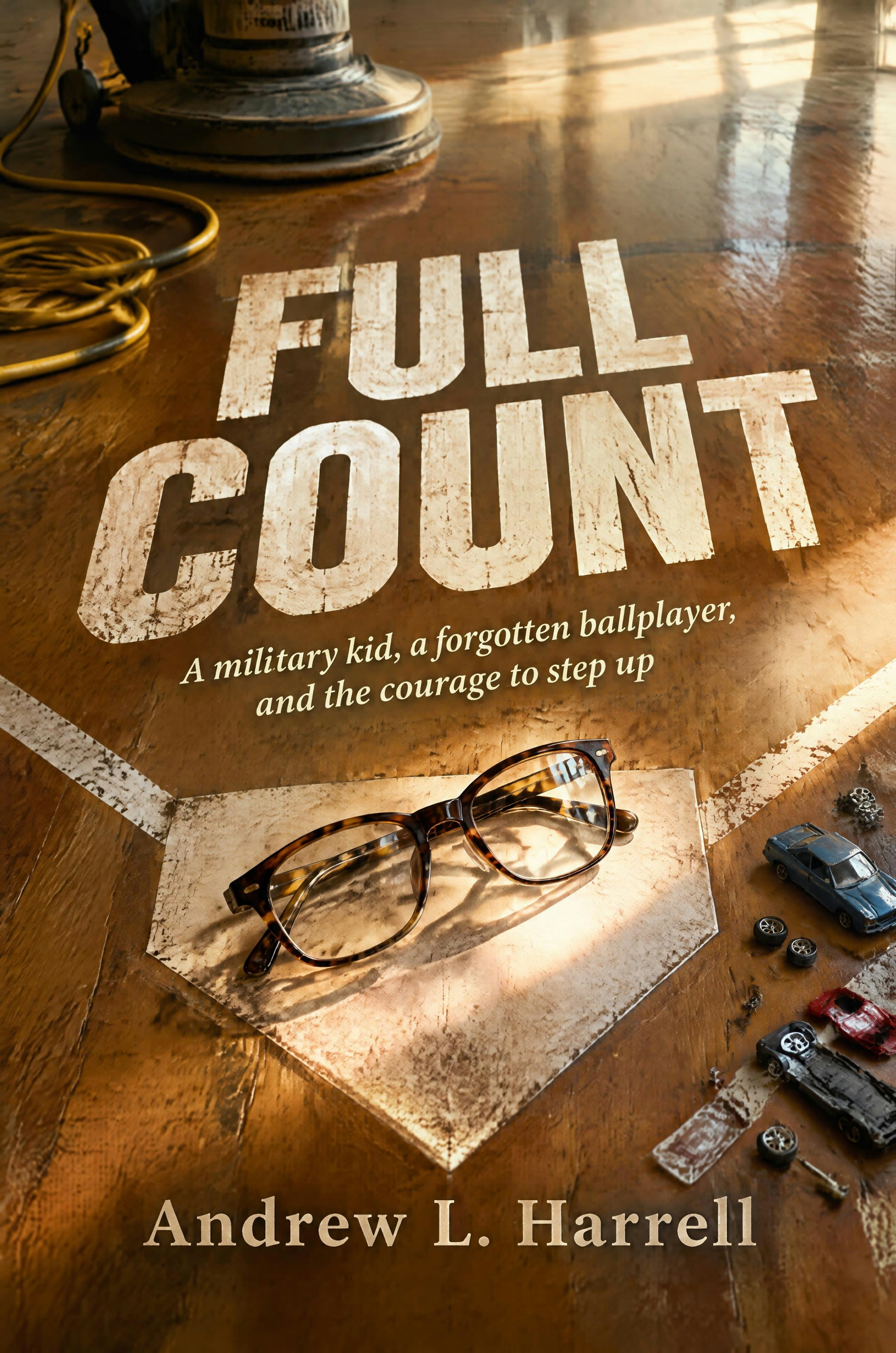
FULL COUNT
A military kid, a forgotten ballplayer, and the courage to step up
by Andrew L. Harrell
Ten-year-old Bennie Carson has packed his life into four different states. At Oak Creek Elementary, his tortoiseshell glasses and clumsy swing make him an easy target. Gym class means getting picked last. His older brother Warren would rather pretend he does not exist. Left out and lonely, Bennie hides behind the bleachers with his model cars until Mr. Jack, the school custodian, finds him. Years ago, Jack was a minor-league infielder. A highway crash ended that dream. What he still has is patience, a worn glove, and the sense that this quiet boy might learn to see the ball the way he sees tiny plastic parts. After-school practices turn into friendship. Neighbor Martha Sutton and classmate Wally Baker pull Bennie into sandlot games. Principal Vance worries about kids on school grounds after hours. Warren, desperate to make the middle-school squad, starts to notice the little brother he pushed away. When the town tournament arrives, Bennie does not need a trophy. He needs to give his absolute best, win or lose, and prove that a steady heart can round every base.
- Child Books
- Literary Fiction
- School Stories
- Friendship Stories
- Coming of Age
- Character Study
The Last Kid in Line
The cardboard boxes in Bennie Carson's new room still smelled like the moving truck, a mix of diesel and dust that clung to the flaps no matter how many times his mother wiped them down with a rag. There were six boxes in all, stacked in two crooked towers against the wall, each one marked in his mother's neat block letters: BENNIE'S ROOM, BOOKS, MISC. He had already decided that MISC was the most honest word in the whole language, because it meant nobody really knew what was inside until they opened it.
He knelt on the bare wood floor and peeled back the tape on the box marked MODELS, careful not to tear the flaps the way Warren always did when he ripped into things without thinking. Inside, wrapped in old newspaper from a town two states back, were the plastic car kits Bennie had been collecting since he was seven. A 1967 Mustang. A powder-blue Chevelle. A half-finished Camaro with its hood still unpainted, sitting propped on a wad of paper towels because the glue had not quite dried before they packed it. He lined them up one by one along the windowsill, turning each so the headlights faced out toward the yard, the way he always did. It was the first thing he unpacked in every new house. It was the one thing that never changed, no matter how many states they crossed to get there.
Outside the window, he heard the scrape and clatter of cleats on the driveway.
Bennie set the Camaro down gently, its wheels not yet glued to the axles, and went to look. Warren was sitting on the back step lacing up his baseball spikes, the leather still stiff and shining, the metal cleats catching the afternoon sun in bright little flashes. He was fourteen now, and every week he seemed to take up more space than the week before, all elbows and knees and a voice that cracked in the middle of sentences and made him scowl like it was somebody's fault but his own.
"Where are you going?" Bennie asked, leaning out the screen door.
"Field," Warren said, not looking up. "There's a pickup game. Some guys from the middle school."
"Can I come?"
Warren tied off the second lace and stood, testing his weight on the cleats the way he always did, rocking heel to toe. "No."
"I could just watch."
"You could just stay here." Warren picked his glove up off the step and slapped it once against his thigh, knocking loose a little cloud of dust. "Last time you tagged along you dropped a ball right on your own face. You want to crack those glasses again, go ahead, but I'm not explaining it to Mom."
Bennie's hand went up to the thick tortoiseshell frames without him quite meaning it to, pushing them back up the bridge of his nose where they had already begun to slide. He could feel his ears get warm. "I wasn't going to play. I just wanted to toss it around in the driveway. You and me."
"I don't have time for that right now." Warren was already walking backward down the driveway, glove tucked under his arm, cleats clicking against the concrete. "Go put together one of your little cars or something."
He turned and jogged off down the street without looking back, and Bennie stood in the doorway and watched him go until he turned the corner by the Hendersons' old mailbox, the one with the crooked flag, and disappeared. The screen door was still propped open against Bennie's shoulder. Somewhere down the block a lawnmower started up, and a dog barked twice and then went quiet.
Bennie let the door swing shut and went back to his room.
He did not put together one of his little cars, though the Camaro sat waiting with its hood off and its parts laid out in a neat row on the windowsill, the wheels and the tiny plastic exhaust pipe and the steering wheel no bigger than a shirt button. He just sat on the edge of his bed and looked at them instead, the way you might look at a friend you were not quite ready to talk to yet.
His mother's voice came up the stairs a few minutes later, calling his name in the particular tone she used when she wanted him to hurry without making it sound like an order. "Bennie, honey, get your shoes on. We need to walk over to the school before the office closes."
"Coming," he called back, though he did not move right away.
He looked at the Camaro one more time, at the little dashboard piece he had not yet snapped into place, small enough to balance on the tip of his finger, and on some impulse he could not quite explain he picked it up and slid it into his pocket. It felt better that way. Something small and steady to hold onto, even through a jacket pocket, even on a walk to a school he had never seen before.
Downstairs his mother was waiting by the front door with her purse over her shoulder and a folder of papers tucked under one arm, birth certificate and shot records and the letter from his old school in Georgia that said he had passed fourth grade with satisfactory marks in every subject except, as always, physical education. She had her hair pulled back and her good cardigan on, the pale yellow one she wore to things that mattered, and Bennie understood without being told that enrolling him at a new school counted as one of those things in her mind, even if it was just walking two blocks down a sidewalk to hand some papers to a stranger behind a desk.
"Ready?" she asked, and smiled at him in the way she always did right before something new, a smile that was trying hard to be certain.
"Ready," Bennie said, though the word came out smaller than he meant it to.
They walked together down the front steps and out onto the sidewalk, and the afternoon was warm in that early way of late spring, the kind of warm that still had a little bit of a chill folded into the shade. The houses on their new street were smaller than the last ones, with chain-link fences instead of wood, and somebody a few doors down had a sprinkler going that ticked back and forth across a yard gone patchy with dandelions. Bennie kept his hand in his pocket the whole way, his fingers wrapped around the dashboard piece, turning it over and over like a worry stone.
"You'll like it here," his mother said, not looking at him but out ahead of them, the way she always did when she wanted the words to land soft instead of pushed. "New start. Nobody knows anything about you yet. That's not always a bad thing, you know. It means you get to decide who you want to be."
"That's what you said about the last place," Bennie said.
"I know." She reached over without breaking stride and squeezed his shoulder once, quick, the way she did when she did not have a better answer but wanted him to know she had heard him anyway. "And I meant it then too. Some places just take a little longer to feel right. Doesn't mean they never do."
Bennie did not say anything to that. He had heard some version of it in Georgia, and before that in Texas, and before that in a town in Kansas he barely remembered except for the wind that never seemed to stop blowing and a teacher who called him "the new boy" for so long he almost forgot his own name applied. Four schools in five years had taught him that his mother's hope was real, and that it was not always enough, and that both of those things could be true at the same time without canceling each other out. He kept walking. Oak Creek Elementary came into view at the end of the block, a long low brick building with white trim around the windows and a flagpole out front where the flag hung still in the windless afternoon. Past a chain-link fence along the side yard was the playground, and even from the sidewalk Bennie could hear it before he could properly see it, that particular roar that belonged only to children let loose at the end of a school day, shrieking and laughing and arguing all at the same volume.
His mother slowed as they reached the gate, checking the address on the folder against the sign bolted to the brick, though there was no real need. There was only the one school on the street, and the sign said OAK CREEK ELEMENTARY in tall green letters that had faded some at the edges. Bennie stopped at the fence instead of following her in. "I'll wait out here," he said. "While you do the office stuff." His mother studied him a second, the way she sometimes did when she was deciding whether to push or let something be. Then she nodded. "Five minutes. Don't wander off." She went in through the side door marked OFFICE, the folder of papers clutched against her chest, and Bennie was left alone at the fence with his fingers curled through the diamond links, looking out at a playground full of kids he did not know and would, in a matter of weeks, be expected to sit beside in a classroom and call by name. There was a kickball game going on near the blacktop, a red rubber ball bouncing hard off somebody's shin before a boy with a buzz cut scooped it up and fired it at a runner sprinting for what must have been second base, though there was no base at all, just a flattened paper plate someone had set down in the dirt. A cluster of girls sat cross-legged near the jungle gym trading something back and forth, cards or stickers, Bennie could not tell from that distance. Over by the swings two boys were having what looked like a serious argument about whose turn it was, both of them red in the face, though neither one was actually swinging. None of them looked over at him. None of them had any reason to. He was just a kid standing outside a fence, watching, the way he had watched playgrounds in Georgia and Texas and Kansas before this one, wondering the same tired question every single time: which of these kids was going to be the one to notice his glasses first, and what they would decide to say about it. He touched the frames without thinking, pushed them back up though they had not slid, and felt the familiar knot pull tight low in his stomach, the one that showed up every single time they moved, right on schedule, like it had been riding along in one of the boxes the whole way. It was not that Bennie minded the glasses themselves. He liked, actually, the way the world came into focus when he put them on in the morning, the leaves on a tree resolving from a green smear into a thousand separate shapes, each one distinct enough to count if he wanted to. What he minded was what the glasses seemed to mean to other people the instant they saw them. Four eyes. Poindexter. Careful, don't break him. He had heard some version of it in every school so far, delivered with the same easy cruelty by boys who somehow always knew exactly where to aim. He wished, standing there with his hand wrapped around the cold metal fence, that he could disappear into a crowd the way a coat of paint disappeared into a wall once it dried, something that belonged there so completely nobody thought to look at it twice. He was good at disappearing when he wanted to. He had gotten a lot of practice. A boy near the kickball game misjudged a catch and the ball bounced off his chest and rolled clear across the blacktop, and for a second the whole game dissolved into laughing and pointing, the boy's ears going red as he chased it down. Bennie watched that too, and felt something in his chest pull tight in sympathy even though he did not know the kid's name and never would, most likely. He knew exactly what that felt like, all those eyes turning toward you at once, waiting to see what you would do next. He reached into his pocket and closed his fingers around the little plastic dashboard piece, running his thumb along its tiny ridged surface, the notch where the steering column would eventually fit if he ever got around to gluing it in. It was such a small thing. It had no business being comforting. But it was, somehow, the one solid shape in his pocket while everything else about the afternoon felt loose and unfinished, like a kit spread out across a table with half the instructions missing. Behind him the office door opened, and his mother came back out with the folder tucked under her arm again, though thinner now, most of the papers handed over. "All set," she said, coming up beside him at the fence. "You start Monday. Homeroom with a Mrs. Albright, she seems nice enough. Little older, been there a long time by the sound of it." She looked out at the playground the same way Bennie had been looking, following his gaze toward the kickball game and the swings and the girls trading their cards in the shade. "Looks like a lot of kids. That's good. More kids means more chances to find your people." "Or more chances for them to find something wrong with me," Bennie said, before he could decide whether he meant to say it out loud. His mother looked down at him, and for a second her face did something complicated, something that was not quite a wince but was close to one. "Bennie." "I didn't mean it like—" He stopped, adjusted his glasses again though they had not moved. "I just meant it's a lot of new people at once." "It is." She put her arm around his shoulders and turned him gently away from the fence, back toward the sidewalk, back toward home. "But you know what? Every single one of those kids in there was new somewhere once. Every one of them started a school for the first time and didn't know a single name in the room. You're not the only person who's ever had to walk in somewhere brand new. You're just the one doing it today." "That doesn't make it easier." "No," she admitted, and her voice was honest in a way he appreciated even if he did not much like what it told him. "It doesn't make it easier. But it's true all the same, and sometimes true things are worth saying even when they don't fix anything." She squeezed his shoulder. "You've got good things about you, Bennie Carson. You just haven't found the place yet where people notice them instead of the glasses." They walked the rest of the way home mostly in silence, past the sprinkler ticking back and forth, past the crooked mailbox, the late sun throwing their shadows long and thin across the sidewalk cracks. Bennie kept his hand in his pocket the whole way, and by the time they reached their own front steps his thumb had worn a smooth little groove into the dashboard piece from turning it over so many times. Warren was not back yet. His cleats were not by the door, and the driveway was still empty of anything but a long crack running diagonal across the concrete that Bennie had noticed the very first day they moved in. He wondered, going up the stairs to his room, how the pickup game was going, whether Warren was playing shortstop the way he liked, whether he had made a diving stop or struck somebody out or done any of the things that made the other kids look at him the way Bennie wished, just once, somebody would look at him. Back in his room, the models were still lined up along the windowsill where he had left them, headlights out. He sat down at the little desk that had come with the house, plain and scarred with somebody else's initials carved into one corner, and pulled the dashboard piece from his pocket. He set it down beside the unfinished Camaro and studied the two of them together; the tiny gray rectangle with its notch, and the toy car itself, hood open and waiting. He thought about what his mother had said, about every kid in that playground having been new somewhere once. He supposed that was probably true. It did not make the kickball game feel any less like a place he did not belong in, and it did not make the sound of Warren's cleats on the driveway feel any less like a door closing. But maybe, he thought, turning the dashboard piece over one more time before finally reaching for the tube of glue, some doors took longer to open than others. Maybe some things, like a model kit with fifty separate pieces and instructions in print so small you had to squint even with glasses on, just needed more patience than other things did. He had patience. That much he knew about himself for certain, whatever else remained to be found out. He dabbed a careful bead of glue along the edge of the dashboard piece and pressed it into place inside the little plastic shell of the Camaro, holding it steady with one finger while it set, counting slowly the way Mr. Jack, whoever that turned out to be, had not yet taught him to count a runner home. Outside his window the sun kept sinking, and somewhere down the block a screen door slammed, and somewhere closer than that, in the quiet of his own new room, something small and stubborn in Bennie Carson kept right on holding steady.
Chalk Marks and Dust
By Friday, Bennie had learned the shape of Oak Creek Elementary well enough to walk its hallways without asking anybody for directions, which was more than he could say for most of his classmates' names. He knew where the water fountain ran too cold and where it ran warm. He knew that Mrs. Albright liked the window cracked open during silent readin…