

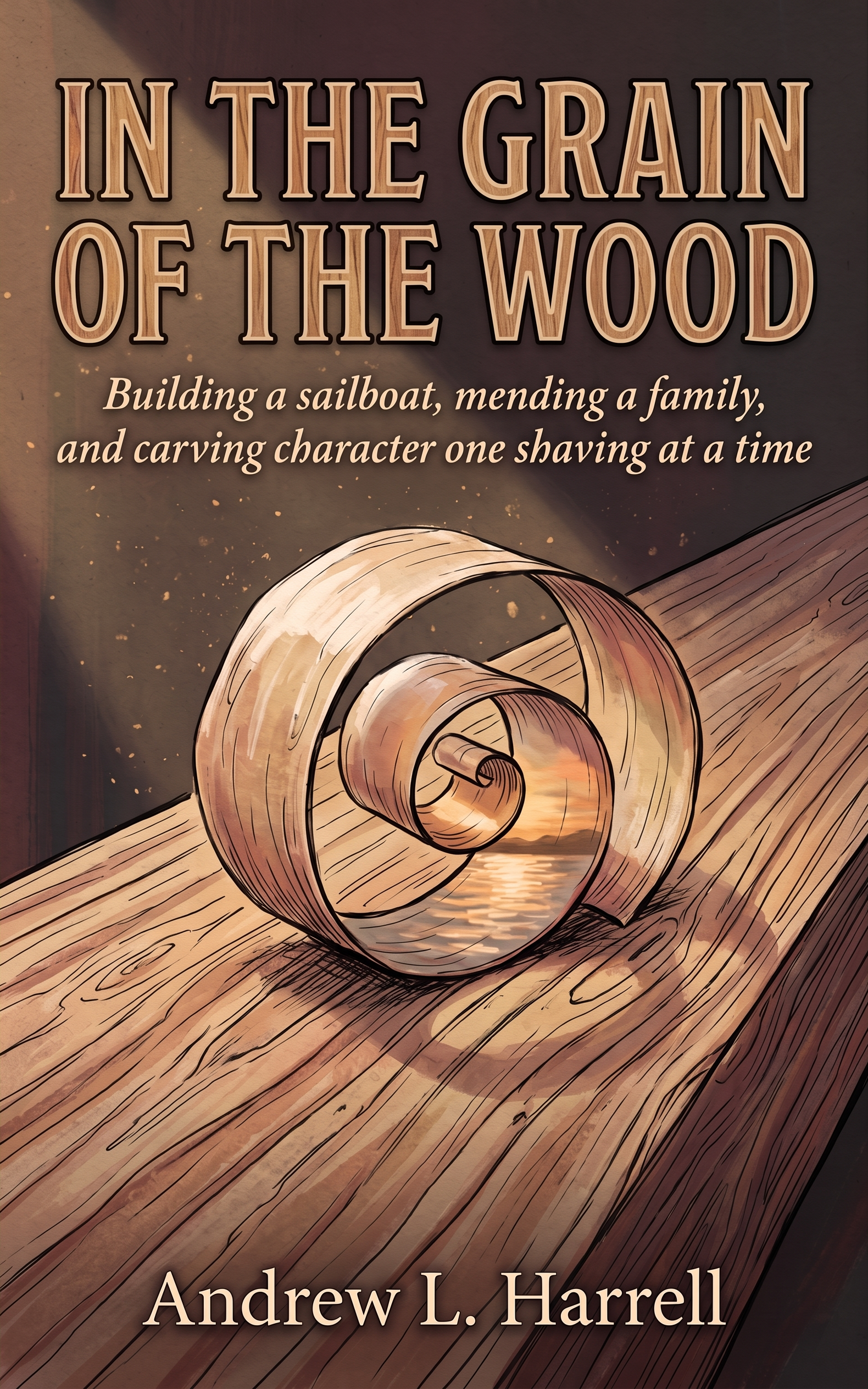
IN THE GRAIN OF THE WOOD
Building a sailboat, mending a family, and carving character one shaving at a time
by Andrew L. Harrell
Some life lessons cannot be taught in a classroom; they must be carved by hand. When thirteen-year-old Pauley and his impulsive younger brother, Bulldog, step into their grandfather's workshop for summer vacation, they expect dusty tools and quiet days. Instead, Grandpa Garrett presents them with raw white oak and an ambitious challenge: build a seaworthy wooden sailboat from the keel up. Still mourning the passing of their beloved grandmother, the three generations settle into the patient rhythm of the craft. Between measuring twice, hand-sawing planks, and steam-bending ribs, Garrett teaches the boys that honest labor reveals the truth of who you are long before your eyes can see it. But when an unexpected accident in the workshop threatens the build and tests their resolve, the brothers must step up to prove what they are made of. In the Grain of the Wood is an unforgettable coming-of-age story about craftsmanship, grief, brotherhood, and the quiet wisdom passed across generations—one curled wood shaving and celebratory scoop of ice cream at a time.
- Literary Fiction
- Child Books
- Young Adult
- Coming of Age
- Family Drama
- Chapter Books
The Scent of Shavings
The station wagon rolled to a gentle stop along the cracked asphalt of Maple Street, its tires crunching on scattered pea gravel. Pauley Bridges adjusted his wire-rimmed glasses and looked out the passenger window toward his grandfather’s house. The single-story home stood quiet under the morning sun, framed by two tall maples whose broad leaves stirred in the early summer breeze. Attached to the far side of the house was the wide garage, its double doors painted a pale gray that matched the weathered siding.
Beside him, his younger brother Rick, whom everyone called Bulldog, was already unbuckling his seatbelt. Bulldog had his running shoes pressed against the floorboard, ready to spring out the second the engine cut off. A fresh strip of adhesive bandage was stuck across his left knuckle, picked up during a backyard race two days earlier.
Their mother, Katherine Bridges, put the car in park and turned around in her seat. She wore her neatly pressed slacks and a summer blouse, her tortoise-shell glasses catching the light as she smiled at her sons. "Now remember what your grandfather said on the phone," Katherine said, resting an arm over the steering wheel. "He has an important project lined up for you two, and it will take some real discipline. Listen closely to whatever he asks you to do. I have curriculum meetings at the elementary school until four, so I expect you both to be helpful and mindful."
"We will, Mom," Pauley said. He smoothed his faded shirt and picked at a loose thread near his collar, wondering what kind of job required both of them for the entire summer.
"I’m going to build whatever it is faster than Pauley," Bulldog announced, bouncing on the vinyl seat. "Just watch me."
"It’s not a footrace, Rick," Katherine replied with a soft laugh. She reached out and patted Bulldog’s knee before nodding toward the porch. "Go on ahead. He’s already expecting you."
The boys climbed out of the car, shutting the heavy doors with a solid thud. Grandpa Garrett was already walking down the side path from the garage entrance. He wore his familiar blue chambray work shirt with the sleeves rolled neatly below the elbows, showing forearms crossed with faint, pale scars from decades of cabinetmaking. A dusting of fine cedar shavings clung to the toes of his leather work boots. His weathered hazel eyes crinkled into a warm smile as he raised a broad hand in greeting.
"Morning, boys," Garrett said, his voice deep and unhurried as he gave Katherine a reassuring nod through the open car window. "Good morning, Katherine. You leave these two with me. We have plenty of honest work waiting inside."
"Thank you, Dad," she called out before waving and pulling back onto the street. "See you boys at four!"
Garrett turned and led the brothers across the driveway toward the wide garage. When he pulled the side door open, the scent hit Pauley immediately. It was a clean, familiar blend of cured cedar, machine oil, and sweet yellow pine sawdust that seemed to hang permanently in the cool air. The floor was broom-swept concrete, and long workbenches stretched beneath shelves of neatly labeled glass jars containing brass screws, washers, and square-headed nails.
In the center of the largest workbench lay a long roll of heavy paper weighted down at the corners by two cast-iron bench dogs. Garrett stepped up to the table, his weathered hand slowly sliding across the smooth surface as he motioned for the boys to gather round.
"Before we talk about any tools," Garrett said, looking steadily at each of them, "you need to see where our path is heading. Come have a look."
He removed the iron weights and let the thick sheet uncurl across the hard maple top. Pauley leaned in close. Crisp white lines crisscrossed the blue paper, forming curved rib arcs, sheer lines, and numbered stations that measured out a twelve-foot wooden sailboat. The geometry looked daunting. Angles were marked down to eighths and sixteenths of an inch, with offsets running in precise columns down the right-hand margin.
"A sailboat?" Bulldog asked, his eyes wide. "A real one we can actually take out on the water?"
"A real one," Garrett answered, his tone steady and proud. "Twelve feet of white oak, marine ply, and cedar. But there is a catch, boys. A boat is not something you start on a whim and walk away from when the weather gets warm or your friends call you down to the ball diamond. If you agree to take this on with me, it is a strict one-year commitment. We work through the summer, through the autumn afternoons, and through the winter weekends until she is properly framed, planked, and rigged. We do not quit halfway. Are you prepared to give me your word on that?"
Bulldog nodded right away, his hands planted firmly on the edge of the wood. "I give my word! When do we start the loud saws?"
Pauley traced one of the curved lines with a fingertip, his throat tightening slightly. "Grandpa, these curves look complicated. What if we cut a board wrong? If we ruin a plank, the whole hull might leak. I don't know if I can get the angles right."
Garrett placed a heavy, reassuring palm on Pauley’s shoulder. The weight of his grandfather's hand was warm and steady. "Mistakes happen to every man who picks up a piece of timber, Pauley. The wood will teach you how to listen to it. But we don't rush, and we don't guess. We measure twice, we cut once, and we use our hands to tell us what our eyes might miss. You have the patience in you if you choose to practice it."
Before Garrett had finished speaking, Bulldog spotted a small iron block plane resting on the side shelf. With a sudden burst of energy, Bulldog grabbed the brass adjustment wheel and picked up the heavy tool, turning toward a spare two-by-four resting against the wall. "Let’s start making wood chips right now!"
"Hold on there, son," Garrett said softly. He stepped forward and placed his fingers around Bulldog’s small wrists, gently easing the hand plane back out of the boy's grip. "You have plenty of fire in you, Rick, and that fire will serve you well when it comes time to shape the keel. But a tool is not a toy, and it doesn't do its job just because you swing it hard. Before anyone cuts timber in this shop, they must learn to respect and care for the edge of every blade. We won't be using loud power saws to rip through this boat. This hull will be shaped by hand, one steady stroke at a time."
Bulldog looked down at his empty hands, blinking in surprise. "No electric saws?"
"Not for the fine joints," Garrett said. "A motor can ruin a plank in half a second. A hand plane gives you time to think. Come over to the sharpening station, both of you."
Garrett moved to a smaller bench fitted with a flat sharpening stone set inside a wooden trough. He reached into a small can, dribbled three amber drops of mineral oil across the gray surface, and lifted an old bevel-edge chisel from a drawer. The steel blade looked dull along its edge, gray and scratched from years of honest use.
"A dull tool is dangerous because you have to push too hard," Garrett explained. He set the flat bevel of the chisel against the oily stone. He locked his wrists, lowered his shoulders, and began to move the steel in a smooth, oval pattern. The stone gave off a quiet, rhythmic hiss with every stroke. *Swish, swish, swish.*
Garrett lifted the chisel after twenty passes, wiped the blade with a rag, and pulled a scrap sheet of newspaper from beneath the bench. He held the paper loosely in his left hand and brought the chisel down across the margin. The steel sliced cleanly through the paper with barely a whisper, leaving a cut as smooth as glass.
"Now," Garrett said, turning the handle toward Pauley. "You take the handle, Pauley. Keep the bevel flat against the stone. Don't rock your wrist. Let the stone do the work."
Pauley took the wooden handle. It felt smooth and cool from decades of grandfatherly palms. He set the blade down, felt for the bevel flat against the wet stone, and pushed forward. The motion felt clumsy at first, but Garrett hovered close, his large fingers guiding Pauley’s elbows until the movement turned into a steady, circular glide. When Pauley tested the edge on the newspaper, it sliced through neatly. A quiet surge of relief settled in Pauley’s chest.
"Good," Garrett nodded. "Now your turn, Rick. Gentle pressure only."
Bulldog stepped up, his brow furrowed in concentration. He started off too fast, but Garrett placed a gentle hand over his forearm, slowing the rhythm down until the boy matched the steady cadence. Within minutes, Bulldog was grinning as his blade, too, whispered cleanly through the test paper.
For the remainder of the afternoon, the garage fell into a calm, focused rhythm. Garrett walked the brothers down the length of the tool walls. They took down vintage drawknives, spokeshaves, and hand planes, wiping each iron surface with an oily cloth to guard against rust. Bulldog used a small brass-bristled brush to clear hardened resin from the teeth of the hand saws, while Pauley carefully matched each auger bit to its numbered slot in an oak box.
By three o’clock, the shop smelled richly of fresh machine oil. Every tool hung in its designated bracket, their polished edges catching the golden shafts of afternoon sunlight pouring through the garage window.
Garrett walked slowly along the main workbench, his weathered hand slowly sliding across the clean timber to check for stray grit. A satisfied smile spread across his face as he looked at his two grandsons. Their hands were dark with light grease, their clothes carried the scent of cedar, and the workshop stood orderly and ready for the year ahead.
"You have something here to be proud of, boys," Garrett said, his voice warm with genuine pride. "It may have taken longer than you planned, but the extra attention to it is really good. Wonderful job, boys. We have an honest foundation now."
He reached into his canvas trouser pocket and pulled out two crisp five-dollar bills, their green ink bright in the sunlight. He pressed one bill into Pauley’s palm and the other into Bulldog’s outstretched hand.
"First lesson is complete," Garrett declared, reaching for his keys on the hook by the doorway. "Now how about we head over to the Frosty Freeze for some ice cream?"
"Chocolate dip cone!" Bulldog shouted, shoving the bill deep into his pocket and bolting for the side door.
Pauley looked down at the five-dollar bill in his hand, then back at the blue paper plans resting securely on the table. The lines on the page still looked complex, but the bench was clean, the chisel edges were sharp, and the garage felt like the right place to spend a summer. He smiled, tucked the money safely away, and followed his grandfather out into the warm afternoon sun.
The Spine of White Oak
The morning sun cut through the open yard of the regional saw mill, where towering stacks of rough-sawn timber dried under open-sided pole barns. The air smelled of sharp green sap, sour bark, and damp river bottom. Grandpa Garrett stepped down between the muddy wheel ruts, his hands resting easily on his hips as he looked across the tall piles of …