

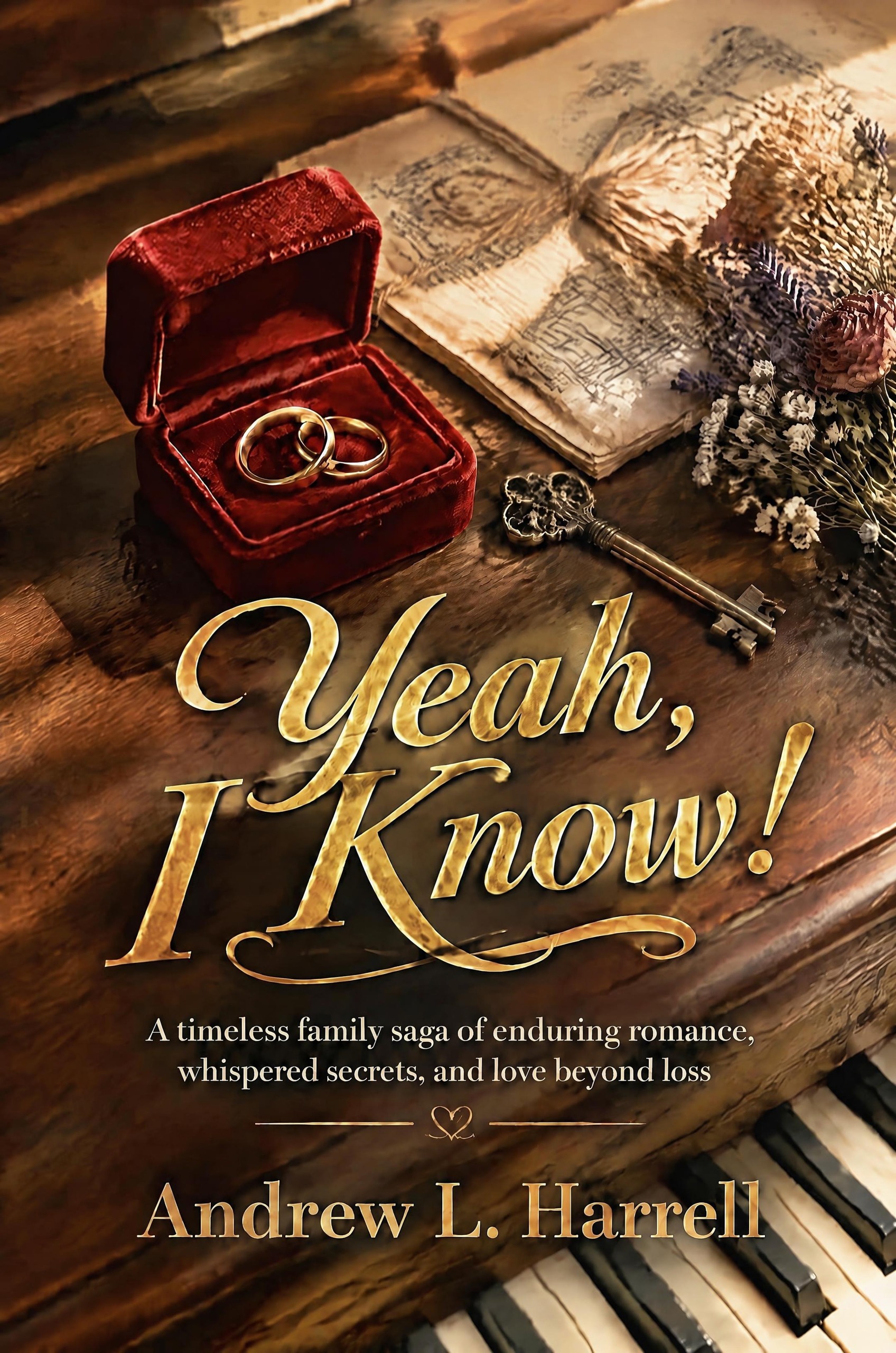
Yeah, I Know!
A timeless family saga of enduring romance, whispered secrets, and love beyond loss
Valentine’s Day is not merely a celebration for the young, but an enduring testament for those whose devotion has weathered decades. Eighty-five-year-old Karla Kaye Russo sits quietly outside Memorial Vista Cemetery on a brisk February morning, her heart brimming with sixty-eight years of memories. From an accidental collision in a high school hallway in 1969 to decades of laughter, music, and raising three children alongside their beloved dog, her marriage to Giovanni De Luca was an extraordinary journey built on small, profound kindnesses. Even six years after cancer stole Gio away, their private bond endures, etched forever into their wedding rings: 'KNOW WHAT?' and 'YEAH, I KNOW!' When Karla gathers her grown children and grandchildren for a family dinner, she reveals a hidden velvet-lined keepsake box discovered inside Gio’s vintage piano. Tucked inside are an unplayed musical score, a mysterious brass key, and a deed to an abandoned lakeside pier—his final Valentine's gift. As old family tensions surface and grief gives way to shared devotion, three generations set out to rebuild the forgotten dock. Facing an unexpected storm and the fragile passage of time, they discover that true love is an everlasting melody that never fades. Yeah, I Know! is a tender, sweeping multigenerational portrait of profound romance, grief, and family devotion that will linger in your heart long after the final page.
- Literary Fiction
- Romance
- Enduring Love
- Grief & Loss
- Generational Saga
- Contemporary Romance
Red Lights and Palomado Lane
The light at the corner of Harbor and Vista Boulevard had always taken its time changing, long before the cemetery gates were built, long before the town council planted the row of crepe myrtles that now stood bare and knuckled against the February sky. Karla Kaye Russo sat with both hands on the wheel of her old sedan, the engine idling low, and watched the red glow hold steady above the intersection as if it, too, understood that some mornings asked for patience.
Behind her, the car was full of voices. Five grandchildren were crowded into the back two rows, their coats still buttoned against the chill, their breath fogging the windows despite the heater Karla had cranked as high as it would go. Nine-year-old KarlaKaye sat closest to the door, her overalls streaked with what looked like yesterday's grass stains, a bundle of white winter carnations wrapped in damp paper tissue resting across her knees like something precious.
"Grandma, is it still red?" KarlaKaye asked, craning her neck to see past the headrest.
"Still red, honey. These lights like to make us wait a little."
"Dad says you drive too slow."
"Your dad also thought he could beat me at checkers until he was thirty-one," Karla said, and the children in the back laughed in the easy, overlapping way children laugh at anything that sounds like a small victory for their grandmother. Karla smiled at the windshield, at the gates of Memorial Vista just visible beyond the intersection, the old stone archway dusted with a light frost that hadn't yet burned off in the morning sun.
She did not mind the light. She had long ago stopped minding the small delays life handed her, the waiting rooms and red lights and empty chairs at the table, because waiting, she had learned, was simply where memory liked to come and sit beside her.
It came now, as it always did at this particular intersection, the way a favorite song comes uninvited to the radio.
She was seventeen again, her arms loaded with a geometry textbook and three library books she had sworn to return that very afternoon, hurrying around the corner outside the chemistry lab in building five of Colombo High School because the bell had already rung and Mrs. Castellano did not forgive tardiness, not even for the daughter of the woman who ran the school cafeteria. She remembered the particular squeak of the floor wax under her saddle shoes. She remembered rounding that corner too fast.
And she remembered him. Giovanni De Luca, broad-shouldered even at seventeen, moving with the unhurried confidence of a boy who had never once in his life worried about being late to anything, his dark hair falling across his forehead in a way that several girls at Colombo had already spent considerable energy discussing in the girls' room between classes. He had not seen her coming any more than she had seen him. They collided with the soft, undignified thud of two people who are each quite certain the hallway belongs to them alone, and her books scattered across the polished floor in a fan of paper and binding.
"Whoa, there," he'd said, already crouching to gather her books before she could, his hands moving faster than his apology. "You all right?"
"I will be, once I find my geometry book before the bell rings again."
"This one?" He held it up, grinning like he'd found buried treasure instead of a battered textbook with her name written in blue ink on the inside cover. Karla Kaye Ferraro, it said, the letters careful and round, the handwriting of a girl who still dotted her i's with small circles.
"That's the one."
"Ferraro," he'd said, testing the name like he was tasting something unfamiliar and deciding he liked it. "I'm Gio."
"I know who you are," she'd told him, because everyone at Colombo knew who Gio De Luca was, star of the soccer team, the senior boy who could make even the strictest teachers laugh without once losing control of a classroom. "You knocked my books out of my arms."
"I'll carry them to your next class as an apology."
"I don't need an apology that follows me to class."
"Then I'll carry them because I want to," he'd said, and something about the plainness of it, the lack of any flourish, had stayed with her longer than any of the practiced lines the other boys tried out on girls in that hallway. He had walked her to English, late, both of them, and neither of them had particularly minded.
February eleventh. She had never once, in sixty-eight years, needed to check a calendar to remember the date.
A horn sounded behind her, short and apologetic, the kind of honk that meant the light's green, ma'am, no rush rather than any real impatience, and Karla blinked the hallway away and eased her foot onto the gas pedal. The old sedan rolled forward beneath the stone archway of Memorial Vista, its tires finding the familiar seams in the pavement, and the morning sun came through the bare branches overhead in long slatted ribbons across the hood.
"We're here, we're here," sang out one of the younger boys from the back seat, and KarlaKaye shushed him gently, the way she had learned to do from watching her grandmother, as though the cemetery itself required a softer volume of voice.
Palomado Lane curved away from the main drive in a long, unhurried bend, bordered on both sides by old live oaks whose roots had buckled the asphalt in places over the decades the groundskeepers had never quite managed to fix. Karla knew every one of those buckles by heart, knew exactly where to ease the wheel so the children in the back wouldn't feel the bump too hard. She had driven this lane more times than she could count, in every season, in sunlight and in rain that came sideways off the coastal hills, and the lane always felt the same to her: quiet, green even in winter, patient in the way that only a place built to hold the dead could be patient.
She parked where she always parked, beneath the widest of the oaks, and turned off the engine. For a moment nobody moved. The children, all five of them, seemed to understand without being told that this part of the day required a kind of stillness before the doors opened, a breath taken together before the walking began.
"All right," Karla said finally, and reached for her door handle. "Let's go see your grandfather."
They came out of the car in a tumble of coats and sneakers, the younger ones racing ahead a few steps before catching themselves and slowing, remembering, the way children do when a place teaches them its rules the first few times they visit it. KarlaKaye stayed close to her grandmother's side, the carnations still clutched in both hands, and offered her free arm the way she had seen her mother do a hundred times, though Karla did not truly need the support, not yet, not today.
They walked east along the gravel path, past rows of granite markers softened by lichen and time, past a scattering of small American flags left over from some earlier holiday, until they reached the gentle rise where the De Luca stone stood beneath a young maple that Gio himself had insisted on, years ago, when he'd purchased the plot and the tree both in the same visit, saying a man ought to have shade even after he was done needing it.
Karla stopped walking before the children did. She always did. It was a small thing, a pause of only a few seconds, but her body had learned over six years to ask permission of the ground before her feet crossed onto it.
And then she saw them.
A spray of white gardenias, fresh enough that their edges hadn't yet browned in the cold, lay propped against the base of the polished stone, tied with a thin ribbon of pale green. Karla stood very still.
"Grandma?" KarlaKaye had noticed the pause and now noticed the flowers too, her head tilting in the particular way that meant a question was coming. "Did you bring those already? This morning?"
"No, honey." Karla's voice came out quieter than she meant it to. "I didn't bring those."
She crouched, slower than she would have liked, one hand finding the cold edge of the headstone to steady herself, and looked at the flowers more closely. Gardenias had never been Gio's flower of choice to give her, not in sixty-eight years. He had always brought her carnations, cheap and plentiful at the corner market, because he said a man shouldn't need an expensive flower to say what he meant, and somewhere along the way the carnation had become theirs the same way the song on their wedding reception playlist had become theirs, or the particular pale blue of their kitchen walls had become theirs. Gardenias belonged to someone else's story.
"Maybe somebody else loved Grandpa too," said one of the younger boys, matter-of-fact in the way only a seven-year-old could manage, and for a moment Karla almost laughed, because it was exactly the kind of thing Gio himself might have said, teasing her about some imagined rival just to see her roll her eyes.
"Maybe," Karla said instead, and let it be. There would be time later to wonder about it, to ask Francesca or Barbara whether either of them had heard of anyone else visiting, but she did not want to spend this particular morning chasing a mystery when there was a whole ritual of remembering still waiting to be done. She set the thought aside gently, the way she had learned to set aside so many things over the years, not forgotten, only waiting.
The children gathered around her now in a loose half circle, and Karla lowered herself onto the cold grass with the careful deliberateness of a woman who had made peace with her knees a long time ago. KarlaKaye sat closest, tucking her legs beneath her, the carnations resting across her lap again.
"Sit with me a minute," Karla said, and one by one the other four settled onto the grass as well, a girl of eleven named Lily who was Dom's eldest, two boys who belonged to Francesca, and the youngest of the bunch, barely five, who climbed straight into Karla's lap without being asked and pressed his cold nose against her cardigan.
"Tell us something about Grandpa," KarlaKaye said. "Something we haven't heard."
Karla looked at the stone a moment, at the carved letters of his name, Giovanni Michaelangelo, and felt a smile tug at her mouth before she'd even decided what story to tell.
"Did I ever tell you about the salt in the sugar bowl?"
A chorus of no's, eager and immediate.
"Well," Karla said, settling the little one more comfortably against her, "your grandfather loved his coffee sweet. Sweet enough to make your teeth hurt just watching him stir it. And every morning for years, without fail, he'd come down those stairs in our first little house, still in his robe, hair a mess, and he'd reach for that sugar bowl like it was the most natural thing in the world."
"What happened?" Lily asked, leaning forward.
"One April morning, I decided I was tired of him teasing me about how slow I made the coffee, so I switched the sugar for salt the night before, hid the real sugar bowl clear up in the cabinet over the refrigerator where he'd never think to look, and I sat right there at that kitchen table and waited."
"Did he yell?" asked the youngest boy, delighted at the idea.
"He did not yell," Karla said, smiling now at the memory the way a person smiles at an old photograph they still love even though the colors have faded. "He took one sip, and his whole face went still, the way your face goes still right before you realize something's gone very wrong. And then he looked at me, very serious, very solemn, and he said, 'Karla Kaye, know what?'"
KarlaKaye's eyes lit at the familiar phrase, the one she had heard her mother and her uncles repeat for as long as she could remember, though she had never once heard the story that started it.
"What did he say, Grandma? What did he say after know what?"
"He said, 'Know what? This is the worst cup of coffee a man has ever had the misfortune to swallow, and I am still the luckiest man in the state of California for drinking it in your kitchen.'"
The children laughed, a bright unguarded sound that seemed almost too loud for the quiet rows of granite around them, and Karla laughed with them, the sound catching a little in her throat the way laughter sometimes does when grief is standing just behind it, patient, waiting its turn.
"And that's where it started," Karla said, once the laughter had settled. "'Know what?' He said it after that for the rest of his life. Any time he had something worth saying, good news or bad, silly or serious, he'd start it that way. 'Know what?' And I learned pretty quick what I was supposed to say back."
"What'd you say back?" KarlaKaye asked, though Karla suspected the girl already knew, had heard the phrase a hundred times at family dinners without ever understanding its full weight.
"'Yeah, I know.'" Karla reached out and touched the carved rings on the stone before her, the two bands interlaced in granite, the words etched small and private inside each one. "Even before he finished telling me whatever it was he wanted to tell me, I'd already say it. 'Yeah, I know.' Because most of the time, honey, I did already know. I knew him that well. And when I didn't know yet, I said it anyway, because I knew I would feel the same way about it once he told me. That was our promise to each other, long before we ever put it on a ring or a stone. Know what. Yeah, I know."
KarlaKaye was quiet a moment, turning the phrase over the way children turn over new stones at the beach, checking all the sides of it. "So it's not really a question," she said finally. "It's like... he's telling you something is coming, and you're telling him you'll love it no matter what it is."
Karla looked at her granddaughter, this small sharp-eyed girl who carried her name and, it seemed more and more these past few years, something of her grandfather's way of seeing straight through to the heart of a thing.
"Yes," Karla said softly. "That's exactly what it is."
They sat a while longer in the cold grass, the little one in her lap growing heavy and drowsy against her, the older children quiet now, studying the stone the way Karla had taught them to study it, not with fear but with a kind of curiosity, the way you might study a photograph of someone you loved but had never quite gotten to meet in the flesh.
After a time, Karla reached into the folds of her coat pocket for the small shears she always carried and trimmed the stems of the carnations KarlaKaye had been holding, dividing the bundle among all five children so that each one had a small sprig of their own.
"Everyone gets to place one," Karla said. "Right along the base there, under his name."
They helped her to her feet first, four small hands gripping her arms and elbows with more earnestness than actual strength, and she rose slowly, her knees protesting in the familiar way, until she stood upright again beside the stone with the wind moving gently through the bare branches of the young maple overhead.
One by one, the children stepped forward. Lily went first, setting her carnation with great ceremony exactly beside the gardenia spray already there, as though she too had noticed the mystery of it and meant to make peace with it by proximity. Then the two boys who belonged to Francesca, each placing their flowers with the slightly bored efficiency of children who understood the importance of the moment without yet feeling its full weight, and then the littlest, who had to be lifted by Karla herself to set his flower where he wanted it, high up near the engraved letters of the surname.
KarlaKaye went last. She crouched low in front of the stone, carnation in one hand, and reached out with the other to trace the carved letters of her grandfather's name, her small fingers moving slowly across the cool granite, following the curve of the G, the straight climb of the I, pausing at the space between Giovanni and Michaelangelo as though counting the letters mattered.
"Grandma," she said without looking up, "does it feel different? Touching his name here, instead of just saying it out loud at home?"
Karla considered the question seriously, the way she had always tried to answer her grandchildren's questions, because she had learned long ago that children rarely asked anything they didn't truly want to know.
"It feels like visiting," Karla said. "When we say his name at home, around the table, that's remembering. That's keeping him close in the ordinary way, the everyday way. But coming here, touching the stone, that's visiting. Sometimes a person needs both. Sometimes remembering isn't quite enough, and you need to come and sit a while, the way you'd sit with a friend."
KarlaKaye nodded slowly, still tracing, and moved her fingers down to the carved wedding bands, the two interlaced circles catching the thin winter sunlight in a way that made the engraving inside each one briefly legible, the small block letters visible only if you knew exactly where to look and how the light needed to fall.
"Know what," KarlaKaye read aloud, sounding out the words slowly though she had surely heard them before, and then, moving her fingers to the second band, "Yeah, I know." She looked up at her grandmother, her freckled nose pink from the cold. "Can I say it? Like you and Grandpa did?"
"You can say anything you want to him, honey. He's listening."
KarlaKaye turned back to the stone, laid her carnation gently beside the others, and said, in a voice that was trying hard to be solemn and only partly succeeding, "Know what, Grandpa? I got an A on my spelling test. The whole list. Even the word 'February,' and that one has a silent R that everybody forgets."
The other children laughed softly, and Karla felt something warm move through her chest, something that was not quite grief and not quite joy but some third thing that lived in the space between them, the thing she had been feeling more and more often these past six years whenever her grandchildren found their own way into the ritual she and Gio had built so long ago.
"He'd be awfully proud of that," Karla said. "He never could spell February right either, not until the day he died. Always left out that same silent R."
"Then how'd he propose to you with a card?" Lily asked, catching some earlier family story that had apparently made the rounds without Karla's knowledge. "Didn't Mom say he wrote you a card once that had February on it?"
"He did," Karla said, laughing a little. "And he spelled it wrong, and I kept the card anyway, because a man who can't spell the name of the month he fell in love with you doesn't need perfect spelling. He needs a good heart. Your grandfather had the best one I ever knew."
They stood together a while longer in the cold, the children quieting again on their own, each of them in their own way studying the stone, the carved rings, the two names waiting side by side, one with dates that bracketed a long full life now ended, the other still open, still unfinished, still waiting for its second date the way a sentence waits for its final word.
Karla looked down at her own name carved there beside his. Karla Kaye Russo. Beneath the shared surname, beneath the De Luca that she and Gio had worn together for sixty-five years of marriage, her own line sat with its dash left empty, the way it had sat empty for six years now, a small blank space that did not frighten her the way she suspected it ought to. She had made her peace with it slowly, the way she had made her peace with so many things since the funeral, understanding that the empty space beside Gio's finished dates was not an ending waiting to happen but simply a fact of living longer, a fact she intended to fill with as much life as she had left in her, for as long as she had it.
"Grandma." KarlaKaye tugged gently at her sleeve. "Who do you think left the white flowers?"
Karla glanced once more at the gardenia spray, pale and fresh against the granite, its ribbon stirring faintly in the breeze that moved down off the rise.
"I don't know, honey," she said honestly. "But whoever it was loved him too, in their own way. I suppose that's allowed. A man like your grandfather, there was plenty of love to go around."
She said it lightly, the way she tried to say most things that troubled her a little, but some small part of her mind had already begun turning the mystery over, wondering who in the world still came to this particular rise of ground to leave flowers that weren't carnations, flowers that spoke a language she didn't recognize. She tucked the wondering away for later, the way she tucked away most things that could wait, and reached instead for the littlest boy's hand, who had grown tired of standing and was now leaning heavily against her leg.
"All right," she said. "I think your grandfather has had his visit for today. Let's let him rest a bit, hm? Say your goodbyes."
One by one they said it, in their own small ways. Lily touched the stone once more and said she'd see him soon. The two boys said goodbye in near unison, already distracted by a squirrel darting along the low branch of the maple overhead. The littlest one simply waved, the way he waved at everything, uncertain and sweet.
KarlaKaye lingered longest, crouched once more beside the stone, her hand resting flat against the cool granite the way a person rests a hand against the shoulder of someone they love.
"Bye, Grandpa," she said softly. "Thanks for teaching Grandma the thing with the sugar bowl. I'm gonna do that to my brother someday."
"KarlaKaye," Karla said, half-scolding, half-laughing, reaching down to help the girl to her feet, "your grandfather would absolutely approve of that plan, and that is exactly why I am not going to stop you."
They walked back together along the gravel path, the children's chatter rising again now that the solemn part of the morning had passed, talk of lunch and cartoons and whether or not the squirrel they'd seen had been the same one from last visit. KarlaKaye walked close beside her grandmother, matching her slower pace without seeming to notice she was doing it, the way children do when love makes them generous without their even realizing it.
"Grandma," she said as they neared the car, "do you think he can hear us? When we say know what and stuff?"
Karla stopped at the car door, her hand on the cold handle, and looked back once toward the rise where the young maple stood over the stone, its branches still bare against the pale winter sky, the white gardenias just visible from here, a small pale smudge against gray granite.
"I think," she said slowly, choosing the words the way she chose most things these days, with care, "that love has its own way of traveling, even when we can't see exactly how it gets where it's going. I don't know if he hears the words exactly the way you and I hear each other. But I believe he knows. I believe he's always known, every single day, every single Valentine's, whether I said it out loud or not."
KarlaKaye considered this with the particular seriousness of a nine-year-old deciding whether an answer satisfied her, and then nodded, apparently content, and climbed into the back seat beside her cousins.
Karla stood a moment longer by the open car door, one hand still resting on the cold metal, looking back across the quiet rows of granite toward the rise where her husband's name waited beside her own unfinished one. The cold had settled into her fingers and the hem of her cardigan, but she did not mind it, not yet, not on this particular morning when so much of the day still lay ahead of her, full of family and flowers and the small unanswered mystery of a stranger's gardenias resting against her husband's stone.
She thought, not for the first time, that grief and love had turned out to be far more alike than anyone had ever told her they would be, both of them patient, both of them willing to wait at a red light for as long as it took, both of them arriving, eventually, exactly when they were needed.
"Buckle up back there," she called over her shoulder, settling herself behind the wheel at last. "All five of you. I promised your mothers I'd bring you home in one piece."
A chorus of clicks answered her, seatbelts snapping into place, and in the rearview mirror she caught KarlaKaye's eyes, bright and curious still, watching her grandmother with the quiet attention of a girl who had just learned something about love that she would carry, Karla suspected, for the rest of her own long life.
Karla started the engine, and the old sedan rolled slowly back down Palomado Lane beneath the bare oaks, past the rows of granite and the scattered winter flags, toward the archway and the intersection beyond it, where, she had no doubt, the light would be red again, patient and waiting, exactly as it always was.
Building Five Echoes
The gravel path narrowed as it left the rise, and Karla took KarlaKaye's hand without quite deciding to, the way she had done a thousand times over nine winters, more out of habit than need. The other four children ranged ahead, their sneakers kicking up small clouds of frost-dried dirt, their voices already drifting toward lunch and cartoons and w…