

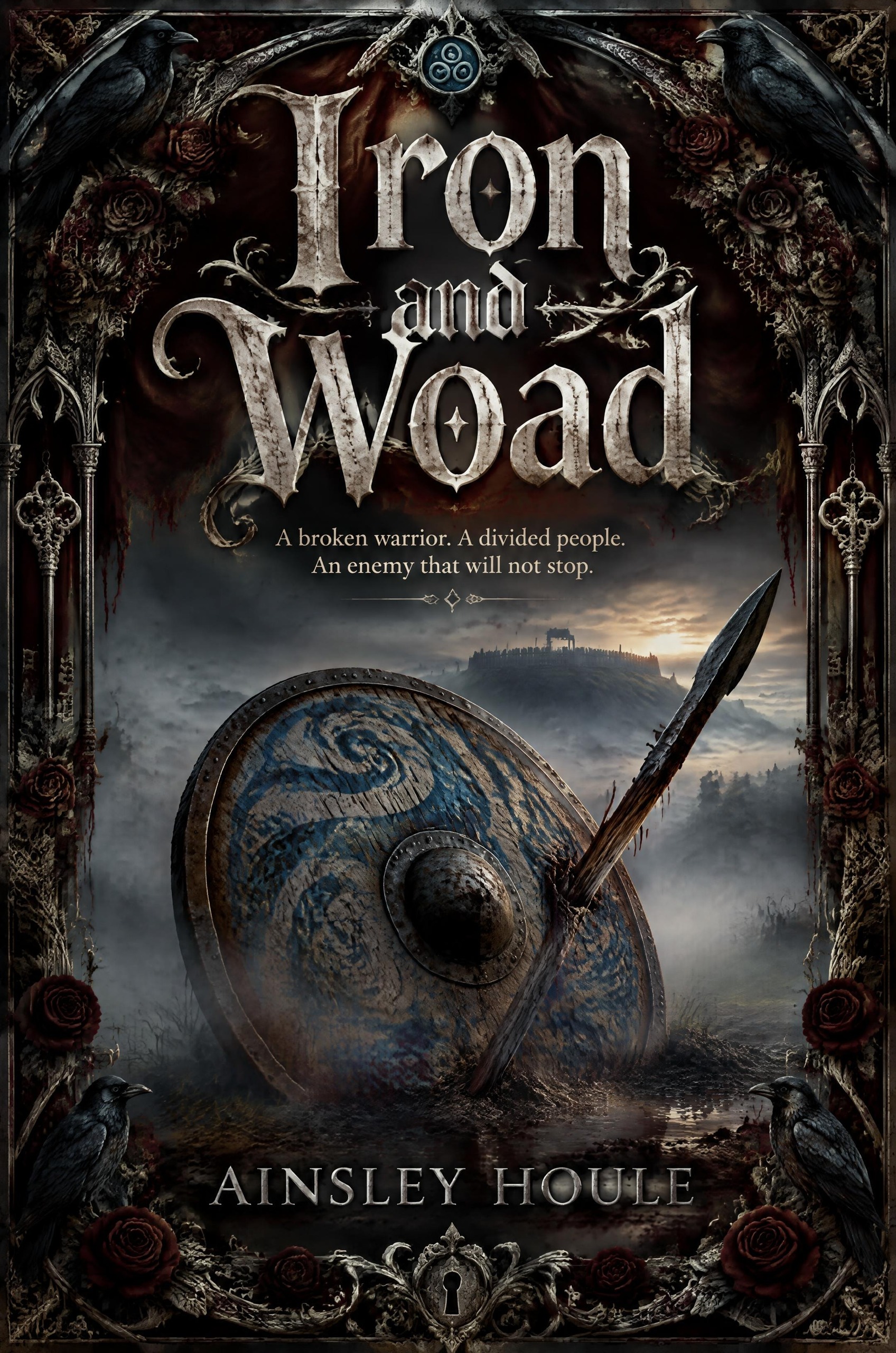
Iron and Woad
The tribes must unite or die. They have chosen neither.
by andrew Ward
The Romans are gone. The Saxons are coming. And the tribes of Britain cannot stop fighting each other long enough to notice. Cadwgan Treharne knows what it costs to face the Saxon war-bands alone. He carries the scars on his back from years in their chains, and the deeper wound of a father he could not save. Now the enemy is pushing deeper into the western valleys, and his small hill fort does not have the warriors to hold them. When the memory-keeper Eiluned Vaughn summons the chieftains to council, Cadwgan sees a chance to unite the fractured tribes before they are picked off one by one. But unity has enemies on both sides of the shield wall. Iorwerth Pritchard, a rival chieftain with old grudges and older rumors, will burn any alliance that does not put him at its head. Rhiannon Madoc, a widow trapped in Iorwerth's household as a political token, holds the knowledge that could bring him down. When Saxon raiders capture Cadwgan's daughter, he must choose between the alliance he is building and the child he is fighting for. Iron and Woad is a gripping novel of Dark Age Britain, where survival depends not on the sharpest sword but on the stubborn endurance of those who refuse to let their world die.
- Historical Fiction
- Adventure
- Medieval
- Military Adventure
- Survival
- Action Adventure
The Saxon's Thrall
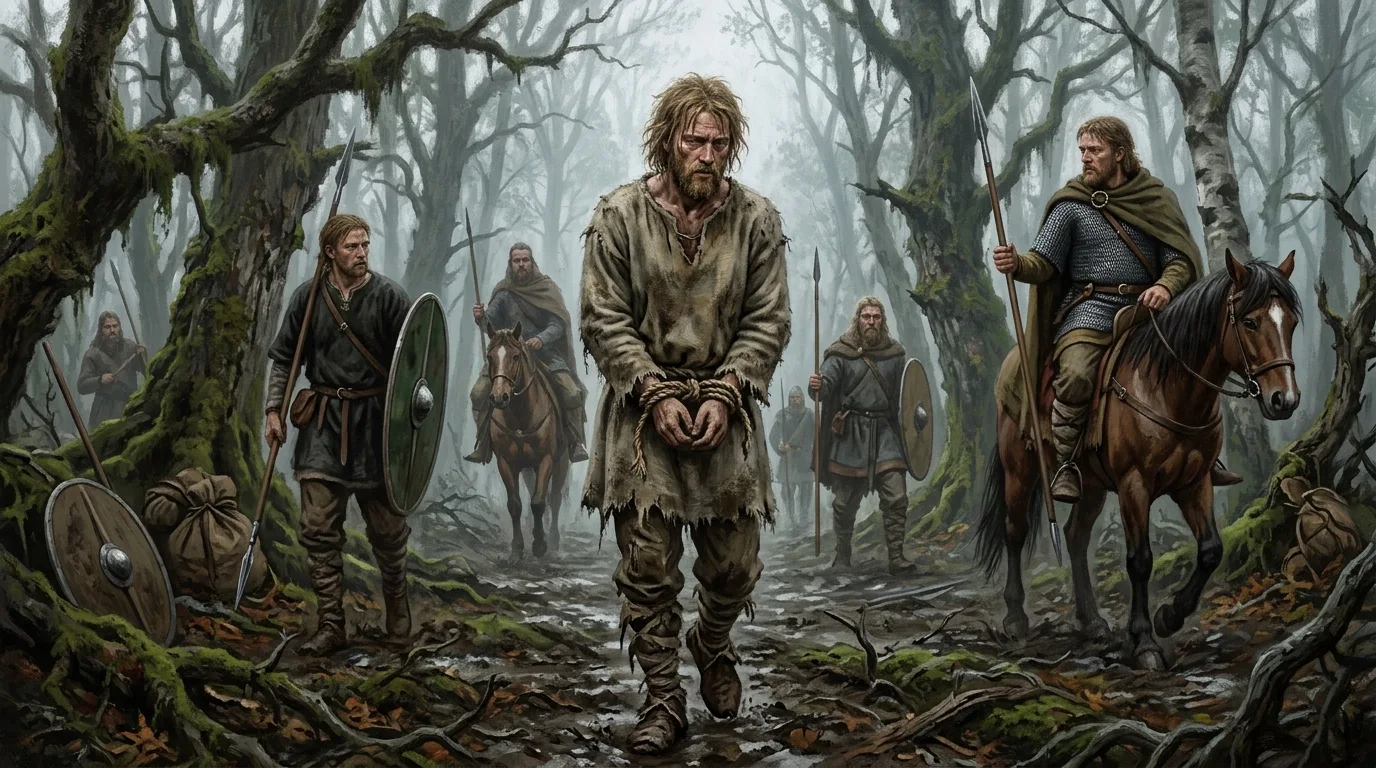
The campfires were the first thing Cadwgan Treharne saw each night, and the last before sleep. They burned in the valley below his hill fort like scattered embers from a dead god's forge, too many to count, too close to ignore. Three more steadings had gone up in smoke this week. The wind carried the smell of it up the slopes: wet ash, turned earth, the sweetness of things that should not be burning.
He stood on the wooden ramparts with his weight on his good leg and watched a new fire catch near the river crossing. Sixty-three warriors. That was what he had. His father had commanded twice that before Black Brook, before the Saxons broke the shield wall and took Cadwgan in chains. Before the whispers started.
The damp made his leg ache tonight. Three years in Saxon iron had marked him in ways that showed and ways that did not. The limp was the showing kind. He shifted his weight as the familiar pull tightened in the muscle, the old wound refusing to let him forget.
"Bryn."
His second stepped out of the shadow by the gate. Bryn was twenty years older than Cadwgan and had served under his father. He never spoke of that day at Black Brook, and Cadwgan had never asked.
"How many watch-fires tonight?"
"Seven new ones since last night." Bryn spat over the rampart. "They're not raiding. They're settling."
Cadwgan said nothing. Settling was worse than raiding. Raiders came and went. Settlers stayed until everything that had been there before was gone.
Inside the longhall, the evening meal was already laid. His daughter Elen moved among the benches with the practiced stillness of a girl who had learned to serve before she learned to smile. She was twelve now. When he had been taken, she was barely walking. When he returned, she was a stranger with his dead wife's eyes.
She did not call him father. She called him nothing at all, if she could avoid it.
He took his place at the high table and watched her pour ale for the warriors with the same careful distance she used for everyone. She did not look at him. She had stopped looking at him years ago, and he had stopped knowing how to change it.
"Elen."
She paused, pitcher in hand.
"The bread is good tonight."
She nodded once, a small dip of her chin, and moved on to the next bench. That was the longest exchange they had managed in a week.
The meal was nearly finished when the watch called down from the gate. A traveler, alone, with a staff. Cadwgan set down his cup and listened to the rhythm of the knock: three strikes, pause, two strikes. The old pattern. The knock of someone who expected to be recognized.
Bryn opened the gate, and Eiluned Vaughn walked into the firelight.
She was smaller than Cadwgan remembered, weathered down by grief and weather and long nights by the fire reciting the names of the dead. Her silver hair was cropped short in the custom of a woman who had put mourning behind her but carried it still in the lines of her face. The rowan staff in her hand struck the packed earth of the courtyard with each step, and the bronze bird pinned at her shoulder caught the light like something alive.
"I have walked three days from the eastern tribes," she said, and her voice filled the yard the way it filled a hall, trained to carry and hold silence. She looked at Cadwgan and did not smile. "The chieftains are gathering at the Great Stones. There is to be a council."
Cadwgan gestured toward the longhall. "Come inside. You did not walk three days to stand in my mud."
She followed him in and took the seat he offered by the hearth. Elen brought her ale without being asked, and Eiluned studied the girl with eyes that missed nothing before turning back to Cadwgan.
"Your invitation was contested," she said.
He had expected that. It still landed like a stone in his gut. "Who spoke against me?"
"Does it matter?"
"Was it Iorwerth."
She did not deny it. Her thin hands wrapped around the cup, and for the first time since arriving, something flickered in her expression. Not pity. Something harder.
"Iorwerth Pritchard has spent more years than I care to count spreading the tale that you survived your captivity by betraying your father's battle plan at Black Brook. Many of the eastern chieftains believe him. Some of the western ones do as well." She paused. "They call you the Saxon's Thrall behind your back."
The words hung in the hearth-smoke. The old heat rose in Cadwgan's chest, and he forced it down. Anger was a luxury he could not afford. His father had been angry. His father had charged the Saxon line at Black Brook with his shield high and his mouth open in a scream no one heard over the clash of iron, and sixty good warriors had died because of it.
"And yet you are here," he said. "You argued for me."
"I did." Eiluned set down her cup. "The old songs show a thing that the young warriors forget. Broken men sometimes build the strongest walls. The ones who have been shattered and put themselves back together understand what it costs to hold." She looked at him steadily. "I did not walk three days to flatter you, Cadwgan Treharne. I walked three days to tell you that if you want this alliance, you will have to face everything you have been avoiding. The stares. The whispers. Iorwerth himself. And you will have to convince men who think you a coward that you are worth following."
"And if I do not come?"
"Then Iorwerth convinces them to make peace with the Saxons. Separate peace, tribe by tribe. And by the time the Saxons come for your hill fort, there will be no one left to stand beside you." She rose. "I leave at dawn. Decide by then."
She did not wait for his answer. The rowan staff struck the floor, and she walked out into the darkness toward the guest hut, leaving Cadwgan alone with the dying fire.
He did not sleep. He went to the smithy instead, where the coals still held their orange heat from the day's work. The Saxon sword hung where he had placed it the night he returned, oiled and wrapped in cloth, untouched for years. He took it down and drew the blade.
The steel was good. He had taken it from a thegn during his escape, killed the man with his own chains and run through the marsh while dogs bayed behind him. The sword had been a trophy then. A reminder that he had survived. The whispers had turned it into something else: proof that he had traded what the dead at Black Brook had not been willing to give.
He tested the edge with his thumb. Still sharp. He had kept it that way for years, waiting for a purpose he could not name.
The forge bellows creaked in the silence. Outside, the watch-fires burned in the valley; Cadwgan stood alone with the blade in his hands and the weight of his father's ghost pressing down on him. Going to the council meant walking into a hall full of men who thought him a coward. It meant standing before Iorwerth Pritchard and knowing that every eye in the room would be weighing him against the rumors.
Staying meant watching the fires creep closer until there was no one left to watch them with.
He sheathed the sword and walked out into the yard. Bryn was still at the gate, wrapped in his cloak against the damp.
"Prepare the horses," Cadwgan said. "We ride at dawn."
The Council of Stones
The Great Stones rose from the hilltop like broken teeth, gray and ancient against a sky the color of wet iron. Cadwgan had not seen them since he was a boy, when his father brought him to a council and told him that men had gathered here to settle their feuds since before the Roman eagles flew. The stones had not changed. The men had. He rode wit…