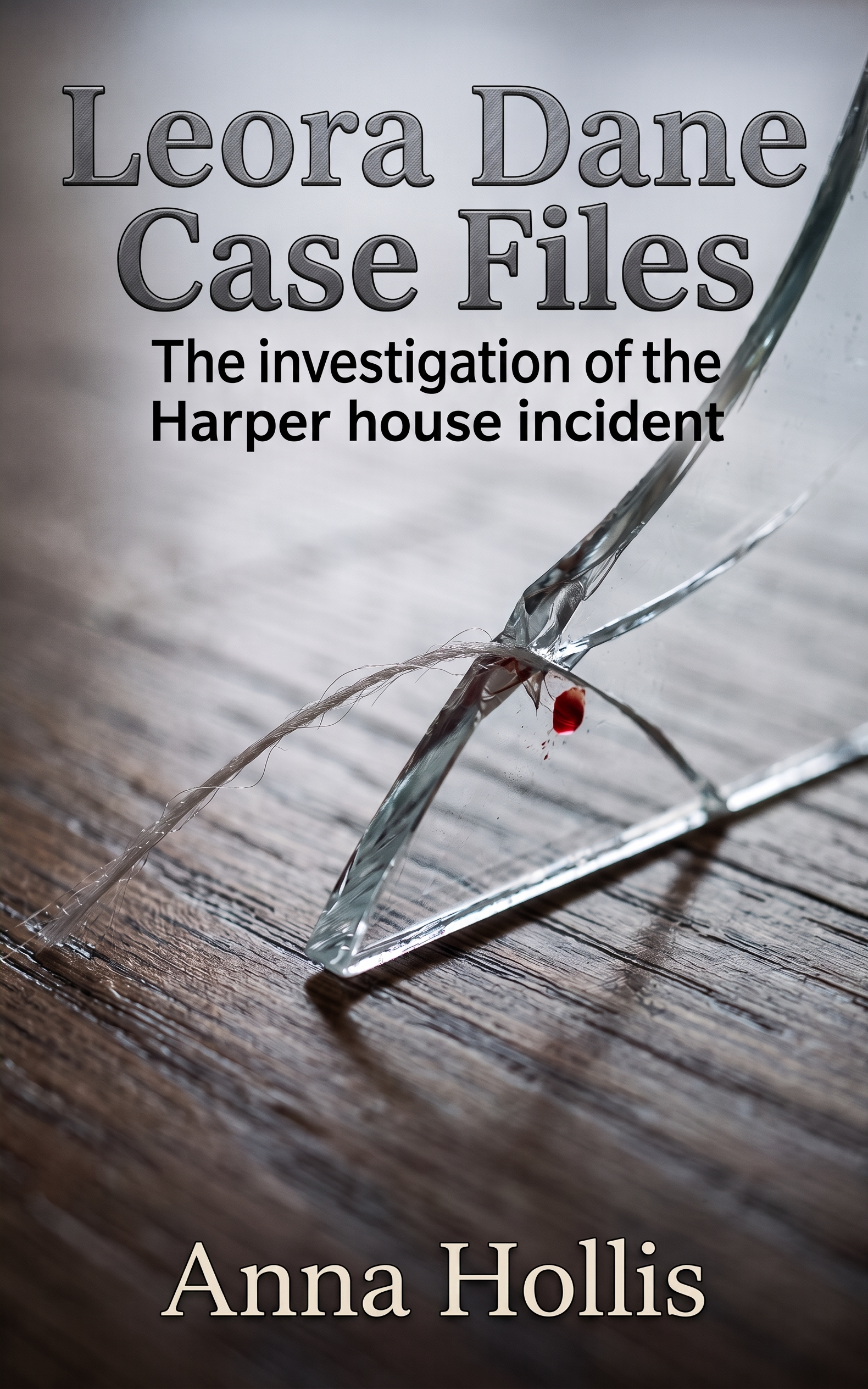
Leora Dane Case Files
The investigation of the Harper house incident
by Anna Hollis
A simple slip. A tragic fall on a living room rug. That is the story everyone in the department is ready to believe about the death of Sarah Harper. But Leora Dane does not believe in accidents. At twenty-three, Leora is the youngest investigative consultant the department has ever hired, possessing an obsessive eye for the physical echoes of truth. While the Captain and the Mayor push for a quick resolution to preserve the neighborhood's pristine reputation, Leora sees the fractures: the misplaced dust lines, the microscopic glass shards, and the suspicious bruising that tells a story of restraint rather than a stumble. Working alongside her only ally, Detective Mercer, Leora peels back the layers of a domestic tragedy built on coercive control and financial blackmail. But the truth comes with a price. As she dismantles a killer's meticulously staged defense, she must confront the toll her genius takes on her own mind. In the Harper house, the most dangerous things are not what is missing, but what has been carefully put in its place. Justice requires a witness, and Leora Dane is the only one who sees everything.
- Mystery
- Thriller
- Crime Fiction
- Police Procedural
- Psychological Thriller
- Crime Thriller
The Scene
Leora Dane stood at the edge of the driveway, still as stone. Her boots felt heavy on the damp asphalt, moisture from the earlier rain seeping upward through the soles. The air hung thick with humidity—that particular density after a storm, when water hadn't fully evaporated but remained suspended, waiting. The temperature had dropped maybe ten degrees in the last hour. She could feel it against her face, a coolness that made her skin tighten.
That was always the first step. Not forward. Not into the house. Not into someone else's version of events.
Stillness first.
The first impression of a scene existed for only a few seconds—the fleeting moment before questions, assumptions, and bureaucratic pressure colonized it and forced it to make sense. After that, the truth became layered. Distorted. It began to leak into the biases of whoever found it first. So she stood still and let the scene come to her.
Her breathing had already shifted—slower, deeper, the kind of breath that came from deliberate control rather than anxiety. She'd learned to recognize the difference. Anxiety made you shallow and fast. Investigation required the opposite: a settling into the body, a grounding that let her peripheral vision expand. She forced the tension from her shoulders and felt them drop. Her hands hung loose at her sides. To anyone watching, she probably looked like she was just standing there. But her entire nervous system had recalibrated.
The air carried the faint, sharp smell of damp pavement and freshly cut grass. A mundane sweetness that felt wrong beside the yellow tape. The tape hung loose in places, sagging between stakes driven into the lawn. She could see where someone had stretched it too tight on one side, causing the opposite end to droop. Uneven tension. Someone had been in a hurry. The stakes tilted at slightly different angles—not the careful, perpendicular placement of someone taking their time, but the quick, efficient work of someone who wanted the scene secured and moved on.
Down the street, a porch light flicked on, then off again with a sharp clack. Someone had looked—and decided not to keep looking. In a neighborhood like this, distance was a choice. Three houses down, a dog barked once, then went silent. Cut off mid-sound, like someone had hushed it. The ambient noise felt wrong for 2 AM—too quiet, too held. Even the insects had stopped. The air felt watched. Not by people necessarily, but by the neighborhood itself, by its collective decision to look away.
Leora understood that instinct. Some scenes got under your skin before you even crossed the threshold. You could feel the structure of the air change, a thinning of reality. The house in front of her—two stories, pale siding, a clean porch with a single wicker chair positioned at precise right angles to the doorframe—already felt like that. Too ordinary. Too maintained. The kind of house that looked staged for a photograph, holding its breath, waiting to be misread.
The front yard was small, maybe twenty feet from sidewalk to porch. The grass had been mowed recently—she could see the striped pattern even in the patrol light.
Leora understood that instinct. Some scenes got under your skin before you crossed the threshold. You could feel the air change, reality thinning. The house in front of her—two stories, pale siding, a clean porch with a single wicker chair positioned at precise right angles to the doorframe—already felt like that. Too ordinary. Too maintained. The kind of house that looked staged, holding its breath, waiting to be misread.
The front yard was maybe twenty feet from sidewalk to porch. The grass had been mowed recently—she could see the striped pattern even in the patrol lights' glow, lines so precise they suggested a riding mower. No flower beds. No decorative stones. Just grass and a concrete walkway leading to three wooden steps. The mailbox stood at the curb, its flag down. Normal. Everything looked aggressively normal. The kind of normal that came from deliberate maintenance, from someone who understood that appearances mattered.
But the side yard—that was different. A wooden fence ran along the property line, maybe six feet tall, weathered to soft gray. The gate hung slightly open, its latch undone. Not broken. Just... open. Like someone had passed through and hadn't bothered to close it. Or had left it open deliberately, creating an exit route. She could see the depression in the grass where the gate's swing had worn a path—not recent, but established. Someone had used that gate more than once.
Behind her, the SUV door closed with a muted thud that echoed down the street. Mercer didn't rush her. He stood by the fender, the flare of a lighter illuminating the deep lines of his face before he let the silence stretch. She could feel him watching her without looking—not impatient, not curious, just present. This moment wasn't about movement; it was about calibration. He'd learned that in the two years they'd worked together. He'd learned to read her the way she read scenes.
"Call came in twenty minutes ago," Mercer said eventually, his voice low. "Husband says she slipped."
Slipped.
A clean word. A frictionless word. Leora hated neat explanations. Real things were jagged. Real fear left a residue. People didn't reduce the collapse of their world into one calm word unless they'd already practiced the shape of it in their mouths. Unless they'd stood in front of a mirror or in the shower or in the dark and said it over until it sounded natural. Until it felt true.
"What else did he say?" Leora asked, still not moving.
"That he heard a sound. Came upstairs. Found her on the bedroom floor." Mercer's tone was carefully neutral. "Said she must have tripped on the rug."
"Must have."
"His words."
Leora filed that away. Must have was speculation dressed as certainty—the language of someone filling gaps they hadn't witnessed.
"The patrol officer—Miller?"
"Yeah. He's inside with the husband. Keeping him company in the living room."
"What's Miller's read?"
Mercer was quiet for a moment. "He said the husband seemed... composed. Too composed, maybe. But grief does strange things."
Leora nodded slowly. Grief did strange things. So did guilt.
"Ready?" Mercer asked. He didn't step toward her. He waited for her to bridge the gap.
She didn't answer. Instead, she let her eyes move across the house's exterior—the windows first, noting how the interior darkness turned them into reflective surfaces, how the patrol lights' red and blue washed across the glass in alternating waves. Anyone watching from the street would see only ghosts of movement through that distortion. Which meant if there'd been a witness, they wouldn't be standing here in the open. They'd be in the shadows where the light didn't reach.
Her eyes tracked to the side yard again. The fence. The open gate. The darkness beyond it. That's where someone would stand to watch without being seen. Close enough to observe. Far enough to retreat.
The porch light was off. The front door sat slightly ajar—not forced, not broken. Opened. There was a difference, and Leora had learned to read it. Forced entry left marks: splintered wood, scratched paint, disturbed hinges. This door had been opened with a key. Or from the inside.
Mercer watched her scan the scene, his expression patient. This was their ritual. Two years together had taught him that Leora needed these first moments of stillness, this calibration where she absorbed the environment before moving through it. He'd learned not to interrupt. Most partners would've crossed the threshold by now, contaminated the scene with their presence. Mercer understood that Leora's methodology required restraint—hers and his.
"The husband's inside?" she asked, still not moving.
"Living room. Patrol's keeping him separated."
She nodded slowly. The air around the house felt compressed, held. Like someone had been breathing the same oxygen over and over, recycling fear into something tolerable. The neighborhood was too quiet for 2 AM—no dogs, no distant traffic, just the ambient hum of suburban silence and the occasional crackle of the patrol radio.
"Yes," she said finally, answering his earlier question. "I'm ready."
"Officer Miller—did he secure the bedroom?"
"Taped it off. Nobody's been in since he arrived."
"And the husband hasn't tried to go back up?"
"No. Miller said he's been sitting on the couch the whole time. Hasn't moved."
Leora absorbed that. Stillness could mean shock. Or someone holding carefully to a script, afraid any movement might reveal something unintended.
But she didn't move. Not yet. She shifted her attention to the sightlines one more time, tracing angles from the street to the windows, from the side yard to the front entrance. The living room window faced the street directly—anyone inside would be visible from the sidewalk if the lights were on. But the side window, the one facing the open gate, offered a clear view into what looked like a hallway. And from the side yard, someone in the right position could see into multiple rooms without being seen from the street.
Mercer had watched her do this dozens of times—this final moment of pure observation before she stepped into the scene and became part of its evidence. He'd learned this was when she was most dangerous to whoever had tried to hide something. This was when she read the truth before anyone had a chance to lie about it.
"You're mapping it," he said quietly. Not a question.
"The approach vectors. If someone was watching, they weren't on the street."
"The side yard."
"Yes." She finally moved, taking her first step toward the walkway. "We'll need to check it in daylight. Look for depressions in the ground. Footprints."
At the threshold, she paused. No splintered wood. No forced entry. The house hadn't been broken into—it had been opened. She crouched, examining the doorframe. No scratches around the lock. No fresh paint chips. The door had opened smoothly, with a key or from the inside. She ran her gloved finger along the edge of the frame. Clean. Undisturbed.
Inside, the atmosphere compressed further. The patrol lights outside flashed red across one wall, then blue across the next, making the living room feel underwater. The air tasted stale—not old, but held. Like someone had been breathing the same oxygen over and over, recycling fear into something manageable. And underneath that—something else. A faint, acrid smell. Not quite sweat, but close. The smell of adrenaline. Of fear processed through skin.
Her eyes went to the coffee table. Not the body. Never the body first.
The table sat slightly off-center. One leg angled outward—an uneven force had acted upon it. But the positioning felt deliberate. Intentional. Like someone had moved it, then stopped, then adjusted. Not chaos. Calibration.
Leora crouched beside it. The wood grain caught the red light, then the blue. The surface was clean except for a faint ring where a glass had sat. Recently—the condensation hadn't fully evaporated. She leaned closer. About three inches in diameter. A drinking glass, not a mug. And beside it—barely visible in the alternating light—a smudge. A fingerprint, maybe. Or the residue of a palm pressed flat.
Someone had been sitting here. Holding a drink. Holding a conversation.
Holding on to normalcy before everything broke.
The glass itself lay scattered across the floor in a wide arc. She traced the pattern with her eyes. The fragments spread outward from the table's edge, but the distribution was wrong. Too consistent. Too directional. Glass didn't fall like that—it exploded, scattered randomly, followed gravity and momentum in unpredictable ways.
This glass had been pushed. Assisted. Arranged.
She pulled on latex gloves and crouched lower, her knees protesting against the carpet. The largest fragment sat nearest the table leg—a curved piece the size of her palm. She lifted it carefully, studying the fracture edge. Sharp. Pristine. The break was recent; the edges hadn't dulled or collected dust. She turned it toward the patrol light, watching it catch the red glow.
The fracture originated from a single impact point, not multiple stress points. One strike. Directional force. The angle of the hackle marks—those microscopic ridges along the fracture surface—pointed downward and to the left. About forty-five degrees. She measured the distance from the table edge to the fragment with her eyes. Four feet, three inches. Maybe four-six. That meant velocity. Force applied with intention, not accident.
She set the fragment down and traced an invisible arc across the floor with her gloved hand, following where the smaller pieces had scattered. The radius was wide—nearly four feet from the table's edge. But the density was wrong. Most of the glass had landed in a concentrated zone between three and four feet out. If the glass had simply fallen, the distribution would be random, more spread out. This was deliberate. Pushed.
Mercer moved closer, camera already raised. She heard the shutter click as he photographed the largest fragment, then the scatter pattern, then the depression in the carpet where the table had sat. He was documenting what she was reading.
"You're seeing it," he said quietly.
"The angle's wrong."
"For a fall."
"For anything accidental." She picked up a smaller shard, this one with a dull edge. Older. This piece had been on the floor longer, had collected microscopic dust along its fractured surface. She compared it to the sharp-edged fragments. Two different breaks. Two different moments. Someone had cleaned up glass before—and then this glass broke again.
Her chest tightened.
She stood slowly, her knees protesting. The room tilted in her perception. Everything was sliding toward a different truth.
"It didn't happen like that," she whispered.
Mercer exhaled behind her. A long, tired sound. "That's what I thought."
Leora pulled out her notebook but didn't write yet. She needed to feel the room first. The lamp stood untouched on the side table, dust undisturbed along its base. The throw pillows on the couch were aligned, edges parallel to the cushion seams. The remote control sat centered on the armrest.
Everything in its place. Everything held in position.
Except the table. Except the glass.
"He's editing," she said quietly. "Editing the scene to control what we see."
She walked to the window. Outside, the patrol lights continued their rotation. Inside, the reflections made the room feel like it was breathing—expanding with red, contracting with blue. The pulsing light revealed things in stages: first the carpet fibers, disturbed in a line from the hallway. Then the couch cushion, compressed on one side more than the other. Then the wall, where a framed photograph hung slightly crooked.
From this angle, she could see the depression in the carpet where the table usually sat. Six inches to the left of its current position. Someone had moved it after the break. Not during. After.
Someone had stood here, looked at the scene, and decided it needed adjustment.
Someone clinging to a narrative. Clinging to control. Clinging to the belief that if the arrangement looked right, the truth would stay buried. But control was like gripping water—the harder you squeezed, the more it slipped through your fingers. And this room showed the evidence of that desperate grip: the table moved a fraction too far, the glass scattered too uniformly, the dust disturbed in ways that exposed the staging rather than concealing it.
Leora turned back to the scattered glass. The largest fragment sat near the table leg, its edge sharp and clean. She crouched again, studying the fracture pattern. The break originated from a single point of impact—not a drop, but a strike. Directional force. Deliberate pressure.
"Mercer," she said, her voice hollow in the compressed air. "Look at the dust."
He moved closer, camera already in hand.
"On the table leg. See it?"
A thin line of disturbed dust ran along the inner edge where the wood met the floor. Fresh. Someone had gripped the table leg—fingers pressing, knuckles white—and moved it. Four parallel lines where fingers had pressed, a wider smudge where the palm had rested. The grip had been firm. Desperate.
Not knocked. Moved.
Held. Positioned. Released.
And there—barely visible in the blue light—fibers. Dark blue, caught on a rough edge where the finish had worn away. Cotton, maybe. She pulled out her phone and photographed them, then carefully collected the fibers with tweezers, sealing them in an evidence bag. Someone wearing dark blue had gripped this table. Recently. Hard enough to leave fibers behind.
The staging was too careful. Too deliberate. Someone had stood in this room after the violence and made choices—small, precise choices about where things should sit, how they should scatter, what story the arrangement would tell. That kind of control didn't come from panic. It came from someone who believed they could still manage the outcome, still hold the narrative together if they just positioned everything right. But the desperation bled through in the details: the dust line too fresh, the glass pattern too uniform, the table moved six inches too far. Whoever did this was unraveling even as they tried to hold on.
She stood, her eyes drifting to the ceiling. Above them, the bedroom. Where the body waited. Where the husband's story began. But even from here, she could feel it—the weight of what had happened up there pressing down through the floorboards. The air felt heavier near the staircase, denser, like gravity itself had shifted.
"You feel that?" she asked Mercer.
He looked up from his camera. "The bedroom."
"Something happened up there that changed the air in the whole house."
"Fear."
"More than that." She moved toward the staircase, stopping at its base. "Desperation. The kind that makes you rearrange furniture at two in the morning because you think you can still control how people see what happened."
Leora understood then that this case wasn't about what happened in the bedroom. It was about what happened after—the gap between violence and the attempt to hide it. It was about the person who stood in this room, gripping a table leg, believing they could still control the truth. Someone who held on so tightly to their version of events that they left evidence of the holding itself: the grip marks in the dust, the fibers caught on rough wood, the glass pushed rather than fallen, the table moved rather than knocked.
She was going to find that gap. And everything hidden inside it.
The room was a held breath. Everything in it was waiting to exhale.
Her notebook remained blank in her hand. She looked toward the hallway, where the bedroom door stood closed. Where the body waited. Where the husband's story began.
But the story didn't start there.
"We're starting in the wrong place," she said.
Mercer understood immediately. "Outside?"
"Yes." Leora turned back to the door, the red light catching her eyes. "It starts outside. Before this. Before the glass. Before the table moved. Before someone stood here trying to hold everything together."
She paused at the threshold, looking back at the living room one more time. The red and blue lights continued their rotation, revealing and concealing in rhythm. In that pulsing illumination, she could see the whole structure of the staging: the table positioned just so, the glass scattered, the room arranged to tell a story that wasn't true. But underneath—in the fibers and the dust and the fear-smell still hanging in the air—was the real story. The one about holding on. About control slipping. About the moment when someone realized they couldn't manage the truth anymore and tried to edit it instead.
Someone had stood here, holding on to the edges of their world as it came apart. Holding the table. Holding the glass. Holding the story they needed everyone to believe.
But you couldn't hold on to everything. Eventually, something slipped.
And when it did, the truth scattered like glass across the floor.
"It starts outside," she repeated quietly. "With whoever was holding on long before tonight. With whoever stood in that side yard, watching through the windows, waiting for exactly this moment."
Mercer nodded slowly. "The open gate."
"Yes. We check it at first light. Before the rain washes everything away."
She took one last look at the living room—at the evidence of desperate control, at the staging that revealed more than it concealed, at the room trying so hard to lie but failing.
Then she turned toward the door, toward the side yard, toward the truth waiting in the darkness.
Because that's where it always started. Not with the violence itself, but with the watching. The waiting. The slow accumulation of pressure that eventually had to break.
And when it broke, someone tried to hold the pieces together.
But the pieces were already scattered.
And Leora was going to find every single one.
The Department
The department felt different in the morning. Sharper. The fluorescent lights hummed overhead like something wounded, casting everything in that institutional white that made Leora's eyes ache. The bullpen was chaos—phones ringing with persistent urgency, deputy laughter bouncing off cinder block walls, burnt coffee smell baked so deeply into the p…