

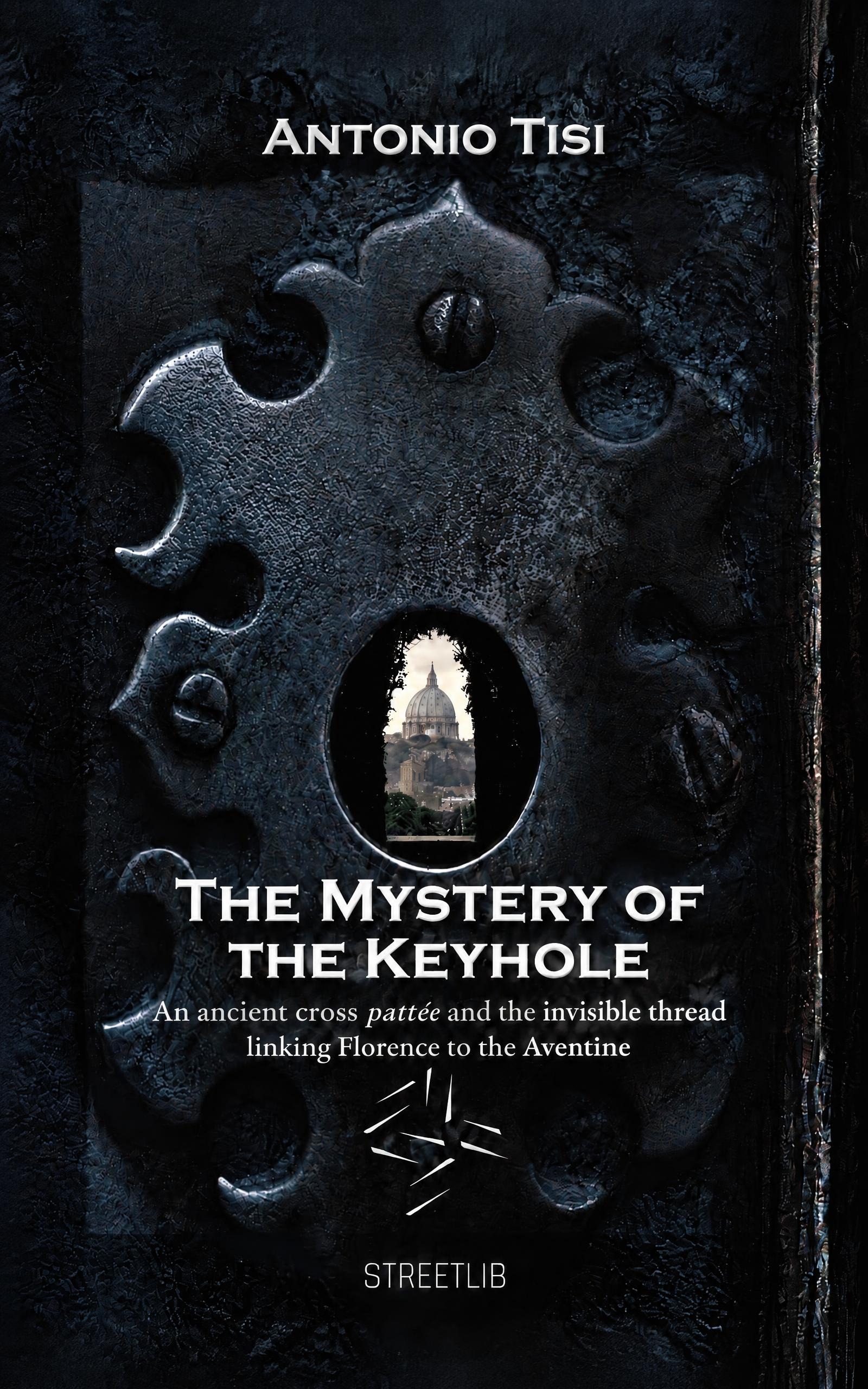
THE MYSTERY OF THE KEYHOLE
An ancient cross pattée and the invisible thread linking Florence to the Aventine
by Antonio Tisi
In May 1977, during a family trip to Rome, young Valerio presses his eye against the famous keyhole at Piazza dei Cavalieri di Malta. That enchanted vision—the dome of St. Peter's framed by the avenue of hedges and an enigmatic kite bearing a cross pattée—marks his life forever. Beside him, a man wrapped in a dark cloak whispers unforgettable words before vanishing, leaving behind a trail of enigmas and a small metal toy soldier depicting a Templar knight. Twenty years later, having become a medieval historian navigating the alleys of Florence and the archives of Rome, Valerio has never stopped searching for the meaning of that revelation. Together with Elena, a brilliant architect and restorer, he begins deciphering the hermetic symbols hidden within the Piranesian architecture of the Aventine and the microscopic details of the toy soldier. The Mystery of the Keyhole is an initiatory, poignant journey between past and present, where every coincidence is a puzzle piece and destiny awaits behind an ancient lock.
- Literary Fiction
- Mystery
- Historical Fiction
- Coming of Age
- Identity Journey
- Historical Mystery
THE TRAIN RIDE
Everything was ready; excitement made it hard for me to swallow. It was 7:30 in the morning, and the sun in Florence was already playing hide-and-seek among bell towers, domes, and the chimneys of the red terracotta roofs. My backpack was crammed full, my T-shirt hastily tucked into my trousers, my shoes tied not quite perfectly with a crooked double knot, but tied nonetheless.
My mother called me in that imperious tone that brooked no argument: “Valerio…., Valeriooo… let's go! The train won't wait for us!”
I answered her right away, almost anticipating her voice and nearly like an echo reverberating down the hallway of the house: “Yes, Mom, I'm coming! I've got everything!”
I ran down the stairs, taking the steps two at a time, overtaking Dad and Mom, and almost shoved open the building's front door with my forehead, stumbling loudly on the last step of pietra serena. Outside the house, Sandro and Cinzia, long-time friends of my parents, had already been waiting for nearly ten minutes, but the one I was truly itching to see was Giulietta, their seven-year-old daughter, with her lively eyes and pigtails that were always a bit messy.
We looked at each other, gripped by a childish shyness typical of that age when words always seem either too many or too few. Without saying a word, we set off, hand in hand, just behind the group of adults. In just over ten minutes, we had all arrived together at Santa Maria Novella station. It was 7:50, and the train seemed to be waiting for us on platform 9, screeching its brakes with a puff of compressed steam and heated metal, ready to depart at 8:15 sharp bound for the Eternal City.
The journey began.
Giulietta and I could no longer keep count; the number had grown so large that it could no longer be pronounced clearly. The game invented to pass the time consisted of counting the houses, country farmhouses, transmission towers, and industrial buildings that we watched blur past the window of the speeding train.
My mother called: “Valerio… Valerio…, come on, peel yourself off the glass… you’re fogging it all up with your nose!”
It was my mother who, between one conversation and another with Cinzia about dinner plans or the latest neighborhood gossip, cast a watchful eye on me from time to time. Caught up in the frenzy, almost in a hypnotic trance, I was glued to the windowpane: forehead and nose pressed flat, counting at top speed like a madman. Meanwhile, Giulietta was dying of laughter seeing me in that ridiculous state, and at the fact that the number coming out of my mouth had by then turned into an entirely incomprehensible mumble.
Piero, Giulietta's four-year-old little brother, had been sleeping blissfully ever since departure in the corner of the compartment, head lolling and thumb in his mouth, showing no sign of annoyance despite the constant chatter of our parents and the ruckus of our frantic counting; he gave no sign of waking for almost half the trip.
The journey toward Rome, after all, proceeded normally, accompanied by the train’s rhythmic, hypnotic cadence that kept up the steady sway of the cars over the railroad ties. Every so often, the prolonged whistle of the engine interrupted this rhythm, which darkened and grew muffled only whenever, on rare occasions, we entered some tunnel bored through the Apennine rock or the Tuscan hills.
Punctually, after emerging from the sudden darkness of the train tunnel, after trying to pop our ears by swallowing hard or pinching our noses, we would attempt to resume counting, but in an utterly confused, repetitive, and ridiculous fashion.
Arezzo station: it was just past 9:00, and the train was stopped at the platform. For a moment, with the train motionless, we felt the surreal silence of the province; no one spoke in the compartment, and only the sharp whistle of the conductor out on the platform sounded, along with distant echoes of the cries from the vendor peddling drinks, ham sandwiches, and hot beverages. Giulietta, too, had surrendered to Morpheus's inviting embrace, slumped with her head resting on my shoulder.
Outside, a fine drizzle was falling, and the forecast certainly offered little hope of improvement for the rest of the day, but that didn't worry me in the slightest, such was my excitement for that distant journey; even less did it bother our parents, who were far beyond the usual polite small talk, fully immersed in a heated political debate ranging from national news to government reforms. The minutes ticked by, perhaps ten or more, and with a lurch the train began moving again.
I had almost dozed off myself, lulled by the warmth of the compartment, when suddenly a firm, deep, and at times menacing voice shouted down the corridor: “Tickets, please! Tickets out!”
It startled everyone awake, making those in the now mostly sleeping compartment open their eyes wide. It was the ticket inspector—or conductor, as they used to say back then—an imposing hulk of a man with a head strangely small compared to his torso, dressed in a stiff dark service uniform with a peaked cap a few sizes too big, which kept slipping down over his forehead on account of the sweat beading on his skin.
A tangled mess of arms, hands, and stiff cardboard train tickets thrust forward inches from his leather belt, where, among other things, the bottom button of his light blue shirt, forcibly tucked into his trousers, hung loose, orphaned of its rightful cotton thread.
Faced with that sudden tangle of hands and tickets, almost annoyed by his daily duty, crinkling his nose with a sneer of superiority, he took one ticket, then, thinking better of it, grabbed the whole stack offered by my father and Sandro and began punching them one by one with his snappy metal hole punch. Click. Click. Click. Those little round holes in the cardboard seemed to linger in my mind.
At that point, my mother, with a half-yawn and smoothing her hair, asked politely: “Excuse me, could you tell us where we are?”
The conductor, as if taking subtle revenge on someone daring to interrupt his imperial routine, replied with a clear smirk of defiance: “Well… ma’am, if I had to tell every passenger on the train where we are at every stop… Anyway, in a few minutes we'll be at Chiusi-Chianciano Terme…”
And he shambled off, bumping into the corridor walls to his left and right under the sway of the rocking train, nearly taking half a glass door with him given his substantial bulk. I could barely suppress a hearty, spontaneous belly laugh tickling my throat.
I plunged back into a deep sleep, absorbed, dazed, and cradled by the muted waltz of the railcar on the tracks. While sleeping, I had the vivid impression of dreaming, but I couldn't remember the details of the image; what was certain was that I felt a strange sensation of pleasant annoyance on my nose, as though some curious insect or light feather were resting there continuously. I fidgeted at times, shaking my head, and for a few seconds I tried to swat away with my hands whatever was tickling and pricking my nose.
I woke up with a start, with two wide-open eyes staring at me from mere inches away, framed by a loud, chorus of collective laughter!
It was Giulietta teasing me and having fun at my expense, gently touching the tip of my nose with a small wooden stick, while all the adults watched, laughing their heads off at my comical reactions in my sleep. For a moment, I had become the plaything of the compartment, the entertainment of the journey.
And so I woke up completely, right near our long-awaited destination. The capital was now close at hand: through the grimy windows, the first Roman suburbs came into view, blocks of apartment buildings, workshops, and finally the imposing silhouette of Termini Station.
In no time at all, the long, narrow corridor of the train filled with people who, in a long human snake moving single file, jostled toward the exit doors, laden with cardboard suitcases, leather bags, and packages tied with twine. People’s faces showed a mix of fatigue accumulated over hours of travel and evident satisfaction at arriving; few smiled openly, only a pair of young sweethearts, giggling, cut through the crowded corridor with bursts of laughter.
The train had not yet completely stopped in the station, accelerating at times and braking with a metallic screech, almost hiccuping over the switches. In this impromptu ballet, tossed by the violent jolts of the train, people crowded together and often collided hard, like a flock of sheep crammed into a narrow stretch of mountain trail. Passengers momentarily lost their balance and crashed heavily into the person ahead.
That was what happened to Giulietta’s father, who, distracted while trying to heave down his heavy leather duffel bag from the high luggage rack, tumbled clumsily with all his weight onto a refined lady in the corridor. The lady, in turn, as in a domino chain reaction, collapsed onto the young man in front of her, who barely managed to stay on his feet by grabbing desperately onto the shoulder of his friend next to him!
A scene worthy of a silent comedy film. Giulietta and I looked at each other and burst out laughing like maniacs, doubled over and completely unable to stop.
It seemed we were there, but before the train finally came to a complete halt at the station platform and the engineers opened the iron doors, nearly another twenty minutes of nerve-racking waiting went by. People were exhausted, overheated, but eager to get out into the open air. We all filed out in a flash, or so it seemed to us: it was more our frantic eagerness to get off than reality that gave us that feeling of speed.
Finally on the ground! Termini Station was a true infernal bedlam of people on the move, piled-up luggage, trains arriving and departing, metallic announcements echoing incessantly over the loudspeakers, and baggage carts rattling along the platform. Utter city chaos, yet we were all happy; tired, certainly, but immensely happy.
We were in Rome. Even the weather, almost as if by magic, had cleared up: the Tuscan rain was a distant memory, a warm spring sun shone over the capital, and everywhere hung an irresistible atmosphere of holiday and celebration. The journey had truly begun.
THE ROMAN STAY
We were all thrilled to have arrived in Rome. Without wasting any time among the crowds of Termini Station, we made our way down the stairs to the subway and reached the Piazza di Spagna stop. Shortly thereafter, heading down one of those characteristic, cobblestone alleyways that weave through the historic center, we arrived at our hotel.The rooms…