

Ready, Set, Talk!
A Practical Parent Guide to Building Speech, Language, and Communication
by Art McCoy
Is your toddler struggling to communicate? Are you wondering what you can do at home to help? You don’t need a therapy room, expensive materials, or hours of drills to support your child’s communication. Some of the best opportunities for building language happen during the ordinary moments you already share—playing on the floor, eating a snack, getting dressed, reading a book, or getting ready for bed. In Ready, Set, Talk!, Art McCoy, a linguist, licensed Speech-Language Pathology Assistant, and graduate student in speech-language pathology, gives parents a practical, easy-to-follow approach for supporting young children who are late to talk or need extra help developing communication skills. You’ll learn how to recognize the ways your child is already communicating, discover what motivates them to interact, use fewer and more meaningful words, encourage pointing and gestures, build functional first words, accept early word approximations, expand single words into short phrases, and gradually help your child communicate more independently. At the heart of the book is the Ready, Set, Talk Communication Cycle: Motivate → Model → Wait → Accept → Respond → Repeat—a simple framework you can use naturally throughout everyday life. You’ll also learn how to respond to repeated language and echolalia, understand behavior as communication, reduce unnecessary prompting, and help new communication skills move beyond practice activities into real life. Most importantly, Ready, Set, Talk! is designed to help you stop wondering, “What am I supposed to do?” and start noticing the small communication opportunities already happening around you. You can start today—one interaction, one gesture, one sound, and one word at a time. For the cover, I would choose Generate with AI, but I would be careful not to make it look like a generic therapy textbook. The strongest concept would be a warm parent-and-toddler interaction with plenty of clean space for the title, rather than speech bubbles, alphabet blocks, or clinical imagery.
- Parenting & Family
- Instructional Guide
- Infant & Toddler Care
- Child Development
- Special Needs Parenting
- Play & Learning
Introduction: You Can Start Today
If you are reading this book, you probably have a long list of questions running through your head at night. Why isn't my child talking yet? Should I be doing something differently? Is this just a phase, or is it something more? Maybe you have compared your toddler to a cousin's child, or a friend's daughter at daycare, and felt your stomach drop a little when you noticed the gap.
You might have already talked to your pediatrician. Maybe someone told you to "wait and see." Maybe you have already started early intervention, or you are waiting for an evaluation appointment that feels like it is months away. In the meantime, you are the one at home with your child every single day, watching, wondering, and wanting to help right now.
I wrote this book for you.
Here is the first thing I want you to know, and I want you to really let it sink in: your child is already communicating with you. Maybe not with words yet, but communication started long before this moment.
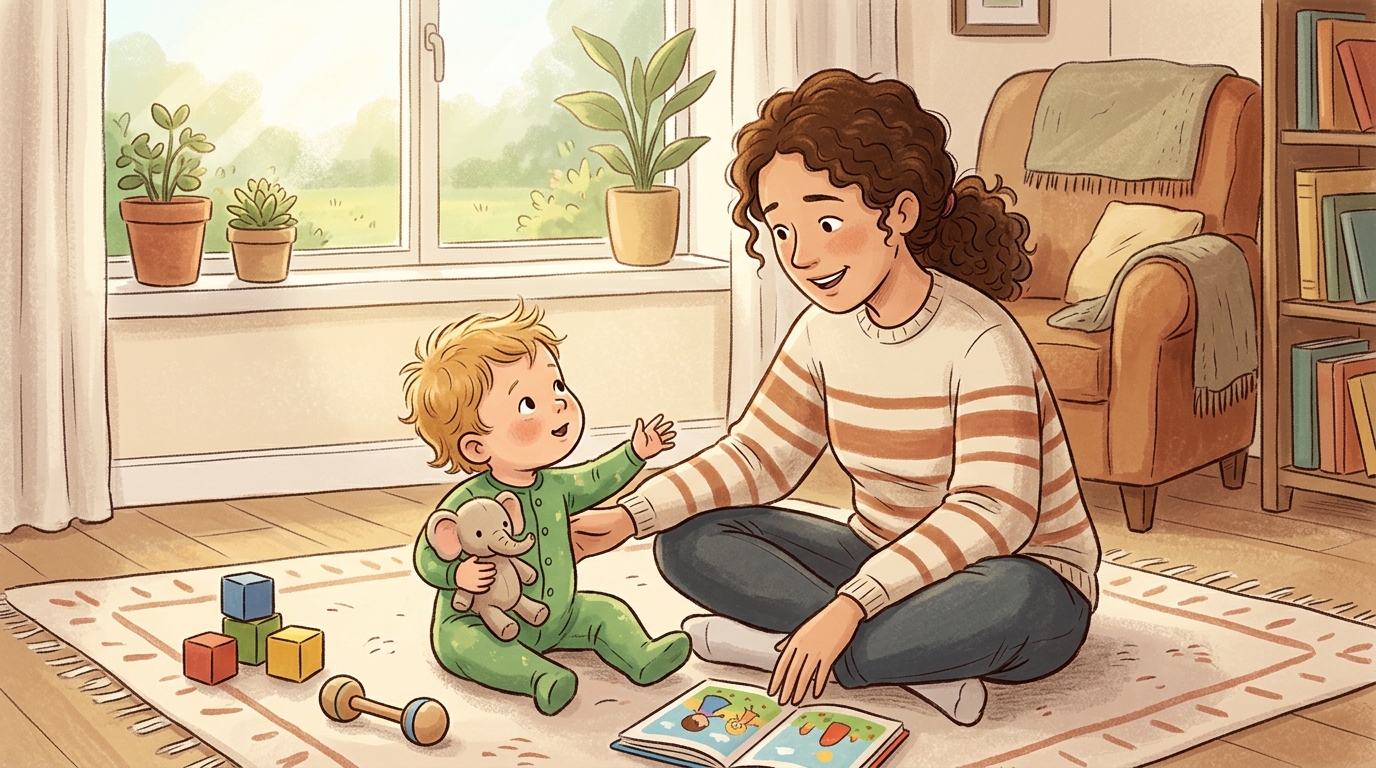
Communication Starts Before the First Word
Long before a first word ever comes, children communicate in dozens of small ways, from crying when they are hungry to reaching their arms up to be held.
Think about your own child for a second. Do they pull you by the hand toward the refrigerator? Do they point at the cookies on the counter? Do they push away a bowl of food they don't want, or hand you an empty cup when they want more milk? Do they make sounds, even if those sounds are not clear words yet?
All of that counts. All of that matters.
Reaching, pointing, pulling you toward something, making eye contact for a moment to check if you noticed, handing you an object, shaking their head, using a sign like "more" or "all done," saying a sound that is close to a word but not quite there yet, or using a picture or a talking device to make a request. Every one of these is a real form of communication, and every one of them deserves your attention and your response.
Some parents worry that gestures, signs, or picture systems will "replace" spoken words or somehow make a child less likely to talk. Decades of clinical research and developmental studies show the exact opposite. Children who learn to use gestures, signs, or communication devices actually tend to develop spoken language faster than those who receive no visual or gestural supports. These alternative forms of communication reduce frustration, help children grasp how language works, and build the foundation that spoken words grow from later. A point or a sign is often a stepping stone to a word, not a substitute for one.
So instead of only asking, "Is my child saying words yet?" I want you to start asking a broader question: "How is my child communicating right now, in any way?" That question opens up a much bigger picture, and it usually reveals that your child is doing more than you realized.
Functional Communication Matters More Than Counting Words
Many parents keep a mental tally of their child's word count. Ten words. Fifteen words. Thirty words. I understand the pull to count, because it feels like a way to measure progress.
But word counts alone do not tell the whole story. A child can have twenty words that they only say once in a while, in no particular order, without using them to actually get something they want. Another child might have only five words, but they use each one on purpose, every day, to ask for what they need.
The second child is using functional communication. That means their words, sounds, signs, or gestures actually do something in the real world. They ask for juice and get juice. They say "up" and get picked up. They point at the door and someone opens it.
This is the kind of communication we are going to build in this book. Not a script your child recites, and not a list of words memorized for a chart on the wall. We want communication that works for your child, in real moments, all day long.
A three-year-old named Mateo is a good example. His parents told me he "had a lot of words," but when I visited, most of those words came out only when he was labeling pictures in a book, usually right after his mom said the word first. He rarely used any of those words to ask for something he wanted or to tell someone what he needed. Once we shifted our focus to functional communication, something changed. Instead of practicing labels, we found moments where Mateo actually wanted something, and we helped him use a word to get it. Within a few weeks, he was requesting snacks, asking for "help," and pulling his dad toward the backyard while saying "outside." Those were not new tricks. They were real communication, used for a real reason.
Motivation Is the Starting Point
Here is something that surprises many parents: you cannot force communication to happen. What you can do is create moments where your child actually wants something, and then help them use a better way to ask for it.
This is why motivation sits at the center of everything in this book. If your child has no reason to communicate, they will not communicate, no matter how many flashcards you hold up or how many times you say "say ball" while pointing at a ball. Some children will happily play alone with a toy for an hour without ever needing you. There is nothing wrong with that child. It simply means we need to find something they cannot get without your help.
Maybe it is a bag of chips they cannot open. Maybe it is a bubble wand they cannot use by themselves. Maybe it is a favorite show that only turns on when someone else presses the button. These small, everyday needs are where communication opportunities live.
Throughout this book, you will learn how to notice these moments and use them. You do not have to invent an artificial situation. You just have to pay closer attention to what your child already wants, and then place yourself right in the middle of that want, as the helpful, responsive person who makes good things happen.
Simple Language, Said Often, With Time to Respond
Once you have your child's attention and motivation, the next piece is how you talk to them. Many well-meaning adults talk to toddlers in long sentences. "Do you want to go outside and play with your ball in the backyard?" That sentence has a lot of words in it, and a child who is not yet talking may not be able to pull out the one word that matters most.
A simpler approach works better. Instead of a long sentence, try saying just the key word: "Outside." Or a short phrase: "Go outside." Say it clearly, and say it again a few times, in a natural, friendly tone, not like a robot repeating a drill.
Then comes a step that feels strange to a lot of parents at first: waiting.
After you model the word, pause. Look at your child with an expectant, friendly expression. Give them three to five seconds of quiet space to try something, whether that is a word, a sound, a gesture, or a step toward the door. This pause can feel like a long time in the moment, but it gives your child room to respond instead of always following your lead.
Whatever your child does with that space, respond to it in a positive way. If they say "ow" for "outside," celebrate it as a wonderful try. If they simply walk toward the door, treat that as communication too, and say the word again as you help them: "Outside! Let's go outside." Then follow through and take them outside.
This simple pattern, saying a key word, waiting, and responding warmly to any attempt, is something you can start using today during ordinary moments. You do not need special materials or a quiet therapy room. You need a snack your child wants, a toy they cannot reach, or a door they want opened.
You Do Not Need to Turn Your Home Into a Clinic
I want to say this clearly, because I know many parents feel pressure to do more, more, more. You do not need to become a speech-language pathologist. You do not need a home filled with flashcards, worksheets, or a strict daily schedule of drills.
What your child needs most is a caring adult who notices small opportunities throughout the day and responds to them in a helpful, encouraging way. Bath time, snack time, diaper changes, car rides, walks around the block, and playing on the floor with blocks are all excellent chances to build communication. In fact, these everyday moments are often more powerful than any formal lesson, because they involve real motivation and real connection.
Think about your day right now. You already give your child a bath. You already prepare snacks. You already read books together, or try to. You already push them on a swing at the park. None of that needs to change. What changes is how you use those moments, with a little more attention to your child's attempts to communicate and a little more skill in responding.
The Ready, Set, Talk Framework
To make all of this easier to remember and use, I built this book around a simple framework with four parts: Ready, Set, Talk, and Grow.
- Ready is about understanding your child. You will learn to notice how your child already communicates, what motivates them, and where they are starting from right now, without comparing them to anyone else's timeline.
- Set is about building the right environment. This means strengthening your connection with your child, finding strong motivators, and setting up small, positive learning moments during play and routines.
- Talk is the heart of the book. This is where you will use the Communication Cycle: Motivate, Model, Wait, Accept, Respond, and Repeat. Later chapters will walk you through each part of this cycle in detail, with real examples you can use right away.
- Grow is about helping communication expand and become independent. This includes reducing how much you prompt your child, helping single words grow into short phrases, and helping new skills show up not just with you at the table, but with grandparents, teachers, and friends, in the kitchen, at the park, and in the car.
You will see this framework return again and again throughout the book. Each chapter builds on the one before it, so by the end, you will have a full set of tools you can use naturally, without turning every interaction into a lesson.
Progress Looks Different for Every Child
Before we go any further, I want to be honest with you about something important. Every child is different. Some children who are not yet talking at two or three will begin using words fairly quickly once they have the right support. Other children will need more time, and some will communicate best using a combination of speech, signs, and picture-based or device-based systems. There is no single timeline, and no single "right" outcome that fits every child. What I can tell you, based on years of working with toddlers and young children and their families, is this: children make progress when the adults around them understand how to motivate, model, wait, and respond in ways that match where that child is right now. Progress might look like a first clear word. It might look like a child using a sign for "more" instead of screaming. It might look like a child pointing at a picture on an AAC device to request a favorite show. All of these are real wins, and all of them deserve to be celebrated.
I am not going to promise you that any single strategy in this book will make your child talk by a certain age. I am not going to ask you to force eye contact, hold your child's mouth to shape sounds, or withhold food, comfort, or a beloved toy until they perform a word. Those approaches do not reflect what we know about supporting communication, and they are not part of this book.
What I am going to give you is a practical, step-by-step way to notice your child's communication, build motivation, use simple language, wait for a response, and respond warmly to whatever your child offers, whether that is a word, a sound, a sign, a gesture, or a reach toward an AAC device.
Your First Step, Starting Today
You do not need to read this entire book before you try something new. In fact, I would rather you close this chapter and try one small thing today than wait until you have finished every page.
Here is a simple place to begin. At some point today, notice a moment when your child clearly wants something, a snack, a toy, a turn on the swing, or help opening a container. Get down to their eye level. Hold up the item or point to it, say one simple word or short phrase for it two or three times, and then wait a few quiet seconds.
Whatever your child does next, a sound, a reach, a look, a word, or even just leaning toward it, respond right away in a warm, positive way, and give them what they wanted.
That single moment is the beginning of everything we will build together in this book. It is small, but it is real, and it is something you can start today, right where you are, with the child you already have in front of you.
Your Child Is Already Communicating
“My son isn’t talking yet. Does he even communicate?” “Does it count if she just points at what she wants instead of saying it?” “What if he pulls my hand to the pantry instead of asking with a word?” “She said ‘ball’ once yesterday. Does that count, or do I need to hear it every day before I get excited?” If any of these questions sound familiar, …