

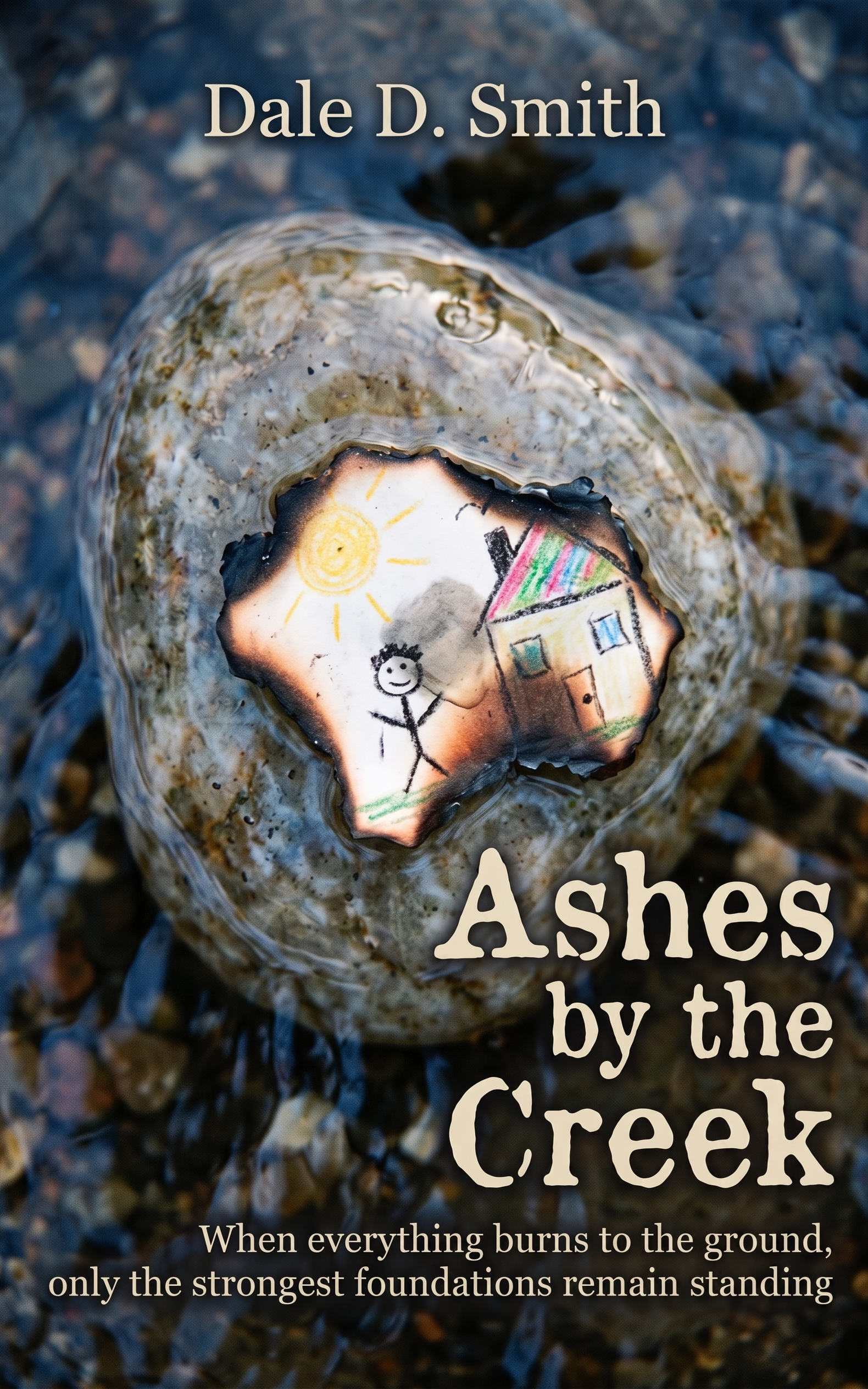
Ashes by the Creek
When everything burns to the ground, only the strongest foundations remain standing
The fire didn't just take the family cabin; it stripped away the last veneer of safety for the McBride family. Two years after losing his wife, Anders McBride is a man adrift, standing before a blackened stone chimney that serves as a grim monument to his failures. He is surrounded by three children he no longer recognizes: an eldest daughter obsessed with erasing the past, a teenage son fueled by volatile rage, and a young girl who has retreated into a world of ghosts and sketches. As the family gathers by the indifferent, flowing creek to sift through the cooling ashes, they discover that some things cannot be incinerated. Long-buried secrets about the night of the fire—and the truth behind their mother’s death—begin to surface through the smoke. The scent of char clings to their clothes and their memories, a sensory trigger that threatens to pull them back into the flames. In the aftermath of devastation, Anders must choose between remaining a pillar of silent stone or breaking his silence to save what is left of his fractured home. Ashes by the Creek is a raw, emotional exploration of grief, resilience, and the difficult journey toward healing when the only path forward leads through the ruins.
- Family Drama
The Weight of Cold Ash
The dawn did not break so much as it bled, a slow, cold gray leaking through the canopy of hemlocks and pines until the mist over the creek turned the color of pewter. It was the kind of light that didn’t promise anything. It just showed you what was already there, whether you wanted to see it or not. Anders McBride stood at the edge of what had been his living room, his boots sinking two inches into the sodden, black slurry of ash and melted insulation. He did not move. He had been standing there since the darkness began to thin, his hands shoved deep into the pockets of his canvas coat, his shoulders slightly hunched as if braced against a wind that wasn't actually blowing.
The smell was the first thing that had met him when he got out of the truck, and it was the thing that stayed, heavy and thick, settling in the back of his throat like grease. It wasn't the clean, sharp scent of woodsmoke from a winter hearth. It was the sour, chemical stench of a life being reduced to its raw elements. It was charred drywall, melted nylon carpet, the synthetic varnish of the dining table he had spent three weeks sanding, and the damp, rotting pine of the subfloor after the firemen had finished drowning it. The moisture from the morning mist had settled over the ruins, turning the dry soot into a slick, heavy paste that clung to the toes of his leather boots. Every time he took a breath, he felt the grit of it on his teeth.
He looked down. Right by his left foot, the brass coil of an old mattress stuck out from the debris like a broken bone, blackened and twisted by a heat that must have been biblical. A few feet away, the buckled frame of a kitchen toaster lay half-buried under a mound of fallen rafters. It was strange how the small things survived while the walls disappeared. The cedar siding he had cut and planed himself, the sturdy oak joists he had notched with a hand chisel, the tongue-and-groove pine ceiling that had taken him an entire summer to nail into place—all of it was gone, turned to smoke and drifted off over the ridges. Only the useless things remained, distorted and ruined, mocking the idea that any of it had ever been solid.
Anders took a slow, heavy breath and looked up. In the center of the black footprint where the cabin had stood, the stone chimney rose sixty feet into the gray sky, completely solitary. It looked like a monument to a battle that had been lost long ago. The stones were river rocks, mostly gray and green slate, rounded by centuries of water before Anders had hauled them up from the creek bed one by one in the bed of his old tractor. He had mixed the mortar himself, dry and thick, troweling it between the joints with a precision that had felt, at the time, like a kind of prayer. The fire had been hot enough to melt the glass windows into green puddles on the foundation, but the stone chimney was still there. It hadn’t cracked. It hadn’t buckled. The soot had stained the lower stones a deep, greasy black, but as his eyes traced the line of the hearth up to the mantle and beyond, the chimney stood as straight and true as the day he had dropped the plumb line against its side.
He walked toward it, his boots making a wet, sucking sound in the ash. When he reached the base, he pulled his right hand out of his pocket. His skin was rough, calloused and grayed around the knuckles from years of working with green wood and stone, but against the rough surface of the chimney, his hand looked fragile. He laid his palm flat against a large, spade-shaped river rock near the hearth. He expected it to be cold, but there was a faint, stubborn residue of warmth deep within the stone, or perhaps it was only the memory of the heat that had consumed everything else. The masonry was solid. He leaned his weight against it, just a fraction, testing it. The chimney didn't stir. It was a monument to his own stubbornness, he thought. He had built it to last, and it had done exactly that, surviving the ruin of everything it was meant to warm.
Still here, he thought. The words were gravel in his mind, dry and sparse. You're still here, and the rest is just wood.
He let his hand drop. He had spent his whole life believing that if you built a thing well enough, if you used the right materials and didn't cut corners, it would protect the people you put inside it. He had believed in wood and stone the way some men believed in scripture. Now, the wood was gone, and the stone was just an empty pillar in the middle of a graveyard. It felt like a betrayal, though he couldn't have said who had betrayed whom. The chimney was structurally sound, a perfect piece of masonry, and it was completely useless.
From down the slope, the sound of the creek rose through the trees, a constant, low murmur that never seemed to pause for breath. The creek didn't care about the cabin. It didn't care about the smoke that had hung over the valley for three days, or the way the hemlocks along the bank had been scorched brown on one side. The water just kept moving, cold and fast, tumbling over the smooth stones and slick logs on its way down to the river. It was an old sound, older than the cabin, older than his marriage, older than the grief that had settled into his bones two years ago when the sheriff had knocked on his door in the middle of the night to tell him about the black ice on Route 9.
Anders turned away from the chimney and walked toward the tree line, his eyes fixed on the ground. He wasn't looking for anything in particular. He was just moving because staying still made his chest feel like it was being compressed by a band of iron. The ground here was a maze of charred timber and wet charcoal, but near the edge where the porch had been, the fire had burned less intensely, leaving a few patches of blackened dirt that hadn't been completely covered by the collapsed roof. He stopped near a half-burnt cedar post that had once supported the handrail.
Something pale caught his eye. It was wedged beneath a piece of corrugated tin that had peeled off the wood shed during the collapse. He reached down, his fingers brushing against a layer of wet soot that felt like grease, and lifted the edge of the tin. The metal was cold and sharp, biting into his thumb, but he didn't let go. Beneath it, lying face down in a pool of dark, brackish water, was a square of thick paper.
He picked it up by the corner, his movements slow and deliberate, as if he were handling something that might dissolve if he breathed too hard. He shook the water from it, then used the sleeve of his flannel shirt to gently wipe away the smear of black paste on the surface. It was a photograph. The edges were curled and blackened, scorched away by a heat that had stopped just short of the center, but the picture itself was still clear.
It was Sarah.
She was standing on the very porch that had just burned to ash, holding a basket of yellow apples she had gathered from the old orchard behind the barn. Her hair was pulled back in a loose ponytail, a few dark strands escaping to cling to her temple, and she was laughing at something the person behind the camera had said. Her eyes were bright, that deep, startling green that had always made him feel like he was being watched by someone who knew him better than he knew himself. She was wearing an old denim jacket that he still kept in the back of the closet—or had kept, until three days ago when the closet and the jacket and the house had all gone up in a rush of orange light.
Anders stared at the image. The coldness in his chest seemed to spread, numbing his fingers until he could barely feel the paper between them. This photo shouldn't have been here. It shouldn't have been anywhere near the porch. He had kept it, along with her silver locket and the letters she had written him during the year he worked the timber crew up in Oregon, in a heavy steel lockbox under their bed. The box was supposed to be fireproof. It was supposed to keep things safe. Yet here it was, lying in the dirt yards away from where the bedroom had been, as if some hand had reached into the flames, pulled it out, and dropped it in the soot.
He looked at her face, the curve of her cheek, the small mole just below her collarbone. The fire had taken her home, her clothes, her kitchen, and the bed they had shared for thirty years, but it had left her face untouched. It felt like a cruelty. A clean, sharp needle driven straight through the thick hide he had spent the last two years growing over his ribs. He didn't want to look at it. He wanted to throw it back into the ash and watch it dissolve into the mud, to let the creek have it, to let anything have it so he wouldn't have to carry the weight of it in his pocket.
He didn't throw it.
Instead, he carefully folded his hand around it, protecting the dry center from the damp air, and slipped it into the breast pocket of his flannel shirt, right against his skin. The paper was cold through the cloth, a small, square stone resting against his ribs.
Why was it out of the box? he wondered. The thought was a dull ache. He hadn't opened that lockbox in a year. He couldn't bear to. But someone had. Or perhaps the fire had simply broken the steel, scattered the contents, and let the wind do the rest. He didn't want to think about who might have been digging through her things before the flames started. He didn't want to think about Max, or the way the boy had been acting lately, like a stray dog that would bite you if you tried to put a hand on its head.
The woods were quiet, the kind of heavy, wet silence that only comes after a rain or a fire. The birds hadn't come back yet. The squirrels were gone. There was only the creek, the endless, rushing sound of it filling the spaces between the trees, a cold white noise that didn't have any words in it. He stood there, looking out through the blackened hemlocks toward the dirt road that wound its way up from the highway. The road was empty now, just a gray ribbon of gravel disappearing into the fog, but he knew it wouldn't stay that way for long. Molly would be here soon. She had called him from her apartment in the city last night, her voice fast and sharp over the crackling cell reception, telling him she had the paperwork, that she had called the insurance adjuster, that they needed to 'mitigate the damage' and 'make a plan.' She had a clipboard for everything. She had a list. She thought you could clean up a life the way you cleaned up a spilled cup of coffee—with a quick hand and a couple of paper towels.
He dreads the sound of her car. He dreads the way she will look at him, her eyes searching his face for some sign of a father she recognized, only to find the same stone wall he had been hiding behind since the day of the funeral. She wanted him to be angry, or sad, or something she could put on a form and file away. But he didn't have those things in him anymore. He had used them all up. Now there was only the moving, the simple, mechanical business of putting one foot in front of the other because the alternative was to sit down in the wet soot and let the moss grow over him.
An urge, sudden and sharp as a physical pain, came over him. He wanted to walk. He wanted to turn his back on the chimney, on the truck, on the road, and just walk up into the ridges. He knew those hills. He had hunted them, logged them, slept on them under canvas when he was young and the world was still large and full of possibilities. He could walk for three days and never see a paved road. He could find a dry rock ledge under a hemlock canopy, build a small fire that didn't smell like plastic, and just listen to the wind. He could let them think he had gone with the cabin. He could let them think whatever they wanted, as long as they didn't ask him to talk about what was gone.
He took a step toward the trees, his boot leaving a deep, black print in the mud. The hemlocks stood dark and silent, their branches dripping with condensation, offering a quiet that felt almost like a hand on his shoulder. He could do it. He could just go.
But then he looked back at the chimney.
The gray stone rose out of the black ruins like an anchor, its base sunk deep into the concrete footer he had poured three feet into the hard clay. It was the only thing he had left that had her handprint on it. He remembered her standing there when they laid the hearthstone, her boots covered in wet mortar, laughing as she wrote their initials in the wet cement behind the woodbox where no one else would ever see them. If he walked away, the chimney would still be here. It would stand here in the weeds, getting grayed by the weather and greened by the moss, until some developer bought the land and hauled it away with a bulldozer to make room for a paved driveway.
He couldn't leave it. Not yet.
He walked back to the edge of the foundation, his boots heavy, and sat down on the one piece of the concrete perimeter wall that hadn't been buried under the roof tin. The concrete was cold and damp, soaking through his trousers in seconds, but he didn't care. He pulled his collar up against the mist and waited, his eyes fixed on the empty road where the fog was starting to lift, revealing the first yellow leaves of autumn clinging to the birch trees by the water's edge.
The silence of the woods felt different now, less like a refuge and more like a breath being held. Down by the creek, a blue heron rose from the shallows, its long wings beating the air with a dry, rhythmic sound as it flew low over the water and disappeared around the bend, leaving the stream to carry its grey reflection away into the dark.
In his pocket, the photo of Sarah felt like a small, cold coal, waiting for a wind that would never come.
He sat on the cold concrete, his elbows on his knees, his hands clasped together so tightly the skin over his knuckles turned white. His breathing was the only sound besides the creek—slow, shallow, and raspy from the soot he’d been swallowing for three days. He looked at his boots. They were old red-wings, the leather scarred and darkened by oil and timber sap, now dusted with a fine layer of white wood ash that looked like frost. He’d had them resoled twice. He liked things that could be repaired. He liked things that didn't have to be thrown away just because they were worn down.
The cabin hadn't been like that. The fire had been too fast, too hungry. It had started in the kitchen—or that’s what the volunteer chief had said, pointing his flashlight at the blackened, melted coils of the stove before they hauled the main body of the house away. Anders hadn't argued. He’d just stood there with his hands in his pockets, watching the water from the hoses turn the charcoal into black soup. He’d known every inch of that kitchen. He knew the way the third drawer from the left always stuck on humid days because the pine had swelled, and he knew the exact spot on the linoleum where Molly had dropped a iron skillet when she was seven, leaving a small, crescent-shaped scar that she’d tried to cover with a rug.
He wondered if the skillet was still in there, buried under the collapsed chimney breast, or if it had melted into a lump of gray metal like the rest of the pots. He didn't want to dig for it. He didn't want to find it.
The sound of an engine broke the silence, distant and thin, but growing louder as it cleared the ridge. It was the high, whining sound of a four-cylinder car, struggling with the gravel and the wet grade of the access road. Molly’s car. A sensible, silver hatchback that always smelled like lavender air freshener and dry-cleaning plastic. She’d bought it because the mileage was good and the safety rating was high, two things she talked about as if they were religious dogmas. Anders had offered to look over the engine when she bought it, to check the belts and the oil, but she’d just smiled that tight, polite smile she’d developed in college and told him the dealership had a warranty. She didn't want his greasy fingers on her clean engine.
He watched the road where it curved around the old birch grove. The silver car appeared through the mist, its headlights two pale yellow eyes cutting through the gray damp. It bounced twice on the deep ruts near the culvert—ruts he’d meant to fill with gravel before the fire—and then slowed to a crawl, its tires crunching softly on the wet slate of the driveway. It stopped twenty feet from his truck, the engine idling with a neat, sewing-machine hum before she switched it off.
For a long moment, the door didn't open. Anders didn't move from his perch on the concrete wall. He just watched the windshield, where the wipers had left two clean, arc-shaped cleared spaces in the mist. He could see the dark outline of her head, her hand rising to adjust her rearview mirror, then moving down to her lap where he knew her clipboard was already waiting. She was preparing herself. She was putting on her armor, the crisp white shirt and the tailored gray slacks she’d chosen for a day of standing in the mud.
When the door finally opened, the smell of her car—that clean, synthetic lavender—drifted out into the wet air, clashing instantly with the sour reek of the ash. Molly stepped out, her polished leather flats sinking immediately into the black muck of the driveway. She winced, a brief, sharp twitch of her mouth, before she caught herself and stood up straight. She was holding a blue plastic clipboard against her chest like a breastplate, a black pen clicked and ready in her right hand.
She looked at the ruins first, her eyes scanning the black footprint, the twisted metal, the standing chimney, and then finally settling on him. Her face was pale, her nose slightly red from the cold morning air, but her jaw was set. She looked like she was about to deliver a speech to a room full of people who didn't want to hear it.
"Dad," she said. Her voice was too loud for the quiet of the woods, sharp and clean, cutting through the murmur of the creek like a knife. "You're wet. You shouldn't be sitting on that concrete. It's drawing the damp right into your bones."
Anders didn't get up. He didn't look at her flats, which were already ruined, the black grease soaking into the tan leather around the soles. He just looked at the clipboard.
"I'm fine," he said. His voice was rougher than usual, a dry rattle that felt like it had been dragged over gravel. He hadn't spoken since yesterday afternoon when he’d told the guy at the gas station to keep the change.
Molly took three steps toward him, her feet making a squelching sound in the mud. She stopped near the edge of the foundation, her eyes darting to the chimney, then down to her papers. "The insurance adjuster is scheduled for ten. I called him twice this morning to make sure he had the correct coordinates. He wanted to wait until next week, but I told him that was unacceptable. We need to get the claim filed before the ground freezes, otherwise the cleanup costs will double. I’ve already got two quotes from reclamation companies in the city. They can have a crew out here with a backhoe by Thursday if we sign the waiver today."
She spoke quickly, the words tumbling out of her in a neat, orderly line, as if she were reading from a ledger. She didn't look at the photo in his pocket. She didn't look at the chimney the way he did, as a thing with a history. To her, it was just a line item under 'structures remaining,' a liability that needed to be assessed and cleared so the land could be listed.
"The chimney is solid," Anders said. He didn't look at her. He looked at the creek, where the water was white and frothy around the big boulder near the bend.
"It doesn't matter if it's solid, Dad," Molly said, her voice rising slightly, that familiar edge of frustration creeping in. "The house is gone. You can't just leave a sixty-foot stone pillar standing in the middle of a clearing. It's a safety hazard. If a windstorm comes through, or if the freeze shifts the footing, it could come down. The insurance company won't cover the land if we leave it like this. We have to clear it. We have to clear everything."
"I built it," he said. He said it quietly, not as an argument, but as a fact, the way he might have said the sky was gray. "It won't fall."
"That's not the point, Dad," she said, taking another step closer, her clipboard shaking slightly. "The point is that we can't live here anymore. There is nothing here. Max is... he’s staying at the motel with Matilda, and he’s about to blow. He’s been pacing the room since six, and Matilda won't even look at me. She just sits in the corner with that notebook, drawing those awful, dark things. We need to get this settled. We need to sell the acreage, take the payout, and get an apartment in town. Somewhere clean. Somewhere that doesn't... doesn't smell like this."
She stopped, her breath coming in short, ragged puffs that turned to white mist in the cold air. She looked down at her shoes, finally noticing the black grease that had crept up the sides of her flats, and her face went tight with a sudden, silent anger. She looked like she wanted to cry, but she wouldn't let herself. She was too busy fixing things.
Anders looked at her, really looked at her, for the first time since she’d got out of the car. She had her mother's eyes, but none of her mother's patience. Sarah had been like the creek—she’d go around a rock if she couldn't move it, but she’d get where she was going eventually, and she’d do it without making a sound. Molly was like a bulldozer. She wanted to push everything into a neat pile and cover it with dirt, even if the dirt was still hot.
"You got soot on your pants," he said.
Molly looked down at her slacks, where a gray smudge had smeared across her knee from where she’d brushed against a charred hemlock branch. She closed her eyes for a second, her shoulders dropping, and when she opened them, the professional, clipboard-wielding fixer was gone, replaced by a girl who looked very young and very tired.
"I don't care about the pants, Dad," she whispered. Her voice was thin now, the sharpness gone. "I just... I can't do this if you're going to sit here like a stone. I need you to help me. I need you to say we're going to clean this up and move on. Please."
Anders looked away, back to the chimney. The stone was silent, holding its warmth deep inside where she couldn't see it. He wanted to tell her about the photo in his pocket. He wanted to show it to her, to ask her why it had been outside the steel box, but he knew what she’d do. She’d take it, put it in a plastic sleeve, file it under 'surviving assets,' and tell him they’d frame it when they got to the city. She’d turn it into a task.
"The chimney stays," he said. His voice was flat, final, the stone mortar of his own mind setting hard around the decision. "For now."
Molly let out a long, shuddering breath that was half a laugh and half a sob. She tapped her pen against the plastic clipboard, the sound sharp and rhythmic, like a tiny hammer. "You're so stubborn. You've always been so stubborn. It's what killed this place, Dad. You tried to build something that couldn't be broken, and now you're just sitting in the ruins of it, waiting for the rest of us to disappear too."
She turned on her heel, her ruined shoes sliding in the mud, and walked back toward her car. She didn't get in. She just stood by the driver's side door, her back to him, her head bowed over her clipboard as if she were trying to find some other list, some other set of instructions that would tell her how to handle a father who wouldn't move.
Anders didn't follow her. He sat on the wet concrete, his hand resting on the breast pocket of his shirt where the photo of Sarah lay cold against his chest, while the creek continued its long, indifferent run down to the valley, washing the black soot from the stones along the bank and carrying it away into the dark.
The mist had begun to rise from the water, drifting up through the hemlocks like pale fingers, blurring the line where the forest ended and the sky began. He could hear the wind now, a low, hollow sound in the upper branches of the pines, but down on the clearing floor, the air was still and heavy with the smell of the cold ash, waiting for the sun that would never quite arrive.
He sat there for a long time, a man of stone in a world of smoke, while his daughter stood by her silver car and the creek kept flowing, caring nothing for the house he had built or the fire that had taken it away.
The silence between them was like a physical wall, thick and gray as the mist over the water. Molly didn't look back at him. She opened the door of her hatchback, the interior light casting a brief, artificial glow over her pale face, and slid inside. She didn't start the engine. She just sat there with her hands on the wheel, her head tilted down, probably looking at her phone, checking the signal that always died three miles down the road. She was trying to connect to a world that made sense, a world where things were written down in black and white and didn't leave black smudges on your knees.
Anders stayed where he was. The concrete under him had gone from cold to a deep, biting ache that settled into his hip, but he didn't care. He liked the pain. It was something clean, something that had an obvious cause and a simple remedy if he chose to take it. The other pain, the one that had been sitting in his chest since the night of the fire, didn't have a remedy. It was just there, like a bad joist you couldn't reach without tearing down the whole wall.
He reached into his pocket and pulled the photograph out again. He held it by the dry corner, looking at Sarah’s face. The fire had scorched the edges, but the center was perfect. Her eyes seemed to be looking past the camera, past him, out toward the ridges where the fog was still thick. She had always loved the fog. She used to say it was like the world was taking a breath, wrapping itself in a blanket so it didn't have to show its scars to anyone.
"Why was it out, Sarah?" he whispered. The words were so quiet they didn't even disturb the mist around his face. "Who opened the box?"
There was no answer, of course. Only the creek, rushing over the slate, its cold voice filling the empty spaces where his house used to be. He looked at the chimney again, the straight, dark line of it cutting through the gray sky. He had built it to last. He had built everything to last. But the wood had burned, the glass had melted, and the only thing left was the stone. It felt like a lesson he didn't want to learn—that the only things that survive are the things that can't feel the fire.
He tucked the photo back into his pocket, patted the wool fabric of his shirt to make sure it was secure, and stood up. His joints popped, a dry, sharp sound like a twig breaking in the woods. He didn't look at Molly's car as he walked toward the edge of the foundation, his boots leaving another set of black prints in the slurry. He had to find a place to start. If he was going to stay, if he was going to keep the chimney from being hauled away, he had to show the insurance man that he was doing something, that he was cleaning up the mess.
He found an old shovel, its wooden handle charred but still strong, lying near what had been the woodshed. He picked it up, the weight of it familiar and grounding in his hands. He walked back to the concrete perimeter, scraped a layer of wet soot off the top of the wall, and threw it into the mud. It was a small thing. A useless thing. But it was a movement.
Behind him, the silver hatchback's door opened again, the smell of lavender drifting out once more into the cold, wet morning, and he heard the soft, hesitant sound of her flats coming back toward the ruins, slower this time, as if she were trying to decide whether she had the strength to argue with a man who had already turned himself to stone.
The Logistics of Grief
The shovel blade sliced through the wet ash with a dull, wet sound, like a spade sinking into grease. Anders did not look up when the silver car’s door opened again, nor did he look up when the scent of lavender was pushed aside by a fresh gust of damp valley wind. He simply lifted the shovel, the weight of the sodden charcoal pulling at the muscle…