

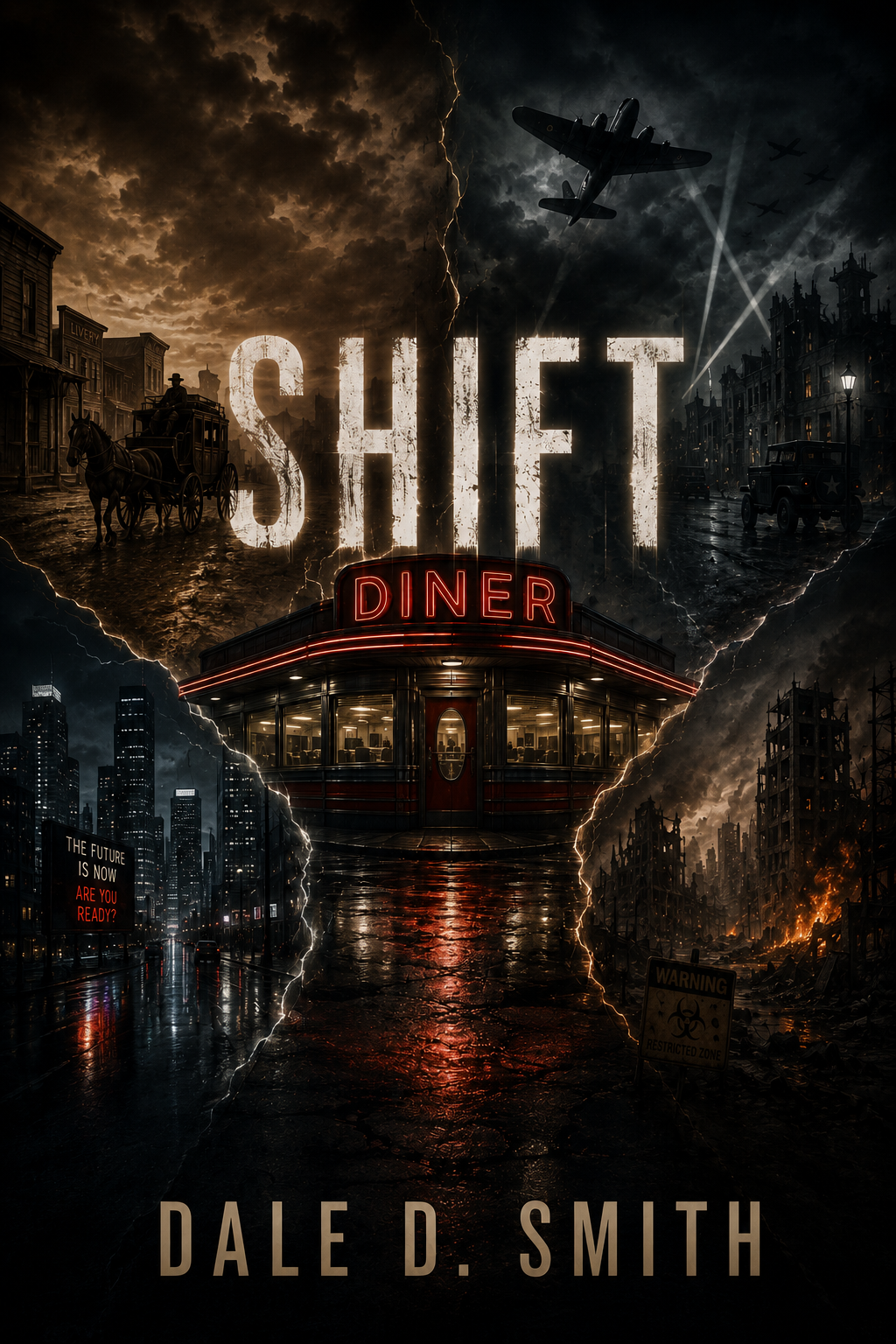
Shift
Five strangers, five eras, one Shift
The neon sign of the diner promised a refuge, but for five strangers, it is a trap that defies the laws of physics. Maisey, a WWII pilot; Brett, a data-miner from the future; Cooper, an 1893 clockmaker; Jo, a modern-day squatter; and Sarah, a social worker, have all walked through the front door of the same diner. But when they try to leave, they find themselves walking right back in through the kitchen. Behind the counter stands Declan, a man who has seen it all before. He tells them they are simply in the middle of a 'shift.' But as the coffee grows cold and the clock on the wall ticks in rhythms that shouldn't exist, the group realizes this is no ordinary roadside stop. The diner is alive, a metaphysical cage that feeds on the secrets they are all running from. To break the loop, they must face the traumas that brought them here. But Declan has his own agenda, and the 'Owners' of the diner are losing their patience. In a place where time has no meaning, they are running out of it fast. Shift is a mind-bending mystery that explores the loops we create in our own lives and the high cost of finally moving on.
- Mystery
- Thriller
The Midnight Griddle
The rain had stopped somewhere over the Atlantic, or at least that was the last thing Maisey could remember with any certainty.
Before that: the cloud bank. A wall of it, gray and absolute, rising out of the ocean like something that had been waiting there specifically for her. The instruments had gone first — the altimeter spinning like a top, the compass needle chasing itself in slow circles — and then the engine coughed once, twice, and the sound of it dying was the loneliest sound she had ever heard. She'd managed to level the nose. She'd run through the checklist in her head, every line of it, the way they'd trained her. And then there was nothing except the gray, pressing in on all sides, and the strange, sweet smell of ozone seeping through the cockpit seals.
Then there was a door.
Not a hatch. Not a crash site. A door, standing in the gray, rectangular and lit from the other side with a warm yellow light, the kind of light that came from a place where someone had left the coffee on too long. A sign above it, neon pink letters buzzing against the void: THE OFFROAD DINER — OPEN 24 HRS. The 'R' in DINER was flickering, on and off, on and off, like a small mechanical heartbeat.
Maisey found herself standing in front of that door, as if levitating on the clouds, for what felt like a full minute. She was a practical woman. She believed in instruments, in checklists, in the physics of lift and drag. She did not believe in doors that materialized out of thin air over the Atlantic Ocean. And yet her hand found the handle, and the handle was cold and real and slightly sticky with old fingerprints, and she pushed it open.
The smell hit her first.
Burnt coffee. Cheap floor wax. The ghost of bacon grease that had soaked itself into every surface and simply decided to stay. The air was warm and slightly stale, the stagnation of a place that had been heated too long by its own contained atmosphere, sealed off from anything fresh. A counter ran the length of the room, eight stools bolted to the floor in front of it, their vinyl seats cracked and patched with electrical tape. Four booths lined the window wall, red vinyl, the tables topped with laminate that had been wiped so many times it had gone from a pattern to a suggestion. A chrome napkin holder on every table. Salt and pepper shakers shaped like little hourglasses. A rotating pie display on the counter, glass-domed, holding what appeared to be a single, extremely tired slice of lemon meringue.
Two men were already seated at the counter.
Maisey stopped just inside the door. Her hand was still on the handle. Her flight jacket, she noticed, smelled of ozone and altitude — that cold, electric smell of the upper air — and it seemed out of place here, in this warm, low-ceilinged room that smelled of nothing but its own long history.
The first man was tall, or would have been if he'd been standing. He sat on a counter stool with the collapsed posture of someone who had given up on the concept of posture entirely. He wore something that Maisey had no category for — a suit of sorts, but the fabric caught the light in a way that fabric shouldn't, shifting between silver and blue and a color she didn't have a word for. His hair was pale, almost white, cut sharp and clean at his jaw. He was staring into a coffee cup like it had personally wronged him. A small light behind his left ear pulsed a dull red, on and off, steady as a warning lamp.
The second man was older, or seemed to be — it was hard to say, exactly. He wore a dark wool overcoat that belonged to another century, the collar high and stiff, the fabric so worn it had gone shiny at the elbows. His hands were wrapped around a coffee cup as well, and she could see, even from the door, that they were trembling. Faintly, persistently, the way hands did when they had been shaking for a very long time. His eyes were dark and deep-set, and they tracked to her the moment the door opened, quick and precise, the eyes of a man accustomed to noticing small disturbances.
Behind the counter stood the third figure.
He was tall and strikingly thin, wearing a faded white short-sleeved button-down and a heavy navy apron. Salt-and-pepper hair tucked under a grease-stained diner cap. His cheeks were hollowed, his hazel eyes deep-set and watchful, and they found Maisey the moment she crossed the threshold with a kind of pre-emptive calm, as if he had already calculated her trajectory and found nothing in it to surprise him.
"Good evening," he said. His voice was level and unhurried, like a man reading from a prepared script. "My name is Declan. Please seat yourself anywhere you are comfortable. I will be with you shortly."
Maisey let go of the door handle.
The door swung shut behind her with a soft, final click.
She looked around the room once more — at the windows, which showed nothing outside but a flat, impenetrable gray, not night, not fog, just gray, a gray so complete it looked painted on — and then she walked to the counter and sat two stools down from the man with the strange suit. She folded her hands on the counter and took a breath.
"I need a telephone," she said. "I've had to put down my aircraft and I need to report my position." Though Maisey had no memory of landing, nor crashing.
The thin man turned from the coffee urn he was attending to. He looked at her with an expression that was not unkind and not concerned. It was simply neutral, the way a wall is neutral. "I am afraid we do not have a telephone on the premises," he said. "However, I can offer you coffee. It is freshly brewed."
"I don't want coffee," Maisey said. "I want a telephone."
"That is understandable," the man said. He set a cup in front of her anyway, moving with the clean efficiency of someone who had performed the gesture ten thousand times. "Nevertheless."
Maisey looked at the cup. She looked at the man in the iridescent suit, who was watching her now with a flat, tired interest, as if she were a data point that had confirmed something he already suspected. She looked at the old man in the overcoat, who had pulled a length of twine from his pocket and was measuring the gap between his stool and the edge of the counter with a focused intensity that seemed to block out the rest of the room entirely.
"What is this place?" she asked.
"The Offroad Diner," the thin man said. He picked up a cloth and began wiping down the counter, moving in slow, deliberate arcs. "We serve breakfast, lunch, and dinner. The pie is lemon meringue. The coffee is serviceable."
"I can see what it is," Maisey said. "I'm asking where it is."
The thin man stopped wiping. He looked at her. "You are a guest," he said. "As are the gentlemen beside you. That is the extent of what I am able to tell you at this time."
The man in the iridescent suit made a sound that was not quite a laugh. "He says that to everyone," he said, without looking up from his coffee cup. "I've been here three hours and that's roughly the most words he's said in that exact cadence. It's impressive, actually. Like a very depressing customer service bot." He paused. "My name is Brett. Brett Orion. I'm from 2082, which I understand sounds insane. I've stopped caring whether anyone believes me."
Maisey stared at him. "2082."
"Give or take," Brett said.
She turned to the old man with the twine. He had produced a small notebook and was recording numbers in it, his handwriting minute and precise. "And you?" she asked, with a slight chuckle in her throat.
Humor me.
He looked up. His dark eyes were sharp beneath the distraction of his measuring, sharper than she'd expected. "Cooper McCloud," he said. "London. The year of our Lord, 1893." He held up the twine. "The distance between these stools does not remain constant. I have measured it four times. Each measurement is different by exactly three-eighths of an inch. That is not accidental. That is a pattern." He said the last word with the gravity of a man delivering a verdict.
Maisey absorbed this. She was a practical woman. She ran through it the way she ran through a pre-flight checklist: one item at a time, no item skipped. A man from 1893. A man from 2082. A diner outside of time, with windows full of gray nothing. She had either survived the crash and was lying in a field somewhere in England having a very specific hallucination, or this was real. She decided, provisionally, to treat it as real. Hallucinations didn't smell like burnt coffee and floor wax.
"Maisey Sinclair," she said. "1944. I was on a ferry run when my instruments went out."
"The ozone smell," Cooper said, nodding slowly. "Yes. I recognized that particular atmospheric residue. The diner appears to draw from moments of acute spatial disorientation." He tapped his pen against his notebook. "I was mid-sentence. Standing in my workshop doorway, explaining the geometry of temporal convergence to my apprentices, and then I was here. No transition. No interval. Simply — here."
"I was trying to upload my consciousness to avoid a prison sentence," Brett said flatly. "So, all things considered, I'm not sure the diner is the worst outcome. The jury's still out."
The door burst open.
The girl came through it fast, the way people moved when they were running from something — not frantic, but committed, her body already angled for whatever came next. She was young, wiry, dressed in a denim jacket covered in patches, her blonde hair fading at the roots, her eyes wide and very alert. She had a nose ring and a tattoo of an owl on her neck that someone had scratched at until the edges were ragged. She cleared the entrance in three steps and then stopped, spinning to face the door with both hands raised, braced.
Outside — for exactly one second — Maisey heard a siren. A police siren, distant but approaching, its pitch rising. She assumed it must be a police siren simply because that was the only kind of siren she knew to call by name — 1944 hadn't given her anything else to compare it to. But it was unlike any she'd heard before, not the rising-and-falling wail of an air-raid warning or a bobby's whistle-shriek back home — this was something steadier, stranger, a sound with no precedent in her ear. And then the door clicked shut, and the sound was gone. Completely. As if it had never been.
The girl lowered her hands slowly. She turned around and looked at the room. At the counter. At the three of them sitting on their stools. At the thin man in the navy apron, who had not stopped wiping the counter.
"What," she said, "the hell."
"Good evening," Declan said. "Please seat yourself anywhere you are comfortable."
The girl stared at him. "Where did the cops go?"
"I am not aware of any law enforcement in the vicinity," Declan said. "Would you like coffee?"
"I don't want— no." She pressed a hand flat against the door she'd just come through, pushing back on it. The door didn't move. She pushed harder. It held. "The door doesn't open from the inside," she said, and her voice had gone very quiet, the quiet of someone reclassifying their situation.
"The front door is an entry point," Declan said. He set a coffee cup at an empty stool with the same unhurried precision he'd used for all the others. "It does not function as an exit."
"Then what does?"
He said nothing. He picked up the coffee pot.
The girl looked at Maisey. Maisey recognized the look — it was the look of someone trying to decide very quickly whether the other person in the room was an ally or a threat. Maisey held her gaze steadily and gave a small, slow nod that she hoped communicated: I know as much as you do, which is almost nothing, and I'm not happy about it either.
The girl crossed to the counter and dropped onto a stool, putting two empty stools between herself and Brett.
"What's your name?" Brett asked, with a slight squinting of his eyes.
"Jo," she said, to no one in particular. "Jolene Mackey. And I'm not staying."
"None of us are," Maisey said.
Cooper made a small sound that might have been disagreement. He went back to his notebook.
They sat in silence for a while, the five of them — four at the counter, Declan behind it — held in the warm, stale air of the diner while the gray pressed flat against the windows and the neon sign buzzed its irregular pulse above the door. The coffee was bad, the way coffee in diners at the end of long roads was always bad, overcooked and slightly metallic, but it was hot, and Maisey wrapped both hands around the cup and thought.
She thought about the aircraft. She thought about the last altimeter reading she'd managed to clock before the instruments went. She thought about the checklist, the way it organized chaos into steps, the way it turned panic into procedure. She needed a checklist for this. Item one: establish the situation. Item two: identify available exits. Item three: determine what was blocking them.
"The windows," she said, setting down her cup. "What's outside?"
"Nothing," Brett said. "I checked when I first got here. It's not fog, it's not night, it's not a wall — it's just nothing. Like the diner is sitting inside a gray room with no ceiling."
"And the road?"
"Gone." He tapped the glowing implant behind his ear, a habitual gesture. "My biometric scanner can't get a read on it. Can't get a read on much of anything in here. The spatial data is completely incoherent." A pause. "Which, for the record, is physically impossible."
"A great many things in this establishment appear to be physically impossible," Cooper said, without looking up.
"I'm going to go check on my aircraft," Maisey said. "It went down somewhere in the vicinity and I have a responsibility to report my position. So if there's no telephone, I'm going to have to go look for one myself." She buttoned the top button of her flight jacket.
"As you prefer," Declan said. He turned back to the coffee urn.
Maisey walked to the front door. The handle was the same temperature it had been when she arrived — cold, slightly sticky, real. She gripped it, pushed, and the door swung open.
Not onto a parking lot. Not onto a highway. Not onto gray nothing.
Onto the kitchen.
She stumbled through into the sharp white light of it, catching herself on the edge of a stainless steel prep table, her hip connecting hard with the corner. The kitchen was narrow and immaculate in the specific way of places that had been cleaned out of habit rather than use — every surface wiped down, every pot hanging in its place, the grill cool and gray. It smelled of the same burnt coffee, the same old grease, but sharper here, more concentrated, the smell of the source.
She straightened up. She was standing in the kitchen. She had walked through the front door of the diner and she was standing in the kitchen of the diner.
Behind her, the kitchen door swung open. Declan stood in the frame, looking at her with the same untroubled expression he seemed to maintain regardless of circumstance. "The front door is an entry point only. I trust that has been adequately demonstrated."
Maisey stood very still for a moment. She was aware of her own breathing, the way it had gone shallow and controlled. She was aware of the hard edge of the prep table against her hip where she'd caught it. She was aware of the other four — through the kitchen door, she could see the counter, and the three faces turned toward her: Brett, with his tired, unsurprised eyes. Cooper, who had stopped writing and was watching with an expression of grim scholarly interest. Jo, who had twisted on her stool and was staring with something that looked, for a moment, like recognition — the look of someone who had already suspected this was coming and had not wanted to be right.
She walked back through the swinging kitchen doors into the diner.
Nobody said anything. The silence was the kind that settled after something had been proven — not a comfortable silence, but a heavy one, the silence of a room recalibrating around a new fact.
Maisey sat back down on her stool. She picked up her coffee cup. She set it back down. "All right," she said. Her voice came out steady, which she was grateful for. "We need to think about this systematically."
"I have been thinking about it systematically for considerably longer than you have," Cooper said, not unkindly. He held up his length of twine. "I have measured the distance between the front door and the kitchen door using this. The interior measurement of the building, following the line of the counter, is forty-one feet and seven inches. The exterior measurement, which I was able to observe briefly through the window before the visibility deteriorated, suggested a building no more than thirty feet in length." He paused to let that settle. "The inside of this building is larger than the outside of it."
"Non-Euclidean geometry," Brett said. He had turned on his stool to face Cooper, his interest apparently overriding his general policy of despair. "Or a spatial fold. The diner occupies a different topological space than the exterior. The two don't have to correspond." He noticed Cooper's expression and added, with some restraint, "It means the walls are lying."
Cooper considered this. "That is a very inelegant way of putting it," he said. "But it is not inaccurate."
"The windows," Jo said suddenly. She had been quiet since Maisey's trip through the door, sitting on her stool with her arms crossed and her eyes moving steadily around the room, cataloging. Now she uncrossed her arms and pointed. "There's no parking lot. There's supposed to be a parking lot. I walked through a parking lot to get to the door. Gravel, two dead floodlights, a dumpster against the side wall. Now it's just gray." She looked at Declan. "Where did the parking lot go?"
"The exterior environment is not something I am able to speak to," Declan said. He was refilling coffee cups with the same mechanical precision, moving down the counter, pouring without being asked. "I would ask that you focus on the interior, as that is the extent of what I am responsible for."
"Responsible for," Maisey repeated. She watched him pour. "What does that mean, exactly? Responsible for?"
Declan set the coffee pot down on the warmer. He looked at her with those still, hazel eyes. "It means I manage the establishment," he said. "The kitchen. The counter. The menu. The comfort of my guests."
"We're not guests," Jo said. "Guests can leave."
"You arrived of your own accord," Declan said pleasantly. "The door was open. The light was on. You came inside." He straightened the coffee pot on its warmer, a small, precise adjustment. "I did not compel anyone."
"The siren stopped," Jo said, and her voice had gone flat and tight. "The second I came through that door, the siren stopped. You're telling me that's a coincidence."
Declan said nothing. He reached under the counter and produced a pad and pencil.
"I will be taking orders shortly," he said. "The breakfast menu is available at all hours. I recommend the eggs. They are consistent."
Jo made a sound that was not a word.
The door opened again.
The woman who came in was different from the others in a way that Maisey registered immediately, the way you registered things that were out of alignment. She was dressed simply — dark slacks, a soft gray sweater, the kind of clothes that belonged to a particular kind of ordinary Tuesday in a world she had left behind. She had the look of someone who had been tired for a long time and had simply learned to carry it. Her eyes were careful, the eyes of a person accustomed to reading rooms quickly and deciding where the danger was.
She stopped just inside the door. She looked at Maisey in her flight jacket. At Brett in his iridescent suit. At Cooper in his Victorian overcoat with his twine and his notebook. At Jo with her patches and her fading hair. At Declan behind the counter in his navy apron.
"Okay," she said, slowly. "I'm going to need someone to explain what's happening."
"That makes five of us," Jo said.
The woman walked to the counter. She sat at the last empty stool, the one on the far end, and she set her bag down on the seat beside her with the careful deliberateness of someone establishing a small perimeter. "Sarah," she said. "Sarah Miller."
Declan placed a cup in front of her. "Good evening, Ms. Miller."
Sarah looked at the cup. She looked at the man who'd placed it there. "Why is everyone dressed like that?" she asked, quietly, and she was looking specifically at Cooper's overcoat, at the brass watch chain that hung from his breast pocket, at the buttons on Maisey's flight jacket that bore the insignia of the WASP program.
"We are from different times," Cooper said, as if he were explaining something very simple to someone very new. "I am from 1893. The young woman in the flight jacket is from 1944. The young man with the peculiar light in his neck is from 2082. The young woman with the patches on her coat is from 2012." He paused. "You appear to be from the early twenty-first century."
Sarah stared at him for a long moment. "2024," she said.
"Thereabouts," Cooper said, nodding. "Yes."
Sarah picked up the coffee cup. She held it without drinking. She appeared to be running some internal process, something methodical and practiced, the way a person ran through a situation they'd been trained to assess. Maisey recognized it. It was what she'd done herself, twenty minutes ago, sitting on this same stool, looking at this same counter.
"The windows," Sarah said finally, looking at the gray. "That's not right."
"No," Maisey agreed. "None of it is."
Cooper had resumed his measuring. He had tied one end of his twine to the leg of his stool and was now walking it carefully toward the far end of the counter, his lips moving slightly as he counted. Brett was watching him with an expression that hovered between amusement and something more genuine — a kind of reluctant respect for the rigor of the method, even if the method was inadequate to the scale of the problem.
"The loop," Maisey said. She turned to face the others, all four of them, and something in her bearing shifted — the particular shift that happened when a pilot stopped being a passenger and started being in command. "I went through the front door. I came out through the kitchen." She looked at Declan. "You knew that was going to happen."
"I was aware of the building's configuration," Declan said. He had picked up his cloth again and was wiping down the counter with slow, even strokes. "Yes. The front door is an entry point only. The kitchen is for staff and exit only."
"And you let me walk into it anyway."
"I advised you to remain seated."
"You didn't tell me why."
"No," he agreed. "I did not."
Jo spun on her stool to face him fully, planting both feet on the floor as if she needed the anchor. "What are you?" she asked. "Not who. What. Because you're not a regular diner guy. Regular diner guys don't stand there like they're waiting for a bus when five strangers from different centuries walk through the door."
Declan folded his cloth with precise, even folds and placed it on the counter beside the coffee pot. He looked at Jo for a moment before he answered, and in that moment his expression did something very slight — a compression at the corners of his eyes, something that wasn't quite discomfort and wasn't quite anything else, and then it was gone.
"I manage the establishment," he said again.
"You said that already," Jo said.
"Yes," he said. "I did."
Maisey stood up from her stool. She needed to move, needed to think with her body the way she thought best, the way she thought in the cockpit when everything was going wrong and there was still time to make it right if she moved correctly. She walked to the far end of the counter, turned, walked back. The floor was solid under her boots. The linoleum was real. The chrome napkin holder caught the light and threw it back.
"The kitchen door," she said. "He said it's for staff and exits only. That's the word he used. Exits." She looked at Brett. "That implies it can be an exit. For someone."
Brett's implant flickered red once, twice. "He also said 'only.' Staff only. Exit only. We're neither." He tilted his head. "But the phrasing is interesting. It suggests the mechanism exists. It's just not available to us. Yet."
"Or under current conditions," Cooper said, without looking up from his notebook. "The word yet implies a fixed quantity of time. The word conditions implies a variable. I prefer variables. They can be altered."
Sarah had turned on her stool and was watching this exchange with the careful, contained attention of someone who was cataloging rather than participating, building a picture. "When you say different times," she said, to the room in general, "you mean — actually. Not figuratively."
"Actually," Maisey confirmed.
Sarah absorbed this with a steadiness that Maisey found, unexpectedly, reassuring. "Okay," she said. "Then the first question is whether we all arrived here from the same moment in our respective timelines, or whether there's a sequence."
"Simultaneously, it appears," Cooper said. "I arrived some hours ago, the young man in the suit approximately the same — we compared notes upon his arrival. The young woman in the jacket arrived shortly after, and now the two of you within moments of each other." He tapped his notebook with his pen. "The interval between arrivals is shortening."
"Like a system filling up," Brett said, mostly to himself. His eyes moved to Declan, sharp and measuring. "Or like a quota being met."
Declan picked up his order pad. "I believe we are ready to take your orders," he said pleasantly.
"We're not here to eat," Jo said.
"You may find that hunger becomes a more pressing concern than you anticipate," Declan said. He clicked his pencil. "The kitchen is fully stocked. The menu is limited but reliable. I would encourage you to eat while the opportunity presents itself."
Maisey looked at him. She looked at the kitchen door. She looked at the windows with their flat, painted gray and the neon sign's reflected buzz moving across the glass in weak pink ribbons. She thought about the checklist. She thought about the cockpit, and how when everything failed you came back to the basics: what do you know, what do you have, what can you do.
What she knew: the front door looped. The windows were blank. There were five strangers and one man who was not, in any ordinary sense, simply a diner employee.
What she had: four other people, one length of twine, one notebook, one malfunctioning piece of technology from sixty years in the future, and a coffee that was getting cold.
What she could do: that was the part she hadn't figured out yet.
"What is going on?" Jo shouted, her fists clenched in front of.
"You are in the middle of a Shift." Declan announced. In a matter-of-fact tone.
"'What does that mean, 'you are in the middle of a shift'?". Jo pressed.
Declan did not look up from his order pad. He wrote something on it, though no one had ordered anything. "It means," he said, "that the establishment is currently in operation. As it generally is."
"That's not what it means," Jo said. "That's not what your face says it means."
For the second time, something moved across Declan's expression and then was gone before it could be named. He set his pencil down on the counter with a small, precise click. He looked at Jo, and the look was careful and very still, like the look of a man who had learned to be very careful about what he allowed to show.
"You are perceptive," he said. "That is noted."
"What are we in the middle of," Jo said, "exactly."
The diner held its breath. The coffee urn clicked and settled. The neon sign buzzed. Outside the windows, the gray was complete and total and without any feature, not a shadow, not a variation, just the gray.
Declan straightened the order pad. He straightened the pencil beside it. He looked at each of them in turn — at Cooper with his twine, at Brett with his flickering implant, at Jo with her crossed arms, at Sarah with her careful eyes, at Maisey standing at the end of the counter with her hands in her jacket pockets and her chin level.
"What are we in the middle of?" Jo demanded, leaning over the counter, her knuckles white. "A shift? What the hell does that even mean?"
Declan didn't flinch. He met her gaze with that terrifyingly calm, bureaucratic stillness. "A shift is a period of work. A division of time. A transition from one state to another." He paused, letting his eyes sweep slowly over each of them. "You are in the middle of a shift. The diner is in operation. Until the shift is completed, nobody leaves."
"And who decides when it's completed?" Maisey asked, her voice sharp as glass. "You?"
"No," Declan said, his voice dropping into a quiet, almost clinical register. "The Owners. I merely manage the transition. Your orders will be taken shortly. I recommend the eggs. They are, consistent."
Cooper looked up from his notebook. He looked at the kitchen door. He looked at the front door. He looked at the length of twine in his hands, trailing from the stool leg, forty-one feet and seven inches of evidence about the nature of the room they were in. He wound it slowly, loop by loop, around his fingers.
"The escapement is fouled," he said quietly, to himself or to the room, it was impossible to say. "We are simply teeth on a rusted wheel." He tucked the twine into his pocket. He closed his notebook. "Waiting," he said, "for someone to wind the spring."
Nobody answered him. The coffee cooled in five cups on the counter, and the gray pressed against the windows, and the neon sign buzzed its incomplete heartbeat into the warm, stale air, and the man in the navy apron wiped the counter in slow, deliberate arcs, back and forth, back and forth, as if he had been doing it for a very long time and expected to be doing it for a very long time more.
Maisey sat back down on her stool. She picked up her coffee cup. She drank it cold. She thought about checklists and about the geometry of impossible rooms and about the particular quality of the silence that had swallowed the siren the moment Jo came through the door, as if the diner had simply closed its mouth around the sound and absorbed it.
She thought about what Brett had said. A closed loop. A recursive function with no exit condition.
She thought about what Cooper had measured. The inside of this building is larger than the outside.
She thought about what Declan had said, the one thing he'd said that felt, beneath its flat and bureaucratic surface, like something real: exits only.
The word was there. The mechanism existed. It was just a matter of finding what opened it.
She set down the empty cup and looked at the four people sitting beside her — a man from the future, a man from the past, a girl on the run from 2012, and a woman from a year that was barely distinguishable from her own — and she thought: this is my crew. Strange as they were, scattered as they were, they were what she had.
She'd flown worse odds.
"All right," she said, and her voice came out steady and clear and with the particular quality of a voice that had given orders at altitude and expected them to be heard. "Let's figure out what we're dealing with."
Declan, at the far end of the counter, wrote something on his order pad and said nothing. The neon sign buzzed. The gray held. And somewhere deep in the kitchen, something clicked — small and mechanical and precise, like the first tooth of a wheel finding its groove.
The Impossible Threshold
The plan came from Maisey, because plans were the only thing she knew how to make when the instruments failed. She laid it out at Booth Four the way she might have briefed a co-pilot before a run: simple, sequential, no room for improvisation once it started. "If the front door only lets people in, and the kitchen door only lets people out, then th…