

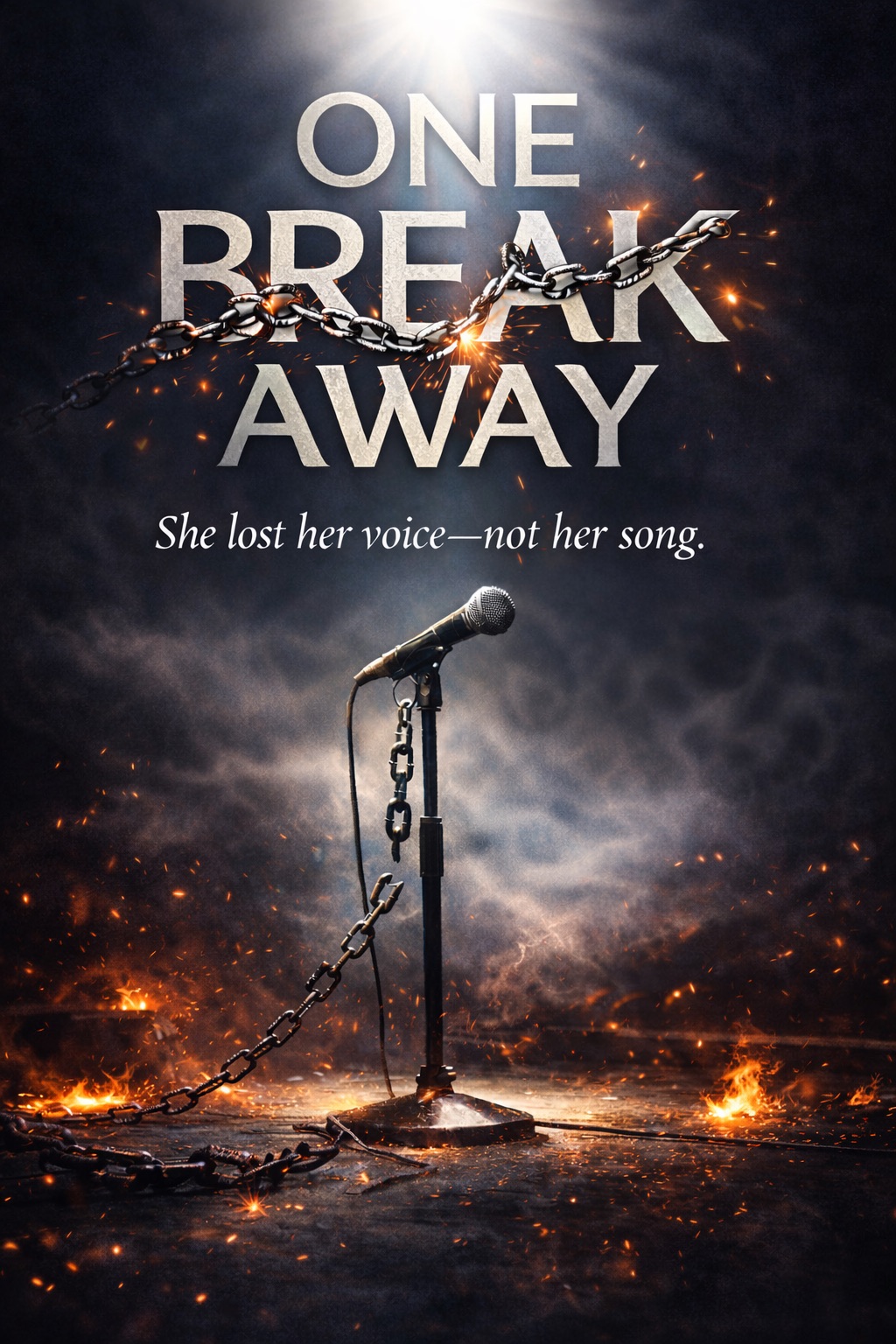
One Break Away

One Break Away

Finding God's grace in the wreckage of trauma, illness, and the miraculous journey to healing

by Becky Smith

30 chaptersen-US

How many breaks can one soul take before it finally shatters? For Becky Smith, life felt like a relentless series of fractures. From the haunting shadows of childhood abuse and family dysfunction to the physical devastation of chronic illness and near-fatal car accidents, her story is one of unimaginable trials. She has navigated the dark corridors of systemic poverty, the sudden end of a military career, and the complexities of traumatic brain injury. Yet, in the midst of every collapse, a singular truth emerged: she was never truly alone. One Break Away is more than just a memoir; it is a raw, unflinching testament to the power of divine intervention. Through the redemptive lens of faith and the healing rhythm of music, Becky illustrates how God meets us in our lowest moments. This intimate journey explores the miraculous restoration of body and spirit, the beauty of motherhood through adoption, and the courage required to lead a life of authentic worship. Interspersed with interactive workbook sections, this book invites you to step into your own healing. Whether you are navigating your own 'broken' season or seeking the strength to rebuild, Becky’s story proves that no matter how far you fall, you are always only one break away from God’s purpose.

  • Biography
  • Religion & Spirituality
  • Self-Help
  • Overcoming Adversity
  • Spiritual Memoir
  • Medical & Health Memoir

A Covenant in the Light

“The Lord is my strength and my shield; my heart trusts in Him, and He helps me.”

(Psalm 28:7)

The Stage in the Spotlight

A blinding surge of white light swallowed her whole, erasing the world around her. She stepped forward, trembling, freckles scattered across her nose like tiny sparks, chestnut hair glinting in the brilliance. The pure white coat she wore clung to her like armor—an illusion of composure, a child’s attempt at businesslike strength.

But fear betrayed her. It flickered across her face, twisted her stomach, clenched her throat. Before her stretched a sea of shadows, the audience blurred and faceless, a silent jury of silhouettes. She couldn’t see their eyes, but she felt them—sharp, expectant, waiting.

Then—the sound. A single, resonant chord, struck with certainty. The music teacher, her anchor, sat at the piano with calm hands and steady presence. The note cut through her terror like a blade.

Her grip on the microphone tightened, every muscle alive with panic and resolve. The downbeat fell—unyielding, final. There was no retreat.

She opened her mouth. A fragile stream of words spilled out, shaky at first, but alive. Inside, butterflies tore through her stomach, their frantic wings like storms against her ribs. And then—something shifted. The fear cracked. Her voice swelled, richer, stronger. Every note became fire, every phrase an act of defiance against the tremor inside her.

Channeling her favorite freckled-face counterpart, a radiant smile cascaded across her face. The sun itself seemed to be coaxed out of the chorus with astonishing strength.

“The sun’ll come out tomorrow, bet your bottom dollar that tomorrow…”

Her voice carried as if the world itself had become a stage, and in that moment, she was Annie.

The music rose, swelling into a breathtaking crescendo.

“Tomorrow, tomorrow, I love ya tomorrow, you’re only a day away!”

The final note soared, ringing through the gymnasium, echoing against the rafters. For one suspended moment, silence held its breath. Then—an eruption. Thunderous applause crashed around her, louder than she had ever imagined. The lights dimmed, and as her eyes adjusted, she saw them: familiar faces, strangers alike—all on their feet, clapping, cheering, celebrating her triumph.

In that moment, fear no longer defined her. What lingered was triumph, a spark undeniable. They saw it. She felt it. Emerging talent, fragile yet fierce, something she could claim as her own.

In that bright gym, God was already engraving something deep into my spirit. His Word says:

“This is the covenant that I will make with them

After those days, says the Lord:

I will imprint My laws upon their heart,

And on their mind I will inscribe them…” (Hebrews 10:16 AMP).

That was the moment His truth took root in me. It wasn’t about music alone. It was about confidence—confidence not in myself, but in Him. I felt what Hebrews 10:19-22 describes: the boldness to step forward, to approach without fear, to walk in faith even when I couldn’t see.

But outside of that stage? Real life was a whole different production. My childhood home was less of a safe haven and more of an obstacle course marked by chaos, screaming matches, and flying objects. I remember reckless car rides where the driver stomped the gas like we were auditioning for a stock car rally, tires squealing around sharp curves while I squeezed my eyes shut in the back seat, half convinced every turn was going to be our grand finale.

And yet — God was still there. He gave me music as a refuge. Music became the way I survived. It gave me courage when I had none. It gave me a voice when fear tried to silence me. It became the place where I could pour out the pain, the confusion, and transform it into something beautiful.

God was writing His law into my heart right through the chaos. He was whispering: “You are Mine. You are not forgotten. You are not defined by this noise.” He gave me boldness through song, faith through sound, and hope through melody.

That covenant He imprinted on me as a child never left. It carried me through the brokenness of my upbringing, through the nights of despair, through the moments when I didn’t think I could keep going. And it shaped who I am today — someone who knows that no matter the pain, no matter the rejection, no matter the dysfunction of the past, God’s promises remain.

His Word is true: “Let us hold tightly the confession of our hope without wavering, for He who promised is faithful.” (Hebrews 10:23).

I share this testimony not as a story of my strength, but of His. The same God who met a trembling five-year-old girl under gymnasium lights is the same God who has carried me through every valley since. His promises were alive then, they are alive now, and they will be alive tomorrow.

And that is why I stand — with boldness, with faith, and with song.

When I stood on that stage trembling, I didn’t know Scripture, but I felt courage that wasn’t my own. That was God. He was already teaching me that boldness doesn’t come from perfection — it comes from His presence. In that moment, I thought I was on the verge of becoming Annie, but truly, faith was being born in me.

Despair in the Dark

I had to be strong. I had to live beyond my years. Childhood for me was never simple; it was interrupted by fear, responsibility, and the weight of things no child should have to carry. My mother was both my anchor and my wound. She endured physical and emotional abuse that left her desperate for escape, desperate for peace.

One night, when we were at my uncle’s apartment, that desperation almost claimed her. Like many nights before, she had locked herself in the bathroom, attempting to swallow enough pills to take her home. But this time, she had left the door slightly ajar.

I walked in — a child, soft and innocent, with eyes too young to see what I saw. My mother’s pain sat in front of me in the form of an open pill bottle. And without thinking, I reached out and knocked it away. The contents scattered into the sink, rattling like glass beads, and for a moment, time froze.

I can’t recall every detail of that night, but I remember enough. I remember the weight of the question that haunted me: How could my mom want to leave me and my sister? I never understood how adults thought children would be better off without them. Didn’t they know we needed them, not perfect, but present?

Those nights marked me. They became the backdrop of my early life. And yet, in the midst of that brokenness, there was also music. Music was where I could escape, where I could pour my fear and pain into something beautiful. Each stage I stood on, each note I sang, became not just performance but survival — a place where God whispered courage into me.

That night God steadied my hands. Even as a child, He was using me as part of His rescue. I didn’t know it then, but I was inches away from losing my mother — and at the same time, witnessing God’s hand of protection over my family.

Years passed, and the story shifted. My mother fought her way through despair. She healed. She became more than the broken woman I once knew — she became my hero. A survivor. A woman who showed me that even the deepest scars can become testimonies of strength. 

And me? Those childhood trials became the soil where my resilience grew. They shaped me into someone who can walk into the hard places of life and still stand tall. They gave me empathy for the broken, strength for the weary, and a voice to speak hope into the hopeless. 

Now, when I look at my life, I don’t just see pain — I see purpose. I see the covenant God made with me as a trembling five-year-old on stage, and again as a little girl in a bathroom saving her mother’s life. I see His handwriting His law on my heart in moments where fear should have destroyed me. And I see how He has taken ashes and turned them into something beautiful. 

Today, I know this with unshakable certainty: 

God equips us, even in our smallest years. 

He gives courage when fear surrounds us. 

He gives strength when weakness consumes us. 

And He redeems even the darkest nights. 

His promises are not distant. They are alive. They are now. They are tomorrow. 

That is why I stand here today — not as a victim of my past, but as a testimony to His faithfulness. My life is proof that He takes broken beginnings and writes stories of redemption. And the same God who carried me then is the God who carries me still. 

Left on the Sidewalk

One morning I woke up expecting a normal day. I brushed my teeth in the tiny bathroom, picked out my favorite clothes, and hummed the songs I hoped to sing to myself later. Usually, I would be dropped at my Grandma Leona’s house, where breakfast always tasted better, and the school bus pulled up right on time.

But that morning was different. My mom had already left for work. My dad was sitting in the kitchen with a coworker, leaning back in his chair like he didn’t have a care in the world. On the table sat a half-empty carton of milk sweating rings into the wood, a glass ready to pour, and a stack of knockoff Oreos — the kind that crumbled too easily and left a pasty film in your mouth. 

He didn’t even look up as he said, “You’re not going to Grandma’s today. You’ll stay here and watch your sister.” 

I froze. My sister wasn’t a doll. She was a real baby. And I was five. 

At first, I tried to rise to the occasion like a little pro. I played peek-a-boo, rocked her, and tried bribing her with warm milk. But by noon, the milk smelled funky, the knockoff cookies were stale, and her shrieks were echoing off the walls. Desperate, I remembered how Mom or Grandma walked her in the stroller when she threw a fit. So, I strapped her in and took to the sidewalk. Looking back, you have to laugh at the sight — a pint-sized five-year-old pushing an infant down the block while cars buzzed past and neighbors waved like this was totally normal. (Seriously, did no one think to ask where the adults were?) My dad was supposed to be a father, but instead he’d walked off to hang out with friends, abandoning two small children without a second thought. To five-year-old me, it felt like I was carrying the entire universe on my shoulders.

Hours dragged by. I tried changing her diaper — which was an adventure all its own. I fastened the tabs crooked, one side loose, the other pulled so tight she wriggled in protest. I whispered to her like a grown-up: “There, see? All better.” But her wails told a different story. 

Eventually, a neighbor woman noticed us. She walked over with wide eyes, her voice sharp but kind: “Where’s your mom and dad?” I spilled out the whole story, and she listened, her mouth tightening with each word. She scooped us up and brought us into her home, her presence like a shield I didn’t know I needed. 

When my mom finally came home from her shift, she was crushed — furious at my father for leaving us, heartbroken for what we’d endured. That night, she dragged his clothes and belongings onto the concrete patio. Flames roared as the pile burned, sparks flying into the dark night. I stood at the sliding glass door, cheeks streaked with tears, wondering if this inferno was somehow my fault. 

The next morning, Grandma Leona stepped in. She was not about to let history repeat itself. She sat me at the kitchen table, locked eyes with me, and declared: “Rebecca Christine, you’re going to know this number by heart before you leave this house.” 

So began the drilling. Over and over, like a drill sergeant with her rawest recruit: 

“Five-two-seven.” 

“Five-two-seven.” 

“Six-one-three-seven.” 

“Six-one-three-seven.” 

She quizzed me while I brushed my teeth. She shouted it from the kitchen while I sat on the porch. She even woke me from a nap and demanded it like a pop quiz.

It was exhausting — but it worked. The number branded itself into my brain: 527-6137. Even now, decades later, I can recite it without hesitation. 

Honestly, looking back, the whole thing was pure comedy. My grandmother didn’t do subtle. She barked numbers with the raw authority of a drill instructor, so loud the entire neighborhood probably had our home phone memorized by nightfall. At times I’d giggle and toss them back in a goofy voice just to get a smirk out of her. But behind the military precision, she was dead serious. Grandma Leona was making sure her grandbaby would never be left stranded without a lifeline again. That was her love — loud, fierce, unpolished, and completely unshakable.

That day shaped me. It taught me the weight of responsibility far too early, but it also taught me survival, vigilance, and the importance of safety. It showed me my mother’s turning point — when she began to fight for our protection and became my hero. 

Even in that chaos, God was present. He gave me the clarity to feed and care for my sister. He sent a neighbor at just the right time to rescue us. He gave my mom the courage to finally draw a line. And He etched another layer of His law on my heart: You are not forgotten. I will protect you. 

What the enemy meant to break me; God used to build me. That day, like so many others, became a part of the story that explains why I’m strong, why I protect, why I remember. And it’s part of my testimony now — proof that His promises were alive then, are alive now, and will be alive tomorrow. 

I didn’t understand it then, but God was equipping me. He was planting in me resilience, courage, and a voice that could not be silenced. What the enemy tried to destroy in me; God transformed into strength. He wrote His law on my heart through experiences I would never have chosen, but ones that became the foundation of who I am. 

That’s what redemption looks like. 

God Has Been Faithful

He carried me through dysfunction, fear, and near-despair.

He gave me a mother who was strong and resilient, neighbors who showed up at just the right moment,

and the gift of memory — so I would never forget where He brought me from.

Now when I speak, I speak with confidence because I know who carried me.

When I face challenges, I face them with assurance because I know the One who never left.

And when I look ahead, I don’t see fear — I see promise.

His Word is alive.

His covenant is unbreakable.

His promises are ever present.

My testimony is simple but sure:

God turns broken beginnings into redeemed lives.

He equips even the smallest child for battles they cannot yet understand.

He takes what was meant to destroy and uses it to write victory.

Today, as an adult, I carry the marks of my past — but not as wounds.

They have become testimony.

They explain why I fight for truth, why I seek justice, why I hold tightly to faith,

and why I step boldly into rooms where fear might otherwise keep me silent.

They explain why I value safety, order, and responsibility in the work I do,

and why I refuse to let others experience the abandonment I once felt.

My childhood gave me empathy for the broken,

and my faith gave me courage to help build what is whole.

Music, which once gave me refuge, still reminds me that my voice matters —

but now my voice is not just song.

It is testimony.

It is leadership.

It is resilience.

I will never stop telling that story —

how my life, though on the verge of crumbling,

was held together by the steady hand of God who proved His faithfulness again and again.

God was shaping me through every single piece of that chaos.

At five years old, I didn’t know theology,

but I knew His presence — the quiet courage that comes when fear should have won.

My story began not with ease, but with endurance.

And through that endurance, God showed me grace.

“My grace is sufficient for you, for My power is made perfect in weakness.”

— 2 Corinthians 12:9

That night on stage, I believed I was one break away from being Annie. But God knew I was one break away from Him — and that was the covenant moment that would carry me for the rest of my life.

Lights and Shadows

“For I know the plans I have for you… plans to give you hope and a future.”(Jeremiah 29:11)The ConnectionMy love for music only deepened over the next two years. By second grade, I was singing “Rainbow Connection” in the school talent show. My gym and music teacher suggested I try “The Rose” or another classic, but I had my heart set on that song.

Read Next Chapter Free

Drop your email — chapters unlock immediately, no spam.