

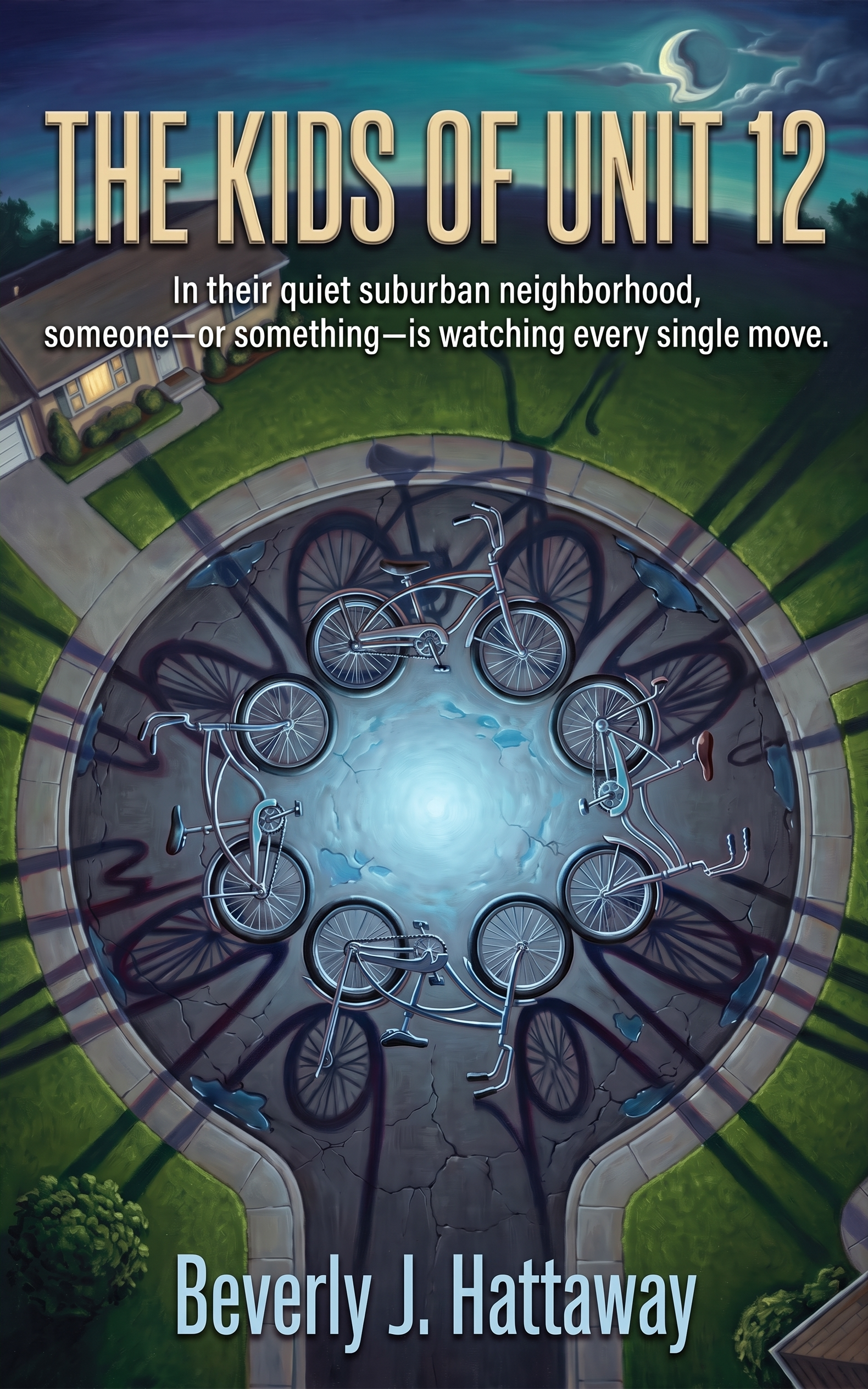
THE KIDS OF UNIT 12
In their quiet suburban neighborhood, someone—or something—is watching every single move.
Nothing ever happens on the quiet cul-de-sac of Unit 12. At least, that is what Riley Tran, Jax Moreno, Priya Das, and Emma Brooks always believed. Then the glitches start. Clocks lose track of seconds. Electronic static swallows cell reception in precise geographic circles. Neighbors repeat entire conversations word-for-word, and discarded objects begin arranging themselves into intricate geometric codes on the asphalt. What looks like ordinary suburban life is slowly unraveling into an impossible puzzle. When the four friends stumble upon an audio broadcast hidden beneath the radio waves, the truth becomes undeniable: their neighborhood is under surveillance by an extraterrestrial intelligence. And deeper within the mystery lies an abandoned house holding decades of secret logs—and a jacket belonging to Emma's brother, who vanished without a trace years ago. To save their families and uncover the truth, the kids must decode the mysterious signals before the observers decide their experiment is finished. An unforgettable adventure of courage, cosmic secrets, and the unstoppable power of friendship.
- Science Fiction
- Child Books
- Mystery
- Adventure
- Middle Grade Adventure
- Alien Contact
Part 1 - Chapter 1: The First Entry
The morning was the exact color of a wet slate shingle. It wasn't gray like clouds before rain, and it wasn't gray like smoke from a furnace. It was a flat, dense, heavy shade that seemed to stop three feet above the gravel road and stay there, holding everything underneath it in a tight, soundless frame. A light drizzle had fallen around five o'clock, just enough to slick the asphalt of the main road two miles back, but by the time the orange moving truck pulled off the state highway and turned onto the gravel lane, the air had dried into something cold and stiff.
Riley Tran sat on the top step of the concrete porch at Unit 12. Her knees were drawn up tight against the chest of her over-sized blue jacket, her chin resting on the notch between her knees. The concrete beneath her was damp and cold, sending a dull chill straight through the denim of her jeans, but she didn't move. Moving meant acknowledging that the truck had stopped and they were actually here.
Six months. That was how long the relocation had been stretched out, like a rubber band pulled so thin you could see through the middle of it. First there were the evening phone calls her father took behind the locked door of his study in the old house, his voice low and rhythmic, dropping into long silences where only the hum of the refrigerator filled the kitchen. Then came the stacks of brown cardboard boxes with black marker scribbles on the sides: KITCHEN - FRAGILE, OFFICE - DO NOT OPEN, BEDROOM 1 - CLOTHES. Then the long weeks of waiting while her father drove out to the site early every Monday morning and didn't come back until Thursday night, his collar smelling of cold damp earth and the sharp, metallic tang of industrial static.
Now, the rubber band had snapped back. They were here.
Across the short gravel driveway, her father was wrestling with the heavy roll-up door at the back of the moving truck. He wore his heavy canvas work coat—the one with frayed cuffs and a dark oil stain on the left pocket—and he looked tired. Small, dry tufts of hair stuck up near the crown of his head, usually combed back neatly. He pulled hard on the metal handle as his boots slipped slightly on the slick gravel, then braced himself until the door gave way with a loud, hollow rattle that echoed across the quiet cul-de-sac.
"I told you the red bins needed to come out first, David," her mother said. She was standing at the corner of the truck's rear bumper, holding a clipboard with a thick sheaf of yellowed inventory paper clipped to it. She wasn't wearing a coat, just a dark gray wool sweater that made her look narrow and sharp against the backdrop of the gray air. She held a red ballpoint pen in her right hand, her thumb clicking the top button over and over. Click. Click. Click. "The kitchen setup is in the red bins. If we don't get the kettle and the stove unit clear before noon, we're going to be eating cold soup off the floor."
"The red bins are behind the wardrobe, Helen," her father said. His voice was lower than hers, pitched in that deliberate, flat key he used whenever he was trying to keep his shoulders from hunching up toward his ears. He reached into the dark interior of the truck and braced his hand against a tall, plywood crate marked with three diagonal blue stripes. "Everything shifted when we hit that frost heave on the access road. The weight moved left. I have to unload the office boxes first or the whole stack is going to tip."
"The office boxes can wait," her mother said. Her voice didn't rise, but it grew thinner, like paper being pulled tight at both ends. "Your office isn't even wired yet. The electrician from the county said he wouldn't be out until Thursday at the earliest. What are you going to do with six boxes of paper in a room without a working outlet?"
"They aren't just papers, Helen."
"They're boxes, David. They have tape on them. They can sit in the hall."
"I'm not leaving the data logs in the hall where the humidity can get to them," he said. He didn't look back at her as he spoke. He leaned into the truck, his shoulder muscles tightening under the heavy canvas coat as he hauled a thick, square box toward the edge of the wooden floorboards. "The sub-floor in the north room has a rise in it. If the moisture level stays this high through the afternoon, the card stock will warp."
Riley watched them from the step. She didn't turn her head, just shifted her eyes left and right, tracking the movement of her father's red-knuckled hands on the cardboard and the slow, precise rhythm of her mother's thumb on the ballpoint pen. Click. Click. Click.
They had been having this exact argument, with different objects and different rooms, since three o'clock yesterday afternoon when the last box was sealed in their old hallway. The quiet cul-de-sac around them was so still that every small sound—the scrape of a boot on gravel, the squeak of a cardboard flap, the dull *thud* of a box meeting concrete—felt too large, like someone dropping heavy books on a library floor.
Riley reached inside her coat. Her fingers slipped past her inner pocket and found the cool, hard edge of the black vinyl notebook she had bought at the pharmacy three days ago, right after the movers finished tagging the heavy furniture. It was small, no bigger than her palm, with stiff covers and a thick black elastic band holding it shut. Beside it, tucked into the spiral spine, was a blue ballpoint pen with the cap slightly chewed at the end.
She pulled the notebook out and laid it flat on her knee. The paper inside was crisp and white, marked with very faint blue lines that were six millimeters apart. She liked the lines. They gave everything a place to sit. They made sure that no matter how messy a word was, it couldn't drift down into the space below it without somebody noticing.
She turned to the very first page. The white surface was clean, blank, and cold to the touch.
With her thumb, she unclipped the pen and brought the tip down to the top right corner of the page. She wrote the date first, the numbers neat and upright:
October 14. 8:12 A.M.
Below that, centered on the top line, she wrote the title in clear, block capital letters, pressing hard enough that the metal tip left a slight indentation in the three pages underneath:
OBSERVATIONS
She paused, looking up at the front yard. The grass was long and pale brown, bent over from the wet weight of the morning mist. In the middle of the lawn sat a round, yellowed plastic lawn ornament—a half-deflated flamingo that had lost its legs and was lying on its side near a cluster of dry hydrangeas. Across the street, the house at Unit 10 was dark, its front windows covered with heavy green blinds that were pulled all the way down to the sills. A small, rust-colored bicycle with no pedals was leaning against the side of the porch next door at Unit 11, its chain hanging loose and red against the gray dirt.
Everything had a detail. Everything had a shape that could be reduced to a description if you looked at it long enough without blinking.
Riley tapped the pen against her lower lip once, twice, then laid the tip back against the paper. She began her first entry. She didn't write about the argument, and she didn't write about the six months of packing or the cold, sour smell of the moving truck's cab. She wrote what was directly in front of her, precisely as her eyes recorded it.
1. The house at Unit 12 faces due east toward the cul-de-sac loop.
2. There are three gravel driveways visible from the porch, each spaced forty feet apart.
3. The large pine tree on the north corner of the lawn has seven major branches on its right side and five on its left.
She stopped writing and read the three sentences back to herself, her lips moving without making a sound. The ink was dark blue, almost black where she had started the lines, drying into a dull navy as the damp air hit the paper.
She looked up from the page to check her work. Her eyes went first to the house's front door, then down the short concrete walk to the edge of the gravel where the road curved around the center island. Then she looked past the lawn, past the yellowed flamingo, toward the rising ground behind the house where the tree line began.
She blinked.
She stood up from the step, her knees making a dry, cracking sound in the cool air. The notebook stayed clamped in her left hand, her thumb marking the first page. She walked four steps down the path until she was standing right at the edge of the gravel driveway, right where the gray stone met the sparse, weeds-and-clover lawn.
She turned back toward the front door of Unit 12.
The morning sun—what little of it could punch through that thick layer of slate-colored cloud—was a dull, round spot of yellow off to her left, hanging low over the roof line of the empty house two doors down. The shadows of the porch railing weren't stretching back toward the front door. They were stretching sideways, long and thin, pointing toward the gravel road behind the moving truck.
The house did not face east.
Riley looked down at the notebook. The ink on sentence number one was fully dry now. The house at Unit 12 faces due east toward the cul-de-sac loop.
She looked up again, checking the position of the yellow spot in the clouds. Then she pulled her small brass magnetic compass—the one her uncle had given her for her ninth birthday—out of her front coat pocket. The needle spun twice, silver and light, before settling with a tiny, metallic shudder.
The front door of Unit 12 faced south-southwest.
She had been so sure when they drove in. She had watched the road signs as they came off the highway, noted the sun behind their backs as they crossed the small concrete bridge over the creek, and tracked the turn as the truck swung into the cul-de-sac. In her head, the map was clear: they had turned right, which meant the house had to be looking back toward the rising sun.
But the compass didn't lie, and neither did the dull yellow circle in the gray sky above the roof line.
She had made a mistake on her very first line. On page one. In the very first three sentences she had ever recorded about this place.
A small, tight feeling gathered in the center of her chest, right behind her sternum. It wasn't anger, exactly, but it was sharp. Riley Tran didn't make errors in her records. If a box had twelve books in it, her list said twelve. If a wall was nine feet long, she didn't write down ten. Accuracy was the only thing that kept a notebook from being just a pile of scrap paper that someone could toss into a fire or leave behind in a wet ditch.
She lifted the pen. She didn't scratch the sentence out with a messy scribble. She didn't tear the page out of the notebook either—tearing pages ruined the binding and left ragged little white teeth along the center seam that made the whole book look broken.
Instead, she drew a single, thin, perfectly straight blue line through the middle of the first sentence, leaving the words readable underneath:
1. The house at Unit 12 faces due east toward the cul-de-sac loop.
Directly below line three, she wrote the correction, her handwriting smaller now, more deliberate, each letter pressed deep into the paper:
4. CORRECTION (Ref: Line 1): The front porch faces 210 degrees South-Southwest. The previous entry was incorrect.
"Riley!"
Her mother's voice came around the side of the truck, sharp and clear. "Take the small green box from the cab floor. The one with the kitchen towels. Don't set it on the grass."
Riley didn't answer right away. She stood on the gravel, her thumb smoothing down the corner of page one. The paper felt thick between her fingers, slightly stiff from the cool air, but clean. The single line through her mistake looked like a small iron bar laid across the words, holding them down so they couldn't move or change into something else.
"Riley!"
"I've got it," Riley said. Her voice sounded small to her own ears, swallowed up by the gray silence that sat over the cul-de-sac like a blanket.
She closed the notebook, stretched the black elastic band over the cover until it snapped back into place with a dry *thwack*, and tucked it deep inside her inner coat pocket. She slipped the blue pen into her sleeve, feeling the cool plastic against her wrist as she turned back toward the truck.
Her father was standing on the rear bumper now, leaning far into the dark wooden bed. "Watch the step, Riley," he called out, his voice muffled by the thick furniture pads stacked around him. "The gravel's loose by the curb. Don't twist your ankle before we even get the beds put together."
"I won't," she said.
She reached the passenger side of the truck's cab and pulled the door open. The interior smelled of old foam padding, cold vinyl, and stale coffee from the thermos her father had kept between his knees for four hours of driving. On the floorboards, wedged between the gearshift and a rolled-up door mat, was the green plastic crate her mother had called out about. Inside, under a layer of folded dish towels, sat a small metal desk lamp, three spare rolls of packing tape, and a small, square glass jar filled with rusted iron nails.
Riley lifted the box. It wasn't heavy, but the corner of the plastic dug into her hip as she lifted it clear of the running board. She used her elbow to push the truck door shut. The latch caught with a heavy *clack* that bounced off the front of Unit 12 and then seemed to drift across the street, dying somewhere in the dry hydrangeas near the dark windows of Unit 10.
She walked back toward the porch steps, her eyes fixed on the concrete path. She counted the steps as she moved.
One. Two. Three. Four. Five. Six. Seven. Eight. Nine. Ten. Eleven. Twelve.
Twelve steps from the front tire of the truck to the bottom concrete riser. Exactly twelve. She made a mental note of it, saving the number in the back of her head where she kept the dimensions of her old bedroom closet and the number of rungs on the fire escape behind the pharmacy back home.
When she reached the top step, she set the green box down right next to the front door frame. Her mother was already inside, her boots making a loud, hollow scraping sound against the bare sub-floor of the front hallway. Somewhere deeper in the house, a pipe clanked—three short, rhythmic knocks—and then went quiet.
Riley didn't go inside yet. She stood on the top concrete step, her back to the open door, looking out at the circle of houses.
The gray air hadn't shifted. The sky stayed the same dull shingle color, thick and flat, hiding the tops of the hills behind the pine trees. There was no wind, but the long grass near the deflated flamingo twitched once, a tiny movement that started at the stems and died before it reached the dry seed heads at the top.
Across the street, at the edge of the woods where the pavement ended and the brown dirt path ran off toward the old drainage ditch, something moved. It wasn't a person, and it wasn't a dog. It was just a change in the light, a slight darkening of the gray space between two birch trunks, like a shadow turning sideways to avoid the wet air.
Riley reached into her coat, her fingers instantly finding the smooth vinyl cover of the notebook. She didn't take it out. She just held it through the fabric of her pocket, feeling the square corners press against her palm.
The notebook was closed now. Page one was complete. The first three sentences were written down, the mistake was crossed out, and the correction was locked behind a thin blue line of ink that wouldn't come off no matter how hard she rubbed it.
Behind her, her father let out a long, heavy breath as he set a heavy wooden dresser down in the hall. "That's one," he muttered to no one in particular. "Only forty more to go."
Riley turned around and stepped through the doorway into the cold, empty house.
The hall was long and dark, smelling of unpainted drywall and old floor wax. Her mother was at the far end, holding a flashlight up to the circuit breaker panel, her pencil moving across the margin of her yellow inventory sheet. Click. Click. Click.
"Riley," her mother said without turning around. "Check the latch on the back porch door. Make sure it's dropped into the keeper. We don't want the draft coming through the kitchen while we're moving the heavy pieces."
"Okay," Riley said.
She walked down the narrow corridor, her sneakers making a soft, sticky sound on the smooth gray linoleum. The kitchen was larger than the one in their old apartment, but it was empty in a way that made her feel like her clothes were too small for her. There were no curtains on the windows, no clock on the wall above the sink, no yellow sticky notes stuck to the refrigerator door with thumb tacks. Just two long laminate countertops, a double stainless steel sink that smelled faintly of dry copper, and a tall back door with a square pane of glass set into the upper half.
Riley walked up to the door. The metal latch was heavy and gray, covered in a thin layer of silver paint that had begun to flake off near the spindle. She reached out and touched the handle. It was ice cold, colder than the air outside.
She lifted the thumb-latch and pulled the door open an inch to check the frame. A sharp, narrow current of air slipped through the gap, smelling of wet birch leaves and cold stone. It didn't smell like the driveway. It didn't smell like the old oil on her father's coat or the stale coffee from the truck cab.
It smelled like nothing at all. Like air that had been kept in a sealed box in a cool basement for fifty years and then let out all at once through a crack in the door.
Riley pushed the door shut. The iron latch dropped into the keeper with a sharp, heavy *thunk* that traveled up her arm and into her shoulder. She stood there for three seconds, her thumb still resting on the cold silver metal, waiting to see if the pipe in the wall would knock again.
It didn't.
She turned her back to the door and looked around the kitchen. On the counter next to the sink sat her mother's small portable radio, its red power light dark, its telescopic antenna pushed all the way down into its plastic clip. It looked small and gray on the wide laminate surface, like an old brick someone had left behind and forgotten to clear away.
Riley walked back toward the front hall. Her father was coming through the outer doorway again, his shoulder wedged against the edge of a tall, dark bookcase made of heavy oak. His face was red from the effort, his teeth pressed together as he shuffled his feet backward over the concrete threshold.
"Watch the frame, David," her mother called out from the breaker box. "That's real pine molding. You scratch that and we'll be sanding it until November."
"I've got... the frame," he panted, his heels scraping against the floorboards as he swung the bottom of the bookcase around. "Just... grab the end... Helen."
They stood there for a moment, both of them breathing hard, their shoulders rising and falling in the damp light coming through the front door transom. Neither of them spoke. Her mother looked down at her hands, wiping a smear of gray dust off her palms onto the sides of her wool sweater. Her father reached up and pushed his wet hair back off his forehead, leaving a faint streak of grease across his brow.
Riley stayed near the kitchen door, her hand tucked inside her pocket, her thumb resting on the black elastic band of her notebook.
This was Unit 12. This was the house with the incorrect heading and the twelve steps between the driveway and the porch. This was where the cardboard boxes were going to sit until the tape dried up and turned yellow at the edges. This was where her father's paper data logs were going to lie in the north room, waiting for an electrician who wasn't coming until Thursday.
She pulled her pen out of her sleeve and clicked the top once. The tiny *click* was lost completely beneath her father's heavy breath, but to Riley, it was the loudest sound in the room.
She didn't take the notebook out again. She didn't need to. She had already memorized the four lines on page one. She knew line four by heart now, every word of it, including the part where she admitted that her first impression had been wrong.
That was the thing about observations. They didn't care what you thought you saw when you first turned off the main road. They only cared about what was actually there when you pulled out the ruler and the compass and held them flat against the light.
She walked past her parents toward the front porch, her sneakers clicking on the bare floorboards. Outside, the slate-colored sky hadn't lifted an inch, but down on the cul-de-sac loop, the air was completely still. Not a single blade of the pale brown grass was moving now. The yellow flamingo lay on its side in the weeds, its round plastic eye staring straight up at the gray clouds, unblinking, perfectly still, waiting for whatever was coming next.
Riley sat back down on the top concrete step, pulled her knees up to her chest, and opened the notebook again to page two.
Part 1 - Chapter 2: The Car That Passed Twice
The morning of her second full day at Unit 12 brought a low, gray ceiling of cloud that clung to the upper branches of the white pines at the edge of the cul-de-sac. It was not raining, but the humidity was high enough to leave a microscopic sheen of moisture on the glass of Riley’s second-floor bedroom window. The air inside the room was cool and …