

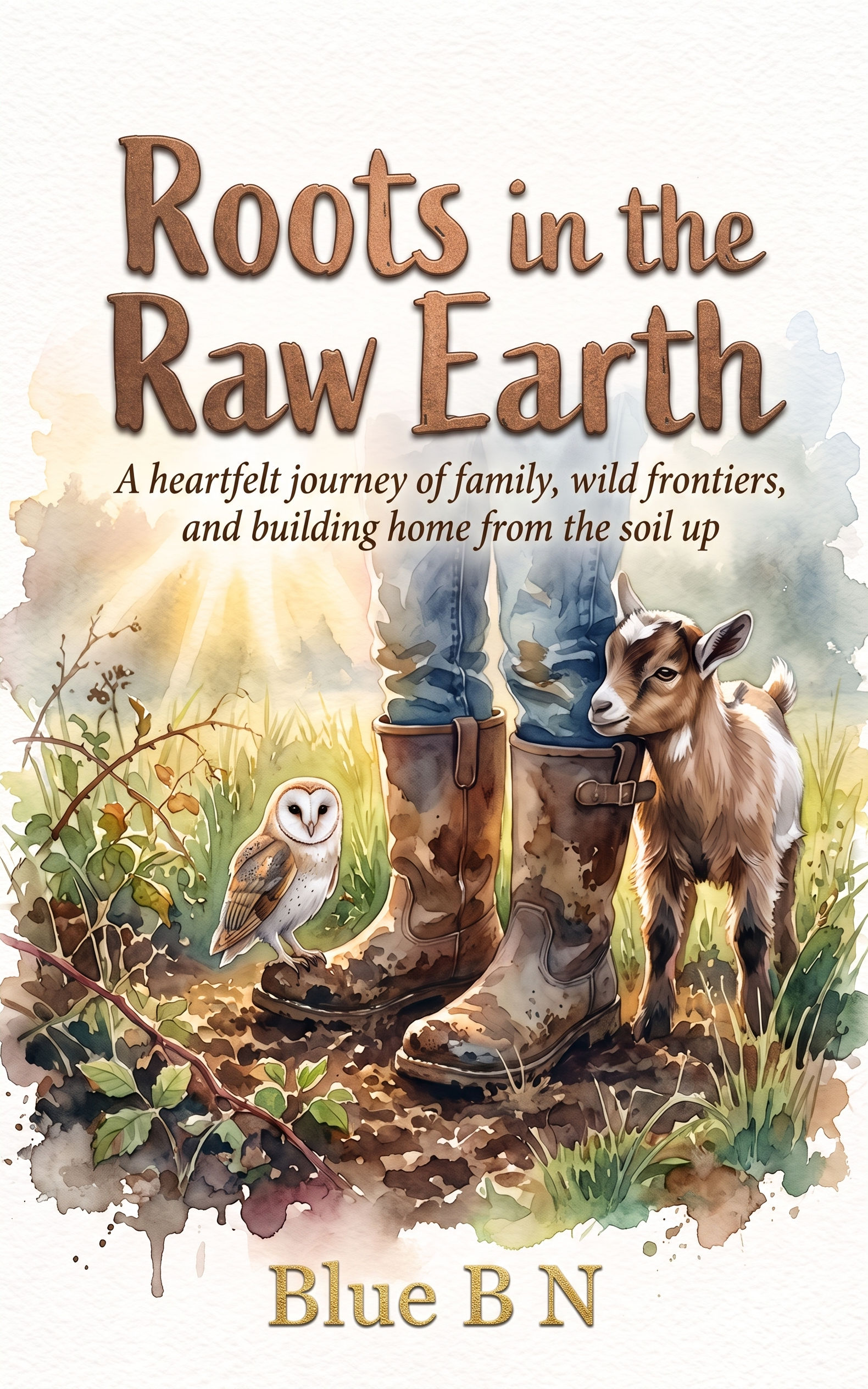
Roots in the Raw Earth
A heartfelt journey of family, wild frontiers, and building home from the soil up
by Blue B N
Leaving the crowded city behind was hard, but eleven-year-old Rosie Thistletree never expected their new homestead to be so utterly wild. Nestled in Whispering Valley, the neglected acreage is a tangle of thorny briars, broken water lines, and raw earth. Yet amid the chaos, Rosie sees something magnificent: a future sanctuary. Alongside quirky neighborhood allies and her determined parents, she dives headfirst into farm life, tending to orphaned goats, nursing a wounded barn owl, and raising rescue animals from scratch. When severe flash floods and a fierce early winter blizzard strike, the fragile homestead faces ruin. A fallen ancient oak threatens the pens, leaving Rosie to make a daring choice to protect the creatures depending on her. Can Rosie and her family weather nature's fiercest trials to turn this untamed wilderness into a true home? Roots in the Raw Earth is an inspiring, heartwarming middle grade adventure celebrating resilience, family bonds, and the tender connections between humans and the animal world.
- Child Books
- Literary Fiction
- Adventure
- Young Adult
- Animal Stories
- Middle Grade Adventure
The Bramble Gate
The tailgate rattled as the pickup bounced over a final, rutted hump in the driveway. Rosie Thistletree braced her yellow rubber boots against a crate of mason jars, leaned over the metal truck bed, and took a deep breath. The air smelled of damp cedar, crushed fern, and warm, wild earth. Before her lay fifteen acres of completely untamed countryside. Wild blackberry briars formed tall green walls along the lane, their hooked thorns catching at the truck mirrors. Weathered fence posts leaned sideways like loose teeth, rotten at the base and stripped of their wire. High up on the slope, gray thistle heads bobbed in the afternoon breeze.
"Holy clover," Rosie whispered to herself, adjusting her wool socks inside her loose boots.
The truck ground to a halt beside the homestead cabin. The house was small, built of heavy square timbers that had faded to the shade of wet river stone. Its front porch sagged slightly to the left, shaded by an enormous walnut tree. Mr. Thistletree turned the ignition key, and the engine gave one last shuddering wheeze before falling silent. He pushed his spectacles up the bridge of his snout, climbed out, and stretched his broad shoulders.
"Watch your step climbing down, Rosie," her father said, his voice deep and steady. He lifted down a heavy wooden chest filled with hand tools. "The wild grass is thick enough to hide old post holes and sunning copperhead snakes. Stay on the crushed gravel path until we clear a perimeter."
"I'm watching, Dad," Rosie said. She hopped lightly off the tailgate, her denim overalls catching a streak of rust from the fender. "Look at the slope behind the cabin! We could build goat pens right along that sunny ridge. And the soil down by the creek bed is dark as cocoa. We can plant squash, beans, and sweet corn enough for three families."
Mrs. Thistletree emerged from the cab with a bundle of canvas towels and a metal basin tucked under one arm. Her apron pockets jingled with pliers, copper wire, and measuring tape. She walked straight to the wooden porch stairs, testing each step with a firm stamp of her boot.
"The stringers under the floorboards are sound, Arthur," she called over her shoulder, setting up a wash station atop an overturned apple crate. She rigged a gravity spigot to a five-gallon water jug in under two minutes. "The cedar foundation blocks haven't rotted through. But that back fence line is practically nonexistent. We will need new split rails before we even think about bringing livestock onto this ground."
"First things first, Martha," Mr. Thistletree replied, hauling a stack of pantry cartons toward the threshold. "We unload the kitchen gear and establish safe paths. Rosie, keep to the yard. Don't go wandering into the tall weeds."
"I won't wander far," Rosie promised. She stepped around the gravel circle, her hazel eyes darting across every tangle of green. To her parents, the land looked like endless manual labor and hidden hazards. To Rosie, it looked like a paradise waiting to be woken up. A colony of bumblebees buzzed through a thick patch of goldenrod, and sparrows chattered among the cedar branches.
Near the edge of the cleared clearing stood the rusted shell of an old tractor shed. The tin roof had buckled in the middle, and heavy wild honeysuckle vines covered the eastern wall. Rosie paused near the doorway. Above the rustle of dry leaves, a strange, rhythmic sound caught her ear. It was a faint, frantic scraping followed by a sharp click.
Rosie froze. "Hello?" she whispered.
The clicking came again, weak and sharp. She stepped off the gravel path, carefully placing her feet on bare dirt to avoid hidden burrows. She reached the tractor shed's warped wooden door frame and peered into the dim, shadowy interior. Shafts of sunlight pierced holes in the rusted iron roof, illuminating floating motes of dust and dry chaff.
In the far corner, beside an abandoned hay rake, something pale shifted among the shadows. Rosie crept closer, ducking beneath a rusted steel beam. On the dirt floor lay a young barn owl. Its heart-shaped white face was smudged with grease, and its dark, liquid eyes were wide with exhaustion. The bird’s left wing was pinned awkwardly behind its back, bound tight by a bird's nest of synthetic orange baling twine that had caught on a rusty bolt in the wall.
"Oh, you poor thing," Rosie murmured softly, dropping to her knees. She kept her voice at a low hum. "Barnacles, that must hurt. Don't thrash, little one. I'm going to help."
The young owl hissed, snapping its small beak in alarm, but it was too tired to put up a fight. Its chest rose and fell in rapid, shallow pants. Rosie reached into her right overall pocket and pulled out her blunt-nosed utility scissors. She knew wild raptors could strike with their talons when frightened, so she moved with deliberate, slow precision.
She slid one hand gently over the owl’s back, pressing its undamaged wing gently against its body. With her other hand, she slipped the blunt blade beneath the tightest loop of orange plastic cord. Snip. The thick twine gave way. She carefully worked the remaining strands free from the delicate flight feathers, making sure not to tear the quills. The wing fell loose, though the joint hung stiffly from the strain.
Rosie quickly unbuttoned her red flannel jacket, bundled the soft fabric around the owl's body, and gathered the bird into her arms. Supporting its weight against her chest, she navigated her way out through the broken metal doorway and jogged back across the yard.
"Mom! Dad!" she called out, keeping her voice controlled so as not to startle the bundle.
Mrs. Thistletree turned from her outdoor workbench, instantly noticing the bundle. Mr. Thistletree lowered a crate of cast-iron pans and hurried down the porch steps. His brow furrowed as he saw the white feathered head peeking out from the red plaid cloth.
"Found him in the tractor shed," Rosie explained quickly, breathless. "He was tangled up in plastic twine on an old bolt. His left wing is sore, but I don't think the bone is snapped."
"Bring him to the table," Mrs. Thistletree instructed calmly. She cleared a clean towel over the apple crate and reached for her first-aid kit. With practiced, gentle fingers, she examined the joint while Rosie kept the owl calm with quiet whispers. "You did well cutting that plastic away cleanly, Rosie. The skin is scraped raw, but the shoulder is intact. He mostly needs rest, warmth, and clean water."
Mr. Thistletree fetched an eye dropper and a shallow ceramic dish, his expression softening as he watched the owl take a cautious sip. Then he looked at Rosie, his dark eyes serious behind his spectacles.
"You handled that rescue with good sense, Rosie," he said gently. "Your mother and I are proud of your quick thinking. But you must remember our rule. This land is wild, and farming requires caution before courage. We cannot fix every creature until our fences are strong and our buildings are secure. Safety comes first, always."
"I know, Dad," Rosie said, nodding earnestly. "I'll help dig post holes tomorrow morning. I'll clear every inch of scrap wire so nothing else gets hurt."
By dusk, the family had cleared a cozy circle inside the cabin's main room. A small fire crackled in the stone hearth, warding off the chilly valley mist. Near the warm stones, Rosie arranged a low wooden crate lined with shredded clean newsprint and a wool blanket. The young owl sat upright in the corner of the box, blinking lazily in the firelight after eating small morsels of raw meat.
Rosie sat cross-legged on the floorboards beside the crate, her chin resting in her hands. Through the cabin window, the shadowy silhouette of the wild ridge stretched out under the emerging stars. The work ahead was massive, and the fences were broken, but her heart felt completely anchored to the raw soil outside.
Paws, Claws, and Picket Fences
Dew clung to the tall fescue grass, soaking the hems of Rosie’s overalls as she marched toward the barn perimeter. In her gloved hands, she carried a pair of long-handled bypass loppers with rusted steel jaws. The morning mist hung low over the pasture, curling around the weathered fence posts like white smoke. Today’s goal was simple: clear the th…