

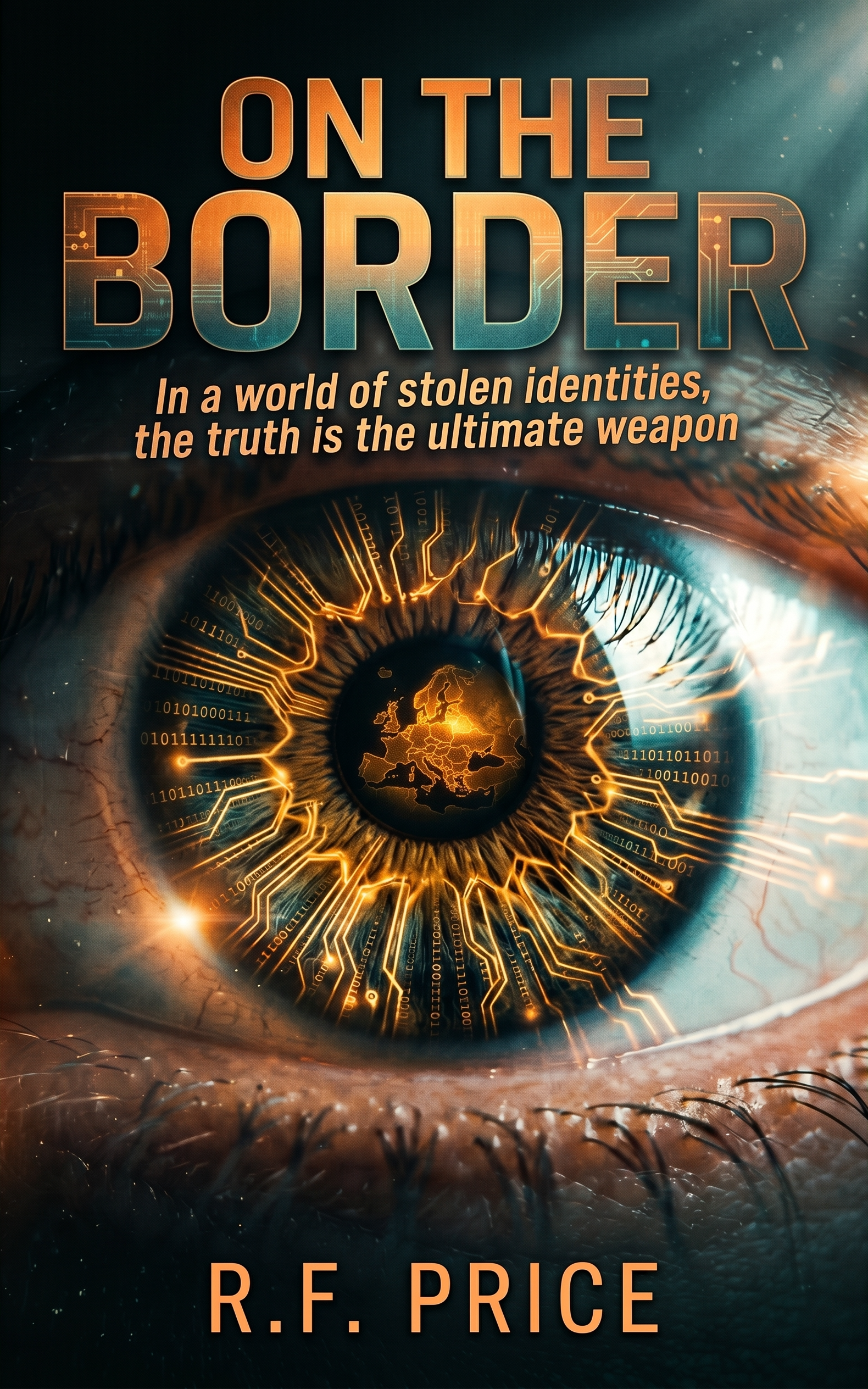
On the Border
In a world of stolen identities, the truth is the ultimate weapon
by Bob Price
Ava Lindstrom is the Ghost of Kabul, a woman who specialized in disappearing—until her past came hunting for her. When a series of precision assassinations ripples across Eastern Europe, Ava recognizes the chilling signature of the Black Lantern, a shadow government she thought was dismantled. But this is something far more dangerous. A new cell, Eidolon, has weaponized stolen biometric data to execute the ultimate coup: replacing world leaders with surgically altered loyalists. In this high-stakes game of digital mirrors, fingerprints and facial recognition are no longer evidence of identity—they are tools of deception. From the gritty backstreets of Berlin to the high-security corridors of Warsaw, Ava must navigate a landscape where technology is a traitor and no face can be trusted. With her own biometric history being turned against her, Ava is forced to operate off the grid, stripping away her own humanity to preserve the integrity of the global order. As the clock ticks down to a world summit that could change the course of history, Ava must decide if she can stop a threat that lives behind the masks of her closest allies. In the age of digital ghosts, the only way to save the future is to become the most dangerous shadow of all.
- Espionage
- Thriller
- Conspiracy Thriller
- Political Thriller
- Techno-thriller
The Berlin Disconnect
She was twelve feet from the turnstile when the overhead scanner swept the platform.
She felt it before she consciously identified it, a shift in the environmental light, the particular flat wash of an infrared array cycling through a facial recognition pass. It was not a standard BVG security camera. Standard BVG cameras were fixed and passive. This was active, mounted on a mobile unit that one of the responding officers had deployed, a unit that was configured to run identifications in real time against a database that she should not be in.
For three years, every database that mattered believed Ava Lindstrom was dead. Her face should have returned no result.
The scanner passed over her for a fraction of a second, and she watched the indicator light on the unit's housing cycle from green to amber.
Amber. Not a match. Not a miss. Something in the system thought Ava Lindstrom might still be alive.
She went through the turnstile and up the stairs and into the rain without running, the amber light sitting in her mind like a coal. Someone had loaded something into that scanner's database. Something that was close enough to her face to generate an uncertainty flag. She needed to be off the street.
***
Ninety Minutes Earlier
The rain had been falling for six hours, and the streets of Berlin had taken on the particular quality they got in late autumn, when the wet cobblestones reflected back a distorted version of the city above them, everything smeared and approximate. Ava moved through it without hurrying, her collar up, her hands loose at her sides, occupying the particular kind of unhurried pace that made her indistinguishable from the thousand other pedestrians grinding through a gray Tuesday afternoon. Berlin was her fourth safe city in eighteen months. Ava Lindstrom had learned that dead women didn’t stay anywhere long. She had been on the courier for ninety minutes.
His name was Dieter Haas, and Jace had put him on Ava’s radar four days earlier.
She followed him down into the Schönleinstraße U-Bahn station, descending the stairs at a distance of forty feet, her eyes on the back of his jacket. The station was crowded with the late-afternoon surge, commuters filling the available space according to some unconscious geometry. The air underground smelled of exhaust and damp clothing. She positioned herself behind a support column near the platform's southern end, angled so she had a clear line of sight to Haas without presenting her face to the fixed camera mounted above the tunnel entrance.
He was checking his phone. That was the tell she'd been waiting for, the micro-behavior that preceded a contact. He checked it once, then again thirty seconds later, then slid it into his jacket pocket and stood very still in the way that people stood still when they were trying not to look like they were waiting for someone.
The man arrived from the northern stairwell four minutes later.
Ava's assessment was automatic and immediate, the way these things had been after fifteen years: six feet, late fifties, well-tailored overcoat, the kind of bearing that came from decades of formal environments. She placed him within two seconds. Klaus Riedel, Deputy Chief of Mission at the German Foreign Ministry, a career diplomat whose face she'd studied in briefing files that predated her current life. She had no reason to expect him here. His presence in a public U-Bahn station, meeting a low-level freight coordinator, was wrong in a way that activated every trained instinct she had.
She watched the exchange. It lasted less than ninety seconds. Haas passed a folded envelope. Riedel accepted it without looking at it, tucked it inside his coat, and said something that Ava couldn't read from this angle. Haas nodded once and turned away, moving toward the far end of the platform. Riedel stayed where he was, waiting for the train.
She was already moving her attention back to Haas when she caught it. A small thing, the kind of thing that the human eye was not designed to notice and that training had rewired her brain to catch anyway. Riedel shifted his weight to step away from the column he'd been standing near, and there was a fractional hesitation in the transfer of weight from his left foot to his right. Not a limp. Not an injury. Something mechanical and precise, a microsecond delay between the intention and the execution, as though the signal had to travel a fraction of a millimeter further than it should have. She had seen it once before, in a controlled demonstration at a facility in Virginia that she was not supposed to remember, and she had never expected to see it in the field.
She was trying to process what that meant when the shot came.
It was suppressed and it was good, the sound reduced to something that most of the platform registered as a dropped bag or a closing door, a soft, percussive thump that the brain filed away as ambient noise. Riedel dropped straight down, no staggers, no drama, the way things dropped when the mechanism was interrupted rather than damaged. Half the platform hadn't turned around yet. Ava was already moving.
She swept the sight lines. The shot had come from the northern end of the platform, the angle consistent with the service corridor that ran parallel to the track behind a reinforced door marked with maintenance signage. She pushed through the crowd against the grain of the panic that was only now beginning to assemble itself as people started to understand what they'd seen. Someone screamed. The sound arrived late, like thunder after lightning.
The maintenance door was still swinging on its return spring.
She went through it without slowing, her shoulder taking the edge of the door frame, and was in the corridor before her eyes had fully adjusted. The space was narrow and poorly lit, conduit and cable bundles following the ceiling in thick parallel lines. There was no one visible in either direction, but the air was disturbed. She went left, following the gradient of the floor, which sloped slightly downward in the direction of the tunnel proper.
She heard nothing. No footsteps, no breathing, no movement. Sixty feet ahead, the corridor branched. She reached the junction in eight seconds and stopped, pressing her back against the wall, listening. The left branch continued toward the active tunnel. The right branch led to a secondary access point she had not seen on any schematic, a door that looked original to the station's construction, its frame sealed with a keypad panel that was decidedly not original. The panel's indicator light was green. It had been used within the last two minutes.
She tried the handle. Locked. She ran her eyes over the panel, identified the manufacturer, and recognized the model as one that used a rolling security code generated by a proprietary algorithm. She didn't have the equipment to crack it in the time available, and she knew it. Behind her, she could already hear the distant sound of German police radio echoing down from the platform level, the BVG security response beginning to mobilize. She had perhaps four minutes before this corridor became compromised.
She turned back.
The body was still on the platform when she re-emerged through the maintenance door, and the platform itself had dissolved into the particular chaos of a public space in shock, people clustered in groups at the stairs, others frozen where they stood, a woman near the far wall with both hands pressed over her mouth. Two BVG security officers had arrived and were pushing through the crowd. Ava moved with the flow of people heading for the exits, just another commuter responding to an event she didn't understand, her face angled down and away from the cameras.
The safe house was a third-floor apartment in a building on Weserstraße, acquired through a rental agency that asked no questions about the cash payment or the lack of a permanent address. She had used it for eleven days, which was eight days past her preferred rotation schedule, and she had told herself each morning that today would be the day she moved. She hadn't moved. The operational thread had kept her in place.
She entered through the rear courtyard, checked the tell-tale she'd left on the door frame, a single strand of dark thread anchored at a specific height, and let herself in. The apartment was cold. She'd kept the heat off during her operational hours to ensure no thermal signature was visible from outside, and the chill had settled into the walls and the floor and the thin mattress on the cot in the back room. She pulled off her wet jacket and stood at the window for a moment, looking down at the street below without moving the curtain, watching the rain.
Then she went to the body bag.
It was not actually a body bag. It was a nylon duffel that contained her secondary kit, and what she pulled from it now was a small evidence collection envelope and a pair of nitrile gloves. She had taken samples from Riedel's body in the four seconds she'd had near it during the initial panic, before the security officers arrived. A swab from the back of his left hand, where the skin had felt slightly wrong under her fingers, and a photograph taken with a miniaturized lens she wore as a button on her jacket. She laid both items on the folding table by the window.
She studied the photograph for a long time.
The resolution was limited but sufficient. What she was looking at was the back of a human hand, and what was wrong with it was visible even in the small image if you knew what you were looking for. The fingerprint ridges were not quite right. Not obviously wrong, not the kind of wrong that a standard scanner would catch or that a human observer would notice in passing. But the ridges had a uniformity to them that natural fingerprints didn't have, a regularity in the spacing that was characteristic of an overlay rather than a growth. She had seen the technique described in a classified briefing on emerging threats to biometric security systems, a theoretical paper that the agency had treated as speculative. The paper had described a process by which a synthetic dermal layer could be adhered to existing fingerprints, carrying a different biometric signature while remaining invisible to visual inspection. The paper had concluded that the technology was at least five years from practical field application.
The paper had been wrong.
She sat back in the chair and looked at the ceiling, and the full architecture of what she'd witnessed assembled itself with the cold, mechanical clarity that her mind defaulted to when the emotional weight of a situation was too large to carry upright. Klaus Riedel had been missing. Not publicly, not in any way that had generated a diplomatic incident or a press inquiry, but missing in the operational sense, the kind of absence that was managed quietly and papered over with communications sent from his accounts by someone else. The man who had met Haas on the platform was not Klaus Riedel. The man who had met Haas on the platform was a replacement, carrying Riedel's biometric signature on a synthetic skin layer, moving through the world with Riedel's credentials and Riedel's face and Riedel's professional contacts, an instrument wearing a human identity like a coat.
And then someone had killed him. Not the real Riedel. The replacement.
Which meant there were at least two competing interests at work here, and she was standing in the middle of both of them without a clear map of either.
She pulled out the burner phone and sent a six-character code to a number that would route through four relay nodes before reaching Jace. The code meant: Contact required. Urgent. Secure channel only. Then she put the phone down and went to the kitchen and ran cold water over the inside of her wrist and stood there for a moment, feeling the water.
The scanner's amber light. That was the piece she kept returning to. Someone had pre-loaded a biometric profile into a scanner that would be deployed to a scene that they had created. The shot had been planned. The scanner deployment had been planned. Which meant someone had anticipated that a person matching her profile might be at that location, or might respond to that event, and had configured the scanner to flag her if she did. She was not certain whether that indicated that someone knew she was alive and operational in Berlin, or whether it indicated something more systemic, a broader net cast across multiple scenarios. Either possibility was bad. The first was worse.
The phone vibrated. Jace had acknowledged. The secure channel would be live in three minutes.
She went back to the table and looked at the evidence envelope, at the swab that contained trace material from the synthetic dermal layer. She thought about the keypad panel in the maintenance corridor, the rolling code, the green indicator light. She thought about Haas, who was almost certainly in the wind by now, and about the envelope he'd passed, which was gone with the body into the chain of custody of a police department that would not know what it was looking at. She thought about the server spike in the Balkan corridor, which had brought her to Berlin in the first place, and about how that spike was now connected to a murdered diplomat-replacement in a U-Bahn station and a shooter who had vanished through a door that shouldn't exist on any public schematic.
The scope of it was larger than she had assessed. It had been larger than she assessed from the beginning, and she had known that somewhere in the part of her mind that she kept quiet during operations because it was the part that understood that the size of a threat and your capacity to address it were not always compatible variables.
The phone vibrated again. The channel was live.
She picked it up. "I'm here."
"You're late." Jace's voice was slightly compressed by the encryption layer, but the underlying register was recognizable, the quick, slightly elevated cadence that meant he'd been sitting on an anxiety loop since her last transmission. "The Balkan node went dark forty minutes ago. Not a shutdown, a clean pull. Someone yanked the hardware."
"That's not the primary issue right now." She kept her voice flat. "I need you to run a biometric cross-reference on Klaus Riedel. German Foreign Ministry, Deputy Chief of Mission. Current status of his official access logs, communication records, and any biometric checkpoint clearances in the last six weeks." She paused, looking down at her notepad. "Haas. Freight coordinator near Tempelhof. Same Haas from the Balkan server spike?"
A pause. She could hear him typing, the rapid percussion of someone moving through multiple interfaces simultaneously. "Riedel. Okay, I'm in the Foreign Ministry's external-facing appointment calendar, which is useless. Going deeper." More typing. "What happened?"
"He was shot on the Schönleinstraße platform approximately ninety minutes ago. The man who was shot was not Riedel."
The typing stopped.
"Run it," she said.
The typing resumed, faster this time. She waited, watching the rain on the window, tracking the paths of individual drops as they found channels in the glass and accelerated downward. Outside, a delivery van was double-parked on the street below, its hazard lights blinking in the wet dark, orange light pulsing across the cobblestones at regular intervals.
"His access logs are clean," Jace said. "Too clean. He's been badging into the Foreign Ministry building every weekday for the past five weeks, standard entry and exit times, no anomalies. His email traffic is active and contextually appropriate, responses that match his established communication patterns." Another pause. "His last verified biometric scan at a high-security checkpoint was six weeks ago. Everything since then has been standard card access, no biometric verification required. If someone wanted to insert a replacement and avoid a hard biometric test, six weeks of card-only access is exactly the window you'd need."
"The real Riedel has been gone at least six weeks," she said. It wasn't a question.
"That's the picture." She could hear him exhale. "Ava. If they can do this to a Deputy Chief of Mission at the German Foreign Ministry, they're not in an early operational phase. This is not a proof of concept. This is an active program."
"I know."
"The biometric overlay technology, the access management, the insertion protocol, whoever is running this has infrastructure. Significant infrastructure." He was working through it the way he worked through everything, following the logical chain link by link, and she could hear in his voice the specific quality that meant he was frightened and was not going to say so directly. "The server spike in the Balkans. The hardware pull forty minutes ago. They're consolidating. Something is moving."
"There's one more thing." She told him about the scanner. The amber flag. The gap between a clean miss and a positive identification, and what that gap implied about the database the scanner had been running against.
The silence on Jace's end was longer this time.
"That's not a standard law enforcement biometric package," he said finally. "Standard packages would either hit or miss. An amber flag on a dead operative means someone has uploaded a predictive composite, a constructed profile built from secondary sources, photographs, gait analysis, maybe contextual data. They don't have your current biometrics, but they're building toward them." He paused again. "They know you're in Berlin."
"Or they know that someone like me might respond to an event like this," she said. "The distinction matters."
"Both options are bad."
"Yes."
She looked at the evidence envelope on the table. The swab, the photograph, the thin thread of physical evidence that was the only concrete thing she had pulled from an event that had already been absorbed into the bureaucratic machinery of the Berlin police department, where it would be processed by people who lacked the context to understand what they were handling.
"I need you to run the synthetic dermal overlay against any known research programs," she said. "Academic publications, patent filings, DARPA adjacents, private sector biometric security firms. The technique is operational, which means it moved from theory to practice somewhere, and there will be a record of the transition if you know where to look."
"I can do that." More typing. "It'll take some time."
"You have until morning." She picked up the evidence envelope and held it up to the light from the window, looking at the swab inside. "Jace. The shooter used a security override to access a restricted maintenance corridor. The panel was a rolling code system, proprietary algorithm, current generation hardware. Someone gave them administrative access to Berlin transit infrastructure."
She heard him absorb that. "That's not a contractor. That's not a rogue cell operating on stolen resources. That's someone with institutional reach."
"That's what I said." She set the envelope down. "Get me the research cross-reference. And stay off your primary server tonight."
"Already running off the secondary," he said. "I moved everything after the Balkan node went dark. I'm not an idiot."
"I know you're not."
She ended the call and sat in the dark apartment with the rain against the window and the cold radiating up through the floor, and she let herself hold the full shape of what she'd seen for the first time without the operational overlay filtering it into manageable components. A man wearing another man's identity, shot dead on a public platform by a shooter who had administrative access to city infrastructure. A scanner configured to flag her face, constructed from sources she couldn't identify. A courier who had passed something to a dead replacement and was now somewhere in the city, untouchable, connected to a server network that had just gone dark.
The Black Lantern remnant had not merely survived. It had evolved. It had moved from the brute mechanics of assassination and political manipulation into something more surgical and more complete, a program designed not to remove people from power but to replace them wholesale, to substitute the real thing with a controlled version that wore the same face and carried the same credentials and operated in the same corridors and left no visible seam.
She began to pack.
Not everything, only what she could carry without weight becoming a liability, which was a discipline she had practiced long enough that the selection was almost automatic. The evidence samples. The secondary kit. The two remaining burner phones. The compact medical package that lived in the front pocket of the duffel regardless of the operational context, because that was a lesson she had learned years ago and had never needed to relearn. She stripped the safe house of everything that carried her DNA or her fingerprints, which was less than most people would have left, because that too was a long-practiced discipline.
The amber light on the scanner meant she had twenty-four hours in this location before the probability of a physical surveillance deployment moved into unacceptable territory. She needed to be in a different part of the city by morning, and she needed Jace's research before she could determine whether Berlin remained a viable operating environment or whether the thread required her to move somewhere else entirely.
She stood at the window one last time, looking down at the street. The delivery van was gone. The rain had thinned to a mist that caught the streetlights and turned them into diffuse orange halos against the wet black sky. A man walked a dog along the far sidewalk, the dog pulling at the leash, interested in something in the gutter that the man was trying to walk past. An entirely ordinary Tuesday night in a city that had no idea what was moving through its transit infrastructure, through its diplomatic buildings, through the corridors of its institutions wearing the faces of people it trusted.
She pulled the curtain closed and picked up the duffel and left.
The replacement's face stayed with her as she moved through the city, not the face itself but the specific quality of wrongness she had seen in the gait, that fractional delay. It was the detail that no one else on the platform had noticed and that she could not have articulated to someone who hadn't been trained to see it. A mechanical echo where a human impulse should have been. The gap between the signal and the response, the tiny interval that revealed the machinery beneath the skin.
She thought about how many rooms in how many buildings were currently occupied by people who moved through the world with that same fractional delay, that same invisible seam between the performance and the person. She thought about how long a program like this could run before someone noticed. She thought about the upcoming summit calendar, the schedule of high-level diplomatic meetings that she had reviewed in Jace's briefing files, the density of targets it represented for a cell that had already demonstrated operational capability at this level.
The cold from the underground was still in her bones. Someone had replaced Klaus Riedel, inserting a perfect digital ghost into the highest levels of government. But the heavier fear lay closer to her chest: someone was searching for Ava, and they were already building the database to find her.
Digital Residue
The loft was on the fourth floor of a converted textile building on Lübbener Straße, and it smelled exactly the way Jace's workspaces always smelled: ozone from the server equipment, stale coffee from a pot that had been heating too long, and underneath both of those things, the specific staleness of a space that had been sealed against the outside…