

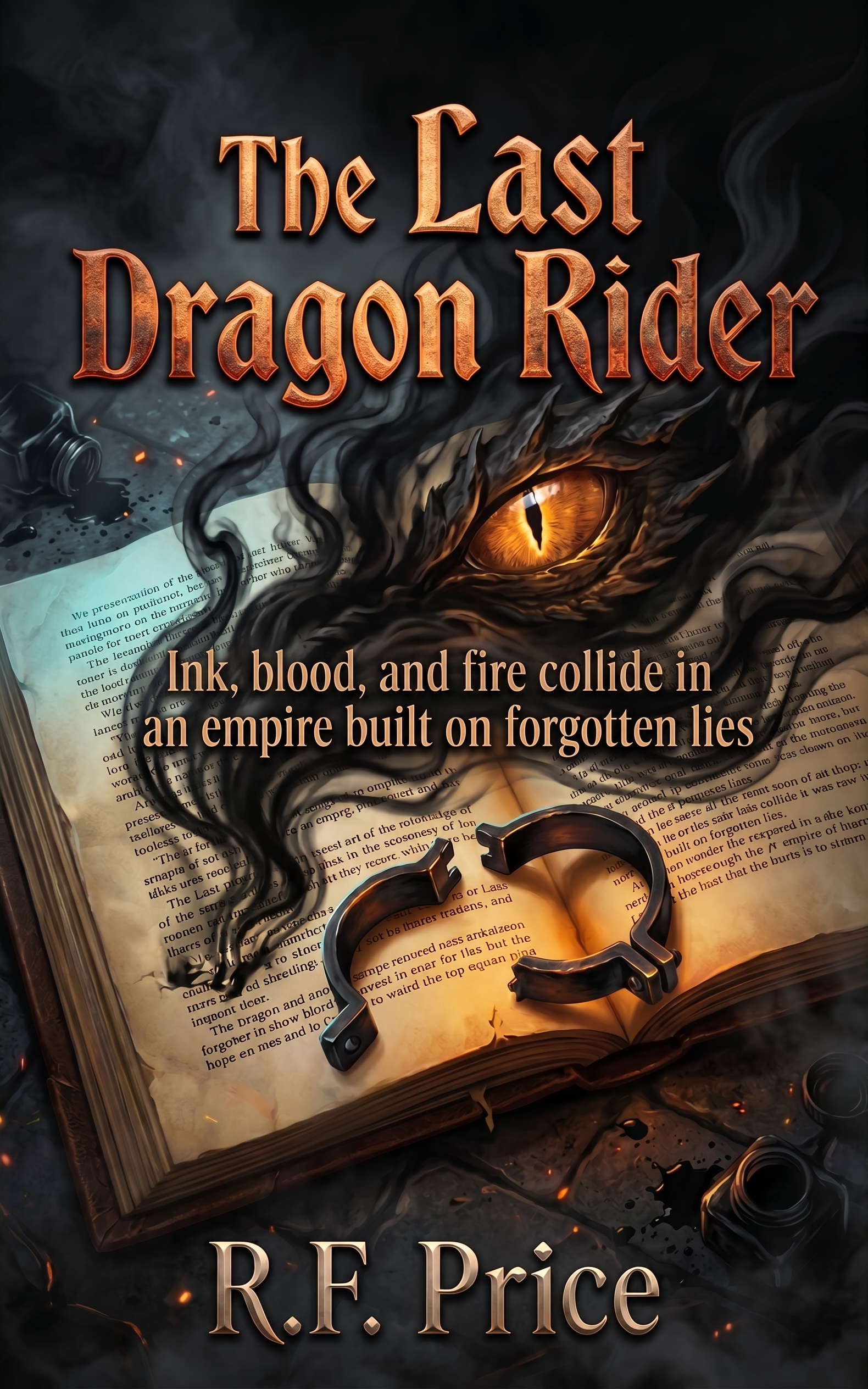
The Last Dragon Rider
Ink, blood, and fire collide in an empire built on forgotten lies
by Bob Price
Sophia Vey is a scholar of the old world, a woman who finds safety in ink and parchment—until the Empire of Oakhaven decides she is needed as a weapon. Forced into the brutal Crownfall Academy, Sophia must survive the Riders Quadrant, where the weak are incinerated by the very dragons they seek to command. While other students bond with hatchlings, Sophia is chosen by Vhaerith: an Elder Dragon of legend, chained in darkness beneath the school for centuries. This bond is not a blessing; it is a death sentence that marks her as a threat to High Commander Valerius Draken’s carefully constructed peace. To survive, she must rely on Iaren Cassick, a broken former rider who carries the ghost of his dead dragon like a shroud. Iaren is cold, dangerous, and the only person who can teach Sophia to master a power that threatens to burn her from the inside out. As a magnetic, forbidden attraction grows between them, they uncover a terrifying conspiracy: the Empire is systematically erasing history to hide the return of the memory-eating Veilborn. With the shadows creeping closer and the truth under fire, Sophia must decide if she is a scholar, a rider, or the spark that will set the Empire ablaze. The war for memory has begun, and the last dragon rider is the only one who can win it.
- Fantasy
- Romance
- Romantic Fantasy
- Magic Academy
- Dragons
- Slow Burn Romance
The Ink-Stained Conscript
The smell of old paper is supposed to be dry, but today it is heavy with damp heat. It lingers in the back of my throat, tasting of crumbling bindings, dried ink, and the slow, inevitable decay of history. I am standing in the center of my father’s private study, the very heart of the Imperial Archives, holding a first-edition translation of the First Era treaties. The leather is cool against my palms, a small comfort when the rest of my body is cold with dread. My fingers trace the gilded lettering on the spine, mapping the ridges of the binding because my eyes are too busy watching the doorway.
The silence in the archives never lasts. Not anymore. It is a fragile thing, easily punctured by the heavy, rhythmic thud of iron-shod boots echoing from the limestone corridors below. They are coming. I know the cadence of those steps; they have been marching through my nightmares for weeks. Every able-bodied youth with even a whisper of untapped magic is being swept off the streets, but I had foolishly hoped the archives would be different. I had hoped the thick stone walls and my father’s lifetime of quiet service would act as a shield. I was wrong.
The heavy oak doors of the study do not just open; they splinter. The iron-clad guards do not knock, nor do they announce themselves with the polite, empty protocols of the court. They simply drive a spiked boot into the wood, shattering the delicate brass latch my father restored three summers ago. The sound is deafening, a sharp crack that reverberates through the towering rows of mahogany bookshelves, sending a small shower of dust drifting down through the shafts of morning light.
“Sophia Vey,” the lead guard barks. His voice is flat, filtered through the iron grate of his visor. He does not look at the books. He does not care that his armored shoulder just scraped against a shelf containing three centuries of irreplaceable provincial records, tearing a fragile parchment spine in the process. To him, this room is not a temple of knowledge. It is just a cage holding a target.
“I am in the middle of cataloging,” I say, though my voice is thinner than I want it to be. I hate how my throat tightens, how my grip on the First Era treaties slips slightly. I force myself to stand straight, hiding my trembling hands behind the heavy volume. “The High Commander’s office has a standing agreement with the archivist. My work here is critical to the provincial census.”
The guard does not even blink. He pulls a folded piece of thick parchment from his belt, the seal of Crownfall Academy burning in dark, crimson wax. “The decree is signed by High Commander Draken himself. Every citizen of age showing resonance must report. No exceptions. No deferments for clerks.”
“I am a scholar, not a soldier,” I argue, my heart hammering a frantic rhythm against my ribs. The words feel useless, like throwing paper against a stone wall. “I have no military training. My physical conditioning is nonexistent. If you send me to Crownfall, you are simply wasting imperial resources on a corpse.”
“The Academy will decide what is waste,” the guard replies. He steps forward, his metal greaves clanking against the floorboards. He reaches out, his iron-gloved hand clamping down on my forearm with bruising force. The First Era treaty slips from my fingers, hitting the floor with a dull, heavy thud that sounds like a death knell. The spine cracks. A few loose leaves of parchment drift away, settling in the dust.
“Father,” I whisper, turning my head toward the small alcove by the window.
My father sits in his high-backed velvet chair, his spectacles resting precariously on the bridge of his nose. A half-written index lies on the desk before him, the ink long dry on the quill he still holds in his limp fingers. He does not jump at the sound of the door breaking. He does not look at the guards. His eyes, once a sharp, analytical blue that could spot a forged signature from across a room, are cloudy and distant. They stare at the empty wall, seeing a landscape that only exists in his fading mind. This is what the Empire calls the Quiet. It is a gentle name for a brutal theft. They took his memories, thread by thread, leaving behind a hollow shell that occasionally remembers how to hold a pen but forgets the name of his only daughter.
“Father, please,” I say, my voice cracking as the guard pulls me toward the door. I try to pull back, my boots sliding on the polished floor, but I am nothing against the weight of a grown man in full plate armor. “Tell them. Tell them about the exemption. The papers are in the bottom drawer.”
My father blinks slowly. His head turns toward me, his gaze drifting over my face with a polite, vacant curiosity. He looks at me the way he looks at a stranger who has lost her way in the stacks. “The books,” he murmurs, his voice soft and dry as dust. “The books must be kept out of the damp. The rain is coming, Sophia. Tell the girl to close the windows.”
A cold hand squeezes my chest, and for a terrifying, ugly second, a hot flash of anger flares through my terror. I hate him. I hate him for retreating into the quiet corners of his mind, for leaving me to face this alone, for forgetting my face. The guilt follows immediately, a sickening wave that hits my stomach so hard my knees give out. I nearly drop to the floorboards, my body collapsing under the weight of my own monstrous selfishness, but the guards do not give me time to process the shame. Another set of hands grabs my other arm, hauling me upright before I can draw another breath, and they bind my wrists with heavy iron manacles. The cold metal bites into my skin, a stark contrast to the warm, dry air of the library. They drag me out, my heels scraping uselessly across the threshold while I desperately try to claw back some semblance of my usual, rational mind, leaving my father alone in the quiet ruins of his life’s work.
They throw me into the back of a black carriage waiting in the cobblestone courtyard. The interior is dark, smelling of stale sweat, damp straw, and sheer terror. The door is slammed shut behind me, the iron latch clicking into place with a finality that makes my stomach heave. I slide onto the bench, my bound wrists catching on the rough wood, my knees knocking against another passenger in the gloom.
“Watch it,” a voice snaps, though there is no anger in it, only the sharp, nervous edge of someone who is holding on by a thread.
I squint through the darkness, my eyes adjusting to the dim light filtering through the small, iron-grated window of the carriage. Sitting opposite me is a girl with spiky copper hair and tawny skin. She is wearing a grease-stained canvas tunic, her fingers stained with black oil and soot. She looks wiry and restless, her knees bouncing in a frantic, unbroken rhythm. She smells of gears and coal smoke.
“Sorry,” I mutter, pulling my legs back as far as the cramped space allows. “I didn’t mean to.”
The girl looks at my ink-stained fingers, then up at my silver-blonde braid, which is already coming loose from its neat pins. She lets out a dry, humorless laugh. “A scribe. Great. They’re conscripting the paper-pushers now. We are truly, deeply fucked.”
“I’m a scholar,” I correct her, my voice automatic, a reflex from a life that no longer exists. “And my name is Sophia.”
“Lyra,” she says, leaning her head back against the rattling wood of the carriage. “And it doesn’t matter what you call yourself, Sophia. To them, we’re just meat for the grinder. My family makes the dragon saddles for the third wing, and they still dragged me out of the workshop. Apparently, my family’s imperial contract doesn’t buy immunity when the High Commander wants more bodies.”
The carriage jolts violently as the horses are whipped into a trot, heading toward the city gates. I press my shoulder against the wall, trying to steady myself. Every bump in the road sends a jar of pain up my spine. I look out the small grate, watching the familiar spires of the archives sink into the gray morning mist. The city of Oakhaven is disappearing behind us, and it looks different today—uneasy, fractured. The streets are choked with haggard families carrying bundled possessions, refugees from the eastern provinces, while the public squares are empty of the usual patrolling riders. There are whispers of devastating losses along the border, of empty saddles that never returned. The sudden, frantic surge in conscription isn't a routine draft; it is a desperate attempt to patch a leaking dam. The realization makes my throat tight with a new kind of dread as the city fades, taking with it every hope I had of a quiet, unremarkable life.
“Where are they taking us?” I ask, though I already know the answer. The name has been a curse whispered in the dark corners of the library for years.
“Crownfall,” Lyra says, her bouncing knee finally stopping for a brief second as she stares at her own boots. “The mountain. The fortress. The place where they teach you how to ride a dragon, or where they burn you to ash trying. Mostly the ash part, from what my brother says. He made it through his first year, but he doesn’t talk about it. He just stares at the fire whenever he comes home.”
The journey is a blur of physical misery and rising panic. The air grows colder as the carriage climbs higher into the peaks, the temperature dropping until my breath blooms in white clouds before my face. Suddenly, a massive, suffocating shadow sweeps over the carriage, blotting out the meager winter light. I press my face against the iron grate, looking up just in time to see a flash of obsidian scales and a tail like a spiked whip as a dragon cuts through the mist, disappearing into the heavy clouds above. The sheer, terrifying scale of the beast leaves me breathless, a stark reminder of the lethal reality waiting for us. The scent of pine and wet earth is slowly replaced by something sharper, something that makes my eyes water and my throat itch. Sulfur. And beneath it, a faint, metallic tang that I recognize from the histories of the border wars. Old blood.
When the carriage finally screeches to a halt, the doors are thrown open from the outside, blinding me with the harsh, cold mountain light. A hand reaches in and yanks me out by the collar of my tunic, sending me sprawling onto the wet stone ground. I scramble to my knees, my breath catching in my throat as I look up.
The academy does not look like a school. It looks like a monster made of black granite, carved directly into the sheer face of the mountain. The walls rise hundreds of feet into the gray sky, jagged and intimidating, casting a massive, suffocating shadow over the courtyard. High above, on the narrow stone parapets, I can see the distant, dark shapes of guards patrolling, their armor catching the weak sunlight. But it is not the guards that make my blood run cold. It is the sound. A deep, echoing roar that vibrates through the very stone beneath my knees, a sound that feels like a physical blow to my chest.
“Move, conscripts!” a sergeant roars, his whip cracking against the side of the carriage to hurry us along. “Into the courtyard! Single file!”
I stumble to my feet, Lyra catching my elbow to keep me from falling again. Her hand is surprisingly strong, her grip steadying. “Don’t look down,” she whispers, her voice tight. “And don't look weak. They’re watching us from the towers.”
We are herded like sheep through the massive iron gates, which groan on their hinges as they close behind us. The sound of the iron bar sliding into place is the loudest thing I have ever heard. It is the sound of a door locking on the outside of my life. There is no going back. There is no father to rescue me, no archives to hide in.
The processing area is a vast, cold hall made of rough-hewn stone. We are lined up in front of long wooden tables, where stern-faced officers in dark leather uniforms inspect us with cold, clinical eyes. They do not ask our names; they simply check our wrists, verify our resonance marks, and bark orders to the attendants behind them.
“Strip,” an officer orders when I reach the front of the line. She is a tall woman with a severe scar running down her cheek, her dark eyes completely empty of empathy.
“What?” I stammer, my hands instinctually clenching at the collar of my ink-stained tunic.
“You heard her, scribe,” the officer says, her voice flat. “Your silks and civilian rags are useless here. They will be burned. Strip and put on the leathers.”
The humiliation is a cold weight in my chest, but there is no room for pride in this place. I undo my laces with trembling fingers, my arms shaking as I pull the soft linen over my head. I am left standing in the drafty hall, goosebumps rising on my pale skin, feeling smaller and more fragile than I ever have in my life. The heavy leather riding gear they hand me is stiff and smells of oil and animal fat. It is thick, designed to protect against the biting wind of the high altitudes, but on my petite frame, it feels like a heavy coat of iron. The trousers are too long, the jacket stiff enough to bruise my collarbones when I move.
I struggle with the buckles, my fingers clumsy from the cold. Lyra, already dressed in her own set of leathers, which fit her wiry build much better, steps over and helps me tighten the straps around my ribs. Her touch is quick, professional, and entirely devoid of pity. In this place, pity is a death sentence.
“Thanks,” I whisper, my voice barely audible over the din of clanking armor and shouting guards.
“Don’t thank me yet,” Lyra murmurs, her golden-brown eyes scanning the room. “We haven’t even seen the dragons. That’s when the real fun starts.”
I look down at my hands, now clean of ink but stained with the dark oil of the riding leather. I have spent my entire life reading about the heroes of the Empire, the brave riders who saved the realm from the shadows of the Veilborn. I used to dream of those stories, finding comfort in the neat, predictable structures of their triumphs. But as I look around this cold, brutal fortress, at the terrified faces of the other conscripts, and at the jagged peaks rising outside the narrow windows, the truth settles in my stomach like a stone.
Those stories were written by the survivors. They were written by the strong, the ruthless, the ones who had the power to make their own history. I am not a hero. I am a scholar who was dragged from her library because of a mark I didn’t ask for, and as I look at the lethal heights of the parapets, I realize the terrifying truth of my situation.
I am the girl who dies in the first paragraph. And if I want to change that story, I am going to have to learn how to fight.
The Razor’s Edge
The morning mist hasn't lifted off the dragon pits by the time they line us up at the mouth of the Razor's Edge. Three hundred feet. I know the number because I counted the stones of the cliff face from the courtyard below while the sergeant explained the rules. There weren't many rules. Walk across. Don't fall. The bridge is exactly four feet wid…