

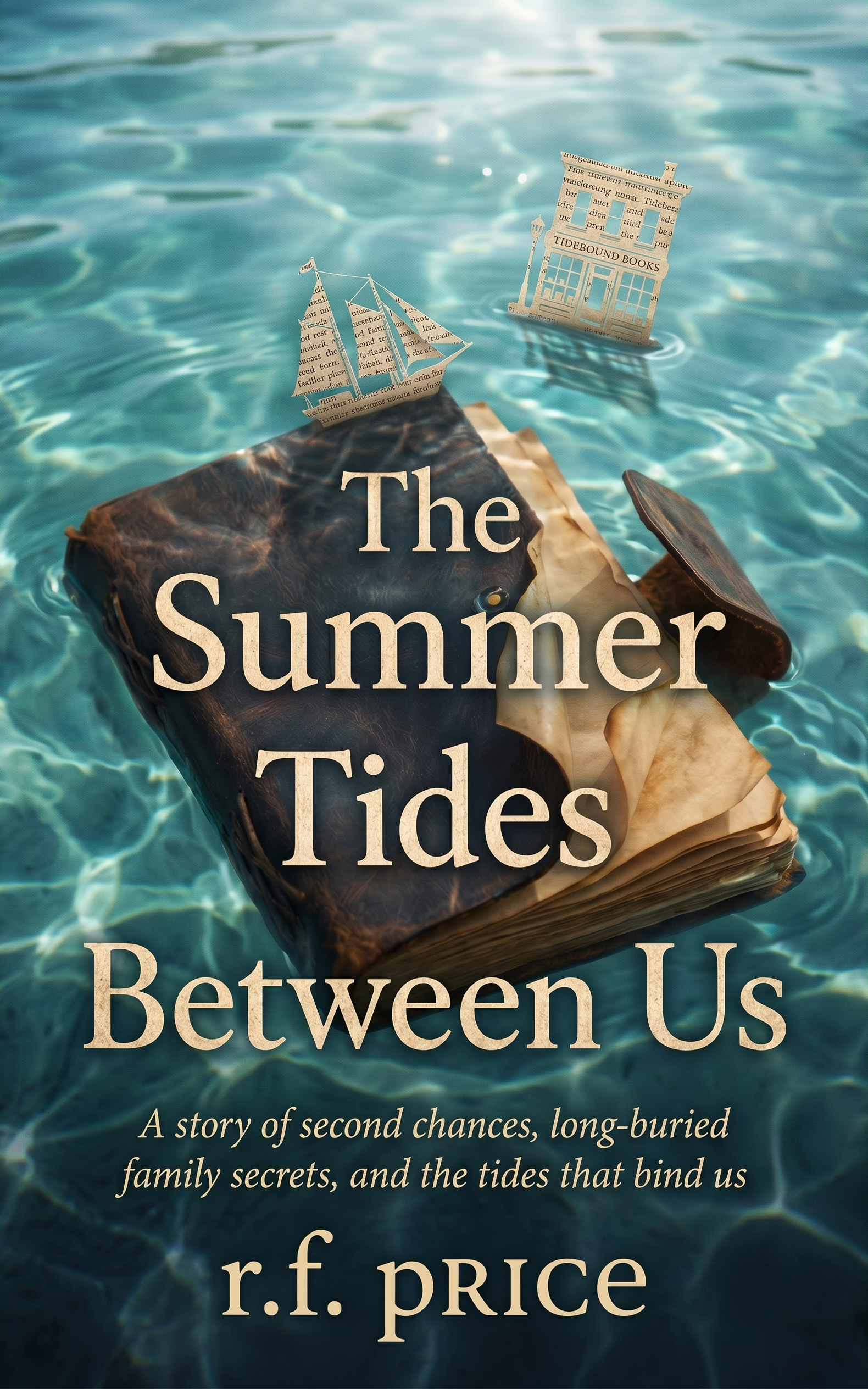
The Summer Tides Between Us
A story of second chances, long-buried family secrets, and the tides that bind us
by Bob Price
Catherine Mercer's life in Boston is a wreckage of infidelity and corporate betrayal. Left with nothing but a bruised heart and a failing legacy, she returns to the rugged shores of Greyhaven Point, Maine, to settle her aunt’s estate. What she finds is Tidebound Books—a bookstore literally sinking into the Atlantic, burdened by salt air and heavy debts. Her return forces a confrontation with Gideon Thayer, the harbor pilot who was her first love and the man who has carried the weight of the town’s silence for twenty years. But the past isn't just haunting her heart; it’s hidden in the ink. While clearing the bookstore's attic, Catherine uncovers her aunt’s secret journals, revealing a terrifying truth: her father’s drowning two decades ago was no accident. It was a cold-blooded cover-up to protect a local empire. Now, Catherine must navigate a treacherous landscape of small-town corruption and rekindled passion. As the Vance family moves to seize her land for a luxury resort, Catherine realizes that saving the bookstore means exposing the very foundation of the community. With the summer tides rising, she must decide if the truth is worth the risk of being pulled under by the same dark waters that took her father.
- Romance
- Literary Fiction
- Mystery
- Second Chance Romance
- Small Town Romance
- Women's Fiction
The Architecture of Failure
The GPS gave up somewhere on Route 1, right between a lobster pound with a hand-painted sign and a gas station whose pump handles were wrapped in duct tape the color of old bruises. Catherine Mercer didn't blame it. She'd given up on a few things herself lately.
She drove the last seven miles by memory, which was its own kind of problem. Memory had a way of cleaning things up, softening the edges, putting golden light on places that probably never deserved it. The road to Greyhaven Point was exactly as she remembered it in its bones but wrong in its details — a diner she'd loved was a nail salon now, the old drive-in screen was a cell tower wearing a poor disguise, and the water tower on the hill had been repainted a cheerful blue that sat uneasily against the gray sky.
She crossed the causeway at five-fifteen in the afternoon, the harbor opening up on both sides of the road like something trying to swallow her whole. The Atlantic was doing what the Atlantic always did in late June — heaving itself against the breakwater with the patient, methodical indifference of something that had been here long before her and would be here long after. Gulls worked the surface in their tilting, banking circles. The smell came through the cracked window before she could stop it: low tide and wet stone and the faint sulfur sweetness of mudflats exhaling under cooling air.
Twenty years. And the harbor smelled exactly the same.
Catherine pressed her fingers against the steering wheel and did not let herself feel anything about that for the approximately forty-five seconds it took to find Pier Street. Feeling things about it would come later, in the dark, the way it always did.
Tidebound Books sat at the end of the pier like something that had been told to leave but hadn't gotten around to it yet. She saw it from the top of the hill before she turned down the waterfront road — the cedar-shingled roofline, weathered to the color of a winter sky, the hand-lettered sign above the door faded to the point of suggestion. A narrow building pressed between the pier's edge and a parking lot with aspirations, three stories counting the dormer window that jutted from the roof like an afterthought. A small balcony on the second floor hung over the water on pilings whose condition she was not going to think about right now.
The lawyer's photographs had been taken in flattering light. Midday, she guessed, with the sun doing its best work on the salt-silvered wood. This was evening light, which was an honest light, and in honest light the building looked like exactly what it was: a century-old structure that had been fighting the ocean for a hundred years and was starting to lose the argument.
She parked in the lot. She sat in the car for a moment.
Okay, she thought. Okay.
The word had been doing a lot of heavy lifting lately.
She got out. The wind off the harbor hit her sideways, pulling at her hair, carrying with it the slap of water against the dock pilings below and the distant sound of a marine radio crackling through a weather report. The pier boards were soft under her feet in a way that was probably fine and probably wasn't. The sign above the door, she could now read in full: TIDEBOUND BOOKS, EST. 1962, and below that, in a smaller, more exhausted font: Open When We're Here.
She pushed the door open.
The smell hit her in a wave — old paper and salt air and something else, something that lived underneath both of those, like cedar and time. The interior was dim, lit by two floor lamps with amber shades and the failing daylight from a pair of tall windows that faced the water. Shelves ran from floor to ceiling on every wall and in two long rows down the center of the room, packed with books in various states of dignity. Some had been shelved with care. Others were stacked horizontally, shoved spine-first into gaps, balanced in small towers on the floor beside their sections. There were water stains on the ceiling in shapes that Catherine's analyst's brain immediately began cataloguing as structural concerns. The floorboards were the wide, dark pine of old New England buildings, and they gave slightly underfoot with a creak that sounded, she thought, almost apologetic.
It was the most beautiful wreck of a room she had ever stood in.
She didn't want to think that, so she didn't.
"You're late."
The voice came from somewhere between American Literature and the back wall. Catherine turned. A small, solid woman emerged from behind a freestanding shelf, moving with the brisk efficiency of someone who had been navigating that particular maze for decades. She was short, white-haired, wrapped in a cardigan the color of sea glass, and regarding Catherine with an expression that managed to be simultaneously welcoming and severely unimpressed.
"I said four o'clock," the woman added. "It's nearly five-thirty."
"I had to stop for gas," Catherine said. "The GPS—"
"The GPS." The woman said it the way you'd repeat a word in a foreign language you didn't speak. "Eleanor Mercer navigated this coast for forty years without a GPS. I imagine her niece can manage Route 1." She extended a hand. "Martha Wickham. I run the shop."
"Catherine Mercer." She shook it. Martha's grip was dry and firm and over quickly, like a punctuation mark.
"I know who you are." Martha reached into the cavernous front pocket of her cardigan and produced a ring of keys — old ones, the kind with long barrel shafts and ornate bows, the kind that belonged in a locksmith's museum. She set them on the checkout counter with a sound like small dropped anchor. "Skeleton keys. One for the front, one for the back, one for the apartment upstairs, and one for the attic. The fourth one I'd leave alone for now. The lock is stiff and the attic stairs have a soft step, third from the top. I've put a piece of tape on it."
Catherine picked up the keys. They were heavier than they looked. "The apartment upstairs — that's part of the estate?"
Martha was already moving back toward the counter. "It is now. I've been using the back room, but that's a conversation for another time." She said it without apology, without particular embarrassment, the way you'd mention a standing arrangement that everyone reasonable would understand. She produced a ledger from beneath the counter and set it beside the keys. It was a physical ledger, the kind with a cloth-covered board and columns ruled in blue, and it had been filled in with a careful hand that Catherine recognized from birthday cards and recipe cards and the backs of old photographs.
Her aunt's handwriting.
She touched the cover before she could stop herself.
"The financials," Martha said, watching her. "I'll warn you — the picture it paints is not a pretty one. Eleanor kept meticulous records. She just didn't keep enough money to make them add up right." She paused. "The tea is in the back, if you need a minute before you open it."
"I don't need a minute," Catherine said.
She opened the ledger.
The first page was a summary. Catherine's eye went straight to the bottom line the way it always did, twenty years of reading financial statements cutting through the columns of careful notation to the single number that told the truth. She read it. She read it again. She turned to the previous month's summary. Then the one before that.
"The lawyer," she said, carefully, "told me the business carried debt in the range of forty thousand dollars."
"Did he," Martha said, in a tone that was not a question.
"This ledger is showing me something closer to a hundred and twenty."
"A hundred and twenty-three, if you count the past-due invoice from the heating company, which I'd recommend you do, since they've threatened to discontinue service twice this winter." Martha folded her hands on the counter. "Your aunt took a second loan against the building four years ago. She didn't tell the lawyer about it. She didn't tell me about it either, not right away. I found the paperwork in the spring, after." She said after the way people in this town probably said a lot of things — quietly, with a period where you'd expect more words.
Catherine closed the ledger. She set her hands flat on the cover. Outside, through the tall windows, the harbor was going gray-gold in the last of the evening light, and somewhere below the floorboards, the water moved against the pilings with a hollow, rhythmic knock.
"Why did she take the loan?" Catherine asked.
Martha looked at her for a moment — a particular kind of look, the kind that held more information than the answer it preceded. "She needed to keep the building," she said finally. "Someone was very interested in purchasing it. She chose not to sell."
"Who?"
"That," Martha said, "is also a conversation for another time. Tonight you should look at the building and sleep on what you've learned. The harbor will still be here in the morning, and so will the problems." She came around the counter and handed Catherine a small flashlight. "The second-floor light is on a faulty switch. You'll want this for the balcony."
Catherine took it. "Do you always manage people this efficiently?"
"I managed a classroom of twenty-eight fifth-graders for forty years," Martha said. "You're considerably less trouble than Tyler Beaumont was, and he once released a seagull indoors." She turned back to the shelves. "The stairs are through the door behind Local History. Mind the third step from the top on your way down."
Catherine stood there for a moment with the flashlight and the ring of skeleton keys and a ledger full of numbers that were going to keep her awake for the foreseeable future. Then she went to find the stairs.
The second floor held the shop's overflow inventory and a narrow corridor that opened onto the balcony. She went to the balcony first, pushing open the door that stuck in its salt-swelled frame, and stepped out over the harbor.
The view was the same one from every photograph her aunt had ever sent her, the same one that appeared behind her eyelids on certain restless nights in Boston when she couldn't remember why she'd chosen the life she'd chosen. The harbor lay below her in the cooling evening, the water dark now, the boat lights strung across it like a sentence in a language she'd almost forgotten. The marina to the north, the commercial pier to the south, the channel marker blinking its slow red pulse in the middle distance. A pair of lobster boats were coming in late, their running lights amber and white against the darkening water.
She gripped the railing. It flexed slightly, and she let go.
Her father had loved this harbor. He'd said it was the only place where he felt like the noise in his head went quiet. She'd been nineteen when he died in it — nineteen and three months away from starting her freshman year of college, and the drowning had been ruled an accident, a man who knew the water better than he knew his own kitchen, somehow overcome by a current on a calm summer night. She had never been able to make those two facts sit in the same room together without one of them knocking the other down.
She'd left. She'd left and not come back, not for the funeral and not for the clearing out and not for the Christmases her aunt had spent alone in the apartment above the books, sending cards with careful handwriting and never once saying please come home.
Below her, a pilot boat was moving through the inner harbor, running dark and quiet on its way to meet a freighter at the channel mouth. She watched it. Something about the way it moved — steady, unhurried, reading the water with the confidence of something that belonged there — made her chest do something complicated. She watched until it rounded the breakwater point and disappeared, leaving a white wake that flattened quickly in the dark water.
She went back inside before she could make anything of it.
The local history section was on the ground floor, tucked in the back corner nearest the water side, where the salt damage was worst. Catherine walked its shelves slowly, running a finger along the spines. Maritime histories, town records, fishing logs bound in cracked leather, a complete run of the Greyhaven Historical Society's annual pamphlets going back to 1954. Someone had organized it with care, by date and then by subject, and the care showed in the way every volume was precisely aligned, its spine legible, its neighbors giving it room.
She noticed the gap almost immediately.
It was on the third shelf from the bottom, in the section covering the 1990s through the early 2000s. A gap roughly the width of a thicker volume, flanked by two town histories that leaned together like they were trying not to think about the missing book between them. She crouched down and looked at the shelf itself. The dust was disturbed in the shape of a rectangle, the ghost of something recently removed — not recently as in last week but recently as in the last year or two, before the dust had time to fully settle back.
She made a note in her phone. Then she stood up and looked around the shop.
Martha was in the front, straightening a display of summer reads near the window with the single-minded focus of someone who did not want to be observed making herself useful. Catherine watched her for a moment. Martha knew this shop the way she knew her own hands, and people who knew places that well knew when something was missing from them.
She didn't ask. Not tonight. Martha had told her: the harbor would still be here in the morning, and so would the problems. She was starting to suspect the problems and the harbor were the same thing, wrapped in different names.
She walked back to the checkout counter. It was an old piece of work, the counter — wide planks of dark wood, smoothed by decades of hands and elbows and stacked books, its surface mapped with the circular ghosts of coffee cups and the thin scratches of pen nibs. She ran her hands along the near edge, the way you did with old furniture, feeling the history of it in the small imperfections.
She almost missed it. Her fingers found it before her eyes did — a slight roughness in the wood, deliberate, too regular to be wear. She bent closer. The light in the shop was going amber and dim, and she tilted the flashlight down.
Two letters. Carved with something small and careful — a penknife, maybe, or a compass point — in the wood along the inner edge of the counter where a customer's hand would never quite reach. T.M.
Thomas Mercer. Her father's initials, cut into the wood of a counter he'd stood behind a hundred times while her aunt ran the register and he reorganized the maritime section and argued cheerfully about whether Patrick O'Brian counted as literature.
Catherine straightened up. She breathed through her nose, slowly, the way her therapist in Boston had taught her to breathe when things came at her sideways. The shop creaked around her. The water knocked against the pilings. Somewhere in the back, a cardigan rustled as Martha moved between shelves.
I thought I was coming here for a funeral, she thought. Not a reckoning.
But even as she thought it, she knew that wasn't quite right. Funerals and reckonings had always been the same thing in this family. You just didn't find out which one you were attending until you were already inside.
"Martha," she called.
The rustling stopped. "Mm?"
"The back room — how long have you been living there?"
A pause. "Since February. The heat in my apartment on Cobb Street went out and the landlord was slow about it. Eleanor would have said to stay, so I stayed." Another pause, shorter. "I pay for my utilities."
Catherine looked at the ledger on the counter. She looked at the skeleton keys. She looked at the gap in the local history shelves, which she could just see from where she stood, the two leaning volumes and the empty space between them.
"The back room is fine," she said. "For now."
From the rear of the shop came the sound of a kettle being filled, and then the snap of a burner catching, and Catherine thought that some decisions made themselves before you quite had the chance to stop them. She sat down on the stool behind the counter — her aunt's stool, worn smooth on the seat, a small permanent hollow in the wood — and opened the ledger again.
Outside, the harbor went fully dark. The channel marker blinked its slow red pulse. The water moved against the building's old bones with the patience of something that had been waiting a very long time, and somewhere in the deep of the wood under her fingertips, her father's initials sat in the grain like a question she wasn't sure yet how to answer.
She turned the first page and started to read.
Salt and Stagnation
The fog came in overnight and stayed. Catherine stood at the kitchen window of the apartment above the shop with a mug of coffee that had gone lukewarm while she wasn't paying attention, watching the harbor dissolve into white. The pier below her was visible for maybe thirty feet before it just stopped existing. Beyond that, the fog had swallowed e…