

Cracked Code of the Matrix
Unlocking the 142857 sequence to reveal humanity's hidden clockwork and the coming master reset
by Bobby Cummings
The universe isn't random—it's a repeating loop. In Cracked Code of the Matrix, Bobby Cummings deconstructs the mathematical architecture of our reality, centered on the enigmatic 142857 sequence. This isn't just a number; it is the recurring blueprint for everything from ancient Egyptian metrology and Sumerian systems to the very biological rhythms that pulse through the human body. Why do planetary axial wobbles, geomagnetic pole shifts, and the 28-day menstrual cycle all align with the same cyclic constants? Cummings argues that we are trapped in a 42,000-year loop of creation and destruction, governed by a geometric matrix that ancient civilizations understood and modern elites still manipulate. From the eschatological prophecies of the Book of Revelation to the cutting-edge experiments at CERN, this book connects the dots between solar flares, deep underground military facilities, and the impending 'lampshade excursion' that threatens a global reset. As technological control tightens and geomagnetic shifts accelerate, the code is finally being cracked. Are we nearing the end of a world age, or just another scheduled restart? Prepare to see the world not as a linear history, but as a sophisticated, mathematical prison waiting for its next master reset.
1:00 Cyclic numbers
The Geometry of the Repeating 142857
The mathematical architecture of the physical universe relies on foundational constants that govern both spatial structures and temporal dynamics. While modern physics frequently emphasizes linear models of progression, empirical observations of planetary motion, electromagnetic radiation, and biological rhythms reveal a deeper commitment to recursive, non-linear frameworks. At the center of these recurring operational frameworks lies a specific numeric anomaly: the cyclic sequence generated by the division of unity by the prime number seven. When expressed as a decimal, the fraction 1/7 yields the infinite, non-terminating sequence of 0.142857142857... This six-digit string—142857—is not an arbitrary artifact of base-ten arithmetic. Rather, it serves as a structural blueprint for how energy moves, distributes, and conserves itself within closed dynamic systems.
To understand the mechanics of this sequence, one must analyze its unique mathematical behaviors, its historical applications in ancient petrologist, and its geometric representations as Galileo Galilei famously observed that the book of nature is written in the language of mathematics. By examining these structural properties of 142857, we begin to decode the specific alphabet responsible for modulating macro-level planetary cycles and micro-level biological periodicities.
The Geometric Blueprint and the Enneagram
The sequence 142857 functions as a closed loop within numerical space. When mapped visually onto a nine-point circle—a geometric form historically designated as the enneagram—the sequence traces a vector path that connects the digits in a precise order: 1 to 4, 4 to 2, 2 to 8, 8 to 5, 5 to 7, and 7 back to 1. This specific vector configuration forms an internal, asymmetric star polygon that explicitly excludes the numbers 3, 6, and 9. The exclusion of these three numbers is fundamental to understanding the operational nature of cyclic systems.
In physical terms, the sequence 142857 models the active, dialectic movement of energy within a localized environment, such as a steroidal magnetic coil or a planetary magnetosphere. The non-participating digits—3, 6, and 9—represent the structural framework or the external field within which this dynamic movement occurs. The number 9 acts as the stabilizing axis or the void around which the operational numbers rotate. The internal continuous line created by 1-4-2-8-5-7 demonstrates how force transitions through six distinct phases without losing momentum or breaking equilibrium. Consider the structural characteristics of this directional path:
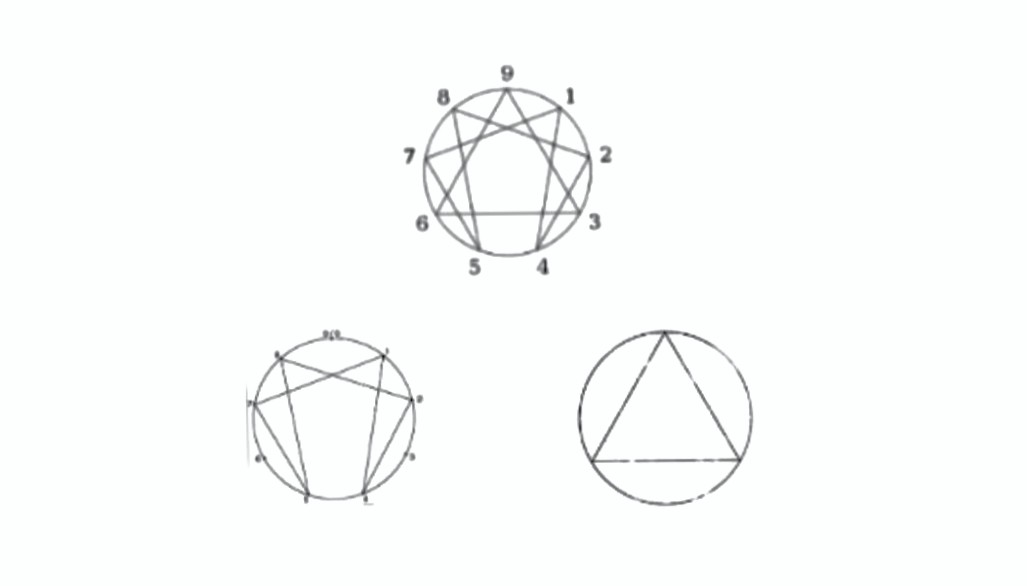
Phase 1 to 4: The initial displacement from primary unity into structural expansion.
Phase 4 to 2: The primary contraction, establishing structural density and opposition.
Phase 2 to 8: The secondary expansion, doubling the initial resistance to achieve critical mass.
Phase 8 to 5: The internal reorganization, where energy shifts from maximum output to internal stabilization.
Phase 5 to 7: The final acceleration toward completion, reaching the threshold of the system.
Phase 7 to 1: The renewal vector, returning the force to its initial origin point to restart the cycle.
This path illustrates how energy undergoes transformation without dissipating into absolute entropy. The system conserves its internal momentum by continually recirculating through these six spatial coordinates. Consequently, any closed environment—whether a localized magnetic field, an organic cell, or an entire planetary body—that exhibits stable periodic behavior relies on this structural geometry to sustain its equilibrium over extended epochs.
Historical Context: Ancient Neurological Systems
The mathematical properties of the number seven and its corresponding reciprocal decimals were not unknown to early human civilizations. Archaeological and neurological analyses of ancient Egyptian and Sumerian architecture demonstrate a sophisticated understanding of fractional mechanics. These cultures utilized the prime number 7 as a fundamental divisor to construct spatial grids, standardize measurements, and calculate celestial movements.
In ancient Egyptian petrologist, the royal cubit was divided into seven palms, each palm further subdivided into four digits, creating a twenty-eight-part system that mirrored both lunar months and standard biological cycles. When calculating architectural proportions for temple complexes and pyramidal structures, Egyptian builders frequently employed ratios based on 22/7, an early approximation of pi that inherently incorporates the fractional dynamics of 1/7. By grounding their physical construction standards in a centenary system, these ancient builders aligned their physical structures with the mathematical proportions governing regional and global environmental cycles.
Sumerian sex ages male arithmetic similarly recognized the distinct mathematical behavior of the divisor seven. Unlike the numbers 2, 3, 4, 5, and 6, which divide the base number 60 into clean whole integers or finite fractions, seven acts as a primary disruptors within the base-60 system. The division of 60 by 7 yields an infinite repeating sequence (8.571428571428...). Sumerian astronomers recognized that this division introduced a recurring temporal wave into their mathematical models, allowing them to track complex planetary intervals and oceanic shifts over multi-generational timeframes.
Rather than viewing the number seven as a mere abstract or mystical symbol, these ancient societies recognized it as a functional physical parameter. The division of a whole unit by seven represents the primary disruption of complete equilibrium in the physical realm. When unity is divided into seven equal parts, the resulting fractional values yield the identical six-digit sequence, shifted only in its starting position depending on the numerator:
1/7 = 0.142857...
2/7 = 0.285714...
3/7 = 0.428571...
4/7 = 0.571428...
5/7 = 0.714285...
6/7 = 0.857142...
In every instance, the sequence of digits remains unaltered. The internal structural order is absolute, demonstrating that regardless of where an observer enters the cycle, the dynamic progression obeys the same mathematical framework.
The Mechanics of 142857: Cyclic Rotations and Stationary Change
To fully grasp the unique behavior of 142857, one must examine its properties under basic arithmetic operations. The term cyclic number refers to an integer of n digits which, when multiplied by any integer from 1 through n, produces the exact same digits in the exact same sequential order, rotated by a specific number of positions.
When 142857 is multiplied by whole integers from 1 to 6, the resulting products demonstrate an absolute internal order:
142857 x 1 = 142857 (Starts at 1)
142857 x 2 = 285714 (Starts at 2)
142857 x 3 = 428571 (Starts at 4)
142857 x 4 = 571428 (Starts at 5)
142857 x 5 = 714285 (Starts at 7)
142857 x 6 = 857142 (Starts at 8)
This phenomenon introduces the concept of stationary change. While the output value changes numerically with each multiplication step, the internal relative order of the constituent elements remains entirely fixed. The sequence shifts its spatial orientation without altering its underlying structural logic. The number moves, yet it stays within a fixed geometric enclosure.
The behavior of the sequence undergoes a dramatic transition when multiplied by the number 7, the very integer that gives rise to the decimal sequence initially:
142857 x 7 = 999999
The multiplication by seven completely resolves the cyclic motion, collapsing the active six-digit rotation into a unified sequence of nines. While this collapse functions as a pure mathematical property of base-ten modulo arithmetic, it directly models the physical laws governing electromagnetic saturation. In this capacity, the product 999999 marks the structural threshold of the system—the point where internal rotation ceases and the accumulated energy within the dynamic cycle either discharges or resets to zero.
Furthermore, if one splits the six-digit string into two three-digit halves and adds them together, the sum yields the same terminal value: 142 + 857 = 999. Similarly, if split into three two-digit pairs, the sum yields a multiple of nine: 14 + 28 + 57 = 99. These structural symmetries confirm that 142857 is an integrated mathematical engine designed to distribute force evenly across a balanced, closed domain.
Modern Revelations: The Lampshade Excursion Model
How does this numerical framework manifest within physical planetary systems? Modern geophysical studies and Paleo magnetic measurements indicate that celestial bodies do not move along perfectly uniform, linear paths. Instead, their orbits, rotational axes, and magnetic poles experience periodic instabilities, wobbles, and full-scale excursions.
The concept of the lampshade excursion provides a geometric model for understanding these period shifts. Rather than imagining a planetary wobble as a simple back-and-forth tilt or a uniform circular cone, the lampshade model describes a truncated, faceted geometric path that a planetary pole or orbital axis follows during phase transitions. When projected onto a three-dimensional plane, the path of this axial excursion traces the exact geometric vector lines defined by the 142857 sequence mapped onto a sphere.
During stable geological epochs, a planet operates within one specific digit-phase of the cycle (for example, the 1-4 vector). As atmospheric, gravitational, or electromagnetic forces build up stress within the planetary system, the equilibrium breaks down, forcing the planetary axis to transit along the vector line to the next positional marker (from 4 to 2). This movement is not random. It follows the exact operational path of the cyclic sequence.
The term excursion is intentionally distinguished from a permanent, complete reversal. In a magnetic or axial excursion, the system undergoes a rapid, dramatic shift in orientation—often accompanied by intense environmental disruptions, cosmic radiation spikes, and tectonic reorganizations—before settling into the next stable numerical node within the sequence. The movement resembles a lampshade due to its flattened, multi-angled conical trace across the surface of the planetary projection.
This model offers a fresh frame of reference for reviewing paleomagnetic data. Historically, unexpected magnetic realignments were categorized as isolated anomalies or stochastic events. However, when these events are plotted chronologically, the time intervals between major global excursions correlate directly with the mathematical multiples of the 1/7 decimal series. The planet rotates through its functional phases (1-4-2-8-5-7), experiencing violent environmental restructuring whenever the axial vector completes a line segment and pivots sharply toward the next numerical coordinate.
Practical Application: Mapping Periodicity and Personal Cycles
The mathematical principles governing planetary excursions apply equally to biological systems. Living organisms are micro-level environments operating within the larger macro-level cycles of the biosphere. Cellular division, hormonal fluctuation, and biological period cities respond directly to external environmental stimuli, which are themselves modulated by mathematical constants.
To analyze biological periodicity, individuals can utilize a geometric mapping technique known as the Seven-Point Radial Projection. This exercise maps the 1/7 decimal sequence onto a 360-degree circular framework to identify critical transition thresholds within personal or systemic development cycles.
Construct the Outer Geometry: Draw a circle and divide its 360-degree circumference into seven equal segments of approximately 51.42 degrees each. Label these points sequentially from 1 to 7 around the perimeter.
Plot the Vector Network: Draw straight line vectors connecting the points according to the 142857 sequence: draw a line from Point 1 to Point 4, from Point 4 to Point 2, from Point 2 to Point 8 (mapped to Point 1 in a 7-point space, continuing the path to Point 5), from Point 5 to Point 7, and from Point 7 back to Point 1.
Calculate the Base Multiplier: Take a primary numerical marker, such as a birth date or the inception date of a specific system (expressed as DD/MM/YYYY), and calculate the sum of its individual digits. Divide this total by 7 to determine the initial positional coordinate within the sequence.
Identify Phase Boundaries: Multiply the initial value by the sequence multipliers (1 through 6) to establish the projected dates or intervals where phase shifts are likely to occur. These calculated intervals represent the operational pivot points where the system transitions from one vector path to another.
By plotting these transition points, an observer can track when a biological or physical system enters a phase of rapid acceleration (the 2 to 8 transition) or a phase of necessary structural consolidation (the 8 to 5 transition). Understanding these internal mechanics allows for better preparation during periods of rapid environmental or physical change, minimizing structural stress during critical phase transitions.
Addressing Common Misconceptions
In analyzing the properties of 142857, several analytical errors frequently arise in contemporary discussions surrounding sacred geometry and number theory. Correcting these misunderstandings is essential for maintaining scientific and mathematical rigor.
A critical analytical consideration is the foundational role played by the number 9 in governing the core sequence. Rather than operating as an active numerical component within the active rotation, the number 9 functions as the overarching frame and structural container that holds the sequence together. The digits 1, 4, 2, 8, 5, and 7 represent active, kinetic operations—the dynamic moving parts of the system. The number 9 represents the stationary axis, the overall field boundary, and the sum of all opposing pairs (1+8=9, 4+5=9, 2+7=9). Incorporating 9 directly within the active rotation vector would instantly collapse the dynamic movement into a static equilibrium, halting the motion of the entire system.
A second common mistake is treating 142857 as an arbitrary or mystical string of digits discovered through coincidence. The sequence is the direct mathematical result of dividing the whole integer 1 by the prime number 7. In physical systems, 1 represents initial unity, absolute balance, or an unbroken field. The introduction of 7 as a divisor represents the first fundamental disruption of that unified field within a three-dimensional spatial framework. You cannot divide a continuous 360-degree circle into seven equal whole-degree parts without producing a repeating fractional remainder. The number 142857 is simply the precise expression of that fundamental spatial disruption.
Finally, researchers often fall into the trap of viewing time as a strictly linear continuum marked by equal, unchanging units. Linear models fail to account for the abrupt shifts, rapid accelerations, and periodic collapses observed throughout Earth's geological history. The 142857 sequence provides a clear mathematical model for non-linear temporal dynamics. Time does not march forward in a straight line; it rotates within a fixed geometric framework. While the system appears to move continuously forward, it is constantly stepping through the same six structural vectors, re-enacting the same spatial relationships on larger and larger scales.
By understanding 142857 as a dynamic constant rather than a static curiosity, we gain a practical analytical tool for evaluating cyclical phenomena across multiple disciplines. From the neurological systems of antiquity to the modern mapping of geomagnetic planetary excursions, this recurring sequence reveals the underlying spatial architecture that dictates how energy, time, and physical matter move through continuous cycles of creation, transformation, and structural renewal.
2:00 Menstrual cycles
The Lampshade Excursion MechanicsThe study of planetary dynamics and geomagnetic shifts demands a precise geometric model to describe how field forces undergo spatial reorganization. Linear models of polar motion suggest a uniform migration across planetary surfaces, while simple inversion models assume a sudden, binary flip from one polarity state…