

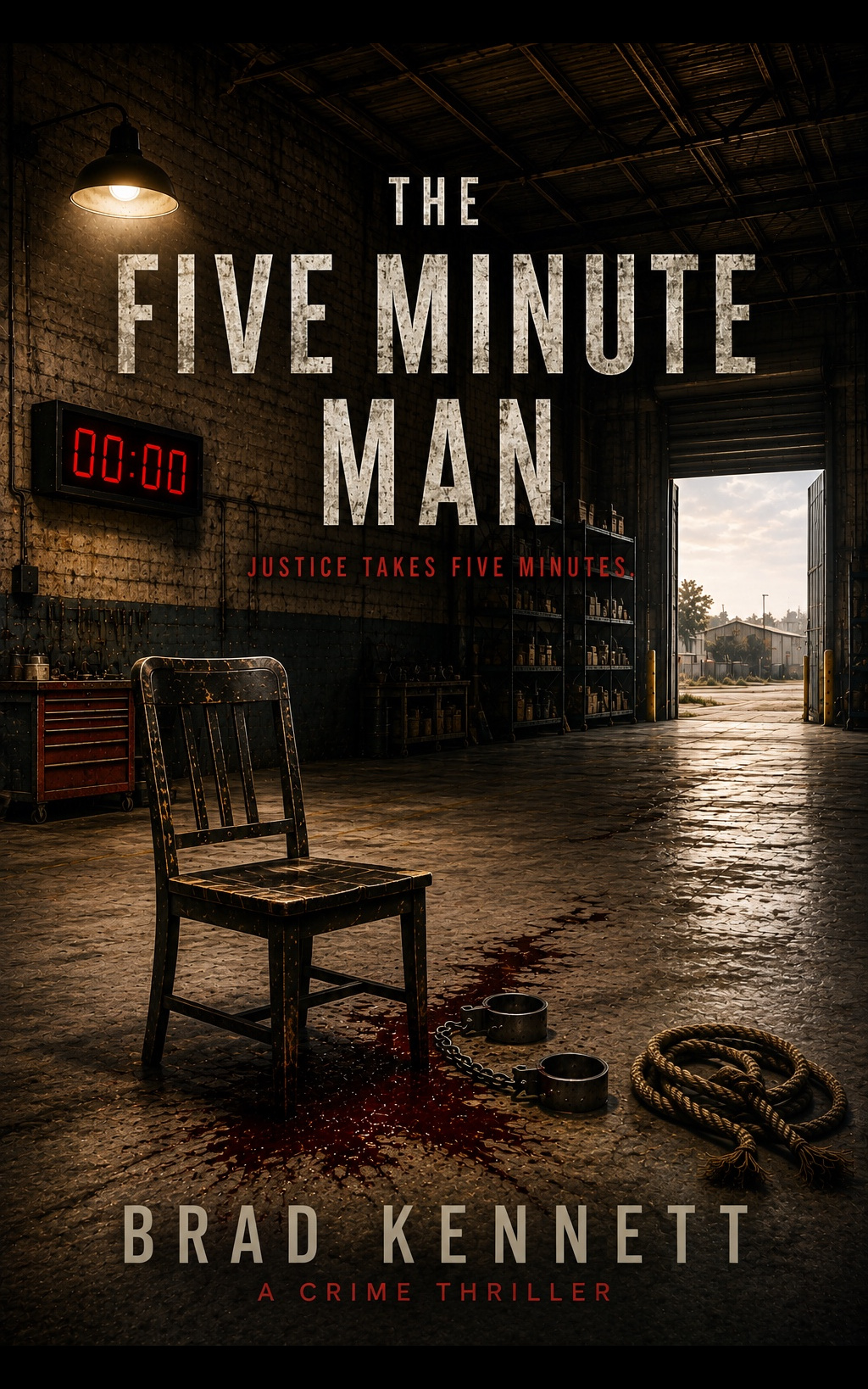
The Five Minute Man
by Brad Kennett
Five minutes. No witnesses. No second chances. When the justice system fails, a rumor begins to spread among the families left behind. Somewhere out there is a man who can give them five minutes alone with the person responsible for destroying their lives. No courtroom. No lawyers. No one to stop them. FBI Special Agent Frank Delaney doesn't put much faith in rumors. But violent offenders are disappearing. Different states. Different crimes. The same pattern: a family denied justice, a case that ended badly, and someone who simply vanishes. The deeper Frank digs, the further back the pattern reaches. Ethan Mercer understands what those families have lost. Years after the death of his daughter shattered his marriage and changed the course of his life, he's still trying to find his way back to the woman he loves and the life they once shared. But as Frank closes in on the truth behind the disappearances, an online legend is becoming harder to dismiss. They call him the Five Minute Man. And somewhere, another family is waiting for the phone to ring.
- Psychological Thriller
- Thriller
- Crime Fiction
- Mystery
- Crime Thriller
- Cat & Mouse
Angela
Angela kept both hands on the wheel and watched the wipers push sheets of water across the glass, back and forth, back and forth, a rhythm that almost felt like it was counting down to something. The industrial park appeared slowly out of the dark, announced first by a single amber streetlamp and then by the long flat silhouettes of warehouses set back from the road. She followed the GPS until it told her to stop, then drove past the address twice before she finally pulled in.
She sat with the engine running for almost a full minute.
The building was exactly the kind of place she would have driven past a hundred times without registering. Corrugated metal walls faded to a dull gray. A row of narrow windows along the second-floor offices, dark behind wire mesh. A loading bay door with a chain across it. The numbers above the entrance matched the numbers on her phone. That was the only thing remarkable about it.
Angela turned the engine off.
Rain tapped steadily against the roof of the car, and through it she could hear the low, distant rumble of highway traffic moving somewhere beyond the fence line. The sound rose and fell like a long, slow breath. She watched a piece of plastic sheeting flutter against a chain-link fence at the far corner of the lot, lifting and dropping in the wet air.
She read the message again.
She had read it probably forty times. The words were short and blunt, appearing on her screen with a starkness that felt, somehow, too simple for what they were actually asking of her.
REAR ENTRANCE. COME ALONE. DOOR WILL BE UNLOCKED.
No signature. No name attached to the number. No explanation of how they had found her, or how they knew what she needed, or how any of this was possible at all.
She opened the car door and stepped out into the cold.
The pavement was cracked and uneven, and water gathered in shallow channels between the breaks, reflecting the weak security lights mounted high on the building's exterior. Her footsteps sounded too loud in the empty lot. She pulled her coat tighter at the collar and moved toward the rear entrance, stepping around a puddle wide enough to swallow her shoe.
The door was gray steel, slightly dented near the bottom where something had struck it years ago. There was no handle on the outside, just a push plate and a keypad that had long since gone dark. But when she pressed her palm flat against it, the door swung inward without resistance.
The smell reached her first.
Old coffee and concrete dust and something faintly chemical, the kind of smell that lived in buildings that had been used for one thing and then another and eventually forgotten between both. She stepped inside and let the door fall shut behind her. The rain disappeared to a muffled sound against the roof, and the air went still and cool around her.
A corridor stretched ahead, lit by a row of fluorescent tubes running along the ceiling. Two of them flickered with a soft, irregular pulse that made the shadows at the edges of the hallway shift slightly. The walls were bare concrete block, and the floor was the same dull gray underfoot, with a thin black cable duct running along the baseboard on the right side. The corridor smelled cleaner than the rest of the building, like someone had taken the time to maintain this particular path, even if nothing else had been touched in years.
Angela stood still.
She could hear her own breathing and the distant vibration of traffic beyond the walls. There were no voices, no footsteps, no sign that another person existed anywhere in the building.
Then the speaker mounted near the ceiling gave a quiet click, and a voice came through it.
"Thank you for coming."
She flinched. She couldn't help it. The voice was calm and even, neither warm nor cold, the way a recorded phone system sounds when it is designed to be inoffensive to the largest possible number of people. There was no static behind it, no ambient noise.
"Continue to the end of the corridor. Take your time."
Angela exhaled slowly. She had expected something different. She wasn't sure what, exactly. Something more dramatic, she supposed. Something that matched the weight of what she was doing here. Instead she got a voice that sounded like it belonged to someone explaining airport security procedures.
She walked.
The corridor was longer than it looked from the entrance. Doors appeared on either side at intervals, most of them shut, their small window panels dark. One was propped open an inch, and she could see the edge of a metal shelving unit inside, empty. Another had a paper sign taped to it that read ELECTRICAL — NO ENTRY in faded block letters. The fluorescent light above her head flickered twice as she passed beneath it, and the shadows stretched briefly before snapping back.
Her shoes were still damp from the parking lot. She could feel the cold working up through the soles.
She thought about the courtroom. The way the prosecutor had stood up after the verdict was read and gathered her papers with that careful, practiced efficiency that told Angela the woman had already moved on before the last syllable finished echoing in the room. The way the man's defense attorney had placed a hand briefly on his client's shoulder, a small satisfied gesture. The way Angela had sat in her seat for a long time after the gallery began to empty, because her legs would not cooperate and she had no idea what she was supposed to do with herself when she finally stood up and walked outside into the ordinary afternoon.
Insufficient evidence.
She had learned the phrase inside and out over the course of three months. She understood, technically, what it meant. It meant that the law had specific requirements, and that the specific requirements had not been met, and that the law therefore could not act. She understood that the law was not designed to be fair. It was designed to be consistent.
She understood all of it, and it had still felt like being pushed off something very high with no warning.
The end of the corridor appeared ahead of her.
A single gray door sat at the terminus, slightly wider than the others she had passed. There was nothing on it. No window, no sign, no number. The handle was plain brushed steel. Beside the door, mounted at eye level on the wall, a small digital clock sat in a black plastic housing. The display showed four red zeros. It was not counting. It was simply waiting.
Angela stopped in front of it.
The speaker clicked again.
"You are here because the process failed," the voice said. It did not frame this as a question or as a judgment. It stated it the way a person states a known fact before continuing to the next relevant point. "You are not required to do anything. You may leave the way you came. The door will remain unlocked for another eight minutes."
Angela looked at the clock.
Four red zeros.
"If you choose to go through the door," the voice continued, "you will have five minutes inside. The clock will begin when you enter. When the clock resets to zero, you will leave. You will leave immediately, and you will exit the building the same way you came in. There is one rule. Only one."
She waited.
"Leave when the clock tells you to."
Another click, and the speaker went quiet.
Angela looked at the door for a long time. The fluorescent light above her pulsed once, that brief dimming, and the red digits of the clock held their zeros with a patience that she found almost unbearable.
She was not a violent person, and she had never once imagined herself as someone who could stand in a desolate place like this and consider the things she was currently considering. She had spent her life being the kind of woman who voted, paid her taxes on time, and coached her daughter's soccer team on Saturday mornings while arguing politely with neighbors about parking. She had cried in a therapist's office and sat through countless support groups, reading books about processing grief that all seemed to have been written by people who had never actually experienced the hollow weight of it themselves. Despite trying to do everything correctly and following every legal channel available to her, she had arrived here anyway, standing in a damp coat in a concrete corridor at the edge of the city, where the silence told her plainly and without drama: she had run completely out of road.
Rain struck the corrugated roof overhead in a long steady wave, and the traffic beyond the fence sent another low vibration through the walls. The building absorbed both sounds and gave nothing back.
Angela thought about her daughter's face. Not the photographs she kept, the careful preserved ones that other people had seen, but the ordinary version. The one she carried around without realizing it. She saw her at the kitchen table doing homework she didn't want to do, pencil moving slow and reluctant across the page. She was asleep in the backseat of the car with her head tipped sideways and her mouth slightly open. Or she was laughing at something that Angela had already forgotten, some small absurd thing, and the laugh was the kind that bent her in half because she had never learned to manage it yet, she was still all loose and open with it.
She pressed her hand flat against the gray door.
The steel was cold and slightly rough beneath her palm. She could feel the faint vibration of the building through it, the deep, steady hum of traffic and machinery carrying on without any awareness of her at all.
She thought about leaving. The thought was clear and reasonable, and she held it for a moment.
Instead, her free hand slipped into the pocket of her coat.
Her fingers closed around something cold.
She held it there for a long second.
Then she opened the door and stepped through.
The room on the other side was smaller than she expected. A single work light hung from the ceiling on a cord, casting a wide yellow pool across the concrete floor. The walls were bare. The air was colder here, noticeably, and it carried a smell of dampness and old metal. A folding chair sat against the far wall.
A man sat waiting beneath the hanging work light.
He turned when the door opened. She saw recognition cross his face, a second before fear did.
Behind her, the door swung shut with a soft, definitive sound.
Angela heard the clock begin.
A quiet, steady beep from the panel on the wall beside the door, each second marked cleanly and without urgency, the way a voice reads numbers into a phone, the way a dispatch operator reads an address, the way all the most ordinary sounds in the world carry on regardless of what is happening inside the room they surround.
She stood just inside the door and looked at the man who had been acquitted. For a moment she was aware of almost nothing except the cold, the counting, and the man tied to the chair in front of her. The clock read four fifty-nine, four fifty-eight, four fifty-seven. Each number replaced the one before it with the same indifferent precision. Angela took one step forward, and then another. The yellow light from the work lamp reached her face. The room held the two of them the same way rooms always hold whatever is placed inside them, without comment, without judgment, and without memory of anything that came before.
Outside, the rain continued against the roof in long steady waves while traffic moved along the highway beyond the fence line, unseen but constant. Somewhere in the corridor, a fluorescent light flickered once before settling again into its soft electric hum.
Then a gunshot cracked through the building.
The clock kept running.
Risk Assessment
The alarm went off at five fifty-eight, two minutes before it needed to, the way it always did. Ethan reached over and silenced it without opening his eyes. He lay still for a moment in the gray light of early morning, listening to the building settle around him as the pipes groaned softly and a door clicked shut two floors above, while the low, in…