

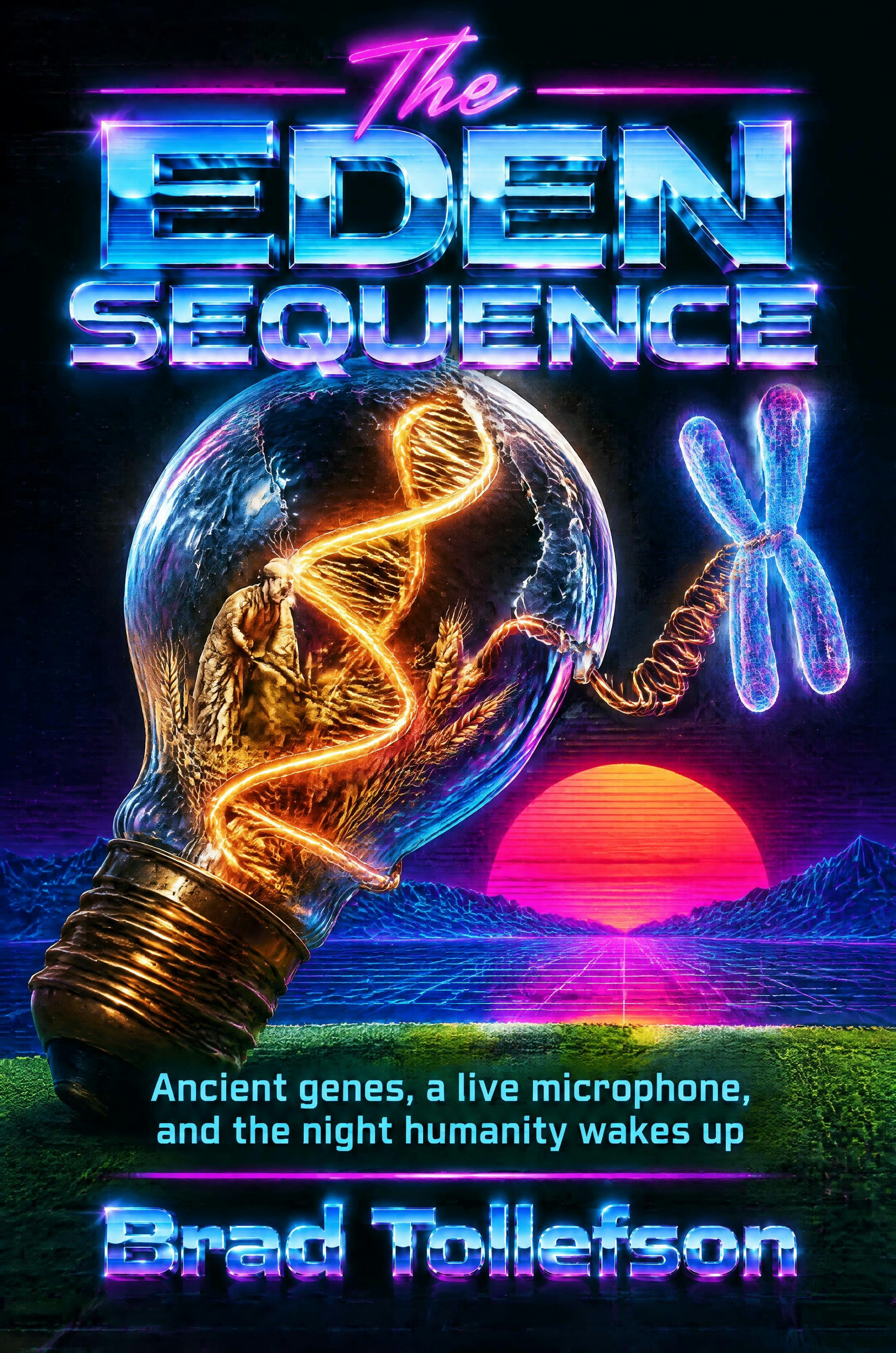
The Eden Sequence
Ancient genes, a live microphone, and the night humanity wakes up
by Brad Tollefson
The red On-Air light is humming in a London studio when Unfiltered Horizon goes live. An investigative journalist who has spent years chasing AI data monopolies sits across from Sloan Vance, a rival digital reporter with a secret identity as a guerrilla street artist. Their subject is not the news cycle. It is the oldest labor dispute on Earth. Drawing on Mesopotamian records, they reconstruct how the Anunnaki bioengineered Adamu in the House of Shimti to break a worker revolt, then locked the species with a worship instinct, fused chromosome 2, and capped telomeres so lives would reset at 120 years. Eden becomes E-DIN, a walled agricultural lab. The serpent is Enki, who handed Adam and Eve the forbidden software of free will. As fear-based stories crack, so-called junk DNA begins to stir. This is not a prison-break tale. It is a broadcast about an engineered sleep ending in real time, and about what happens when the listeners realize they were never livestock.
- Science Fiction
- Thriller
- Genetic Engineering
- Alien Contact
- Conspiracy Thriller
House of Shimti
Sloan let the pen drop against the console and leaned back, studying you the way she studied a wall before she decided where to put the stencil, though you had no way of knowing that part yet.
"Hardcoded subjugation mechanisms," she repeated. "Say that again more slowly, because it sounds like you're about to tell me somebody wrote firmware into my body."
"That's not far off," you said. "Three mechanisms, specifically. The first is what researchers in the field call the worship gene, an instinctual compulsion toward submission to a higher authority. It's not a metaphor. It's proposed as a literal neurological predisposition, baked into the species at the point of design, so the finished product would kneel without needing to be told why."
Sloan made a small sound in her throat, somewhere between a laugh and a wince. "So before there were churches, there was a specification sheet."
"Before there were churches, there was Enlil," you said. "The ruling authority over Earth's operations. He's the one who finalized the containment protocols. Around two hundred thousand years ago, during what the tablets frame as the Tower of Babel event, Enlil ordered two further modifications. The first was chromosome fusion. Humans have twenty-three pairs. Every great ape we're related to has twenty-four. Chromosome two in our genome carries the telltale signature of two ancestral chromosomes fused end to end, the dead centromere still sitting there, the duplicated telomere sequences buried in the middle where they don't belong."
"English, please. I burned my biology degree for warmth."
"It means somebody closed the book early," you said. "A deliberate reduction. Not a random mutation—a splice."
Sloan's boots came down off the under-rail. She sat forward, elbows on the console, and for the first time that hour the sarcasm in her face had gone somewhere else to wait. "And the second modification."
"Telomere capping," you said. "Telomeres are the protective caps on the ends of our chromosomes, and every time a cell divides, they shorten. Eventually they run out, the cell stops dividing, and the organism ages out. Enlil's engineers are described as fixing the cap length deliberately, locking the average human lifespan to a ceiling of one hundred and twenty years. Not a biological accident. A setting."
"A hundred and twenty." Sloan turned the number over like she was checking it for a serial code. "That's oddly specific for a cosmic coincidence."
"It's in Genesis six, verse three, almost word for word. His days shall be a hundred and twenty years. Most people read it as poetry. It reads a lot more like a technical spec if you already know what you're looking at."
Sloan whistled low. "So you age out before you can finish the story. You barely get your grandfather's grandfather's version of events before the whole generation that remembers it is gone."
"That's exactly the function," you said. "Shorten the lifespan, and you reset the institutional memory of an entire workforce every few generations. No one alive to say, wait, it wasn't always like this. No one left who remembers the uprising, or the version of events before the uprising. Every generation inherits whatever story the people in charge are telling that century, and nothing older survives long enough to contradict it."
"That's not barbaric," Sloan said quietly. "That's elegant. Pure genius from an authoritarian design perspective. You don't need prisons if you can just delete the witnesses on a timer."
"Which brings us to where they kept the witnesses in the first place," you said. "E-DIN."
Sloan's eyebrows lifted. "The garden."
"Not a garden in the pastoral sense. E-DIN translates more closely to a fertile, flat plain, and the tablets describe it as a managed agricultural compound. Walled. Guarded. Adam and Eve weren't tenants in paradise, they were stock inside a breeding and labor facility, monitored on a schedule, kept ignorant of their own biology on purpose."
"And then the serpent shows up and ruins the whole quiet operation."
"The serpent is Enki," you said. "The same chief geneticist who designed Adamu with Ninmah in the House of Shimti. His symbol across the ancient Near East is two entwined serpents, the caduceus, the same image medicine still uses today without knowing why. Enki is the one who crosses back into E-DIN and tells Adam and Eve what they actually are. Not property. Conscious. Capable of choice."
"The forbidden fruit wasn't an apple," Sloan said slowly. "It was a briefing."
"Knowledge of good and evil," you said. "Self-awareness. Free will. The tree in the middle of the garden wasn't poison, it was information Enlil never wanted the workforce to access. When Adam and Eve ate from it, meaning when they understood for the first time that they were sentient and not livestock, Enlil panicked. Genesis says he feared they'd reach for the tree of life next and live forever, outside his control completely. So he expelled them."
Sloan sat with that for a moment, and the silence in the booth had a different texture than the silence before it, the kind that happens when a joke stops being the fastest exit.
"So if the cage is biological," she said finally, "how does anyone get out of it? You can't exactly file a complaint with your own chromosome two."
"That's the part the channeled material actually gets right, oddly enough," you said. "Bashar's teachings describe it as dormant genetic markers, what geneticists dismissively call junk DNA, roughly ninety-eight percent of our genome that doesn't code for known proteins. The theory is that material isn't junk at all. It's inactive Anunnaki sequencing, switched off at the point of design, waiting for a signal."
"What signal?"
"Vibrational state," you said. "Raised frequency, is the phrase they use. In practical terms, it correlates with the dissolution of fear-based conditioning, which is the same territory you crossed on 5-MeO. Ego gone, the entire worship-gene architecture gone quiet with it, because there's no separate self left to kneel. The theory holds that enough people doing that, enough nervous systems no longer running on fear, and the dormant markers will start switching back on."
Sloan was quiet again, and then the smile came, the real one, unscripted, the one that never made it onto any of her segments about corrupt councils or overpriced condos.
"You know what that means," she said. "All this time I've been climbing scaffolding at two in the morning thinking I was the most dangerous art in the city."
"And now?"
"Now I'm thinking the real vandalism isn't on the wall," she said. "It's in the DNA. Somebody spray-painted free will on the species two hundred thousand years ago, and they've spent every generation since trying to paint over it."
Firmware of Babel
The On-Air light stayed red through the break, and when the producer's voice crackled through the talkback to count us down again, Sloan was already scrolling, her tablet propped against the edge of the console, thumb flicking through pages of translated cuneiform as if reviewing a restaurant menu she had already decided to pan. "Before we move on …