

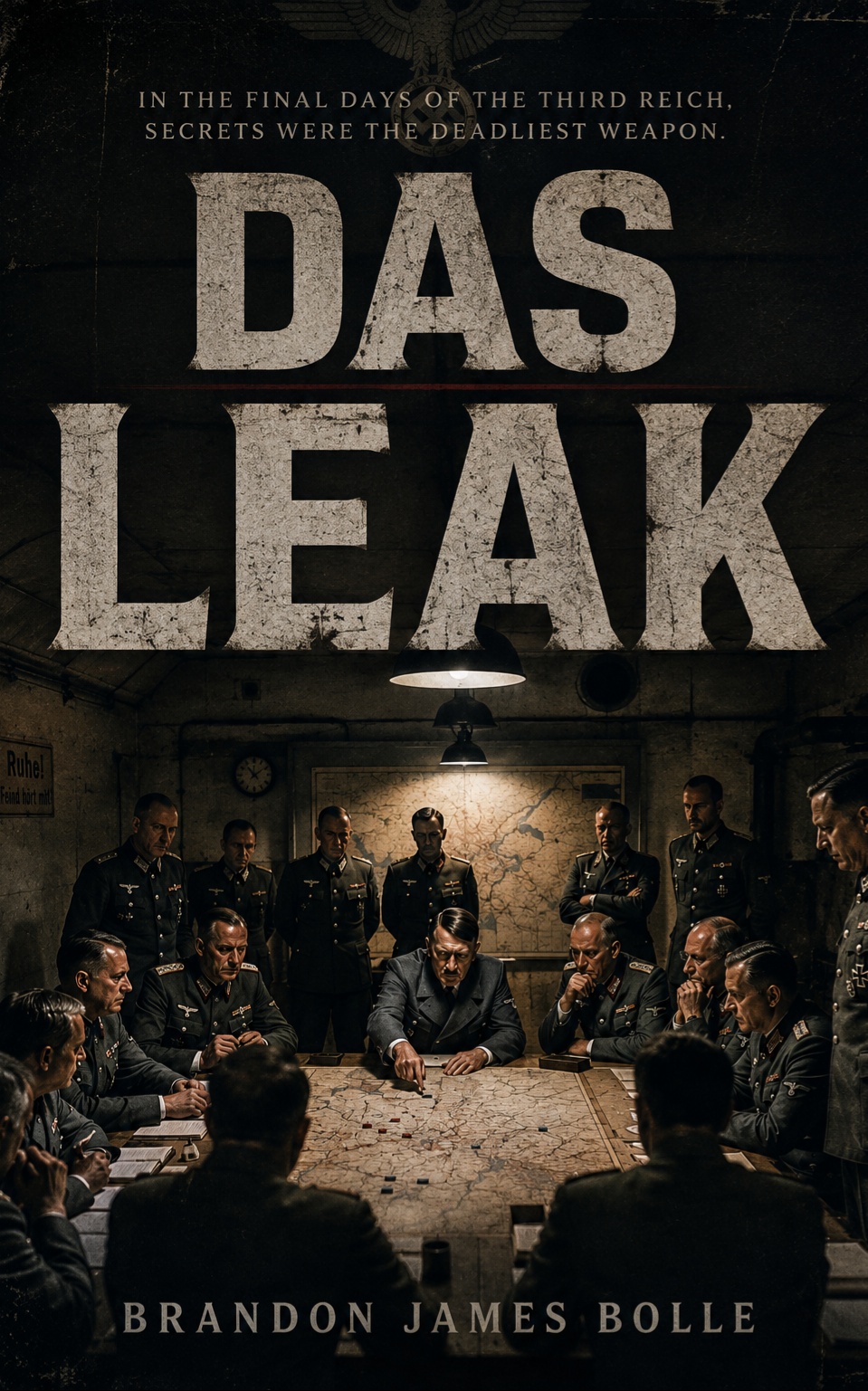
DAS LEAK
Inside the Reich's deepest bunker, one traitor holds the fate of the war
by BRANDON JAMES BOLLE
Late 1944. Deep beneath the concrete reinforced ceilings of the Nazi High Command bunker, a ghost is bleeding the Reich dry. Vital battle plans for the Ardennes offensive are vanishing into the airwaves before the ink can dry. The leak is devastating, precise, and lethal. Signals officer Friedrich Müller operates in the suffocating shadows, transmitting stolen encryption codes to Allied intelligence through an improvised radio network with the help of a few brave conspirators. To plug the leak, Berlin unleashes Johann Kaiser—a legendary, relentless criminal detective who cares nothing for Nazi politics and everything about the hunt. Alongside brutal Gestapo rivals, Kaiser tightens the noose around the bunker staff, turning every shadow, whisper, and loose wire into a death sentence. With the Allied advance hanging in the balance, Friedrich must execute one final, impossible transmission while Kaiser closes in. In a labyrinth where a single breath can betray you, who will break first? DAS LEAK is a pulse-pounding historical espionage thriller of razor-sharp suspense, claustrophobic dread, and deadly cat-and-mouse intrigue.
- Historical Fiction
- Thriller
- Mystery
- World War 2
- Spy Thriller
- Cat & Mouse
Concrete and Static
December 1944. The signals hall sat three levels down, where the air never moved unless a fan forced it. Fluorescent tubes hummed over rows of teleprinters and a map of the Western Front pinned with grease pencils. Friedrich Müller sat at his desk in a grey suit a size too large and typed movement summaries with fingers already stained black from ribbon ink. The copy in front of him listed new fuel dumps west of the Rhine. He kept his face blank. The keys clicked. A clerk two desks over coughed and went back to his own stack.
He stayed after the shift change. The hall emptied except for a duty officer who dozed behind a glass partition. Friedrich waited until the man’s head dipped, then rose and walked to the far wall as if checking a fuse. The junction box was painted the same dead green as everything else. He opened it with a small screwdriver he kept in his pocket. Inside, a thin lead ran into the unused telephone trunk, the one the engineers had abandoned in 1942. He fitted a key, tapped a short coded burst, and closed the lid. The current would ride the dead wire out of the bunker and into a British Secret Service black radio site that already spoke, in German phrasing, to occupied cities. He wiped his hands on a rag and returned to his chair. His pulse stayed even. That was the discipline.
In the ventilation crawlspace above the hall, Helmut Becker oiled a fan that had begun to shriek. Grease on his jumpsuit, wrench in his belt, he inched along the duct on his elbows. The click reached him through the sheet metal, small and sharp, like a switch closing. He froze. He knew that sound. He had found the extra wire weeks ago and had not reported it. He bit a fingernail and listened until the hall went quiet again. Then he crawled on, oiling the next bearing, telling himself he had heard nothing but the building settling.
Above ground, at Police and SS headquarters, rain slicked the cobbles. Johann Kaiser stood in a briefing room that smelled of wet wool and cigars. The head of police sat at the table. The SS security chief sat beside him. Intercept logs lay between them, carbon copies marked in red. Allied broadcasts to occupied nations had used German phrasing hours after the same data left this bunker. Kaiser read the times without touching the paper. His gloves stayed on.
"You answer to us," the security chief said. "Not to the generals. They will try to bury this in their own files. You will not let them."
Franz Günther stood by the door in black, pale and silent. Wilhelm Krause stood opposite him, red hair cropped, scar through the brow, watching Kaiser as if measuring a rival. Neither spoke. Kaiser set the last log down.
"The phrasing is not coincidence," Kaiser said. "Someone in the complex is feeding a transmitter. I will have the building."
Rudolf Koch arrived late, uniform tight across his gut, schnapps on his breath. He was told to give Kaiser full access to signals. He laughed, a wet sound, and waved a hand.
"Radio ghosts," Koch said. "We have had them since the Russians started jamming. My boys type what they are given. You want to chase static, chase it. Just don’t keep my clerks from their work."
Kaiser looked at him until the laugh died. "Full access," he said. "Starting tonight."
They went down together. The elevator rattled. The signals hall looked smaller with Kaiser in it, overcoat dark, cane tapping once on the concrete. He walked the aisles without hurry. Clerks straightened. Friedrich kept typing. Kaiser stopped a yard from his desk and looked at the ink on Friedrich’s fingers, then at the stack of summaries, then at the wall where the junction boxes sat in a neat line. He said nothing. He moved on. Günther’s eyes followed every man who blinked. Krause smiled at no one.
Koch trailed them, still talking about ghosts and jammed frequencies. Kaiser let him talk. He noted who looked at the floor and who looked at the clock. He noted Friedrich last of all, the hunched shoulders, the quiet hands. Then he left for the upper corridors to request current logs from maintenance.
Later, in a service passage that smelled of ozone, Becker found Friedrich by the water cooler. Becker’s voice came out in a rush.
"There’s a civilian," he said. "Gloves. Asking about extra current on trunk line seven. I told them the meters drift. I don’t know if they believed me. You have to stop. Or not stop. I don’t know. I just—don’t get me hanged."
Friedrich filled a paper cup. He did not look at Becker.
"The fans need oil," he said. "That is all you heard. Go back to work."
Becker swallowed and went. Friedrich drank the water. It tasted of pipes. In the hall the teleprinters started again, paper feeding, numbers moving west of the Rhine. He sat down and typed the next summary as if the night had never opened a box in the wall. Somewhere above, a black radio would already be talking. Down here the concrete held the sound. Kaiser would come back. Friedrich kept his face exhausted and ordinary, and he waited for the next page.
The Current on Trunk Seven
The electrical plant ran hotter than the rest of the bunker. Generators thumped behind mesh cages. Load meters jumped and settled. Johann Kaiser stood with a clipboard and did not raise his voice. "I want load charts for every trunk," he said. "Last seventy-two hours. Printed, timed, and signed by the man who read the needles." Helmut Becker pulled…