

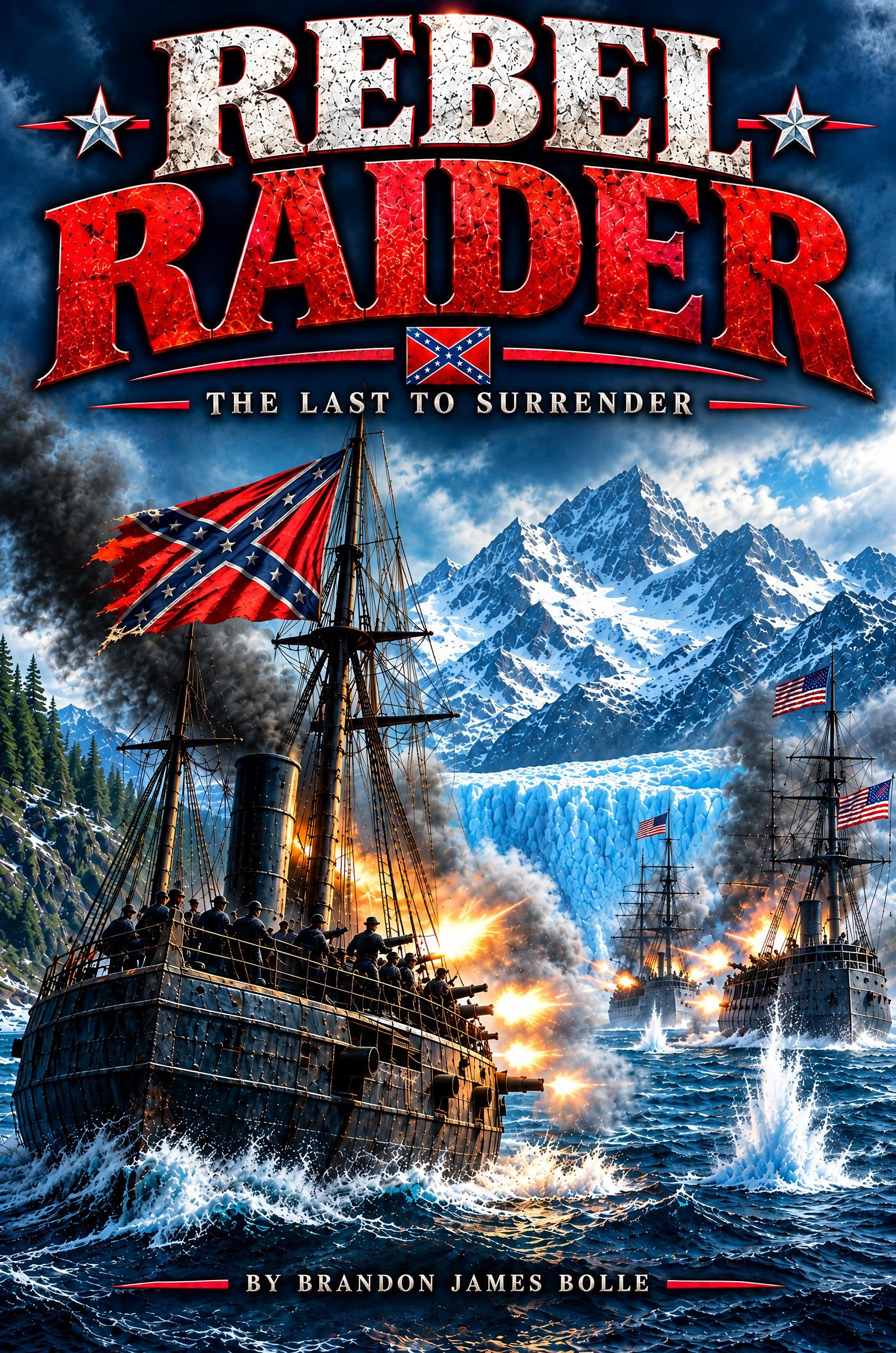
Rebel Raider
One captain. One secret. One logbook history erased.
April 1865. The Civil War is over. But Captain James I. Waddell doesn't know it yet. Commanding the CSS Shenandoah in the remote North Pacific, Waddell is hunting Union whalers—and winning. Cut off from reliable intelligence, he follows his written orders to the letter. But when a captured newspaper reports Richmond has fallen and Lee has surrendered, the truth becomes a weapon more dangerous than any broadside. His first lieutenant, Elijah Bannon, believes the newspaper is a lie and pushes for more blood. The crew, already exhausted, begins to mutter the word every sailor fears: piracy. And young clerk Micah Satterfield watches helplessly as Waddell's moral compass spins off its axis. Then a captured vessel yields a secret Confederate dispatch—an unsanctioned mission to seize foreign gold. To protect his men from the hangman's noose, Waddell tears the incriminating pages from the official logbook and drives his ship toward a desperate, non-stop flight to a neutral port. Decades later, federal investigator Jeremiah Collier finally corners the aging captain in an Annapolis courtroom. The missing pages are the only evidence that can prove the Shenandoah's final attacks were war crimes. But the truth buried in that logbook is darker than either man is prepared to admit. Rebel Raider is a gripping historical thriller about duty, denial, and the stories we shred to save ourselves.
- Historical Fiction
- Adventure
- Mystery
- American Civil War
- Sea Adventure
- Historical Mystery
Ice and Iron
The spray had frozen into grey crusts along the stays, and every lift of the bow tossed slush against the bulwarks. Captain James I. Waddell kept his gloved hands behind the small of his back, feeling the steady roll of the deck beneath his boots as the CSS Shenandoah forced her way through the freezing mist of the Sea of Okhotsk. The wind came out of the north, smelling of brine, dead kelp, and the flat, cold breath of pack ice. Overhead, the heavy canvas was stiffened with frost, groaning in its iron hoops with every roll.
They were thousands of leagues from Wilmington and Richmond. The charts spread across his cabin table were decades old, drafted by British surveyors who had never sounded these northern shoals during winter breakups. He knew what lay behind him: oceans crossed under auxiliary steam, charred hulks left smoldering in the tropics, and the long, solitary haul into the high latitudes where no Confederate ensign had ever flown before. He had his written orders signed by Secretary Mallory, folded inside an oiled pouch beneath his berth. Those orders told him to seek out the New England whaling fleet, sweep the waters clean, and cut the economic arteries that sustained the Northern treasury. A naval commission permitted no hesitation. It demanded absolute adherence to duty, regardless of the desolate waters through which a vessel sailed.
A pair of quick, sharp footsteps rang out upon the ice-slick planks. Waddell did not need to turn his head to know who approached. The gait was familiar, brisk and rigid, carrying none of the seasoned seaman's easy sway.
First Lieutenant Elijah Bannon came to a halt beside the binnacle. A crust of salt coated the collar of his faded grey tunic, where several brass buttons were missing, replaced by coarse black thread. His narrow, hawk-like face was raw from the wind, but his amber eyes burned with an unflagging fever. He held a brass spyglass under his arm.
"Lookout in the foretop sings out a sail, sir," Bannon said, his voice clipped and dry. "Bearing north-northwest, just where the fog thins along the ice edge."
Waddell took the glass without a word and raised it toward the northern horizon. Through the circular field of blurred grey, the world appeared drained of color. Great pans of floe ice drifted like shattered white plates across the dark swell. Then, framed between two pale crags of floating bergs, he saw the masts: three spars raked slightly aft, their yards squared, hanging motionless in the mist.
"A bark," Waddell said calmly, lowering the glass. "Square-rigged on the fore and main. A whaler, by the look of her cutting stages."
"Then she is our lawful prize," Bannon urged, leaning forward against the rail. "We should beat to quarters immediately, sir. Clear the six-pounders and run out the Whitworths before she catches a draft off the floe and slips behind the point. If we crowd on sail now, we can have her under our guns before two bells."
Waddell looked down at the lieutenant. "A ship's deck permits no room for haste when navigation is uncertain, Mr. Bannon. Look at her canvas. Her topsails are clewed up to the yards. She is not under way."
"She may be waiting for a lead to open, Captain," Bannon countered, his jaw setting hard. "Every hour we delay gives her master time to scuttle his cargo or fire his papers. The Yankee merchants know why we are in these seas. They have heard the rumors from Melbourne. If we hesitate, we dishonor the flag we carry."
"We sail beneath our commission, Mr. Bannon, not beneath impulse," Waddell replied, his tone even and unyielding. "We will raise steam before we clear the guns. In this ice, canvas alone will foul us on a lee shore. Signal the engine room to prepare the fires."
Bannon stiffened, his lips drawing into a thin, colorless line. For a fraction of a second, an objection hovered behind his sharp gaze, but the iron habit of naval hierarchy held him in check. He touched the brim of his cap with two fingers. "Aye, sir. Steam it is."
He turned on his heel and strode down the ladder toward the main deck, barking orders to the boatswain's mates to clear the halyards and prepare the hawseholes.
Waddell watched him go, then turned toward the companionway. The cold had settled deep into his bones, stiffening his knees. He descended into the sheltered warmth of the after-cabin, where the air was thick with the scent of whale-oil lamps, wet wool, and old paper.
Micah Satterfield sat at the small mahogany day desk bolted to the deck beams. The young clerk's fingers were wrapped in fingerless wool mittens, his straw-colored hair tucked tightly under a grease-stained canvas cap. His left hand, missing the tip of the index finger from some forgotten accident in a Savannah yard, held the ruler flat across a sheet of ledger paper. With his right, he guided a steel-nibbed dip pen, his breath puffing in faint clouds as he worked.
"Captain," Micah said, rising quickly from his stool and knocking his knees against the drawer.
"Sit, son," Waddell said softly, pulling off his heavy gloves and setting them on the edge of the chart table. "How goes the register?"
"The ink keeps crusting on the nib, sir," Micah said, pointing with a sheepish grimace toward the small iron stove in the corner, which gave off barely enough heat to warm a man's shins. "I have entered the dead reckoning coordinates for eight bells. Latitude fifty-nine degrees north, longitude one hundred and forty-nine east. But the cold thickens the fluid faster than I can draw the lines."
Waddell leaned over the boy's shoulder, scanning the neat, slanted script. Micah had recorded the days with meticulous precision: the course changes, the soundings, the sightings of drift ice, and the tallies of merchantmen seized and burned across the Pacific. It was a sterile, orderly record of devastation.
"A ship's ledger must remain exact," Waddell told him quietly. "When we return to a recognized port, every capture will be weighed by an admiralty court. Every barrel of oil destroyed, every bond signed by an enemy master must be accounted for according to the law of nations. Without the written word, a cruiser is merely a corsair."
Micah looked down at the open ledger, his clear blue eyes clouded with an unspoken hesitation. He picked up the heavy leather-bound logbook and held it out with both hands, offering the brass dip pen toward the captain. "The official log for the morning watch, sir. It only requires your signature to confirm the noon position."
Waddell took the pen, dipped it into the stone inkwell, and scratched his name across the bottom of the page: Jas. I. Waddell, Lieut. Comdg. The ink was pale and watery from the frost, but the letters were firm and unyielding.
"Keep your paper dry, Micah," Waddell added, handing back the pen. "The sea has an appetite for records."
"Aye, sir," the boy murmured. "Though sometimes I wonder who will ever read it all, once we reach home."
Waddell did not answer. The word home carried an empty, hollow resonance in this cabin. It was an abstraction that belonged to another hemisphere, to a continent choked with siege lines and ruined rail depots. He turned toward the door as the heavy, iron-shod boots of another man sounded on the companionway stairs.
The latch lifted, and Tobias Garrick stepped into the cabin. The Scottish engineer was broad and thick as an oak timber, wearing a blackened oilskin apron over grease-stained wool trousers. A cloud of coal dust and warm tallow entered with him, instantly overpowering the stale smell of the cabin. Garrick did not bother to remove his cap. He held a brass-handled spanner in one hand and a greasy rag in the other, wiping his thick, soot-crusted fingers with violent, jerky motions.
"You sent word for steam, Captain," Garrick said, his Glaswegian burr rumbling up from deep within his barrel chest. "And I tell ye plain, the boilers are willing enough, but the shaft is another matter entirely."
"The bearing, Mr. Garrick?" Waddell asked, his voice remaining level.
"Aye, the brasses on the stern gland," Garrick said bluntly, stepping closer and tapping the heavy spanner against the heel of his palm. "We took a glancing blow from a growler two nights back, whether the deck watch noticed it or not. The brass is binding. If I spin that shaft up past forty revolutions in this slush, the metal will score until it seizes solid. Then you'll have an auxiliary cruiser that is nothing more than a floating log."
"We have a quarry in sight," Waddell said, gesturing toward the bulkhead that separated the cabin from the open sea. "A whaler, pinned against the shore ice five miles north. I cannot risk maneuvering under topsails alone with these currents running. We require the screw."
"Then you will get half-speed and not a revolution more," Garrick replied, squinting through watery hazel eyes rimmed with soot. "You can hang me for mutiny if it pleases the Richmond government, Captain, but salt water does not care what flag you hoist at the mizzen, lad. Run these boilers dry or bind that shaft, and we all sink under the same depth. The iron does not give a damn about your embargo."
Micah lowered his eyes to the desk, his pen frozen over the inkwell. A younger officer might have put Garrick under arrest for such language, but Waddell knew the truth of the engineer's words. Without Tobias Garrick's Scottish hands nursing the reciprocating engine, the Shenandoah would have foundered off the Cape months ago.
"Half-speed will suffice, Mr. Garrick," Waddell conceded quietly. "Give me steerage way to clear the reefs and bring us within range of her foremast. Maintain a heavy watch on the bearing. If the temperature rises, pump cold tallow into the sleeve."
"I've been pumping tallow till my arms are stiff as salt cod," Garrick grumbled, turning his bulk toward the door. "We'll turn the screw, Captain. But mind you keep her out of the thick pack. This hull was built for the Bombay tea run, not for cracking polar ice."
The engineer hauled himself back up the ladder, the hatch thudding shut behind him. Waddell took a slow breath, smoothed the front of his coat, and reached for his heavy sea cloak and gloves.
"Put the books away in the iron chest, Micah," Waddell instructed before stepping toward the companionway. "Lock the seals. When we come alongside, there will be work enough for you with the manifest."
"Yes, sir," Micah said, his voice small in the dimness of the cabin.
Waddell climbed back to the quarterdeck. The freezing air struck his face like a slap. Forward, a plume of dark, greasy coal smoke was beginning to roll from the funnel, staining the clean white fog with trails of soot. The ship vibrated as the auxiliary engine stirred below, a low, rhythmic thumping that traveled through the deck timbers into the soles of his boots.
Bannon was waiting for him at the weather rail, his eyes fixed intently on the distant vessel. "The wind is dying, sir. The fog is settling over her."
"Then the engine will do what the canvas cannot," Waddell said. "Helm there, keep her head north-northwest. Steady as she goes."
"Steady as she goes, sir," the helmsman echoed from behind the double wheel.
The Shenandoah forged ahead, her iron-braced stem cutting through the grey slush. Chunks of shelf ice struck the wooden hull with dull, booming thuds that echoed through the lower decks. As they drew nearer, the white veil of mist began to shred against the jagged shoreline of an uncharted bay. The black coastline of the Siberian mainland rose behind the ice shelves, barren, craggy, and dusted with old snow.
Waddell raised his spyglass once more. The target was now less than two miles off. He adjusted the brass focus ring, expecting to see men scrambling into the rigging to loose the sails or lower whaleboats to attempt an escape toward the open sea.
Nothing moved on the stranger's decks.
Her three masts were stark against the pale sky, her yards bare. Below her waterline, the sea was not fluid. A solid sheet of white floe ice, six feet thick and jammed into the mouth of the bay by the northern gale, held the vessel in an immovable grip. The whaler was frozen fast, locked in a cradle of iron-hard pack ice from which no wind or sail could ever free her.
Bannon peered through his own glass, his breath hissing through clenched teeth. "She has no way on her. She cannot run."
"She could not run if she had all the steam of the British navy," Waddell said, lowering his glass. The merchantman was entirely at their mercy, helpless, silent, and motionless in the frozen waste. "Signal the gunners to stand down, Mr. Bannon. We will not waste powder on an enemy that cannot move. Prepare a boarding party. We take her where she sits."
Smoke on the Floes
The iron casing of the pivot gun swung outboard with a screech of grease and frozen iron. Captain James I. Waddell watched the gun crew haul on the side tackles, their woolen mitts biting into stiff hemp until the black muzzle pointed across the white expanse of the shelf. The whaler lay three cables distant, trapped fast in the floe. Her timbers g…