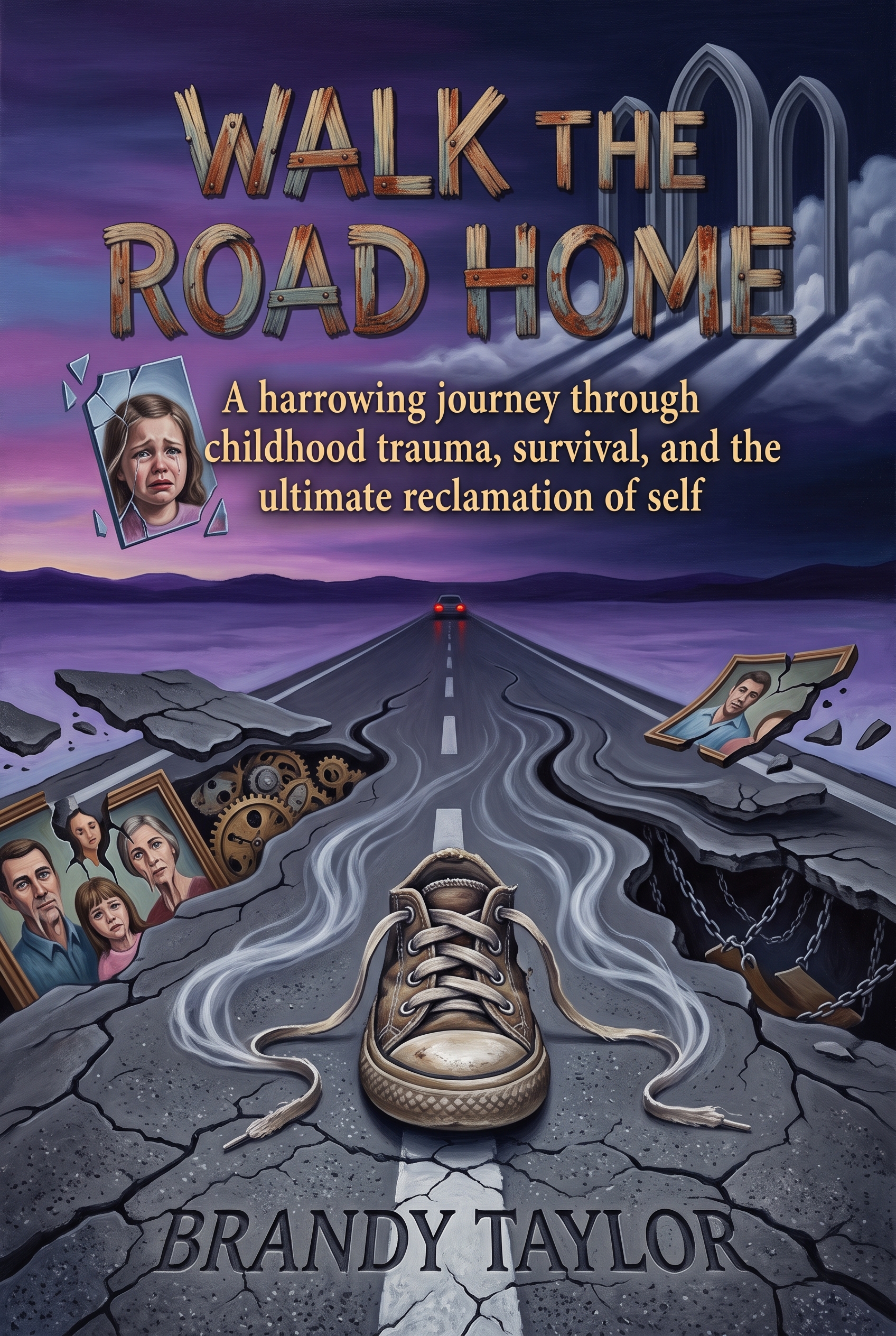
Walk the Road Home
A harrowing journey through childhood trauma, survival, and the ultimate reclamation of self
by Brandy Taylor
How do you find your way when the people meant to guide you leave you in the dark? Brandy Taylor’s childhood was a battlefield of fractured loyalties and hidden cruelties. Caught between a father’s household fueled by petty rivalries and a mother who sought escape in the neon glow of nightlife, Brandy was a child adrift. While her grandparents provided a rigid structure of religious rules, they could not shield her from the darkness that moved into her home. When a new stepfather enters the picture, neglect turns into active terror. From the psychological weight of constant surveillance to the chilling night she was forced out of a vehicle and abandoned on a desolate road, Brandy’s story is a raw, unflinching look at the failures of parental protection. 'Walk the Road Home' is more than a memoir of trauma; it is a testament to the resilience of a young girl who refused to be broken. Through the haze of instability and fear, Brandy discovers the strength to survive and the courage to finally speak her truth. This is a powerful, transformative story for anyone who has ever had to navigate a treacherous path to find their own voice.
- Biography
- True Crime
- Overcoming Adversity
- Family Memoir
- Survival Memoir
- Domestic Violence Crime
The Day the Glass Broke
The sound did not resemble a clean snap. It was a heavy, dull thud followed by a sharp, musical shiver that seemed to travel right through the floorboards of our small suburban house. In the kitchen, a drinking glass had slipped from someone’s hand, or perhaps it had been thrown. To a five-year-old child standing at the far end of a dimly lit hallway, the distinction did not matter. What mattered was the sudden change in the air, the way the atmosphere in our home turned thick and difficult to breathe. That shattered glass was the physical boundary line between the life I had known and the fractured existence that lay ahead. It was the precise second my childhood world split down the middle, leaving two jagged edges that would never fit back together.
I remember standing perfectly still, my back pressed against the wall. The wallpaper had a textured pattern of small, faded flowers that felt rough against my bare shoulders. From my vantage point, I could see into the kitchen where the yellow linoleum floor was littered with sparkling shards. My mother was on her knees, not to sweep up the mess, but to reach into the bottom cabinet where the heavy winter blankets were stored. My father stood near the back door, his coat already on despite the warmth of the afternoon. He did not look at her, and she did not look at him. They were two people occupying the same room but living in entirely different universes, both of them fueled by a quiet, toxic anger that had been building for years.
There was no grand explanation offered to me. Children in those days were often treated as pieces of furniture that could be moved from one room to another without explanation. I watched as my mother dragged a pair of heavy, brown vinyl suitcases from the closet. The metal latches made a loud, double-click sound as she popped them open. She began grabbing clothes from the drawers, not folding them, but stuffing them into the bags in chaotic clumps. Blue jeans, sweaters, mismatched socks, and shirts were crammed together under the pressure of her hands. The urgency of her movements was terrifying. It felt as though a flood was coming, and we had only minutes to pack before the water rose above our heads.
I wanted to ask where we were going, or if we were coming back, but the words caught in my throat. The silence between my parents was far more intimidating than any shouting match could have been. It was a heavy, suffocating weight that filled the gaps between their hurried movements. My father took a step toward the hallway, his boots clomping heavily on the floorboards. For a brief second, his eyes met mine. There was no warmth in his gaze, no reassurance that everything would be fine. Instead, I saw a mixture of defeat and resentment. He looked at me not as his daughter, but as a living reminder of the woman he was leaving behind. He turned his back, opened the screen door with a metallic whine, and walked out into the bright afternoon sun. The door slammed shut behind him, the spring vibrating with a high-pitched hum that seemed to last forever.
When the front door closed, a terrible stillness settled over the house. The silence was not peaceful; it was the kind of quiet that follows a natural disaster, where the air is heavy with dust and the threat of further collapse. My mother remained on the floor of the kitchen, her hands resting on the edges of an open suitcase. She did not cry. Her face was set in a hard, pale mask that I would come to recognize very well in the years to follow. She seemed entirely absorbed in her own thoughts, completely unaware of the small girl watching her from the shadow of the hallway.
I crept backward, away from the kitchen and the broken glass, until I reached my bedroom. The room felt different now, as if the furniture had been subtly shifted or the light had lost its warmth. I sat down on the hardwood floor in the center of the room, my legs tucked beneath me. My favorite stuffed animal, a worn gray rabbit with one missing button eye, lay on the unmade bed. I reached up, pulled it down to my chest, and held it as tightly as I could. The fabric smelled of laundry detergent and dust, a familiar scent that offered a tiny sliver of comfort in a world that had suddenly become unrecognizable.
As I sat there, a cold realization began to take root in my chest. It was a physical sensation, like swallowing a stone. I realized that home was no longer a single, permanent place. It was no longer a sanctuary where I could close my eyes and feel entirely safe from the outside world. The walls of our house had always seemed solid and impenetrable, but now I understood they were fragile. They could be breached, emptied, and abandoned in the span of a single afternoon. The fear that settled into my bones that day was not a fear of the dark or of monsters under the bed. It was a far more realistic terror: the fear that neither of my parents truly wanted to keep me, and that I was simply another piece of baggage to be divided, argued over, or left behind.
Looking back at that afternoon through the lens of adulthood, the perspective changes from simple childhood fear to a deep, reflective anger. It is easy for adults to justify their actions during a divorce. They tell themselves that children are resilient, that they adapt quickly, and that they will not remember the details of the transition. They use these justifications to shield themselves from the guilt of their own selfishness. My parents were young, but youth is a poor excuse for the total absence of emotional care. They were so deeply consumed by their own drama, their petty high school-level grudges, and their desire to hurt one another that they completely forgot about the child standing in the hallway.
They did not stop to consider how a five-year-old brain processes the sudden, violent dissolution of her reality. To a child, parents are not just people; they are the entire ecosystem. They are the sun, the sky, the ground beneath your feet, and the rules of gravity. When they split, it is not simply a change in living arrangements. It is a cosmic betrayal. It is the destruction of the natural order of things. By failing to offer a single word of comfort, a reassuring hug, or a simple explanation of what was happening, my parents left me to navigate the smoking wreckage of our family entirely on my own. They threw me into deep water and expected me to swim, never checking to see if I was keeping my head above the surface.
This total abandonment of parental responsibility planted the seeds of a psychological defense mechanism that would define my life for decades: hyper-vigilance. When your primary caregivers demonstrate that they can discard their commitments and change your entire life in an afternoon, you learn very quickly that stability is an illusion. You learn that the world is an inherently dangerous place where people can vanish without warning, and where safety can be revoked at any moment. To survive in such an environment, you must become an expert observer.
I became a child who monitored adult moods like a weather vane. I learned to read the subtle shifts in the household atmosphere before a storm ever broke. I could tell what kind of evening we would have simply by the sound of my mother’s keys jingling in the front door, or the specific rhythm of her footsteps as she walked down the hall. A sharp heel strike meant anger; a slow, dragging step meant exhaustion or depression. I memorized the facial expressions, the tones of voice, and the long silences that preceded an outburst. I constantly scanned my environment for threats, always calculating the quickest route to safety or the best way to make myself invisible. This constant state of high alert is exhausting for an adult; for a small child, it is a form of slow-burning psychological torture that rewires the brain, making trust almost impossible to achieve.
Yet, even in the midst of that initial collapse, a tiny spark of resilience began to form within me. It was not a conscious choice, but rather an instinctive survival mechanism. As I sat on my bedroom floor clutching that one-eyed rabbit, a small part of my mind began to build a wall. I made a silent agreement with myself that I would never let anyone see how much I was hurting. I would tuck my feelings away, deep down inside a fortress where no one could reach them, criticize them, or use them to hurt me. If I did not care, I could not be disappointed. If I did not trust, I could not be betrayed.
This internal fortress was the very first tool I developed to survive the years of instability that were about to follow. It was a defense mechanism born of necessity, a shield designed to protect a child’s fragile heart from the blows of adult negligence. In the short term, it worked. It allowed me to stand straight, to move between two hostile households, and to endure the coldness of adults who should have loved me. But a wall built to keep out pain also keeps out everything else. It would take me many years, and a great deal of suffering, to realize that the fortress I built to survive my childhood had eventually become the prison of my adult life. But on that afternoon, as the shadows lengthened across my empty room, that wall was the only thing keeping me from falling completely apart.
The Anatomy of a Shattered Sanctuary
To understand the depth of this initial fracture, one must look at what a home represents to a young child. It is not merely a physical structure made of wood, brick, and drywall. It is the primary blueprint for how the world works. Within those walls, a child learns whether the world is a benevolent place or a hostile one. They learn whether their physical needs will be met, whether their emotional expressions are valid, and whether they are worthy of protection. When that blueprint is torn up in front of their eyes, the damage is not easily repaired.
The day my parents separated, my primary sanctuary was demolished. In its place, I was handed a chaotic, unpredictable reality where the rules changed depending on who was in the room. The physical environment itself became a source of stress. My mother’s packing was not a organized transition; it was a frantic escape. When we finally left the house that evening, we left behind half of our belongings, including many of my toys and books. The items that remained were shoved into plastic garbage bags that rattled in the back of the car as we drove away. This transition from a structured home to a life packed into trash bags is a physical representation of the loss of dignity that children of divorce often experience.
We moved into a small, cramped apartment on the other side of town, a place that smelled of stale paint and other people’s cooking. The walls were thin, and at night I could hear the muffled arguments of the neighbors through the plaster. There was no yard to play in, no familiar tree outside my window, and no sense of permanence. Every cardboard box that sat unpacked in the corner of the living room was a reminder that we were temporary residents, guests in a life that did not belong to us. This physical instability mirrored the emotional instability that now defined my relationship with both of my parents.
During this period, the concept of a weekend visit became a source of intense anxiety. I was shuttled back and forth between my father’s new apartment and my mother’s place like a piece of mail. Each transition required a complete recalibration of my behavior. In my father’s world, there were new rules, a new partner with her own set of expectations, and a palpable resentment toward my mother. In my mother’s world, there was financial stress, emotional exhaustion, and a growing desire to escape the burdens of motherhood. I quickly learned that what was acceptable in one household was strictly forbidden in the other. To survive, I had to become two different people, constantly shifting my personality to suit the needs of the adults around me.
The High School Grudges of Adults
One of the most damaging aspects of my parents' separation was their inability to separate their roles as former spouses from their roles as parents. They had married young, high school sweethearts who had grown to dislike each other with a passion that only young people can generate. When the marriage ended, their resentment did not fade; it simply shifted into a cold war, with me serving as the primary battleground.
Every pickup and drop-off was a tense, silent standoff. They would not speak directly to each other. Instead, they used me as a messenger, passing hostile notes and verbal demands through a five-year-old child. "Tell your mother she needs to return the blue coat," or "Tell your father he is late with his payment." I felt the immense weight of these messages, understanding instinctively that carrying them made me complicit in their warfare. If I forgot to deliver a message, or if I delivered it incorrectly, I was met with anger or disappointment from the parent who had sent it.
This dynamic forced me into the role of a mediator, a position that no child should ever occupy. I was constantly trying to soften the blows, to rephrase their hostile words into something less damaging, or to hide information that I knew would spark another conflict. This is a common phenomenon in high-conflict divorces, where parents use their children as emotional shields or spies. It strips the child of their innocence, forcing them to develop sophisticated adult coping mechanisms long before their minds are ready to handle them. It teaches them that their own needs are secondary to the emotional demands of their parents, a lesson that is incredibly difficult to unlearn.
The Cultivation of the Internal Fortress
As the months turned into years, the wall I had begun to build on the day of the separation grew taller and thicker. I became an expert at emotional containment. When my parents argued in front of me, I would look down at my hands and count the lines on my palms, completely tuning out their voices. When my stepmother made cruel, passive-aggressive remarks about my appearance or my behavior, I would simply nod and stare at the floor, refusing to give her the satisfaction of seeing me cry.
This emotional numbing was highly effective. It made me appear strong, independent, and mature beyond my years. Adults often praised me for being so "good" and "easygoing," not realizing that my quietness was not a sign of peace, but of profound disconnection. I had learned that expressing sadness, anger, or fear was dangerous. In my father’s house, showing sadness was interpreted as a betrayal of his new family. In my mother’s house, showing fear was seen as a burden she did not have the energy to carry. So, I chose to show nothing at all.
The cost of this survival strategy was incredibly high. By shutting down my ability to feel pain, I also shut down my ability to feel joy, love, or connection. I walked through my childhood like a ghost, observing the lives of others but never fully participating in my own. I looked at other families—families where parents laughed with their children, where homes felt warm and permanent—with a mixture of envy and deep confusion. I could not understand how they lived without the constant, underlying fear of collapse. To me, their safety seemed like a beautiful, fragile lie that could be shattered at any moment by the sound of a breaking glass.
A Reflection on Childhood Resilience
There is a common misconception that children are incredibly resilient, that they can bounce back from almost any trauma without lasting scars. This idea is often promoted by adults who wish to minimize the impact of their own decisions on their children. But true resilience is not the absence of damage; it is the capacity to survive the damage. It is a slow, painful process of adaptation that often leaves deep, invisible scars beneath the surface.
My survival during those early years was not a sign that I was unaffected by the divorce. It was a testament to the desperate, instinctive efforts of a child trying to keep her head above water in a storm she did not create. The tools I developed—the hyper-vigilance, the emotional numbing, the internal fortress—were essential for my survival at the time. They kept me safe from the emotional volatility of my parents and the instability of my environment. But those same tools became major obstacles as I grew older, preventing me from forming healthy relationships, trusting others, or finding a true sense of peace.
The day the glass broke in our kitchen was the day my childhood ended. It was the moment I was forced to step out of the protected world of early childhood and enter the unpredictable, often hostile world of adult conflict. I could not go back to the way things were before. I could only walk forward, carrying the pieces of my shattered sanctuary with me, trying to build a life out of the wreckage. The road ahead was long, dark, and filled with dangers I could not yet imagine, but the journey began on that quiet afternoon, on a dusty bedroom floor, with a one-eyed rabbit held tightly against my chest.
Old Rivals and New Walls
The transition from my mother’s chaotic, unstable apartment to my father’s house was a journey between two entirely different types of silence. In my mother’s world, the silence was heavy, neglected, and unpredictable, often broken by the sudden, frantic preparations for another night out. In my father’s world, the silence was sharp, manufactured, …