

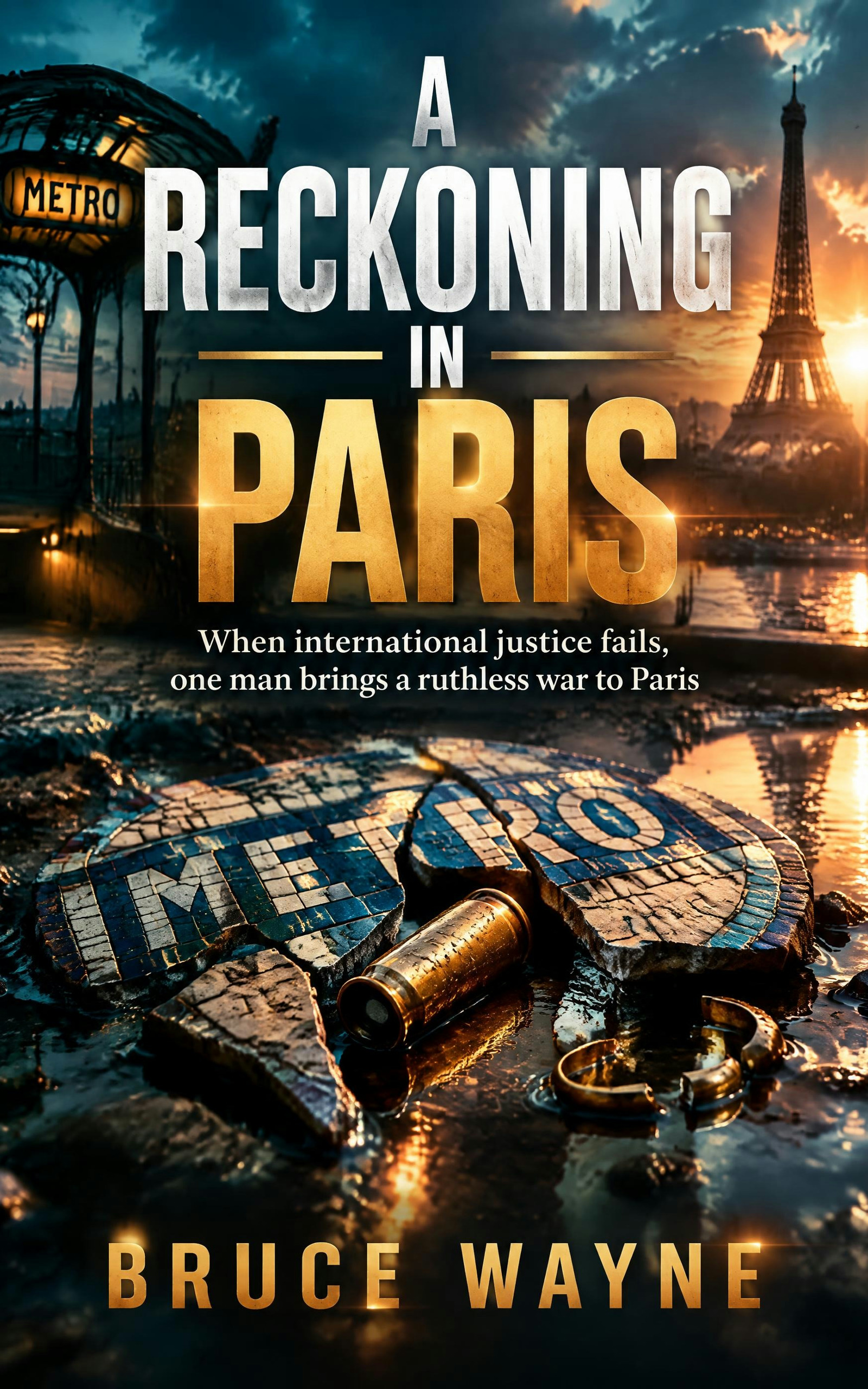
A Reckoning in Paris
When international justice fails, one man brings a ruthless war to Paris
by Bruce Wayne
A romantic honeymoon in Paris ends in horrific tragedy when a terrorist bomb tears through a crowded subway car, killing Richard Miller's beloved wife. Devastated and ignored by corrupt authorities who label her death mere collateral damage, Richard refuses to walk away. Instead, he vanishes into the unforgiving Nevada desert, dedicating two agonizing years to mastering brutal hand-to-hand combat, covert infiltration, and tactical weapons. Now, the former surveyor returns to France completely off the grid—transformed into an unstoppable instrument of vengeance. Hunting down the conspirators one by one across the Parisian underworld, Richard exposes a chilling truth: the blast was no random extremist attack, but a calculated corporate massacre funded by a ruthless billionaire. With crooked officials protecting the mastermind and a dedicated French detective closing in, Richard wages a relentless one-man war through the City of Light. Armed with lethal precision and nothing left to lose, he will stop at nothing to balance the ledger in blood. Fans of explosive vigilante justice and gritty conspiracy thrillers will be gripped by this pulse-pounding, high-octane vengeance tale..
- Thriller
- Crime Fiction
- Revenge Thriller
- Action Thriller
- Vigilante
Shattered Glass and Ashes
The train rocked with the easy rhythm of a Tuesday morning, and Richard Miller watched the tunnel lights strobe across the window glass, counting them the way he used to count sheep as a boy, back when sleep came easy and the world made sense. Virginia's head rested against his shoulder, her chestnut hair smelling of the lavender soap from their hotel, and her fingers were laced through his like she meant to keep them that way for the rest of her life.
"Six months," she said, apropos of nothing, the way she always started conversations mid-thought as if he could read the first half off her face. "That's what the doctor said. Six months and we can start trying."
"Trying for what," he said, though he knew, though his chest already ached with the knowing.
She pinched his arm. "For a baby, Richard. Keep up."
"I like the sound of that." He did. He liked it more than he had words for, and that was saying something, because Virginia always said he had a poet's heart hiding under an engineer's mouth. "A little girl who argues with me about everything."
"Or a boy who reads too much and never comes out of his room." She laughed, and the sound of it filled the crowded car, rose above the murmur of commuters and the electric hum beneath the floor. "We'll figure out which one when we get there."
The car was packed the way Paris trains always were at that hour, shoulder to shoulder, briefcases and baguettes and a woman with a stroller near the far doors. Richard didn't know most of their faces. He would remember every one of them later, in dreams that came uninvited for the rest of his life, but in that moment they were just strangers riding the same rattling box through the dark.
Virginia touched the antique silver locket at her throat, an heirloom of her grandmother's she wore every day since he'd given it back to her, repaired, on their wedding morning. "We should come back here," she said. "For our tenth anniversary. Bring the kids. Show them where their parents fell in love with croissants and got horribly lost near the Panthéon."
"Deal," he said, and he meant it the way he meant everything with her, completely and without reservation, the last uncomplicated promise of his life.
The explosion took the promise and everything after it.
There was no warning, no click or hiss, only a wall of white heat and a sound that wasn't a sound at all but a physical thing, a fist that reached inside his skull and squeezed. The satchel had been sitting three feet from them, wedged beneath the seat of a man who had gotten off two stops earlier, and when it detonated it turned the car into a coffin of screaming metal. The windows sprayed outward in a glittering hail. The ceiling buckled and dropped in sheets. Richard felt himself lifted and thrown, weightless for one endless second, and then the floor came up and hit him like a demolition ball.
He woke to smoke and the smell of burning insulation and copper, to a ringing in his ears so total it felt like silence. Sparks rained from severed wiring somewhere above him. A woman was screaming, or had been screaming, her voice fading in and out as his hearing crept back in ragged pieces. He tasted blood and ash. His hands moved before his mind caught up, clawing through debris, searching.
He found Virginia six feet from where they'd been standing, half-buried under a twisted length of handrail, her sundress dark and wet across the stomach in a spreading stain that had no business being that color. Her eyes were open. She was looking for him.
"Richard." Her voice was a whisper stripped of everything but his name.
He got the rail off her and gathered her into his lap, and his hands came away red, and he pressed them against her without knowing where to press, because there was no single wound, there was only wreckage, only her. The locket at her throat had come loose from beneath her collar, and blood had already worked into the engraved silver, filling the grooves of the initials her grandmother had scratched there sixty years before.
"Stay with me," he said. "Stay with me, Ginny, help is coming, I can hear it, just stay with me."
"I don't—" She coughed, and it cost her something he couldn't watch and couldn't look away from. "I don't think I can."
"Don't say that. Don't you say that to me."
Her hand found his, weaker now than it had been an hour ago when she'd laced her fingers through his and talked about children who didn't exist yet and never would. "Six months," she said, and there was almost a smile in it, almost the ghost of the joke, and then there was nothing at all. Her hand went slack in his. Her eyes stayed open, fixed somewhere past his shoulder, at a ceiling that wasn't there anymore.
Richard Miller sat in the wreckage of a subway car holding his dead wife while Paris burned in miniature around him, and by the time the rescue crews cut their way in through the twisted doors, he had stopped making any sound at all.
The weeks that followed blurred into a gray smear of hospital corridors, sedatives, and forms he signed without reading. His body healed faster than anyone expected, three cracked ribs and a laceration along his jaw that would scar white and thin, a permanent line drawn by a piece of shrapnel that had missed his throat by less than an inch. His mind did not heal at all. It sat in that subway car indefinitely, replaying the six inches of space that had separated survival from loss, wondering if he had leaned toward her or away from her in the half second before the blast, wondering if that half second had been the difference.
He asked for updates every day. He was polite about it at first, then less polite, and eventually he stopped being polite altogether, because politeness had gotten him nothing, and the woman across the table from him on a gray afternoon in early autumn was the closest thing to an answer he'd been given in six weeks.
Detective Helen Martinez set a manila folder on the small table between them, in a private room off the hospital's administrative wing that smelled of antiseptic and cold coffee, and she didn't open it.
"Mr. Miller," she said, her English careful, precise, the accent underneath it Parisian and unhurried even now. "I want you to know I fought for this meeting."
"That doesn't sound like something you say when you're bringing good news."
She looked at him for a long moment, and something crossed her face that he would later recognize as the particular shame of a person forced to deliver a decision she did not make and did not agree with. "The investigation into the bombing on Line One has been reclassified. Files sealed at the ministry level. My unit has been reassigned to other matters, effective this morning."
"Reclassified." He said the word like it tasted foul, because it did. "My wife is dead. Twenty-three people are dead. And you're telling me the case is closed because somebody at a desk decided it should be."
"I am telling you it has been taken out of my hands," Martinez said. "There are political considerations. Foreign nationals were among the victims. Certain governments prefer certain conversations not happen in public."
"Certain governments." Richard leaned forward, and his voice, when it came, was quieter than the anger deserved, flat and cold in a way that surprised even him. "You had a name. Three weeks ago you told me you had a name, a cell, people you were watching. What happened to that?"
"I still have the name." Martinez's jaw tightened, and for a moment the careful bureaucratic mask slipped enough that he saw the same fury underneath it that lived in him now, banked and burning. "I am not permitted to share it with you. I am sorry, Mr. Miller. I am genuinely sorry. This is not why I became a detective."
"Sorry doesn't bring her back." He stood, and the chair scraped against the tile, loud in the small room. "Sorry doesn't put anybody in a cell for what they did to her."
"No," Martinez agreed quietly. "It doesn't."
He walked out of that room and out of the hospital and did not look back, and something in him that had been holding on by a thread, waiting for the system to do what it claimed it existed to do, let go for good. He understood, standing on a sidewalk in the gray Paris light with his wife's ashes in a box he would carry home on his lap, that no one was coming to answer for Virginia. No tribunal. No sentence. No justice with a capital letter that meant anything at all. There was only the law's shrug, and behind it, somewhere, men who had built a bomb and walked away from what it did.
Nevada took him back the way a desert takes back anything, without comment, without warmth. The homestead outside town looked the same as it had two months earlier, sun-bleached and quiet, Virginia's garden gone to weeds because no one had thought to water it. He stood in the kitchen the first night and looked at her coffee mug still sitting in the drying rack and could not make himself move it.
He sold the survey firm within three weeks, signed the papers in a lawyer's office in Reno without arguing over the price, because the price didn't matter and neither did the work, precise measurements and blueprints for buildings other people would live long, undamaged lives inside of. He packed the house into boxes that mostly went to storage and a few that went to the county dump, and he kept almost nothing of what had belonged to the man he used to be. He kept her books. He kept the wedding photographs. He kept the locket, cleaned now, the blood gone from the grooves though he would never forget it had been there.
The morning he buried her, the sky over the little cemetery outside town was the flat, hard blue of a Nevada autumn, and the wind carried grit across the headstones. He stood alone at the grave after the handful of mourners had gone, after Virginia's parents had driven away with their grief folded small and private into the back seat of their car, and he crouched down and pressed his palm flat against the cool granite where her name was cut.
"I tried it their way," he said, and his voice did not shake, because he had used up all the shaking weeks ago in a Paris hospital room. "I gave them every chance. They had a name and they buried it in a file somewhere so nobody has to answer for you."
He stayed there a long time, long enough for the wind to numb his hands, long enough for the sun to shift the shadows of the headstones across the dry grass.
"I'm not going to bury it," he said finally. "I don't care what it costs. I don't care what I have to become to get it done. Somebody is going to answer for you, Ginny. I swear that to you now, and I'm not a man who breaks his word."
He stood, brushed the dust from his knees, and looked out at the flat brown horizon where the desert ran unbroken to the mountains, an empty land as merciless as the promise he had just made. Somewhere out past that horizon, past an ocean he intended to cross again, men were still breathing who had built the thing that took her from him.
Richard Miller had been a surveyor for architects of buildings his whole working life, a man who measured and mapped property boundaries to locate infrastructure. and prepare sites for construction. Driving back to the empty homestead that afternoon, he began, for the first time, to draw the lines of something else entirely, a structure with only one purpose, and no room in its design for mercy.
The Nevada Crucible
The road to Frank Garcia's compound wasn't on any map Richard had bought in Reno, and the man at the gas station in Beatty had looked at him twice before giving directions, the way you'd look at someone asking for the fastest way to hell. Forty miles of washboard dirt past the last billboard, past the last fence line that still had cattle behind it…