


Mental Strength Stories For Teen Boys
12 Inspirational Stories to Help Boys Build Resilience Under Pressure, Make Hard Choices with Confidence, and Develop Strong Character
by Cameran Everlight
Pressure can hit fast: a failed project, a blowup on the field, a group chat that goes too far, a mistake nobody else saw, or a choice that could cost you something. *Mental Strength Stories For Teen Boys* follows twelve boys and young men as they face pressure, failure, rejection, dishonesty, responsibility, and difficult choices. Each realistic story puts a character in a situation where the easy choice and the right choice are not the same. After every story, readers get a simple breakdown of: - **The Pressure Point**: what made the situation difficult - **The Principle**: what the story reveals about strength and character - **The Next Right Step**: something practical to do with it - **Questions to Think About**: a chance to apply the lesson personally These stories show that mental strength is not about never struggling or never making mistakes. It is about what you do next. For teen boys, parents, grandparents, coaches, and mentors who want practical stories about resilience, confidence, responsibility, integrity, and becoming someone others can count on.
- Self-Help
- Religion & Spirituality
- Parenting & Family
- Resilience & Grit
- Personal Growth & Habits
- Ethics & Morality
The Blank Slide
The slide should have changed when Nolan Reed pressed the key.
It didn't. The district showcase logo remained on the screen behind him, bright blue and empty except for the words NORTHGATE JUNIOR HIGH.
Nolan pressed the key again.
Nothing.
Beside the demonstration table, Jasmine stopped turning the crank on their model wind turbine. The small blades slowed. Cole leaned toward the laptop, but Nolan blocked him with one arm.
"Give it a second," Nolan whispered.
There were eighty people in the auditorium. Nolan knew because he had counted the rows while the previous team presented. Parents, teachers, judges, and students from six schools sat beneath lights that seemed much brighter from the stage.
Their two-minute setup window had ended.
One of the judges lifted her pen. "You may begin when ready."
"We are ready," Nolan said.
He clicked again.
The logo vanished.
For half a second, relief loosened his shoulders. Then the screen turned white. Not blank-slide white. Frozen-computer white.
Cole reached for the trackpad. "Where's the final file?"
"It's right there."
"That's the web version."
Nolan looked at the browser tabs across the top. The presentation had loaded from the shared drive during lunch. It should have worked. It had worked before he changed the video settings at 11:42 the night before.
Cole had messaged him then.
Save the old copy before you touch it.
Nolan had sent back a thumbs-up and kept editing. Saving a second file would have taken thirty seconds. It would also have admitted that his new idea might fail.
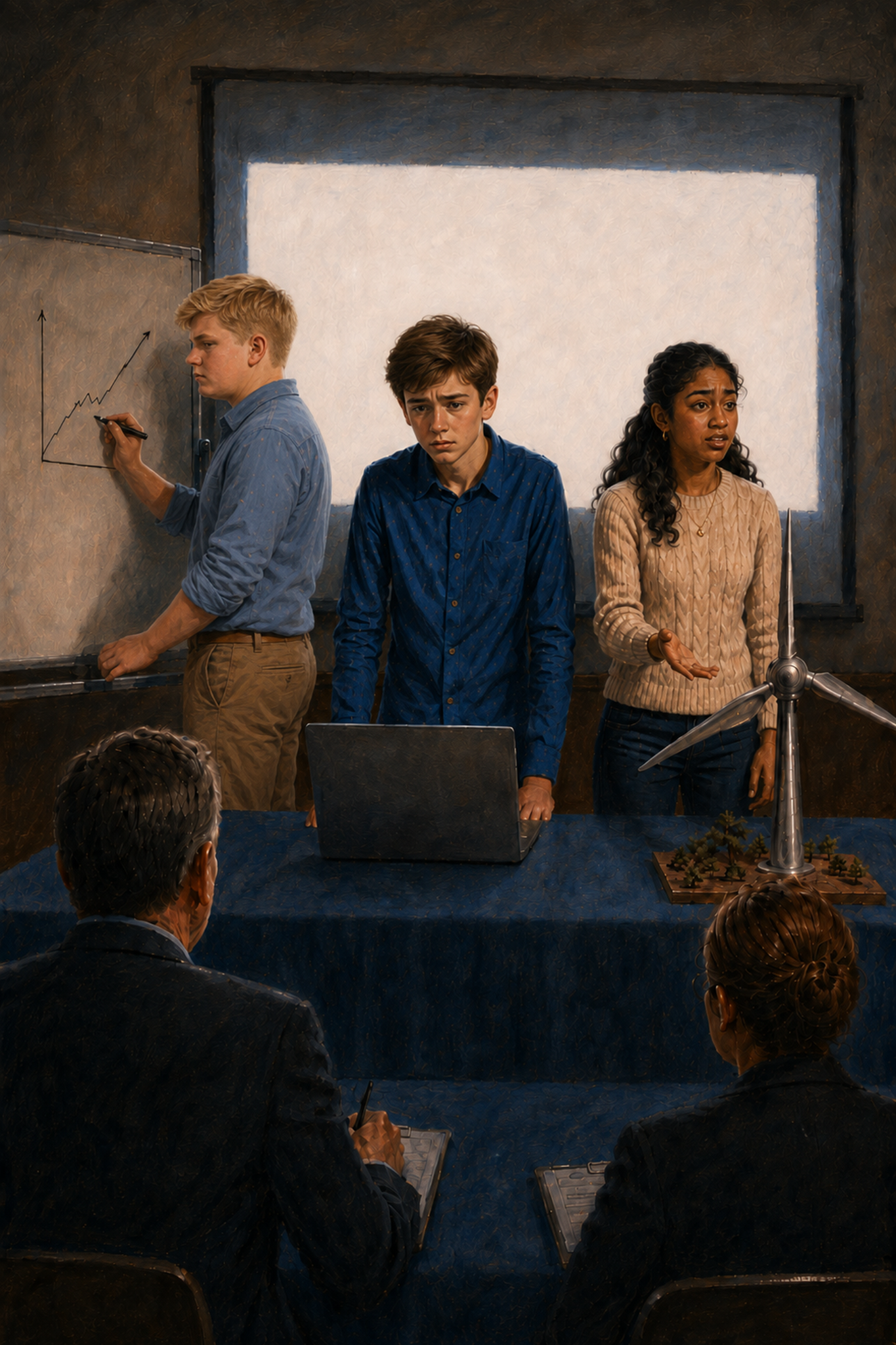
He hadn't saved it.
Jasmine spoke first. "Our project measures how blade angle changes the power output of a small turbine."
Her voice shook at the beginning and steadied by the end. She turned the crank again. Cole began explaining the meter readings while Nolan restarted the browser.
The screen stayed white.
"Do the local backup," Cole whispered.
Nolan stared at him.
Cole's expression changed. "You made one, right?"
Nolan pulled a flash drive from his pocket. It held the version from Monday, before the graphs, the recorded test, and half their evidence.
The judges allowed them to continue. Jasmine presented the model. Cole drew one of the missing graphs on a whiteboard with a marker that squeaked every time he made a line.
Nolan stood beside the frozen screen and answered two technical questions. He knew both answers. That somehow made the failure worse. When their time ended, the applause was kind and brief.
Backstage, Cole closed the laptop.
"You said you saved it."
"The drive lost connection."
"That isn't what I asked."
Nolan unplugged the cable. "The file was there. You saw it."
"The file you changed. Did you save the old one?"
Jasmine stood between them, still holding the turbine crank. "Can we do this after the results?"
Cole looked at Nolan. "Ask him. He's the lead." The word had been Nolan's favorite part of the project.
Now it sounded like an accusation.
Mrs. Patel met them in the hallway. "What happened to the local copy?"
Nolan opened his mouth.
Cole answered first. "I sent Nolan the file Monday."
"Was it loaded onto the presentation laptop?"
Cole looked toward Nolan, waiting.
One sentence would have cleared Cole.
Then a volunteer called Mrs. Patel toward the auditorium. She held up one finger and turned away.
"We'll talk after awards," she said. "Cole, you were responsible for the final file transfer. Find out what failed."
Nolan let her go.
Cole stared at him.
"You heard her," Nolan said. "Figure out what failed."
Cole's face went still. "I just did." He carried the laptop toward the classroom they were using as a team room. Nolan stayed where he was, watching the door after Cole disappeared through it.
Northgate received an honorable mention for design. Jasmine accepted the certificate because neither boy moved when their school was called.
On the ride home, the team chat filled with messages from parents who had watched the presentation. They praised Jasmine for continuing and Cole for drawing the graph from memory. Nobody mentioned Nolan except Mrs. Patel, who wrote that the team would review the technical failure Monday.
Nolan opened the shared folder. The failed file showed his name beside the final change and a timestamp from 11:57 Sunday night. Cole's original version remained in an archived email attachment. The evidence was plain enough that Nolan could already imagine how foolish his silence would look if anyone compared them.
He downloaded both files and reproduced the failure on his own laptop. The drive connection hadn't caused it. His video setting had.
For several minutes, he considered restoring the earlier file into the shared folder and changing its name. That wouldn't alter the timestamp in the message thread, but it might make the project history look more confused.
Nolan closed the folder.
He hadn't told the truth, but at least he hadn't changed the evidence. The fact that he had even considered it scared him.
In the parking lot, Nolan's mother hugged him and said the turbine looked impressive. His father asked whether the projector had broken.
"Something with the file," Nolan said.
That answer was technically true. Technical truth had become very useful that afternoon.
On Sunday, Nolan tried to pray about the regional project without mentioning Cole. Every sentence about future success ran into the same unfinished fact. He finally said, "I let Cole take the blame," and stopped there.
The prayer didn't make Monday easier. It made it harder to pretend he didn't know what he needed to do next.
On Monday, the certificate hung in Mrs. Patel's room beside the whiteboard. The hand-drawn graph was still faintly visible beneath a poor erasing job.
"Before we discuss the showcase," she said, "we need to choose leads for the regional water project."
Nolan straightened in his chair. Regional was larger than district. The winning team would present at the state science center in March.
Mrs. Patel handed out role sheets.
Nolan's name appeared beside SYSTEMS LEAD.
Cole's appeared beside DOCUMENTATION SUPPORT.
Nolan read both lines twice.
Mrs. Patel addressed Cole. "Your ideas are strong. The way you handled the files wasn't. I need you working under a checklist until I know the handoff will happen."
Cole folded the sheet once, then again.
"I sent the file," he said.
"And it wasn't available when the team needed it."
"Nolan changed it."
The room went quiet.
Mrs. Patel turned toward Nolan. "Is that true?"
Nolan felt every person look at him. He had imagined this question many times over the weekend. In every version, he answered calmly and honestly, and people respected him for admitting the mistake.
The real moment felt nothing like that. His face was hot, and his throat tightened. He looked at the folded role sheet in Cole's hand and had to swallow before he could speak.
"Yes," he said. "I changed the video Sunday night. Cole told me to save the old file. I sent him a thumbs-up, but then didn't save it."
Jasmine leaned back in her chair. "You knew that Friday?"
"Yes."
"And you let her blame Cole?"
Nolan could feel the next excuse waiting. Mrs. Patel had been busy. The drive really had disconnected. Cole had owned the transfer earlier in the week.
"Yes," he said again.
The second answer was harder. The first had already taken away his easiest excuse.
Mrs. Patel asked both boys to stay after class. Then she moved to the next role as if the discussion were finished.
Nolan barely heard it.
After the bell, Mrs. Patel asked Cole to show her the message thread. The evidence matched what Nolan had admitted.
Mrs. Patel slid the phone back. "Cole, you may go."
"What about the role?"
"I will review it."
Cole picked up his backpack.
At the door, he looked at Nolan. "You could've said something Friday."
Then he left.
Mrs. Patel removed Nolan's role sheet from the desk.
"You made a bad technical decision," she said. "That cost the team a presentation. Then you made a character decision. You let your teammate take the blame."
Nolan stared at the blank place where the sheet had been.
"Am I off the team?"
"You are off lead until I decide otherwise. Tomorrow you will give the team the complete account. No speech. No explanation of how stressed you were. The facts."
"Cole showed everybody already."
"Cole defended himself. You haven't taken responsibility. Those are different things."
She handed him a printed checklist.
"You will work documentation under Cole if he accepts the lead role."
Nolan looked at the page. File names. Version numbers. Local copies. Test dates. Every boring step he had dismissed because he thought skill meant he could recover from anything.
"He'll make this miserable."
"He might. You still have to do your part."
At home, Nolan dropped the checklist beside his dinner plate. His father read it without asking for the whole story first.
"How much did the mistake cost?" he asked.
"We got honorable mention."
"That wasn't my question."
Nolan pushed rice around his plate. "Cole got blamed. I didn't correct it."
His father nodded once. "What happens tomorrow?"
"I tell the team."
"And after that?"
"I work for Cole. Maybe."
Nolan waited for his father to say that was unfair. Cole had posted the messages in front of everyone. Cole would probably enjoy ordering him around.
His father folded the checklist and returned it.
"Then tomorrow starts the repair," he said.
That night, Nolan opened the water-project folder. He could already see three ways to improve the system. A shared naming rule. An automatic backup. A better video format.
His fingers moved toward the keyboard.
He stopped. The checklist required the lead's approval before structural changes.
Nolan sent Cole one message.
Mrs. Patel asked if you'll lead. If you do, I will follow the checklist. I should've told her Friday.
The message showed as read.
No reply came. The next morning, Nolan stood in front of the team with the old flash drive in his hand.
"The presentation failed because I changed the final file and didn't save Cole's copy," he said. "When Mrs. Patel blamed him, I knew that wasn't true… but I stayed quiet."
He had planned one more sentence about the drive connection. He left it out.
Jasmine crossed her arms. "You knew Friday. Why didn't you say anything?"
"I didn't want everyone knowing it was my fault. I thought maybe it would blow over."
Cole sat at the far side of the table. He didn't look pleased. He looked tired.
Mrs. Patel asked whether he would take the lead role.
"Yes," Cole said.
She assigned Nolan to documentation support.
For the next two weeks, Cole checked every file Nolan touched. Sometimes twice. He rejected a new animation because it hadn't been tested on the school laptop. Nolan argued for thirty seconds, saw Jasmine watching, and stopped.
He saved the old version.
The team also rebuilt the district presentation for the school board archive. Nobody would judge it, and the honorable mention wouldn't change. Nolan wanted to skip the work because repairing a presentation nobody would see felt pointless. Cole assigned him the version log.
Nolan spent an afternoon naming files, recording changes, and linking evidence to graphs. The task required none of the talent he had wanted people to notice. It was also the first time the team could open any result and see exactly where it came from. Jasmine reviewed the log and found two missing dates.
"I thought this was punishment," Nolan said.
"It can be both punishment and useful," she said. "Very efficient."
He added the dates.
At the first regional review, the water model produced a reading nobody expected. Nolan found an error in the sensor code with seven minutes left. He knew how to repair it.
Cole looked at the clock. "Can you fix it and test it in six?"
"I can fix it in two."
"That wasn't the question."
Nolan looked at the backup folder, then at the model.
"No," he said. "Use the last tested version. I'll repair this one after."
They presented with the less impressive display. It worked. When the room cleared, Cole handed Nolan the laptop.
"Make the fix," he said. "Duplicate the file first."
Nolan nodded.
Cole hadn't said he trusted Nolan again or given the lead role back. He'd trusted him with one file. That was a start.
Nolan made the copy before changing anything.
Pressure Point
Nolan didn't hide because he thought Cole deserved the blame. He hid because he didn't want people to see him as the one who had messed up. He was used to being the capable one, the lead, the guy who could fix the technical problem.
Staying quiet protected Nolan from embarrassment for a weekend, but Cole took the blame.
The failed presentation was one problem. Letting Cole carry the blame created another.
Principle
A mistake may happen once. Hiding it can teach you to keep hiding.
Nolan couldn't recover the district presentation. The time had ended. Telling the truth didn't change the award or make Cole trust him again. It made clear that Cole wasn't responsible and stopped Nolan from hiding one more day.
Skill is useful, but skill without responsibility can cause bigger problems. A talented person can make better excuses and take bigger risks with other people's work.
Backups, checklists, testing, and handoffs may seem boring, especially when you're good at what you do. But those simple steps keep your mistakes from becoming someone else's problem.
The better response is easy to understand and harder to do: tell the full truth, own your part, accept the changed role, and then prove through your work that people can depend on you again.
Next Right Step
Correct one false impression that makes you look better than the truth does.
Do it without waiting for someone to discover the message, file, grade, damage, or missed task. State what you did, who had to deal with the consequences, and what you will do next. Leave out the long defense unless a responsible adult asks for necessary details. Then accept that trust may return one assignment at a time.
Questions
- What failure are you making worse because you don't want people to know you caused it?
- Whose work or trust did your choice damage, and what can you do next to repair it?
The Empty Seat
Caleb Brooks learned about Ethan's birthday from a picture of eleven boys holding paintball guns.Ten of them wore camouflage masks. Ethan stood in the middle without one, smiling beside a blue cake on a picnic table.Caleb looked again. The second look didn't put him in the picture.He sat on the edge of his bed with one shoe on. His mother had alrea…