

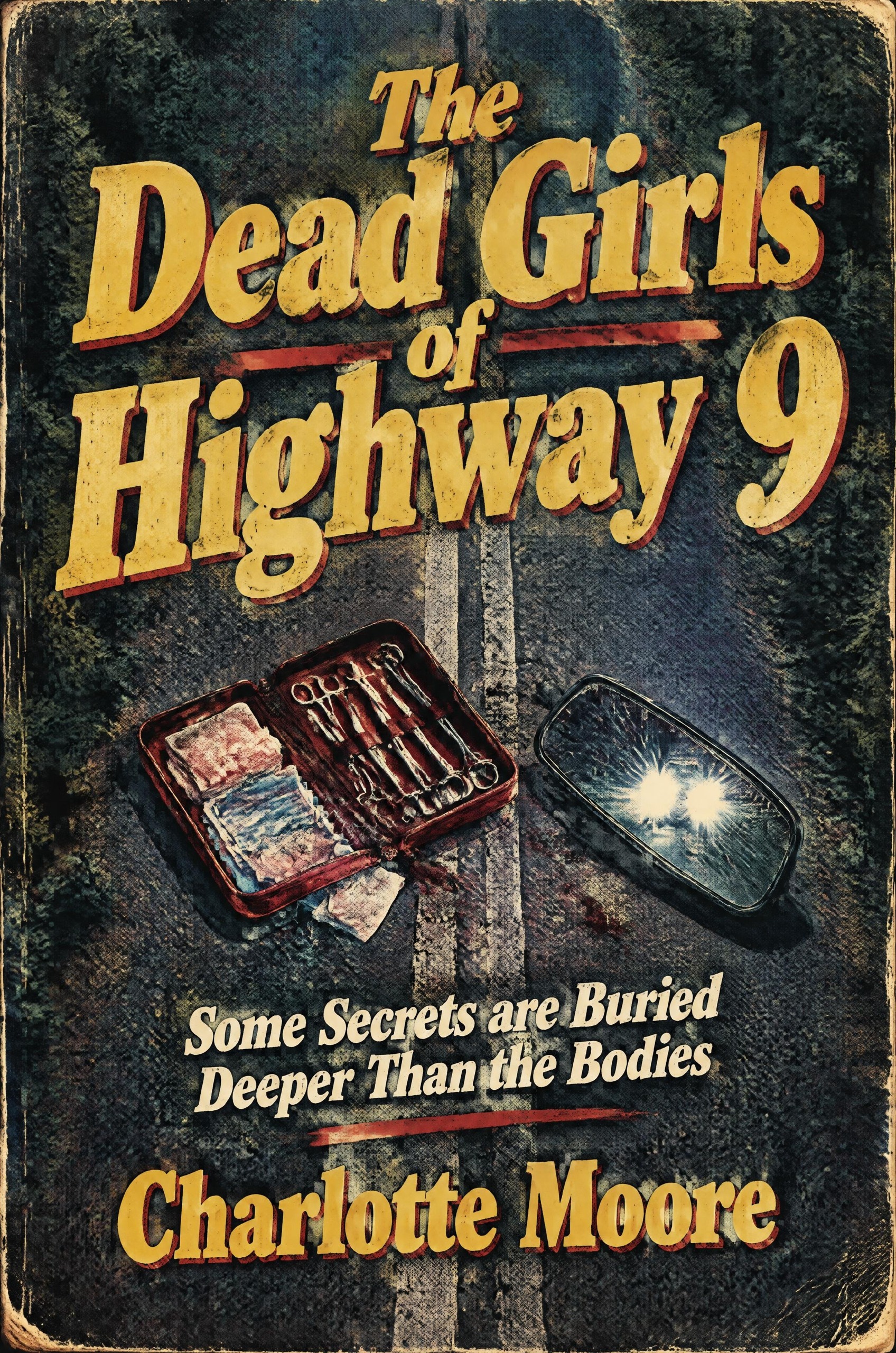
The Dead Girls of Highway 9
Some Secrets are Buried Deeper Than the Bodies
by Carol c
Traveling emergency room nurse Rachel Whitfield has lived on the run for five years, moving between rural hospitals to stay ahead of the violent ex-husband who nearly killed her. Now taking shifts in an isolated timber town, she thinks she has finally built a quiet life. Then women matching her exact appearance begin vanishing along the desolate county highway. Rachel's suspicion that someone is tracking her every move turns into cold terror when her ex-husband appears inside her locked home in the middle of the night. He claims he escaped a psychiatric facility not to harm her, but because he discovered an outside predator stalking her along her route—and he insists he is her only defense. With local authorities dismissing her fears and the attacks escalating around her, Rachel is caught in a suffocating psychological vice. To survive, she must untangle a web of terrifying clues and determine whether a phantom serial killer is on her trail, or if the monster from her past has orchestrated the entire hunt to force her back into his grasp.
- Thriller
- Mystery
- Psychological Thriller
- Stalker Thriller
- Domestic Thriller
Mile Marker 47
The sleet had turned to a thin gray rain by the time Rachel crossed the county line, and she drove the last ten miles with both hands locked at ten and two, watching her mirrors more than the road ahead. Ninety minutes behind schedule. She hated being late almost as much as she hated being seen.
The duplex sat back from Old Mill Road behind a stand of bare pines, its porch light already burned out, which she noted the way she noted everything now, as a fact with a weight attached to it. She parked the station wagon nose-out in the gravel, the way she always did, and sat for a moment with the engine ticking before she let herself move.
The sweep took eleven minutes. She checked the window latches on both sides of the duplex, tested the deadbolt until the mechanism bit clean, and walked the tree line at the edge of the yard to confirm she could see the road from the kitchen window and the kitchen window from the road. Only then did she go back for her duffel bag, the single piece of luggage that had carried her through six towns in five years, its strap worn soft from her shoulder.
Inside, the duplex smelled like someone else’s cooking and old carpet cleaner. She didn’t bother unpacking beyond the essentials. A go-bag stayed zipped by the door no matter where she slept. She ate a protein bar standing at the counter, brushed her teeth, and lay down on top of the covers with her shoes still on, the way she had learned to sleep when sleep was something you did in case you needed to stop doing it.
By six the next morning she was dressed in clean scrubs and driving the winding two-lane into town, the clinic’s low brick building rising out of the fog like something half-remembered. Blackwood County Memorial Hospital was smaller than the name suggested, a single-story annex bolted onto the back of the old county building, with a parking lot full of pickup trucks and one ambulance idling by the bay doors.
She had barely cleared the automatic doors before a woman with honey-blonde hair and a cardigan the color of a traffic cone peeled off from the nurses’ station and crossed the lobby toward her, smiling like they’d already met.
“You must be Rachel,” the woman said. “I’m Amy. Amy Sullivan. I’m going to be your shadow for orientation, which is just a fancy way of saying I’m going to talk your ear off for eight hours.”
“Nice to meet you,” Rachel said, and meant it the careful, professional way she meant most things now.
Amy fell into step beside her, badge swinging from a lanyard covered in faded enamel pins. “Oh my gosh, look at us,” she said, stopping to hold her own forearm up next to Rachel’s like they were comparing paint swatches. “Same hair, same height, same everything. People are going to think we’re sisters. Twins, even, if they squint.”
Rachel managed a small smile and didn’t look at her own reflection in the glass doors behind them, because she already knew what she’d see.
“I get that a lot,” she said, which wasn’t true, but it was easier than explaining that she had spent five years trying to look like no one in particular.
Amy laughed and led her down the hall, narrating supply closets and bathroom codes and the temperamental coffee machine in the break room with the same breathless enthusiasm, never once glancing behind her, never once checking who was in the hallway before she turned her back on it. Rachel clocked every open door they passed, every unlocked supply closet, every exit sign, while Amy chattered about a nursing conference she wanted to go to in Portland someday.
They ended up in a cramped office off the nurses’ station, pulling patient charts for the morning handoff. Amy perched on the corner of the desk instead of the chair, scrolling through something on the department tablet with her bottom lip caught between her teeth.
“Okay, this is going to sound dark for a Tuesday,” Amy said, “but did you see the bulletin that came through yesterday?”
“What bulletin?”
“State police put it out to all the regional clinics. Missing persons.” Amy turned the tablet so Rachel could see it. “Girl from Fenwick, two towns over. Worked at some feed store off Route 9. She didn’t show up for her shift four days ago and nobody’s heard from her since.”
“That’s terrible,” Rachel said, and meant that too, in the flat way she meant things that were terrible but not yet hers.
“It’s the third one,” Amy said. “In like, ninety days. There was a waitress out near Carlisle in the fall, and before that a girl who worked at the motel by the junction. Sheriff’s office is calling them unrelated, which, I don’t know, feels like a lot of unrelated for one highway.”
Rachel reached for the tablet to be polite, to look interested the way a new colleague should look interested, and found the missing woman’s photo already filling the screen.
The air left her chest in one slow pull.
The woman in the bulletin had dark blonde hair cut to shoulder length, parted the same way Rachel wore hers. The same narrow build, the same pale coloring, the same small, pointed chin. Even the eyes, hazel and a little hooded at the corners, looked like they could have come out of Rachel’s own mirror on a tired morning.
“Rachel?” Amy was watching her now, head tilted. “You okay? You went kind of white.”
“I’m fine,” Rachel said, setting the tablet down carefully, the way she might set down something that could still shatter. “Long drive yesterday. I didn’t sleep much.”
“Yeah, that stretch of 9 will do that to you.” Amy took the tablet back, glancing at the photo again without any particular weight behind it, the way a person looks at a stranger’s face. “Sad, right? She’s pretty. Looks a little like you, actually.”
“Does she,” Rachel said, in a voice that came out steadier than she felt.
Amy was already moving on, flipping to the next chart, talking about a patient with a wound vac that needed changing before noon. Rachel nodded along and wrote down what she needed to write down, her hand moving on its own while the rest of her sat very still, turning the photograph over and over behind her eyes.
Three women. Three towns strung along the same highway she’d just driven in the dark. Three faces that could have been hers if you caught them at the wrong angle, in the wrong light, on the wrong night.
She thought of the duplex waiting for her at the end of her shift, the dead porch light, the tree line she could see from the kitchen window. She thought of all the small rituals she performed to keep herself invisible, and how none of them would matter if the thing hunting women on Highway 9 wasn’t looking for a stranger at all.
It was looking for someone who looked exactly like her.
Cold Ignition
Her shift ended at seven, the sky still black over the staff lot, and Rachel came out through the side door with her bag slung across one shoulder and her keys already threaded between her fingers. The lot lights buzzed overhead, yellow and uneven, throwing long shadows between the parked trucks. She counted cars out of habit. Fewer than when she’d…