

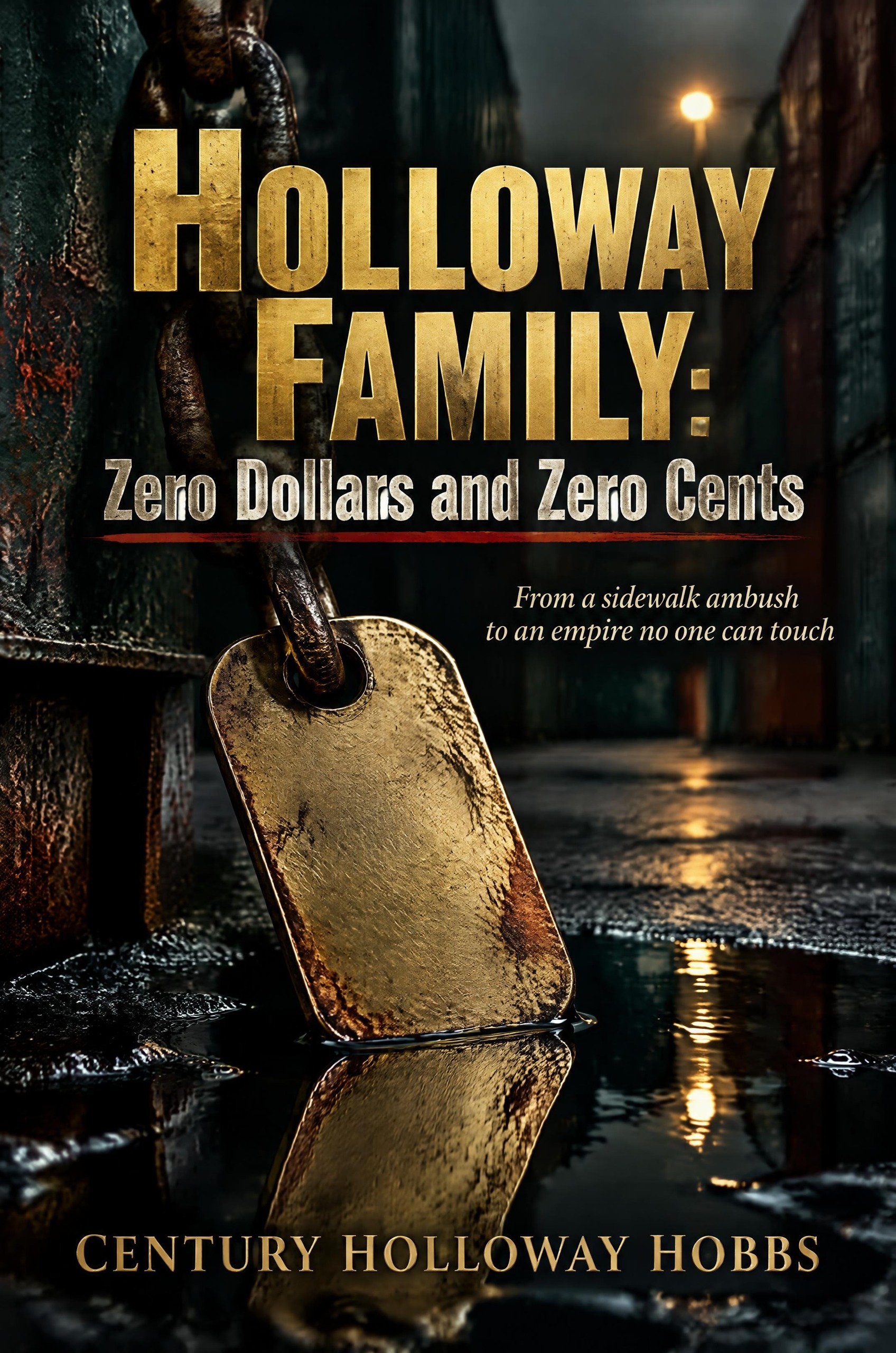
Holloway Family: Zero Dollars and Zero Cents
From a sidewalk ambush to an empire no one can touch
Dominic Moretti crawled out from under three dead men on Virginia Avenue and did not run. He hunted the shooters in hospital wards, seized the river docks, and made himself useful to Charles Lynch, the old-money crime boss who thought street muscle was disposable. Federal investigator Marcus Gallo saw the pattern and opened a racketeering case no one wanted him to pursue. Dominic did not stay muscle. He turned crude rackets into logistics, shells, and corridors no cop could follow. When Lynch tried to purge him before the wiretaps closed in, Dominic flipped the trap at the freight terminal, fed the dynasty to the indictment, and left Gallo staring at a waterfront with no old hierarchy left standing. Holloway Family: Zero Dollars and Zero Cents is a crime thriller about calculated alliances, crushed cartels, and a survivor who converts blood into an invisible corporate empire—and then has to make the last move that turns a regional throne into something global and untouchable.
- Thriller
- Crime Fiction
- Psychological Thriller
- Crime Thriller
- Organized Crime
- Crime Family
Asphalt and Shards
The smell of gasoline mixed with copper came first. Rain fell against the overturned chassis of the sedan, steady and cold, drumming like fingernails against an iron hull. Underneath the steel frame, the darkness was complete except for the dull amber pulse of a shattered hazard light blinking into an oily pool of water.
Dominic Moretti did not move until the engine block finished clicking. The heat radiating off the cracked manifold was dying, replaced by the damp chill of the Virginia Avenue underpass. He lay flat on his stomach, pressed against the wet concrete, his ribs screaming where the steering column had buckled into his sternum. Above him, wedged between the collapsed roof and the leather bench, rested the weight of three corpses. Petey lay twisted across the console, his neck broken when the armored Lincoln took the first volley of heavy rifle fire. Behind him, Sal and Frankie were tangled together, their coats soaked black with blood that dripped through the floorboards onto Dominic's shoulders.
He pushed upward with his palms. The sheet metal groaned. Blood ran down Dominic’s jawline, warm and thick, pooling at the collar of his ruined shirt. A large shard of automotive safety glass remained embedded just beneath his ear, grinding against the bone every time he turned his neck. He reached up with gloved fingers, gripped the jagged edge of the laminate glass, and pulled it free with a single jerk. He did not make a sound. The pain was immediate, sharp and cold, a nauseating jolt that left him trembling as shock blunted the edges, narrowing his focus.
He dragged himself forward through the crushed driver-side window. The asphalt grated against his forearms. Out in the open air, the underpass smelled of wet gravel, spent rifle propellant, and burned rubber. The shooters had departed sixty seconds earlier, leaving behind dozens of brass casings glittering in the puddles. They had fired over eighty rounds of 7.62 through the windshield before turning their rifles into the side doors, expecting no survivors. A normal crew would have stayed to check pulses. These men had been rushed, or they had assumed four dead bodies inside a crushed cage of reinforced steel was an absolute guarantee.
Assumptions were fatal in this city. Dominic had learned that fifteen years ago, running crates of untaxed liquor along the rail yards.
He hauled himself up against the concrete pillar of the overpass, keeping his back pressed flat against the damp stone. His right leg dragged slightly, numb from the impact, but the tendon held. Across the roadway, headlights cut through the sheets of rain. An unmarked gray utility van slowed as it approached the wreckage, its tires splashing through the debris field. The driver's side window rolled down two inches.
Dominic stepped out from behind the pillar, his right hand buried inside his soaked coat, fingers resting on the checkered grip of his Kimber .45. The brake lights of the van flared red against the concrete pillars. The side door slid back with a dull mechanical rattle.
"Get in," Paul Castiglione said from behind the wheel. His hawk-nosed profile was lit by the dim glow of the dashboard. He did not look at the dead men inside the sedan; he kept his eyes sweeping the dark industrial avenue.
Dominic climbed into the rear compartment, pulling the heavy sliding door shut behind him. The lock engaged with a solid click. Inside, the van smelled of motor oil, damp canvas, and solvent. Dominic collapsed onto an aluminum equipment case, breathing hard through his teeth. Every breath caught in his crushed sternum, tasting of raw copper and rainwater.
Paul shifted into drive and accelerated down Virginia Avenue, keeping the speed five miles below the city limit. He did not use sirens, and he turned off the headlights as they crossed beneath the rail bridge, navigating the dark industrial district by the amber streetlamps alone. He reached into the passenger seat, grabbed a canvas medical pouch, and tossed it into the back without looking over his shoulder.
"Petey?" Paul asked. His voice was quiet, clipped, devoid of panic.
"Gone," Dominic said. His voice was rough, scraping against his throat like dry paper. "Frankie and Sal too. Point-blank through the doors."
"I heard the chatter on the scanner three minutes after the call came in," Paul said, his eyes checking the side mirrors. "They used short-barreled carbines. Clean breach, heavy caliber. They knew your route from the warehouse."
"They knew the schedule," Dominic corrected. He unzipped the canvas pouch and pulled out a roll of heavy cotton gauze, pressing it hard against his torn jaw. The blood soaked through the fabric almost instantly. "Turn toward the canal. We do not use the clinic on Fourth."
"You have a four-inch tear across your face, Dom. You're bleeding through your collar. Saint Jude is eight blocks west. We could drop you at the emergency bay and circle back."
"No," Dominic said. He leaned his head back against the corrugated wall of the van, watching the shadows of warehouses flicker past the rear windows. "Emergency rooms file police incident reports before the anesthesia takes hold. Marcus Gallo has two investigators monitoring every trauma unit from here to the river. We go to your garage."
"You'll lose enough blood to put you into shock before midnight."
"Then drive faster," Dominic said.
Paul tapped the accelerator, and the van surged through the empty intersections of the lower waterfront. The docks loomed to their left, black cranes standing like skeletal towers against the iron sky. They turned down a gravel lane between two shuttered sheet-metal fabrication plants, pulling up to the roll-up door of an unmarked commercial garage. Paul pressed a remote transmitter clipped to the sun visor. The chain-link door rattled upward just enough to clear the van’s roof, and he drove inside, cutting the engine before the door finished closing behind them.
The silence in the garage was heavy, broken only by the steady pinging of the van's hot exhaust. The air was thick with the scent of degreaser, transmission fluid, and stale coffee. Overhead, two bare fluorescent tubes buzzed into life as Paul hit the wall switch.
Dominic stepped out of the van, his boots hitting the grease-stained concrete with a dull thud. His legs felt stiff, but the numbness had retreated into a steady, throbbing ache. He limped to the steel workbench at the back of the shop, gripping the edge of the tool rack as a cracked mirror swayed above an array of socket wrenches and oil filters. He tore away the blood-soaked gauze and examined his reflection.
The laceration ran from the bottom of his left earlobe down along the curve of his jaw, stopping an inch short of his chin. The skin hung open, dark red and ragged where the laminated glass had torn through the muscle. His hair was plastered to his forehead with rain and grime, his eyes narrow, cold, and dark.
"I have a suture kit from the surplus yard," Paul said, setting a plastic tray on the workbench. Inside were three curved surgical needles, a spool of black nylon thread, an amber bottle of iodine, and a pair of locking forceps. "Sit on the crate. I'll do it."
"No," Dominic replied. "You check the lines. Find out who handled the point on Virginia."
"Dominic—"
"Find them, Paul."
Paul stared at him for a beat, his dark eyes measuring the older man's stillness. Then he nodded once, stepped over to a steel desk in the corner, and pulled a prepaid phone from his coat pocket. He dialed a sequence of numbers from memory, keeping his voice low as he spoke into the receiver, using short, coded phrases that left no trace of names or addresses.
Dominic picked up the bottle of iodine and poured it directly over the open wound. The sting was savage, like a hot wire drawn across raw meat, but he did not blink. His jaw tightened until the muscles stood out like iron cords against his neck. He picked up the forceps, locked a needle in the jaws, and threaded the nylon strand through the eyelet.
Looking into the cracked glass of the mirror, he pushed the steel needle through the ragged flap of skin near his ear. He pulled the thread tight, tied an overhand knot, and trimmed the excess with a pair of mechanic's snips. He repeated the motion. One stitch. Two. Three. Cold sweat stung his eyes as he fought a tremor in his fingers, forcing the needle through with stubborn, mechanical precision. By the seventh knot, the bleeding had slowed to a dark, sluggish seep along the black seams.
Paul ended his call and walked back to the workbench, sliding the phone into his pocket. His expression had hardened.
"Marcone," Paul said simply.
Dominic wiped his jaw with a dry rag. "Which crew?"
"Vince's boys out of the North End. Four men in an iron-gray Suburban. They hit you because Lynch gave them the nod to test the docks. They wanted to take out your senior runners before the weekend shipment arrived."
"Lynch didn't order it," Dominic said, setting the snips down with a sharp click against the metal bench. "Lynch watched. He wanted to see if I was soft enough to bleed out in a ditch, or if Marcone had the stomach to take the river corridors himself. It was an audition."
"Whatever it was, Marcone’s men didn't walk away clean," Paul said. "Petey got off four rounds through their side glass before his rifle jammed. Two of their shooters caught fragments in the torso. The driver dumped them at Saint Jude Memorial forty minutes ago before ditching the truck in the river canal."
Dominic looked at his reflection in the mirror again. The black sutures made his scarred jaw look like a stitched seam on a baseball. His suit coat was ruined, the left shoulder soaked with the blood of his dead lieutenants. He peeled the coat off, dropped it into a metal trash drum in the corner, and opened a locker behind the workbench. Inside hung an assortment of clean clothes Paul kept for logistics runs. Dominic pulled out a clean black wool overcoat, slipped his arms through the sleeves, and buttoned it up to his throat.
"Which floor?" Dominic asked.
Paul paused, his hands resting on the edge of the tool chest. "They're in the west wing recovery ward. Third floor. But that wing is locked down after ten at night. Saint Jude has private security at the desk, and Gallo probably has a patrol car parked out front on general suspicion."
"Gallo is at the precinct," Dominic said, checking the magazine of his .45 before sliding it into his coat pocket. "He operates by the book. He won't post a federal guard until the hospital formally logs the bullet wounds as gang violence, and Marcone’s people paid the night shift intake clerk fifty thousand dollars to list them as industrial accidents. We have two hours before the paperwork hits the desk of the district attorney."
"You just took four inches of glass to the skull, Dom," Paul said, his voice flat with warning. "You need twelve hours off your feet. You're running on pure adrenaline."
"If we wait twelve hours, Marcone puts twenty men around those hospital beds," Dominic said, stepping toward the gun safe beneath the workbench. "And Lynch decides that I am dead. Bring the hardware."
Paul sighed through his nose, a brief, resigned sound, then reached into the bottom drawer of the safe. He brought out two Austrian nine-millimeter automatics fitted with six-inch cylindrical suppressors. He checked the actions, wiped the slides with an oiled cloth, and handed one to Dominic. He tucked the second into his own overcoat.
"We take the service alley behind the boiler room," Paul said. "The loading dock doors don't latch properly when the rain backs up the drainage."
"Good," Dominic said. "Let's go."
They left the garage in a different vehicle, a dark sedan with clean plates. The rain had picked up, sweeping across the pavement in heavy, gray waves that obscured the streetlights. Saint Jude Memorial Hospital sat on a low hill overlooking the river ward, its red brick towers dark against the clouds. A single ambulance sat under the emergency bay awning, its engine idling, steam rising from its radiator into the cold air.
Paul cut the headlights three hundred yards out, coasting down the rear alley beside the loading docks. He parked beneath the shadow of a steel fire escape. The building hummed with the distant vibration of industrial laundry equipment and high-pressure steam pipes.
Dominic stepped out into the rain. The cold water hit his stitched face like a handful of gravel, but he barely felt it. His focus was dialed down to the layout of the corridors: three flights of service stairs, the double doors leading into the orthopedics wing, and the quiet corridor of the third-floor recovery ward. He moved without making a sound, his black overcoat pulled tight against the damp.
Paul tested the rear delivery door with a thin pry tool. The latch popped with a soft click, and they slipped inside into the warm, disinfectant-scented air of the basement. They moved past stacked crates of saline bags and laundry hampers, taking the concrete steps of the fire exit two at a time. Dominic’s breathing remained shallow, controlled, his fingers resting lightly against the cold steel of the suppressed pistol inside his pocket.
On the third floor, the hallway was quiet. The overhead fluorescent lights had been dimmed to night mode, casting long, rectangular shadows across the linoleum floor. At the central nursing station, an orderly crossed toward the linen closet while a nurse sat behind a partition, her gaze fixed on a glowing computer monitor beside a paper cup of coffee.
Dominic and Paul waited until the orderly vanished into the supply room, then moved swiftly down the left corridor, their boots quiet on the waxed tile. Room 314 was marked with a yellow quarantine tag on the door handle. Through the frosted glass panel, the rhythmic, electronic beep of a heart monitor pulsed in the dark.
Dominic turned the brass handle and pushed the door inward. The room was narrow, illuminated only by the green and blue digits of two bedside telemetry monitors. Two men lay in adjustable hospital beds, their torsos wrapped in white elastic bandages, intravenous lines running into their arms. The first man, a heavy-set shooter named Tony, had an oxygen cannula hooked beneath his nose. His eyes were closed, his face pale from blood loss. The second man, younger with shaved hair, stirred as the draft from the hallway entered the room.
The younger man opened his eyes. He saw Dominic standing at the foot of his bed, tall, soaked with rain, the black nylon stitches jagged across his jawline like an unhealed fracture. The shooter's eyes went wide with pure terror. He reached desperately for the plastic call button clipped to his pillow, his mouth opening to shout.
Dominic raised the suppressed pistol. He fired twice through the center of the man's chest. The weapon gave two muffled chuffs, like heavy books dropped onto a carpet. The impact drove the man back into the mattress, his breath escaping in a sharp rattle before the heart monitor flatlined into a continuous high-pitched hum.
Tony woke at the sound, gasping as he tried to sit up, his heavy hand clutching at the IV stand. Dominic stepped around the bed, pressed the cylindrical suppressor firmly against the center of Tony’s forehead, and pulled the trigger once.
The sound was swallowed by the room's curtains. The heavy man slumped sideways against the safety rail, his head resting against the cold steel bar. Dominic reached over with a gloved thumb, switched off the monitors, and unplugged the power cords from the wall sockets. The continuous tone died instantly, leaving the room in complete, heavy silence.
Paul stood at the door, his eyes scanning the corridor. "Clear," he whispered.
Dominic looked down at the two dead men. There was no pleasure in the room, no relief, only the cold subtraction of two threats that could no longer speak to the authorities or carry rifles for Marcone. He pulled a clean linen napkin from his pocket, wiped a single drop of gun oil from the barrel of his weapon, and slid the pistol back beneath his coat.
"Tell the docks the shipments run at sunrise," Dominic said, his gravelly voice quiet in the room. "And tell Lynch I'll see him tomorrow."
He turned and walked back toward the fire escape, leaving the dark room behind him as the rain continued to fall against the glass.
The Docks of Saint Michael
The dawn over the river was the color of a lead pipe. Fog hung low across the black surface of the water, clinging to the wooden pilings of Pier 44 and drifting between rows of corrugated shipping containers stacked three high. In the distance, gulls wheeled over the oily surface, their cries sharp and flat against the hum of diesel generators. Dom…