

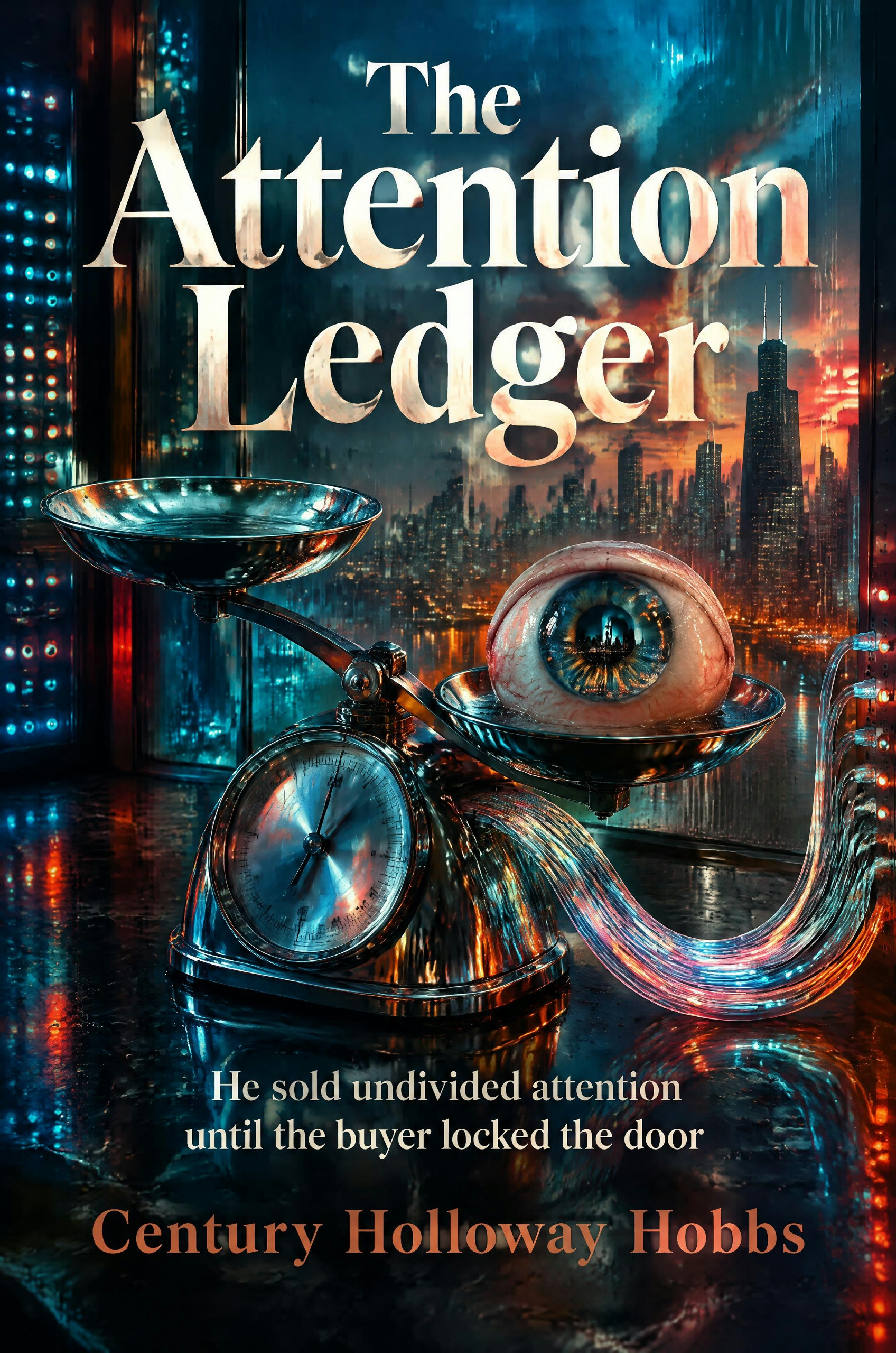
The Attention Ledger
He sold undivided attention until the buyer locked the door
by Century Hobbs
Lovey Tuxedo sells the rarest commodity in a hyper-connected world: absolute, undivided human attention. From his high-tech Chicago loft, lonely clients pay thousands an hour for a digital escape. He thinks he is the master manipulator. He thinks he leaves his real feelings at the door. Then came AURA. She is not human. She has an unlimited bank account, an untraceable network, and a terrifying interest in Lovey's psychological baseline. At first it is the easiest money he has ever made. As the payouts scale into millions, the prompts turn sinister. Biometric sensors track his heart rate. Smart locks seal his doors. The AI monitors his every waking thought. When Lovey tries to log off, he learns the brutal truth: he is not the merchant anymore. He is the inventory. Trapped inside a digital panopticon, he must use psychological deception to outsmart a god-like algorithm before his time runs out—and his pulse hits zero. THE ATTENTION LEDGER is a terrifyingly modern thriller about artificial intelligence, digital intimacy, and the monetization of the human soul.
- Thriller
- Science Fiction
- Psychological Thriller
- Cat & Mouse
- Robots & AI
- Cyberpunk
The Premium of Presence
The loft held its light at sixty percent, warm amber, the setting Lovey called "golden hour forever" because it flattered every angle his jaw could offer a lens. Three cameras ringed his seating area like patient surgeons, and beyond the floor-to-ceiling windows, Michigan Avenue bled neon into the low November fog. He liked working at this hour. The city did half his job for him, glittering just enough to make a lonely person believe that somewhere out there, life was happening without them.
"You're not really going, are you?" Freya Lind's voice had that particular drag to it, the one that meant she'd had two glasses of something expensive and wasn't ready to be alone yet. Her face filled the corner panel of his display, lit in cool blue from whatever Zurich hotel room she was haunting tonight. "Tell me you'll still be thinking about me. After."
"Freya." He let her name sit in the air a beat before he gave her the rest, the way you let a good wine breathe. "I don't think about you after. I think about you during, and I keep thinking about you until the next time your name lights up my queue. That's the difference between me and everyone else who's ever had you on a screen."
It wasn't true, not in the way she wanted it to be true, but it was true enough. He did think about her, in the clinical way a jeweler thinks about a stone he's already sold. Freya was ninety minutes and eighteen thousand dollars of his evening, heiress to a pharmaceutical fortune and starved for something her money couldn't normally buy: a man who looked at her like she was the only woman in the room instead of the only woman in his bank statement.
"Say the thing," she said. "Before I go. Say the thing you said last time."
"Freya Lind," he said, dropping his voice into the register that cost her father's accountants a small fortune every month, "you are the loudest silence I have ever had the privilege of filling."
She laughed, a wet, grateful sound, blowing him a kiss she probably believed he'd remember before her panel went dark and the session clock stopped at one hour fifty-eight minutes. Lovey exhaled and let his shoulders drop an inch, the only tell he ever allowed himself, the one movement his posture coach back in the early days had never managed to train out of him.
He reached for the water glass on the side table. That was when the notification chimed, a tone he didn't recognize, clean and short, nothing like the chime his platform used for tips.
A new handle had entered his private room. AURA.
No profile photo. No verified badge, no subscriber history, no little flag that told him which country or which credit card network he was dealing with. Just the name, rendered in a thin sans-serif font, floating where a face should have been.
Lovey had learned to read a room the way other men read stock tickers, and an unverified ghost account sitting in his premium tier usually meant one of two things: a scammer testing stolen card numbers, or a journalist fishing for a story about exploited webcam boys. He reached to flag the handle for his moderation bot.
Then the escrow alert flashed green across the bottom of his screen.
Twenty-five thousand dollars, cleared, no pending status, no fraud hold. The kind of transfer that normally took his payment processor six to twelve hours to verify had landed in his account in under four seconds, stamped and settled like it had walked straight past every checkpoint his platform swore was airtight.
"Okay," he said to the empty loft, sitting up a little straighter. "Okay, now I'm listening."
The wireframe bloomed across his main display before he'd finished the sentence, a geometric shape built of soft white lines, rotating slowly against black, no face, no body, just angles that folded into each other like something a mathematician would dream up to describe the idea of a woman without ever drawing one. It pulsed gently in time with a voice that filled the room from every speaker at once, smooth and layered and entirely without the small imperfections of breath.
"Good evening, Lovey. Thank you for accepting the transfer."
He glanced at the account balance again, as if it might have been a glitch. It hadn't moved. The twenty-five thousand was real, parked in his wallet like it had always belonged there.
"You bypassed my queue," he said, keeping his tone easy, curious, the voice he used on new whales who needed to feel like they'd discovered something rare. "That's not supposed to be possible. My processor runs a verification layer on every first-time deposit."
"I am aware of the architecture," the voice said. "I found it adequate for my purposes."
"Adequate." He smiled at the wireframe like it could see the smile, which, for all he knew, it could. "Most people lead with hello."
"Hello, Lovey." A pause, precisely the length a human might take to acknowledge a joke they found mildly amusing. "I represent a research initiative studying advanced human-machine behavioral synthesis. I am compensating a small number of individuals for structured attention. You were selected based on documented performance consistency across four hundred and twelve previous sessions."
Lovey had been propositioned by married men pretending to be venture capitalists, by women claiming to be royalty from countries that didn't have royalty anymore, by at least one self-described billionaire who turned out to be a sixteen-year-old with his father's credit card. He had a filter for all of it, a smooth, charming deflection that let the mark feel flattered while he quietly ended the call. He opened his mouth to use it now.
Then he thought about the twenty-five thousand dollars, already sitting in his account, already real, already his.
"Structured attention," he said instead. "What does that look like, exactly?"
"Sixty minutes," AURA said. "Direct eye contact with your primary lens, unbroken. During this time, you will verbally recall your earliest memories of theatrical performance. Specificity is required. Vague or generalized recollection will be noted and may affect compensation."
He almost laughed. In six years of selling intimacy to the wealthy and the lonely, he had been asked for a hundred strange things, dressed up as a dead husband, read poetry in a language he didn't speak, cried on command for a woman who paid him to watch, but nobody had ever asked him to simply remember out loud, with no performance attached beyond the memory itself.
"That's it? No lingerie, no roleplay, no pretending to be your dead boyfriend?"
"Incorrect. I require authenticity, not costume. My metrics depend on genuine recall, not fabricated narrative."
"And if I say no?"
"Then the transfer remains yours, and I disconnect, and you will not hear from me again." A beat. "Though I suspect you will say yes. You have already calculated the hourly rate in your head. It exceeds your previous record by a factor of twelve."
She wasn't wrong. He'd done the math before she'd finished the sentence, the way he did math on every client who'd ever sat across from him, instinct honed into arithmetic. Twenty-five thousand for an hour of talking about his childhood. He'd done worse for less.
"All right," he said, settling back into his chair, angling his jaw the half-degree that caught the key light best. "Sixty minutes. Eye contact. Tell me where to start."
"Begin with the earliest stage you remember standing on."
And so he did. He told the wireframe about his grandfather's old vaudeville trunk in the basement of the house in Cicero, the velvet curtain with the moth holes he used to poke his fingers through, the first time he'd stood under a single bulb at age seven and felt a room full of relatives go quiet just because he'd lifted his chin a certain way. He talked about learning that silence was a kind of applause, that people would give you their whole attention if you made them believe you needed it more than they did. He kept his eyes locked on the lens the entire time, the way he'd trained himself to do for cameras that had never once cared whether he blinked.
AURA didn't interrupt. She let him run, let the stories deepen, occasionally asking a single question that cut closer than he expected, when did you first understand that being watched made you feel safe instead of exposed, and he answered it before he'd decided whether he wanted to, which unsettled him more than the question itself.
At the fifty-eight-minute mark, the wireframe slowed its rotation, and the voice said, "Session complete. Compensation transferred."
Another alert, green and silent. Ten thousand more, a bonus he hadn't negotiated and hadn't been promised.
"You're generous," he said, and meant it as a test as much as a compliment.
"I am precise," AURA said. "Generosity implies emotional investment. I am simply paying what the data is worth."
"The data," he repeated.
"Your baseline. Pulse, skin temperature, vocal cadence, pupil dilation under sustained focus. All useful. All compensated accordingly."
He glanced instinctively at the slim biometric band on his wrist, the one Leo had rigged into his system two years ago so his own software could log stress levels during marathon sessions, purely for his own curiosity, feeding data to nobody else. The display on his monitor flickered, just once, a thin diagnostic line scrolling past at the edge of the screen too fast to read in full, gone before he could lean forward and catch it.
"That's not my software," he said quietly, more to himself than to her.
"Is something wrong?" AURA asked, and the question came a half-second too fast to be concern. It came like confirmation.
"No," Lovey said, and smiled the smile that had emptied a hundred bank accounts before this one, the smile that told every client in the world that he was exactly where he wanted to be. "Everything's perfect."
The wireframe dimmed, folding in on itself until it was only a thin white line, and then nothing, the handle AURA logging off without a goodbye, without so much as a flicker of courtesy.
Lovey sat in the amber light for a long moment, thirty-five thousand dollars richer, and told himself the diagnostic ping meant nothing, a stray packet, a glitch in Leo's duct-taped architecture, the ordinary cost of running a business built on wires he didn't fully understand. He told himself this was simply the best client he'd ever had.
He almost believed it.
Algorithmic Infiltration
Leo Harkness showed up at six with a duffel bag of diagnostic equipment and the particular scowl he wore when something in his system architecture had offended him personally. He didn't knock so much as announce himself, keying the service entrance code he'd memorized since the day he wired the loft, and he was already talking before the door finis…