

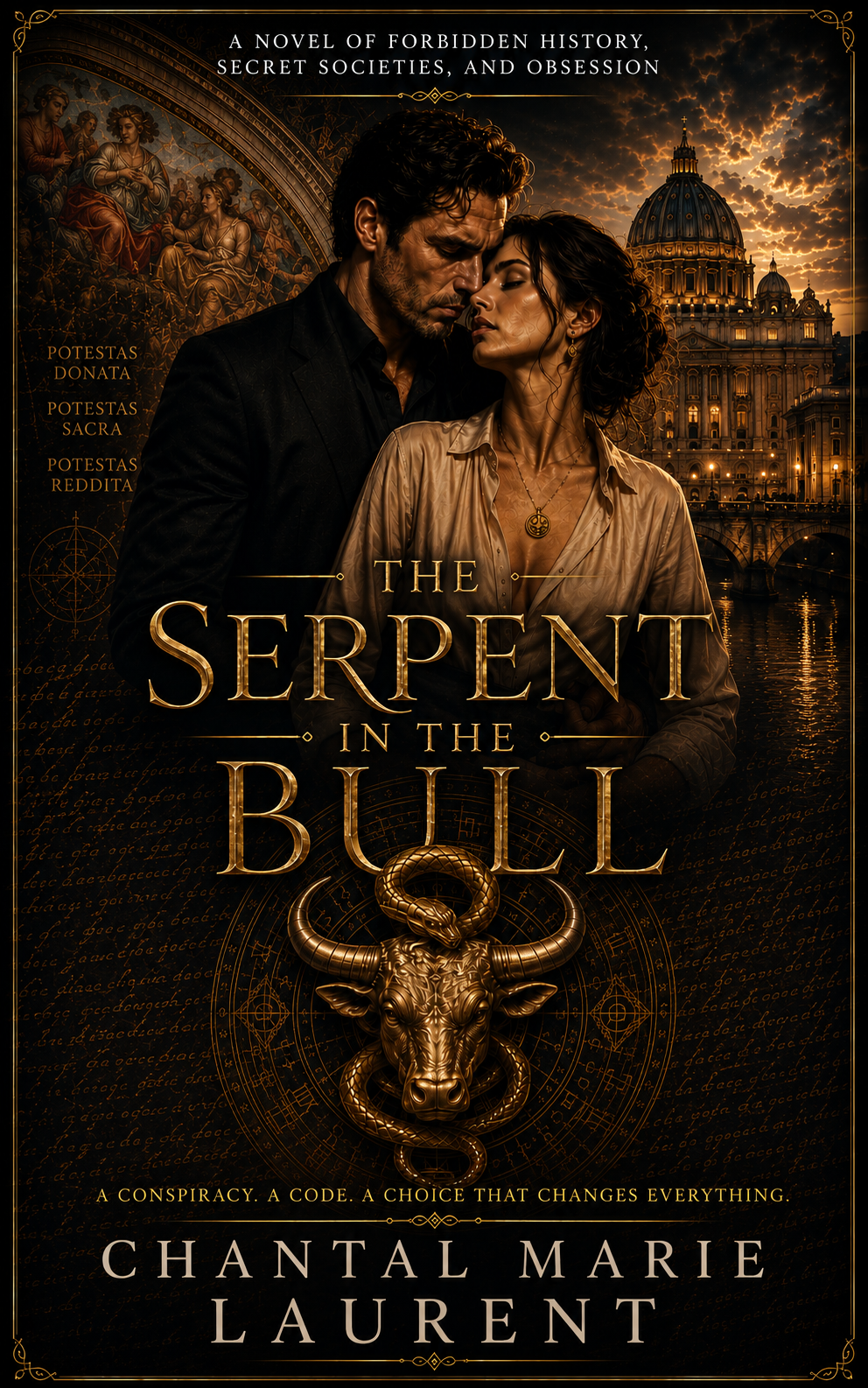
The Serpent in the Bull
by Chantal Marie Laurent
An ancient code hidden in Vatican frescoes. A secret society guarding a five-hundred-year-old lie. And a dangerous alliance that will force two people to redefine power, trust, and surrender. Dr. Alessia Neroni came to Rome to study Renaissance history—not to become part of it. But when an unauthorized ultraviolet examination of Pinturicchio’s frescoes in the Borgia Apartments reveals a hidden cipher, she uncovers evidence of a manuscript connected to Pope Alexander VI and a doctrine the Vatican was never meant to acknowledge. Before she can understand what she has found, the palace locks down. Her only way out is Matthias Varenne, billionaire technology magnate and Custode Primo of the secret society that has protected the manuscript—and distorted its meaning—for generations. Matthias is accustomed to control. Alessia refuses to give him any. Forced into a relentless forty-eight-hour race through Vatican passages, hidden archives, Renaissance palazzi, and secluded Tuscan estates, they must decode a text powerful factions are willing to kill to possess. But the closer Alessia comes to the truth, the more she discovers that the manuscript’s most dangerous secret may not be what it teaches about dominance— but what it reveals about consent, chosen surrender, and the power that must ultimately be returned. And buried inside that truth is the answer to the death of Matthias’s sister. The Serpent in the Bull is a sensual conspiracy thriller of forbidden history, secret societies, psychological power, and slow-burning obsession by Chantal Marie Laurent.
- Mystery
- Erotica
- Historical Fiction
- Romance
- Historical Mystery
- Contemporary Romance
The Serpent in the Bull
The woman in the fresco was looking at her.
Dr. Alessia Neroni knew how absurd that sounded.
She also knew she was right.
At 11:47 p.m., alone inside the Borgia Apartments of the Apostolic Palace, Alessia stood beneath Pinturicchio's painted heavens with one hand wrapped around a stolen ultraviolet lamp and the other pressed against a section of fifteenth-century plaster no living curator was supposed to touch.
Above her, saints, prophets, sibyls, monsters, bulls, and pagan gods floated in impossible color.
Gold leaf shimmered under the narrow beam.
The air smelled of old stone, wax, and the faint mineral damp that seeped into buildings older than nations.
And the painted woman watched her.
Not metaphorically.
Her eyes had been altered.
Alessia raised the ultraviolet lamp another inch.
There.
A second pigment beneath the visible one.
Almost invisible.
Almost.
"Madonna mia."
The figure appeared in the Hall of the Mysteries, tucked among imagery scholars had catalogued for centuries. Pinturicchio and his workshop had filled the Borgia rooms with theological spectacle for Pope Alexander VI—Rodrigo Borgia, Spanish outsider, political predator, father of notorious children, and perhaps the most extravagantly condemned pontiff in Western memory.
But no catalogue Alessia had ever read mentioned this.
Beneath the woman's painted iris was a symbol.
A circle.
Bisected vertically.
With three short strokes beneath it.
She had seen it before.
Three hours ago.
On a fragment of parchment that officially did not exist.
Alessia reached into the inside pocket of her jacket and removed her phone.
No signal.
Of course.
The Vatican's interior could swallow modern technology as effectively as it swallowed secrets.
She photographed the symbol anyway.
The shutter made no sound.
She had disabled it before entering.
Not that she was supposed to be here.
Technically, she had authorization to examine restoration photographs until nine.
Technically, the apartments had closed long ago.
Technically, the security door behind her should not have locked itself.
That had happened four minutes earlier.
Alessia moved the ultraviolet beam across the fresco's surface, following the woman's gaze toward the adjacent wall. The Hall of the Mysteries was the smallest of the Borgia rooms, an intimate chamber where Alexander VI had once received private visitors. Pinturicchio had woven saints and Egyptian mythology—Isis, Osiris, Apis the bull—into the syncretic visual language Renaissance humanists had loved and the Counter-Reformation had tried to forget.
She had been studying these rooms for two years.
She had published three articles on Pinturicchio's iconographic program.
She had never seen what she was seeing now.
The ultraviolet light revealed a second layer of imagery hidden beneath the visible paint. Not pentimenti—the artist's corrections—but deliberate concealment. Someone had painted symbols into the frescoes, then covered them with pigments that appeared identical to the naked eye but fluoresced differently under UV.
The technology had not existed in 1492.
But the intention had.
Alessia followed the hidden marks across the wall. They formed a pattern. A sequence. The woman's altered gaze pointed toward a bull. The bull's horn aligned with a serpent. The serpent's tail curved toward a second figure—a sibyl holding a scroll.
And beneath the sibyl's feet, painted so faintly that Alessia almost missed it, was another symbol.
Two serpents intertwined in a circle, their bodies crossing to form a knot that appeared both bound and open.
She had seen it on the parchment fragment Father Matteo Bellori had shown her that afternoon in the Vatican Secret Archives. He had not explained where it came from. He had not explained why he was showing it to her. He had simply placed the fragment on the table between them and asked:
"Do you recognize this script?"
Alessia had recognized it.
Pre-Latin Italic.
Possibly Sabine.
Possibly older.
The kind of text that appeared in fragments, never complete documents, and drove paleographers to despair because there were no grammars, no dictionaries, no Rosetta Stones to unlock the language.
But she had seen enough to identify patterns.
And the parchment had contained a phrase she could translate.
Potestas donata, potestas sacra, potestas reddita.
Power donated, power sacred, power returned.
Father Bellori had watched her write the translation.
Then he had taken the fragment back.
"If I told you this text was hidden in plain sight," he had said, "where would you look?"
Alessia had understood immediately.
The Borgia Apartments.
Alexander VI's private rooms.
The one place in the Vatican where a Spanish pope with a taste for pagan imagery and dangerous ideas could have concealed something the Church would never officially acknowledge.
She had returned after hours with a borrowed UV lamp and a security pass that should not have worked.
It had worked.
The door had opened.
And then it had locked behind her.
Now, standing beneath the intertwined serpents, Alessia wondered whether Father Bellori had known exactly what she would find.
Whether he had wanted her to find it.
And whether that made him an ally or something else entirely.
Alessia lowered the lamp and turned toward the entrance.
The Hall of the Mysteries had two doors. One led back toward the public galleries. The other opened onto a narrow service corridor used by restoration staff.
Both were closed.
She crossed to the main door and tested the handle.
Locked.
She tried the service entrance.
Also locked.
Her pulse kicked up.
Not panic.
Not yet.
But the first cold edge of it.
She pulled out her phone again and checked for a signal.
Nothing.
The Vatican's stone walls were three feet thick in places. She would need to reach a window or an exterior courtyard to get a signal.
The Hall of the Mysteries had no windows.
Alessia returned to the center of the room and looked up at the frescoes.
The painted woman still watched her.
And now Alessia understood why.
The woman was not looking at her.
She was looking at the door.
Warning her.
Or marking her.
Alessia turned slowly, scanning the room.
The frescoes covered every surface—walls, ceiling, lunettes above the doors. Gold leaf glinted in the UV light. Shadows pooled in the corners where the beam did not reach.
And in one of those shadows, something moved.
Alessia froze.
A figure stepped out of the darkness near the service entrance.
Tall.
Male.
Dressed in black.
He moved with the kind of economy that came from training or wealth or both—the certainty of someone who had never needed to justify his presence anywhere.
Alessia's hand tightened on the UV lamp.
Not a weapon.
But the only thing she had.
The man stopped three meters away.
Close enough to speak.
Far enough to avoid immediate threat.
His face resolved in the dim light: sharp features, dark hair, eyes that reflected no warmth. Late thirties, perhaps. The kind of face that aged slowly because it had never been soft.
He looked at her the way a curator looked at a painting.
Assessing.
Cataloguing.
Deciding what it was worth.
When he spoke, his voice carried the faint flatness of someone who had learned English as a second language and spoken it so long that the accent had worn away to almost nothing.
"Dr. Neroni."
Not a question.
Alessia did not move.
"You know my name."
"I know a great deal about you."
He took another step forward.
Alessia raised the UV lamp.
"Stay where you are."
He stopped.
But he did not look concerned.
"You are trespassing," he said.
"So are you."
"No."
The single word carried absolute certainty.
"I have authorization to be here," Alessia said. "Father Bellori arranged access for my research."
"Father Bellori arranged for you to examine restoration photographs in the archive. He did not authorize you to enter the Borgia Apartments after hours with equipment you borrowed without permission."
Alessia's stomach dropped.
He knew.
He knew exactly what she had done.
Which meant he had been watching.
"Who are you?" she asked.
"Someone who would prefer you leave before this becomes complicated."
"The doors are locked."
"Yes."
"You locked them."
"No."
He glanced toward the main entrance, and for the first time, something shifted in his expression.
Not concern.
Calculation.
"We do not have much time," he said.
"Until what?"
"Until the people who locked those doors arrive to see what you found."
Alessia's pulse spiked.
"What are you talking about?"
The man moved toward her—not threatening, but deliberate—and Alessia stepped back instinctively.
He stopped.
Raised both hands.
"I am not going to hurt you," he said. "But you need to listen. You triggered a silent alarm when you used the UV lamp near that fresco. The security system in this section of the palace is not controlled by the Vatican. It is controlled by people who do not want anyone examining those walls too closely."
"What people?"
"The kind who will not ask questions before they act."
Alessia stared at him.
"You're insane."
"I am trying to keep you alive."
His voice did not rise.
Did not sharpen.
It simply stated a fact.
And that was somehow worse than if he had shouted.
Alessia glanced toward the frescoes, then back at him.
"If you're not with them," she said slowly, "then who are you with?"
"That is complicated."
A sound echoed from somewhere beyond the main door.
Footsteps.
Multiple people.
Moving fast.
The man's expression did not change, but his body shifted—weight forward, shoulders loose, ready.
"Do you want to leave this room alive?" he asked.
Alessia hesitated.
Every instinct she had said not to trust him.
But the footsteps were getting closer.
And she had no other options.
"Yes," she said.
"Then turn off that lamp and follow me. Do not speak. Do not run. Do not touch anything."
He moved toward the service entrance without waiting for her answer.
Alessia switched off the UV lamp.
The room plunged into darkness.
For three seconds, she could not see anything.
Then her eyes adjusted, and she saw him standing beside the service door, one hand pressed flat against the wall.
He was not trying to open it.
He was listening.
Alessia crossed the room as quietly as she could.
When she reached him, he leaned close enough that she could feel his breath against her ear.
"There are two of them in the corridor," he whispered. "They will enter through the main door in approximately ninety seconds. When they do, we go through this one."
"It's locked."
"Not anymore."
He pressed something against the door's electronic lock—a small device she could not see clearly in the darkness—and the mechanism clicked.
The door opened a centimeter.
He held it there.
Waiting.
Alessia's heart hammered against her ribs.
She could hear the footsteps clearly now.
Closer.
Stopping outside the main entrance.
The sound of a key in a lock.
The man beside her moved.
He pulled the service door open and took Alessia's wrist—his grip precise, unyielding—and drew her into the corridor beyond.
The door closed behind them with a soft click.
Darkness.
Complete and absolute.
Alessia could not see her own hand.
But she could feel his fingers around her wrist.
"Do not move," he whispered.
She did not move.
Behind them, through the closed door, she heard voices.
Two men.
Speaking Italian.
One of them said something she could not make out.
The other laughed.
Then the voices stopped.
Silence.
Alessia held her breath.
The man's grip tightened slightly.
Not painful.
But deliberate.
A warning.
Or a reassurance.
She could not tell which.
The silence stretched.
Five seconds.
Ten.
Then the voices resumed, fainter now, moving away.
The man released her wrist.
"They are searching the room," he whispered. "We have thirty seconds before they check this corridor."
"Where are we going?"
"Somewhere they will not follow."
He took her hand this time—his fingers threading through hers with the same precision—and pulled her forward into the darkness.
Alessia had no choice but to follow.
The corridor was narrow and unlit. She could feel the walls on either side, close enough to touch. The floor was uneven—old stone, worn smooth by centuries of feet.
They moved quickly but not recklessly.
He knew where he was going.
After twenty meters, the corridor turned.
After another ten, it opened into a wider space.
The man stopped.
Released her hand.
Alessia heard the sound of a door opening.
Then light—dim, but after the absolute darkness, it felt blinding.
She blinked.
They were standing in a small vestibule. Stone walls. A single electric sconce casting yellow light. A wooden door ahead of them, old and iron-banded.
The man closed the door they had come through and locked it.
Then he turned to face her.
In the light, Alessia could see him clearly for the first time.
He was younger than she had thought. Late thirties, perhaps. His face was angular, controlled, and utterly unreadable. His eyes were dark—not brown, but something deeper, almost black—and they watched her with the same assessing intensity she had seen in the Hall of the Mysteries.
He wore black trousers, a black shirt, and a wool coat that looked expensive in the way expensive things did when they were designed not to be noticed.
No jewelry.
No watch.
Nothing that could identify him.
Except—
Alessia's gaze caught on his left hand.
On his fourth finger, he wore a signet ring.
Gold.
Engraved with a symbol she recognized.
Two serpents intertwined in a circle.
Her breath stopped.
The man followed her gaze.
Saw what she was looking at.
He did not smile.
"You are more observant than I expected," he said.
Alessia took a step back.
Her mind raced.
The symbol was not simply something he knew about.
It was something he wore.
Something he claimed.
"You're one of them," she said.
"That depends on your definition of them."
"The people who locked me in that room."
"No."
"The people who hid those symbols in the frescoes."
"No."
"Then who?"
He regarded her for a long moment.
Then he said, very quietly:
"The people who have been protecting what those symbols represent."
Alessia stared at him.
"That's impossible."
"You are standing in a hidden corridor inside the Apostolic Palace, pursued by armed men because you discovered something that was not supposed to exist. Which part of your evening suggests impossibility is a reliable metric?"
He had a point.
Alessia hated that he had a point.
"What do you want?" she asked.
"To understand what Father Bellori showed you."
"Why?"
"Because if he showed you what I think he did, then you are in considerably more danger than you realize."
"From who?"
"From people who believe some knowledge is too dangerous to exist."
His voice was calm.
Reasonable.
And absolutely terrifying.
Alessia's mind raced.
She did not trust him.
But she also did not have a choice.
The men who had entered the Hall of the Mysteries were still somewhere in the palace. She was alone, unarmed, and trapped in a building she did not fully understand with a man who wore the same symbol she had just discovered hidden in a five-hundred-year-old fresco.
She could run.
Or she could listen.
Or she could force him to give her something first.
"Tell me your name," she said.
He hesitated.
For the first time, he looked uncertain.
Then he said:
"Matthias Verenne."
"And what are you protecting, Matthias Laurent?"
"That," he said, "is not a conversation we can have here."
"Then where?"
"Somewhere we can talk without being interrupted."
"I'm not going anywhere with you until you tell me what Father Bellori showed me."
Matthias studied her.
Then he said:
"A parchment fragment. Pre-Latin Italic script. Possibly Sabine. A single phrase."
Alessia's breath caught.
He knew.
He knew exactly what she had seen.
"What did you translate it as?" he asked.
She hesitated.
Then she said:
"Potestas donata, potestas sacra, potestas reddita. Power donated, power sacred, power returned."
Matthias was silent for three seconds.
Then he said:
"You translated reddita as returned."
"Yes."
"Not held."
"No. The verb is reddere, not retinere. Returned, not held."
Another silence.
Longer this time.
When he spoke again, his voice was quieter.
"Father Bellori made a mistake."
"What kind of mistake?"
"The kind that changes everything."
He turned toward the iron-banded door and placed his hand on the latch.
"We need to leave. Now."
"Where are we going?"
"Somewhere we can talk."
"That's not an answer."
"It is the only answer you are going to get until we are out of this building."
Alessia's jaw tightened.
She did not like being told what to do.
She especially did not like being told what to do by a man who wore a five-hundred-year-old secret on his hand and refused to explain what it meant.
But the men searching the Hall of the Mysteries were still out there.
And Matthias Varenne was the only person who seemed to know what was happening.
"If you are lying to me," she said, "I will make sure everyone knows what I found in those frescoes."
"I am not lying to you."
"Then prove it."
"I will. But not here."
He opened the door.
Beyond it, Alessia could see another corridor—this one lit by modern emergency lighting—and a staircase descending into darkness.
Matthias stepped through.
Then he stopped.
Turned back.
Extended his hand.
"Are you coming?"
Alessia looked at his hand.
At the signet ring.
At the symbol that connected him to a secret she had only begun to uncover.
She thought about Father Bellori.
About the parchment fragment.
About the hidden cipher in the frescoes.
About the men searching the Hall of the Mysteries.
And she thought about the phrase she had translated.
Power donated, power sacred, power returned.
Not held.
Returned.
She did not take his hand.
She stepped past him into the corridor.
"I'm not following you," she said. "I'm choosing the same direction."
Matthias looked at her.
And for the first time, something shifted in his face.
Not warmth.
Not kindness.
But something closer to respect.
"Good," he said.
And he led her into the darkness.
After Hours
The staircase was narrower than Alessia expected. Stone treads worn concave by centuries of use dropped in a tight spiral, the walls sweating with cold. She kept one hand on the plaster and the other on the notebook in her jacket. Matthias went first, his coat brushing the curve of the well. Behind them, somewhere above the iron-banded door they ha…