

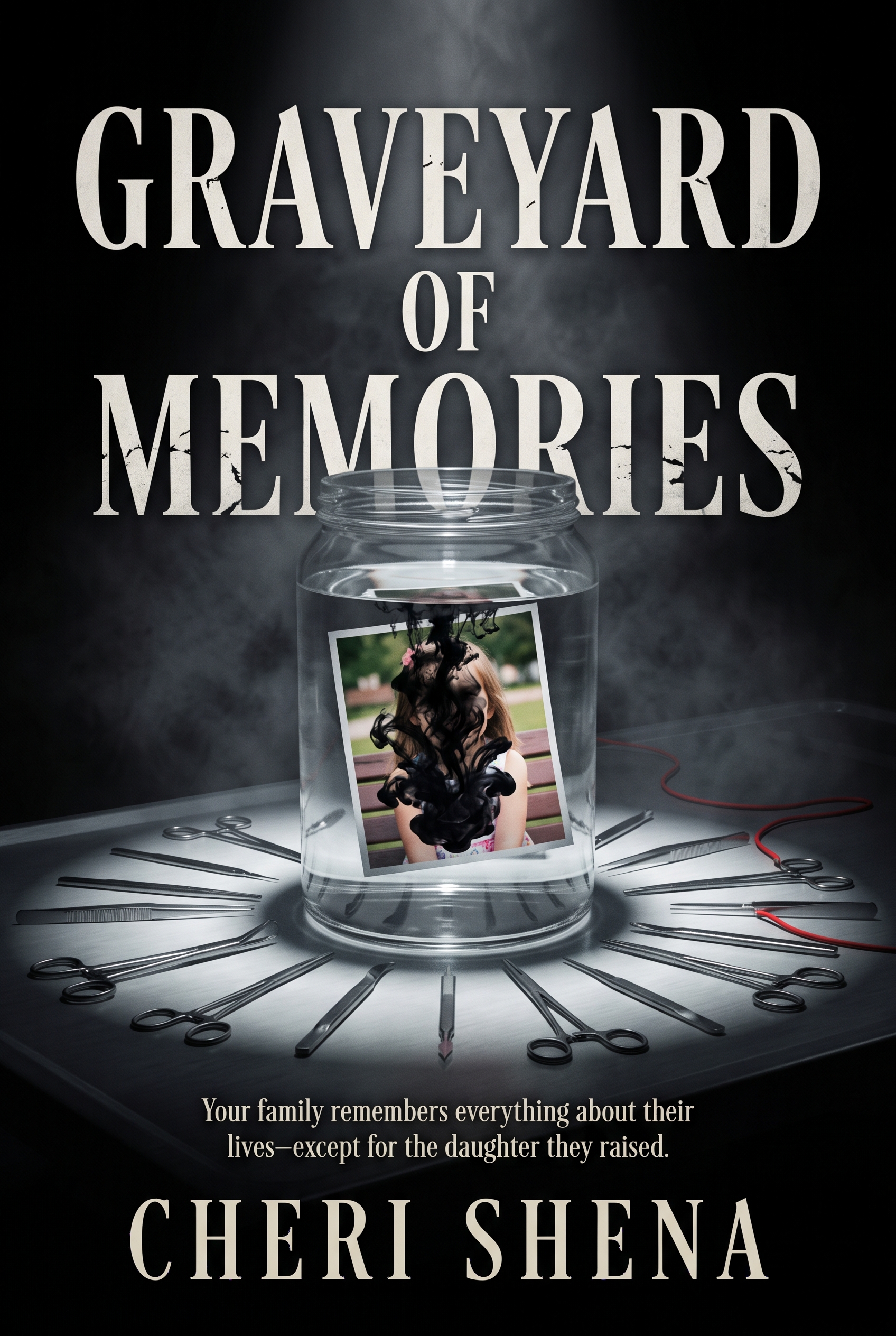
Graveyard of Memories
Your family remembers everything about their lives—except for the daughter they raised.
by Cheri Shena
Home is where they have to take you in. But what if they don't even know who you are? Rebecca Sterling returned from a summer internship expecting a warm welcome. Instead, she found a nightmare. Her parents look at her with the cold eyes of strangers. Her bedroom is a guest suite. Her face has been digitally scrubbed from every family portrait, and her digital footprint has vanished into thin air. She hasn't just been replaced; she’s been erased. Hunted by a shadow security firm and desperate for answers, Rebecca finds an unlikely ally in Daniel Taylor, a disgraced detective chasing a suppressed murder case. Together, they uncover the chilling existence of The Mnemonic Group, a corporation specializing in the high-tech theft of memory. As Rebecca digs into the basement of her own home, she discovers that her existence was the price of her father’s darkest secret. To reclaim her name, she must navigate a web of neuro-chemical conspiracies and corporate assassins. In a world where your own mother can’t remember your name, the truth is more than a memory—it’s a weapon. And Rebecca is ready to strike back. A pulse-pounding psychological thriller with a twist that will leave you breathless, Graveyard of Memories explores the terrifying possibility of being a ghost in your own life.
- Thriller
- Psychological Thriller
- Crime Thriller
- Action Thriller
- Conspiracy Thriller
The Stranger in the Mirror
The bus exhaled a cloud of diesel behind her then pulled away, and Rebecca Sterling stood alone on the corner of Willowbrook Lane with her suitcase wheels sinking into a patch of grass she'd once tripped over as a kid, chasing a soccer ball into the Hendersons' yard. Three months. Ninety-two days, if she was being precise, and she liked being precise. Ninety-two days of humid Georgia mornings and lab coffee that tasted like burnt rubber, and now she was home, and home smelled the way it always had in late September, cut grass and somebody's charcoal grill three houses down.
She should have felt something like relief. Instead there was a low hum under her sternum, the kind she got before a big test, except there was no test. There was just a street she'd known her whole life, looking exactly the way it always looked, which for some reason unsettled her more than if it had changed.
The Whitmores' hydrangeas were still blue and overgrown. The Petersons' basketball hoop still hung crooked over their garage door. And her house, the big colonial with the wraparound porch her father had been so proud of, sat at the end of the cul-de-sac looking freshly painted, the shutters a crisp navy against white siding, the lawn cut into those perfect diagonal stripes her dad paid a service to make even though he could have used a push mower himself in half the time.
Rebecca dragged her suitcase up the driveway, the wheels clattering over hairline cracks in the concrete she knew by heart, and told herself the tight feeling in her chest was nothing but travel exhaustion. She'd been awake since four a.m. She'd eaten a granola bar and half a warm bottle of water for breakfast. Of course she felt strange. Anyone would.
The porch light wasn't on yet, though the sun was starting to bleed orange behind the Kowalski place across the street, and the whole neighborhood had that hushed, golden quality it got in the last hour before dark, like the world was holding its breath. She dug her key out of the zippered pocket of her backpack, the same brass key she'd carried since she was fourteen, worn smooth at the edges from years in her palm, and slid it into the lock.
It turned. And then it stopped, hard, against something that wasn't supposed to be there.
She frowned and tried again, jiggling it the way you do when you're sure it's just a fluke, just old age in the mechanism, and got the same dead stop. The deadbolt. Someone had thrown the internal deadbolt, the one they only used at night, the one her mother was religious about after the Ferrara house three streets over got broken into back when Rebecca was in middle school.
She knocked. Three sharp raps, the same rhythm she'd used a thousand times when she forgot her key or had her hands full of grocery bags.
Footsteps. Measured, unhurried, the sound of dress shoes on hardwood, and something in her chest loosened at the familiarity of it, because she knew that gait, knew the particular weight of her father's step even through a door.
The door opened on the security chain first, a thin brass line stretched taut, and one eye and a slice of her father's face appeared in the gap. Grant Sterling. Salt-and-pepper hair combed the way it always was, the same rectangular jaw, the same tired blue eyes, and for one full second Rebecca smiled, because there he was, and she was home, and the strange hollow feeling in her chest could finally let go.
"Dad. Hi. Sorry, the key's doing something weird, can you—"
"Can I help you with something?"
The words landed wrong. Not unkind, exactly. Worse than unkind. Polite. The tone he used with delivery drivers and door-to-door solicitors and the kid who mowed the lawn when he forgot to leave cash out.
Rebecca laughed, a short, confused bark of a sound. "Dad, it's me. Open the door, I've been on a bus since six this morning and I really have to pee."
He didn't move. His eyes tracked over her face with the flat, careful attention of a man reading a stranger's driver's license, checking it against a description someone had given him. There was no recognition in it. No flicker of anything. Just a kind of clinical patience, the look you'd give someone slightly unwell who you didn't want to spook.
"I'm sorry," he said, "I think you have the wrong house."
The words didn't process at first. They just sat there in the air between them, foreign and impossible, like he'd spoken in a language she almost knew but couldn't quite translate fast enough. She actually looked past him at the foyer, at the runner rug on the hardwood, at the small table by the stairs where the family kept a bowl for car keys, and it was all exactly right, exactly as she'd left it, which made the wrongness of his face even harder to hold in her mind at the same time.
"This is 14 Willowbrook Lane," she said, and heard her own voice climbing, thinning out. "This is my house. I'm Rebecca. Dad, it's Rebecca."
Something moved behind him in the hallway, a shape drawing closer, and then her mother was there, one hand braced on the door frame, the other clutching a cordless phone against her chest like a shield. Eleanor Sterling had the same soft brown waves she always wore loose around her shoulders, the same cardigan she practically lived in around the house, cream-colored with pearl buttons, and Rebecca's mind kept insisting, stupidly, that if her mother was here, this could be fixed, her mother would see her and everything would snap back into place the way a dislocated joint slides home with one hard pull.
Eleanor's eyes found her face and something crossed them that wasn't recognition. It was fear. Genuine, animal fear, the kind that made her mother's knuckles go white around the phone.
"Grant." Her mother's voice was a thin thread. "Grant, who is this?"
"She says she lives here." His voice stayed level, almost gentle, the tone of a man narrating a minor inconvenience. "I don't know her."
"Mom." Rebecca's throat had gone tight and hot. "Mom, it's me, it's Rebecca, I just got back from the internship, I texted you from the bus station, I—"
"We don't have a daughter." Eleanor's voice cracked on the word daughter, like the sentence cost her something to say, and she lifted the phone slightly, a small, trembling threat. "I'm going to call the police if you don't leave right now."
The porch tilted underneath Rebecca, or maybe it was just her own legs, gone rubbery and unreliable. She had the sudden, absurd urge to laugh, the kind of laugh that comes right before you cry, because surely this was a joke, some elaborate homecoming prank her father had cooked up, the kind of thing he'd never actually do because Grant Sterling did not do jokes, Grant Sterling budgeted his sense of humor the way he budgeted everything else, in small, careful amounts, reserved for holidays and good news from his stock portfolio.
"This isn't funny," she said, and her voice broke on the last word. "Please, just, let me in, I have my key, I have—"
She stepped forward, meaning only to close the distance, to put her hand on her father's arm the way she had a thousand times, and Grant's hand came up fast and hard against her shoulder and shoved her back off the threshold. Not a slap. Not a punch. Just enough force to send her stumbling off the top step, her suitcase tipping and crashing down the porch stairs ahead of her, and she caught the railing hard enough to bruise her palm.
"We have lived in this house for twenty years," Grant said, and his voice had dropped, gone quiet and even and terrible in its calm. "Just the two of us. There is no daughter. There has never been a daughter. I'd like you to leave the property before I have to involve the authorities."
The door shut. Not a slam, just a firm, decisive click, followed by the deadbolt sliding home with a sound like a gunshot in the quiet street.
Rebecca stood on the cracked concrete path with her palm throbbing and her suitcase on its side and the porch light finally flickering on above her, some automatic sensor triggered by the dusk, and for a long moment she couldn't make her body do anything at all. The neighborhood had gone very still. Somewhere down the block a sprinkler ticked on, hissing across someone's lawn, ordinary and indifferent. She thought, absurdly, of her mother's voice cracking on the word daughter, and how it hadn't sounded like a lie. Liars stumbled or they overcommitted. Eleanor's fear had been raw, unrehearsed, the kind of fear you can't fake convincingly even if you tried, and that was so much worse than if her mother had simply been lying to her.
Rebecca's mind, the analytical part of her that had gotten her through advanced organic chemistry and every gymnastics meet where her body wanted to quit before her brain did, tried to assemble the pieces into something that made sense. Maybe it was early-onset dementia. Maybe her father had suffered a stroke and it had scrambled something. Maybe this was a mass hallucination, and she was the one who'd had the break, standing on a stranger's porch insisting she belonged there.
She looked down the street to steady herself, to find something solid and unchanged to anchor to, and that was when she saw it.
A black SUV, windows tinted dark enough to swallow light, idled at the end of the cul-de-sac where the street curved back toward the main road. It hadn't been there when she'd walked up. She was almost certain of that. Almost. The engine was running, a low, patient rumble, exhaust curling faintly in the cooling evening air, and though she couldn't see a face behind the glass, she felt the weight of eyes on her, the particular pressure of being watched by someone who wasn't in any hurry to stop.
Her pulse kicked hard against her throat. She told herself it was nothing, a neighbor's guest, a delivery driver checking an address, and even as she thought it she knew she didn't believe it, because the vehicle didn't move, didn't pull into a driveway, didn't do anything a normal car would do. It just sat there, engine humming, watching her fall apart on her own front lawn.
She fumbled the key out of her pocket again with fingers that had started to shake, some small, stubborn part of her insisting she must have tried it wrong the first time, that this was fixable, that there was a rational explanation waiting just behind the panic if she could only stay calm enough to find it. She slid the key toward the lock.
It didn't fit. Not stuck this time. Not caught on the deadbolt. The metal simply refused the shape of the mechanism, the teeth wrong, the whole key foreign in her hand, and she stood there under the porch light jamming a piece of brass into a lock that had somehow, impossibly, in the span of a single afternoon, stopped being hers.
Behind her, down at the end of the street, the SUV's engine revved once, low and deliberate, like something clearing its throat.
Deleted History
Rebecca ran until her lungs burned and the porch light was a small orange smear behind her, and then she made herself stop, because running looked like guilt, and guilt got you noticed. She walked the last three blocks to Grover Street with her suitcase wheels clattering against the sidewalk like a second heartbeat, and by the time she pushed throu…