

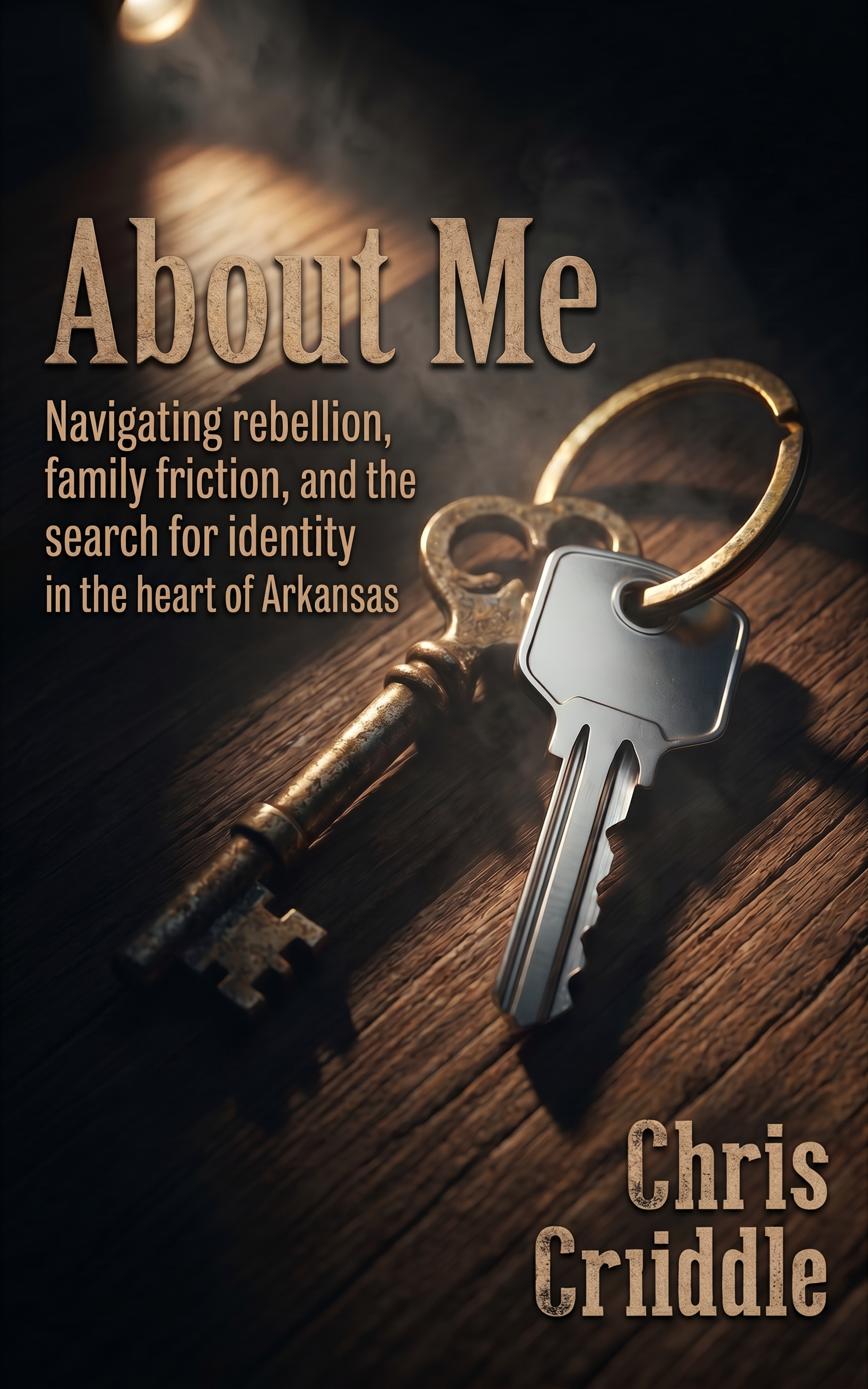
About Me
Navigating rebellion, family friction, and the search for identity in the heart of Arkansas
Sharing a name with your father is a heavy burden when you are still trying to find your own voice. In 'About Me', Christopher Shane Criddle Jr. pulls back the curtain on a life defined by fire, friction, and the fight for independence. Starting with the literal ashes of a childhood home in Little Rock and moving into the complex social landscape of Benton, this is a raw, unvarnished look at growing up in the modern South. From the thrill of sneaking out into the night to the quiet haze of finding solace in cannabis, Chris explores the edges of rebellion with unflinching honesty. He details the highs and lows of his time in the public school system, the weight of family expectations, and the unexpected mentorship found while working at a local Walmart. It is a story of a young man caught between the person his family wants him to be and the adult he is actually becoming. At eighteen, Chris is done living in shadows. This memoir is an invitation to witness the messy, beautiful process of self-discovery. It is about making mistakes, owning your choices, and finally stepping into the light as your own man.
- My Life
Inheriting the Name
The living room was quiet, the kind of heavy quiet where you can hear the dust settling on the old television set and the hum of the refrigerator from the kitchen. My father sat in his usual chair, his eyes fixed on some show that neither of us was really watching. I sat on the couch across from him, just a kid trying to figure out where I fit in a world that already seemed to have all the answers mapped out for me. That was the moment it really hit me. I looked at him, then I thought about myself, and I realized my name was not just my own. It belonged to the man sitting right there, breathing the same air, occupying the same space, and carrying the same history. I was Christopher Shane Criddle Jr., and in a small town in Arkansas, that name carried a weight I never asked to carry.
Growing up as a junior is a strange kind of existence. You are born into a world where your identity is already pre-packaged and labeled. You do not get to start with a blank slate. Instead, you get a name that has already been used, tested, and established by someone else. In Little Rock, and later in Benton, everyone knew my father. When people heard my name, they did not see me, a kid just trying to navigate school and life. They saw him. They looked at my face to see if I had his eyes, they watched my walk to see if I had his posture, and they listened to my voice to see if I sounded like him. I was not just a kid; I was a second edition. It felt like my life was a sequel before the first movie even started, and that is a tough way to begin your journey.
The struggle was silent, but it was always there, bubbling right beneath the surface. There was this constant, unspoken pressure to mirror my father’s choices. People expected me to like the things he liked, to react the way he reacted, and to follow the path he had already carved out. It was like living in a shadow that grew longer every single day. I remember looking at my hands and wondering if they would look exactly like his when I got older. I wondered if I was destined to make the same mistakes, have the same temper, and live the same life. The early realization that I wanted something different was terrifying because it felt like a betrayal. To want a different life meant rejecting the name, and rejecting the name felt like rejecting my family.
We lived in a small townhouse in Little Rock back then, before the fire happened and we had to pack up and move down to Benton. Even in that small space, the presence of my father’s name was huge. It was on the mail on the counter, it was spoken by the neighbors, and it was echoed every time my mother called out for one of us. I used to think about what it would be like to just be Chris, without the suffix, without the baggage. But in our house, you could not escape it. The pressure was not always loud or angry. Sometimes it was just a quiet expectation, a nod of approval when I did something that reminded them of him, or a look of disappointment when I showed a side of myself that was entirely my own. It made me feel like an imposter in my own body, like I was wearing clothes that were tailored for someone else and trying to pretend they fit perfectly.
The turning point came during a family gathering. The house was packed with relatives, the smell of food filled the air, and the noise of laughter and overlapping conversations was deafening. I was standing near the kitchen, trying to blend into the background, when an uncle called out our name from across the crowded room. He just yelled, "Christopher!" instantly, without thinking, both my father and I turned our heads and answered. We both said, "Yeah?" at the exact same time. The room went quiet for a second, and then everyone laughed. They thought it was funny, just a classic father-and-son moment. But to me, it felt like a punch to the stomach. It highlighted the complete lack of an individual identity. In that moment, I realized that when people spoke my name, they were not calling out to me. They were calling out to a collective concept, a shared label where I was just the copy. I was the junior, the footnote at the end of his page.
That moment stayed with me, rotting in my head as I grew older. It was the spark that started my rebellion. If my name was not truly mine, then I had to find other ways to make myself real. When we moved to Benton, I started finding my own ways to cope with the weight. I started going to Benton Public Schools, and while I liked some of the staff, like Ms. Graham, who was a real one, I felt out of place. I started going to the bathroom a lot during the school day, pulling out my nicotine vape to make the hours go by faster. It was a small, stupid rebellion, but it was mine. It was something my father did not do, something that belonged entirely to my own secret world. Sure, it got me out-of-school suspension more times than I care to admit, but it was a way of saying, "I am here, and I am making my own choices, even if they are bad ones." I made sure my name was on that diploma when I graduated, and when I looked at it, I wanted to ensure it represented my struggle, not just his legacy.
Looking back on it now as an eighteen-year-old, I can see how much I hated being a junior. It was a quiet resentment that poisoned a lot of my younger years. You want to believe you are unique, that you are the main character of your own story. But when you share a name with the man who brought you into the world, you feel like a supporting actor in his biography. I spent so much time trying to run away from that name, trying to find a version of myself that did not have his stamp on it. I wanted to be my own person, to have my own thoughts, and to make my own path, even if that path involved working at Walmart for nearly three years and finding comfort in cannabis to calm my racing mind. At eighteen, you start to see things a little differently. You start to realize that the anger you carried was just a shield to protect your own fragile sense of self.
I started finding solace in small, simple ways. I began using nicknames, asking friends to call me by variations of my name that felt more like me and less like my dad. I started emphasizing the things that made us different rather than the things that made us the same. I realized that finding peace did not mean changing my name legally or running away to a place where nobody knew my family. It meant realizing that a name is just a label, not a destiny. My name is Christopher Shane Criddle Jr., but the "Jr." is just letters on a birth certificate. It does not dictate how I talk, how I treat people, or what I want to do with my life. I can still respect my father and learn from him, while also building a completely separate life for myself.
Working at Walmart has actually helped me understand this. I have been there for two years and nine months now. My mentor, Toby, who was my team lead for my first two years, taught me so much about how to handle people and how to lead. He knows everything about the company, and he knows how to talk to people without micro-managing them. Seeing how Toby operates made me realize that leadership and identity are things you build through your actions, not things you inherit. I want to go into management eventually, and when I get there, it will be because of the work I put in and the skills I developed, not because of the name on my name tag. I am building my own reputation, block by block, in a place where my father’s shadow does not reach.
To help process these feelings, I often think about the differences and similarities that define us. It helps to put things into perspective. Here are a few exercises and reflection points that helped me figure out where my father ends and where I begin:
Identity Exercises
- Write down three traits you share with your namesake and three traits that are uniquely yours. This helps you see that while you share a connection, you are still an individual. For me, I might share my father's stubbornness, but my drive to lead in my own way and my creative outlet through writing are entirely mine.
- Create a personal mission statement that does not mention your family or your past. Focus entirely on what you want to achieve in the next five years based on your own values. My goal is to move into management and master the art of leading people without micro-managing them, just like Toby taught me.
- Identify one small act of self-expression that is completely independent of your family's expectations. It could be a hobby, a style of dress, or even a personal habit. For me, it was finding my own rhythm in my work and my personal life, separate from the expectations of the household I grew up in.
Key Takeaways
- Identity is built, not inherited. You are the architect of your own character, regardless of the name you were given at birth.
- Sharing a name does not mean sharing a life path. You can honor your family while choosing a completely different destination for your life.
- Small acts of rebellion can be the start of self-discovery. Even the mistakes we make are part of finding out who we really are when the noise of everyone else's expectations fades away.
Reflection Questions
- How does your family name or family reputation influence your current sense of self?
- Have you ever felt like you were living in someone else's shadow, and what did you do to step out of it?
- What does it mean to truly own your identity when your environment is constantly trying to define it for you?
I am still figuring things out, and I do not have all the answers. But I know that I am no longer angry about the name. It is a part of my story, but it is not the whole book. I am Christopher Shane Criddle Jr., and I am finally okay with that, because I know the person living behind the name is entirely me.
Smoke and Ashes: Little Rock Roots
The memory is not like a movie you can just play from start to finish. It is more like a collection of polaroids that got dropped in water, where the colors are all bled together and the edges are ruined. I was born in July in the year of 2007, and by the time I was old enough to actually start registering the world around me, we were living in a s…