

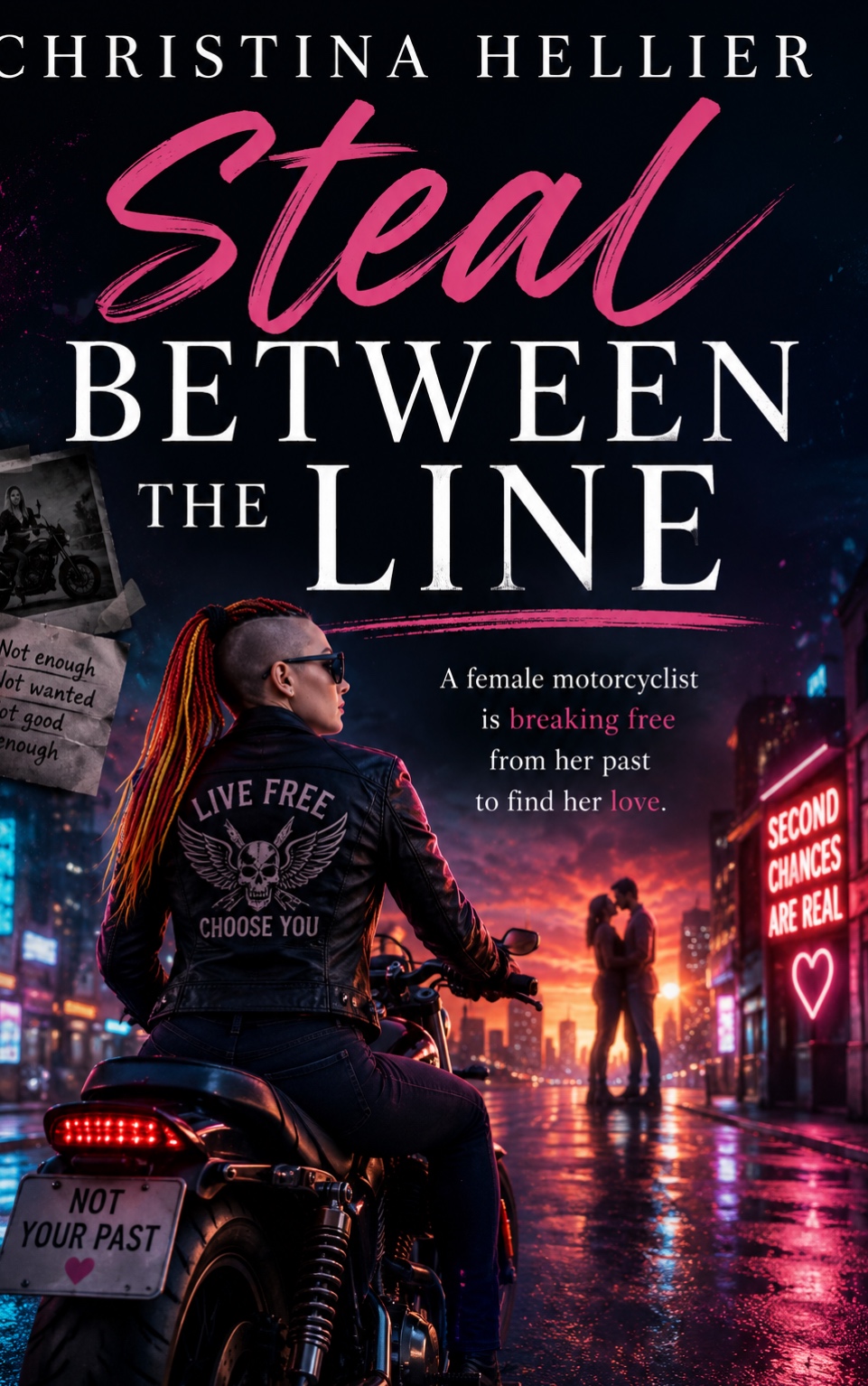
Steel Between the Lines
Finding freedom on the open road and the courage to stop running from the past
Ash Ryder didn’t just leave her life behind; she burned the map. Known on the road as Valkyrie, she’s spent years outrunning the suffocating shadow of an abusive marriage, trading the cage of her past for the roar of a motorcycle engine and the anonymity of the highway. When she pulls into a small-town salvage yard, she isn't looking for a home—she’s looking for parts. But in the quiet strength of Mason “Grim” Calloway, a former combat medic who bears his own invisible scars, Ash finds something she never expected: a man who doesn’t want to tame her fire, but to ride beside it. But the past is a persistent predator. Her ex-husband, Steven, views Ash as property, and he’s spent months tracking her with a cold, corporate precision. As the distance between them closes, Ash must decide if she will twist the throttle and flee once more, or if she’ll finally stand her ground with the help of the found family at Martin’s Roadhouse Café. Steel Between the Lines is a gripping story of survival, the reclamation of identity, and the discovery that home isn't a place you find—it's the person who keeps up with you on the road to freedom.
- Literary Fiction
- Romance
- Thriller
- Identity Journey
- Contemporary Romance
- Women's Fiction
The First Mile of Freedom
The sun hung low over Highway 62, bleeding orange and rust-red across a sky that hadn't seen rain in weeks, and Ash Ryder rode straight into it like she meant to disappear inside the light. Her crimson Harley ate the last few miles of cracked asphalt, engine growling low and steady beneath her, the only voice she'd heard in six hours that didn't come from her own head. Her arms ached. Her thighs ached. Somewhere around mile three hundred her spine had stopped complaining and simply gone numb, which she'd learned to take as a mercy rather than a warning.
She'd left the interstate two hours back, trading the anonymity of eighteen-wheelers and rental sedans for a two-lane road that cut through scrub brush and dead grass, past gas stations with hand-painted signs and houses that looked like they'd been abandoned sometime during the Reagan administration. This was the kind of road that swallowed people whole if they wanted to be swallowed. She wanted that. She wanted a town small enough that nobody would think to look for her here, and ugly enough that nobody would want to stay longer than they had to.
The salvage yard appeared at the edge of a stretch of nowhere, a chain-link fence sagging around acres of dead cars and stripped engines, their metal skin gone dull with rust and time. A hand-lettered sign read MOORE'S SALVAGE & CYCLE in letters that had once been red and were now the color of dried blood. Beyond the fence, stacks of tires rose like crooked totems, and somewhere a dog barked twice and then thought better of it.
Ash cut her engine at the gate and sat for a moment, letting the silence rush in to fill the space the Harley's growl had left behind. Her ears rang faintly. Her braids, red and orange and gold, hung heavy with road dust, the vibrant color muted under a film of highway grit. She peeled off her sunglasses and rubbed at the bridge of her nose, feeling the day settle into her bones like sediment.
She was tired in a way that went past muscle, past mile count. She'd been tired like this for three years now, ever since the morning she'd walked out of a house that had never once felt like hers and gotten on a bike that did. Some days the exhaustion felt like grief. Today it felt like nothing at all, just weather, just a condition of being alive.
A man emerged from the shop at the center of the lot, wiping his hands on a rag that had clearly given up trying to get clean sometime around the Clinton administration. He was big in the way certain men got big from decades of hard labor rather than gyms, a belly that strained against an orange safety vest, forearms like cordwood, a beard shot through with gray that made him look like something between a grizzly bear and a Christmas card. He stopped in the middle of the gravel lot and looked at her the way men in places like this always looked at a woman alone on a motorcycle — like she was a problem he hadn't decided yet whether to solve or ignore.
"We're closed," he said. His voice was gravel dragged over gravel. "Sign's right there."
"I see it." Ash swung her leg over the bike, boots hitting dirt with a solid, grounding thud that she felt travel up through her knees. "I'm not looking to buy anything off the lot."
"Then what are you looking for?"
"A Bendix-Zenith carburetor. Model 289, if you've got it, or close enough I can adapt it. Ninety-eight Softail's been running lean on the left cylinder for four hundred miles and I'm done nursing it."
Something shifted behind the man's eyes. Not quite respect. Not yet. But the wariness eased back a notch, replaced by the specific, narrow attention of a man deciding whether someone standing in front of him actually knew what she was talking about, or had memorized a phrase off a forum somewhere to sound like she did.
"You rebuilding that thing yourself?"
"Since Oklahoma." She nodded toward the Harley, its crimson paint dulled under a layer of dust that couldn't quite hide the care that had gone into every inch of it. "Replaced the fuel lines outside Amarillo. Rewired the taillight in a parking lot in Tucumcari because the wiring harness melted somewhere around the Sonoran border and I didn't trust it to make it another hundred miles without catching."
The man — she assumed this was Moore, given the sign — studied her for a long moment. His eyes moved over her face, over the fading yellow shadow of a bruise along her jaw that three years and a lot of concealer hadn't fully erased, over the tattoos climbing up from beneath her jacket collar, over the braids and the shaved sides of her head and the dust that coated everything like a second skin. She let him look. She'd stopped flinching from being looked at a long time ago. Flinching only told people where to aim.
"Come on, then," he said finally, turning without waiting to see if she'd follow, which told her more about his character than any greeting could have. "Got a bin of old Harley parts in the back. Might have what you need. Might not."
She followed him past rows of gutted trucks and a school bus with a tree growing through its windshield, past shelves of engine blocks arranged with more care than the yard's exterior suggested, into a shop that smelled like motor oil and cut steel and forty years of honest work. The walls were hung with tools she recognized and some she didn't, everything organized by a logic that made sense only to the man who'd built it.
He dug through a bin near the back wall, muttering to himself, tossing aside carburetors that weren't right with the casual disregard of a man who'd handled ten thousand of them and had stopped being precious about any single piece of metal a long time ago. Ash crouched beside him without being asked and started sorting through a second bin, her hands finding the shapes she needed by feel before her eyes had even confirmed them.
"There." She held up a carburetor caked in old grease, turning it in the shop light to check the casting number stamped into its side. "This is a '97, but the throat diameter's close enough I can shim it if you don't have the exact year."
Moore stopped digging and looked at her hand, then at her face, then back at the part. "You know your castings."
"I know my bike." She set the carburetor down on the workbench and wiped her palms on her jeans, leaving twin gray streaks across denim that had already seen worse. "Grandfather taught me on a lawnmower engine when I was nine. Told me a machine never lies to you. It just tells you the truth in a language most people never bother learning."
Something in the old man's face cracked open, just slightly, like a door left ajar. "Smart man."
"He was." She didn't offer anything else, and Moore didn't ask, and that quiet mutual restraint told her more about the rules of this place than any conversation could have. Out here, on roads like this, in yards like this, people didn't ask where you'd come from. They asked if you could pull your weight, and then they decided what you were worth from the answer.
He took the carburetor from her, turned it over twice in his thick hands, and set it on the counter beside an ancient cash register that looked like it hadn't rung up a sale honestly since the eighties. "Twenty for the part. But I'll tell you right now, girl, that thing's gonna need adjusting once you get it mounted. Float level's different on the '97s."
"I figured." She reached for the wallet tucked into her jacket, counting out bills that represented more of her remaining cash than she wanted to admit, even to herself.
"Hold up." Moore held up a hand, studying her again, longer this time, the way a man studies a used engine before deciding whether it's worth the labor to fix. "You got somewhere to be tonight?"
The question landed with more weight than its size suggested. Ash felt the old, familiar tightening behind her ribs, the reflexive calculation of how much truth a stranger deserved. "Just the next town."
"Which is forty miles down a road with no lights and no shoulder worth mentioning, and it'll be full dark in twenty minutes." He said it flatly, a statement of fact rather than a warning, though it carried the weight of both. "I got a loft over the shop. Ain't much. Bed, hot plate, a window unit that fights me every August but wins most rounds. I could use a hand around here — inventory's a mess, half the customer bikes waiting on repair are backed up because my knees don't bend the way they used to, and I'm behind on everything a man my age shouldn't still be doing alone."
Ash said nothing. She let the silence stretch, the way she always did when someone offered her something that sounded too easy, waiting to see if a catch would surface underneath it like a shape moving beneath still water.
"I'm not looking for charity," she said finally.
"Didn't offer any." Moore's mouth twitched, the ghost of something that might have become a grin on a less weathered face. "I'm offering labor for a roof. You work the yard, help me catch up on repairs, keep your hands off anything that ain't yours, and you got a place to sleep that locks from the inside. That's the whole deal. No fine print."
She looked past him, out through the open shop door, to where the sky had gone the deep bruised purple of a day finally surrendering to night. Forty miles down a dark road with no shoulder, on a bike running lean on one cylinder, with a body that had spent itself down to the last aching mile. Or a locked room above a stranger's shop, in a town small enough that nobody would think to look, with work to keep her hands busy and her mind quiet.
"How long you need help for?"
"However long it takes to catch up. Week. Month. However long you want to stay, so long as you're pulling weight." He shrugged, a motion that traveled slowly through his broad shoulders. "I don't ask questions I don't need answered, and you don't owe me any explanations. That work for you?"
It worked for her in a way that made her wary of exactly how well it worked, but three years on the road had taught her that some gifts came without hidden costs, that some men wanted nothing more complicated than a fair trade of labor for shelter, and that her survival sometimes depended on recognizing the difference between suspicion that kept her alive and suspicion that would eventually keep her alone forever.
"Deal," she said, and put her hand out.
Moore's grip swallowed hers whole, rough and warm and entirely without the grasping firmness she'd spent years learning to read as a threat. He shook once, businesslike, and let go.
"Loft's around back. Stairs on the outside. Bathroom's down here, so you'll want to plan your trips." He was already turning back toward his workbench, the conversation closed as efficiently as it had opened. "Breakfast's whenever I get up, which is early. You don't have to join me, but the coffee's there if you want it."
"Thank you." The words came out quieter than she meant them to, and Moore didn't acknowledge them beyond a small nod, which she understood to be its own kind of grace. Some people needed to be thanked loudly. This man clearly wasn't one of them.
She wheeled her bike around back, past a stack of rusted rims and a dog that turned out to be an old blue heeler mix who eyed her with the weary suspicion of a creature that had seen a thousand strangers come and go and had learned not to invest hope in any of them. The stairs to the loft were exactly as advertised, exterior, metal, groaning under her boots with a complaint that would announce any visitor from fifty feet away. She noted that with the automatic, practiced part of her mind that never fully switched off anymore, the part that cataloged exits and sightlines and warning systems the way other people noticed decor.
The loft door had a deadbolt, old but solid, and a chain besides. She tested both before she'd even set her bag down, sliding the bolt home, hooking the chain, listening to the particular click of metal on metal that had become, over three years, its own strange kind of lullaby. Only then did she let her shoulders drop.
The room was small, exactly as Moore had promised. A twin bed pushed against one wall, a battered dresser, a hot plate on a counter that had seen better decades, a window unit currently silent and waiting for August to test it again. A single window looked out over the yard, over the rows of dead cars going dark under the last light, and she stood there a moment just breathing, feeling the day's miles settle out of her body like sand through a sieve.
She set her saddlebags on the bed and began, out of habit more than need, the small ritual of unpacking that had become its own form of prayer. Two changes of clothes, worn soft from washing in gas station bathrooms and the occasional kind stranger's laundry machine. A leather-bound journal with a broken spine, its pages full of handwriting that had gotten smaller and more cramped the farther she'd traveled, as though she were trying to fit more truth into less space. A small tin of tools she never let out of arm's reach. And at the bottom, wrapped in an old T-shirt, the burner phone.
She held it for a moment before setting it on the nightstand, feeling its cheap plastic weight, the particular dread it carried despite never having rung once in the six weeks since she'd bought it in a truck stop outside El Paso. It was for emergencies only. She'd promised herself that. A single number programmed into it, a number she'd made herself memorize and then delete twice over, just in case. She didn't know, some days, if the phone was a lifeline or a leash, a tether back to a life she was trying to outrun even in the smallest, most practical ways.
She crossed to the small mirror bolted above the dresser and studied her reflection in the dim light. Dust in her braids, dulling the fire of them. Shadows under her eyes that sleep never quite erased anymore. And along her jaw, faint now, faded to something that could almost pass for an old scar from a bicycle accident if anyone bothered to ask, the mark Steven had left the last time he'd decided her voice was too loud for his liking. She touched it, lightly, the way she sometimes did without meaning to, a habit her fingers had developed independent of her conscious will. Three years. It should have faded from memory the way it had faded from her skin. It hadn't. Some nights she still felt his hand close around her jaw, still heard the particular quiet of his voice right before it happened, quieter than any shout, quieter than anything should have been allowed to sound while still promising violence. Her heartbeat picked up, a familiar climb, adrenaline arriving uninvited the way it always did when memory got too close to the surface. She recognized the pattern by now. The tightness in her chest. The way her hands wanted to shake even though nothing in this room threatened her. The part of her brain that had learned, in a house with beautiful furniture and locked doors that locked from the wrong side, that safety was never something to be trusted, only something to be tested, over and over, until the testing itself became its own exhausting kind of survival. She breathed. In for four. Hold for four. Out for four. A trick a hospital social worker had taught her once, in the weeks right after, when she still flinched at doorbells and couldn't eat in restaurants that had windows facing the street. It didn't fix anything. It never fixed anything. But it gave her hands something to do besides shake, and some nights that was the whole victory available to her. She turned from the mirror before the memory could pull her any further under, and made herself focus on the room instead, on the physical present, on the particular grain of the wood floor and the smell of grease drifting up faintly from the shop below. The floor creaked once, somewhere near the door, and her whole body went rigid before her mind caught up and identified the sound as the building settling, nothing more, an old structure exhaling after a hot day. She stood there anyway, counting her own pulse, waiting to be sure. When her heartbeat finally leveled, she sat on the edge of the thin mattress and pulled off her boots, working slowly, giving her hands something methodical to do. The bed frame wobbled slightly under her weight, one leg shorter than the others, and she filed that away as something to fix tomorrow, a problem small enough and solvable enough to feel almost like a comfort. It was in reaching under the bed to check for anything she might have kicked loose that her fingers found the seam. She almost missed it. The floorboard beneath the bed frame sat slightly proud of the others around it, a hair's width higher, the kind of detail that would mean nothing to anyone not trained by years of living in spaces where details were the only warning system available to her. She knelt on the floor, running her fingertips along the board's edge, and found a groove worn smooth by handling, a place where someone, long ago, had pried the wood up so many times that the edges had gone soft with wear. She worked her fingers into the groove and lifted. The board came free with a small, dry groan, revealing a shallow compartment cut into the floor joists beneath, no more than a foot square, lined with what had once been newspaper and had gone the color of weak tea with age. Inside, rolled and tied with a length of twine gone brittle, were papers. She lifted them out carefully, aware of their age, aware of the particular fragility that old paper acquired after decades of being forgotten. The twine came apart at the first gentle pressure, disintegrating into threads. She unrolled the papers on the bed, smoothing them flat under her palms. Blueprints. Motorcycle blueprints, hand-drawn in ink that had faded to sepia, the draftsman's lettering careful and precise in a way that spoke of pride rather than mere function. She recognized the frame geometry immediately, an old rigid-frame design, decades out of production, the kind of bike that showed up now only in museums or in the private collections of men who understood that some machines were worth more than the sum of their parts. Someone had labeled measurements in the margins in a cramped, confident hand. Someone had circled a modification to the frame's backbone with a note beside it that read, in letters gone soft with age: for the girl. she'll want it lower. Ash sat very still, staring at those four words until they blurred slightly in her vision. She didn't know who had drawn these, or who the girl had been, or whether the bike in question had ever been built at all. But something about finding them here, hidden beneath a floorboard in a room she'd occupied for less than an hour, in a life built entirely out of borrowed rooms and temporary shelters, settled into her chest like a small, unexpected gift. Someone, once, had built something with a woman in mind. Had thought about her comfort, her needs, had adjusted the geometry of steel and rubber to fit a body that wasn't his own. It was such a small thing. It undid something in her anyway, some knot she hadn't realized she'd been carrying since Oklahoma, since Amarillo, since the morning three years ago when she'd first understood that no one was coming to lower anything for her, that if her life was going to fit her better, she'd have to be the one to bend it. She rolled the blueprints carefully and set them on the dresser, deciding she'd ask Moore about them in the morning, when the light was better and her hands weren't quite so unsteady with the strange tenderness the discovery had left behind. She replaced the floorboard, pressing it back into its groove until it sat flush again, though she noted, with the automatic vigilance that never fully switched off, exactly how it lifted and exactly how loud it was when it did, filing the knowledge away the way she filed away every exit, every hiding place, every small mechanism of safety this transient life had taught her to inventory on instinct. Down below, she heard Moore moving through the shop, the particular scrape of a stool being dragged across concrete, the low murmur of a radio tuned to a station playing something with too much steel guitar in it. He hadn't asked her name beyond what she'd offered. Hadn't asked why a woman traveled alone through country like this, hadn't asked about the yellow-faded shadow along her jaw or the way she'd tested both locks before she'd even set down her bag. He'd looked at her, decided something, and let it be enough. She wondered, staring up at the water-stained ceiling, whether he'd guessed. Men who ran salvage yards on lonely highways saw all kinds of people passing through, she imagined. Women running from bad marriages. Men running from worse debts. People running, simply, because staying still had become more dangerous than moving. He hadn't looked at her like a mystery to be solved. He'd looked at her like a fact to be accepted, the way he might accept a stray dog that showed up hungry at his gate, no questions about where it had wandered from, only a bowl set out and a decision made about whether it would stay. She didn't know yet that she was right about the guessing. She didn't know that downstairs, Richard Moore had already clocked the fading bruise and the reflexive way she'd angled her body toward the door the whole time they'd talked, positioning herself so she always had a clear line to the exit, a habit only certain kinds of people carried, and that he'd already decided, in the quiet way of a man who'd seen plenty in fifty-some years of running a yard that attracted every kind of drifter the highway produced, that whatever she was running from was none of his business unless it came looking for her here, in which case it would become very much his business indeed. She didn't know that he'd already resolved, somewhere in the back of his mind while counting out her twenty dollars, to keep whatever she didn't say to herself, the same way he kept the business of half the county to himself, because a man who ran a salvage yard learned early that some secrets were safer buried than dug up, and some people deserved the dignity of not being asked to explain themselves. She only knew, lying in a stranger's bed above a stranger's shop, that for the first time in longer than she wanted to count, no one on earth knew exactly where she was. That thought should have felt like triumph. Some nights it did. Tonight it felt like something closer to grief, a loneliness so total it had its own particular weight, pressing down on her chest in the dark. She missed, absurdly, the sound of another person's breathing in a room. Not Steven's, never his, but someone's, anyone's, some evidence that she wasn't the last woman alive on a planet gone entirely silent. She got up once more before sleep took her, crossed to the door, and checked the deadbolt and the chain a third time, her fingers finding the cool metal and the small, definitive click that told her the world outside couldn't get to her tonight, whatever the world outside happened to be. It was a ritual now, three checks, always three, a number that had become sacred to her sometime during her second year on the road, though she couldn't have said why three felt safer than one or five. The mind built its own strange architecture out of fear, she'd learned. You didn't get to choose the shape of it. You only got to live inside it, and hope, eventually, that the walls might loosen. She lay back down and stared at the ceiling, listening to the shop go quiet below her as Moore finally called it a night, listening to the blue heeler settle with a heavy sigh somewhere near the back door, listening to the vast, star-strung silence of a highway town where nothing moved after dark except the wind through dead grass and the occasional truck passing three miles off, its engine a fading hum swallowed quickly by distance. She thought about the blueprints on the dresser. For the girl. She'll want it lower. She thought about her grandfather's hands guiding hers over a lawnmower engine when she was nine years old, patient in a way her whole family had rarely managed to be about anything else. She thought, though she tried not to, about Steven's hand on her jaw, and the particular quiet of his voice, and the year it had taken her to stop mistaking that quiet for calm. Her hand drifted, unbidden, to her own jaw again, tracing the faint line there in the dark. Three years. The mark had faded almost to nothing. She wondered, not for the first time, whether the parts of her that didn't show on skin would ever fade the same way, or whether some scars simply moved inward once the surface healed, taking up residence somewhere deeper, somewhere she couldn't reach with concealer or time or forward motion at seventy-five miles an hour. Freedom isn't a location, her grandfather used to say, though she suspected now, lying in the dark above a stranger's shop with a phone she never wanted to use next to the bed, that she'd spent three years discovering exactly what he'd meant, one mile and one motel and one hidden compartment beneath one borrowed floor at a time. Somewhere outside, an owl called once, and went quiet. She let her eyes close. Sleep came slowly, the way it always did these days, arriving in pieces rather than all at once, but it came. And for the first night in longer than she wanted to admit, she didn't wake at every sound the old building made settling into its bones. She slept, instead, with the blueprints on the dresser and the burner phone silent on the nightstand and the deadbolt thrown three times against a world that, for tonight at least, had no idea where to find her. Morning would bring grease under her nails and a carburetor waiting to be mounted and a gruff old man who asked no questions she wasn't ready to answer. It would bring, though she couldn't know it yet, the first real anchor she'd found since the morning she'd ridden away from everything Steven Lewis had ever tried to make her. But that was still hours off, still waiting somewhere past the dark window and the quiet yard and the small, stubborn miracle of a woman finally, finally sleeping through the night. For now, there was only the loft, and the silence, and the faint, impossible comfort of four words written in an old man's careful hand: for the girl. she'll want it lower. Somewhere, once, someone had thought to make the world fit her better. It was a small thing. It was enough, for tonight, to let her rest.
Grease and Grim
Three days into her arrangement with Richard Moore, Ash had learned the shop's rhythms the way she'd once learned the sound of Steven's car in the driveway, cataloging every creak and hum until the building's language became as familiar as her own pulse. Mornings started with the coffee maker's death rattle at half past five, followed by Richard's …