

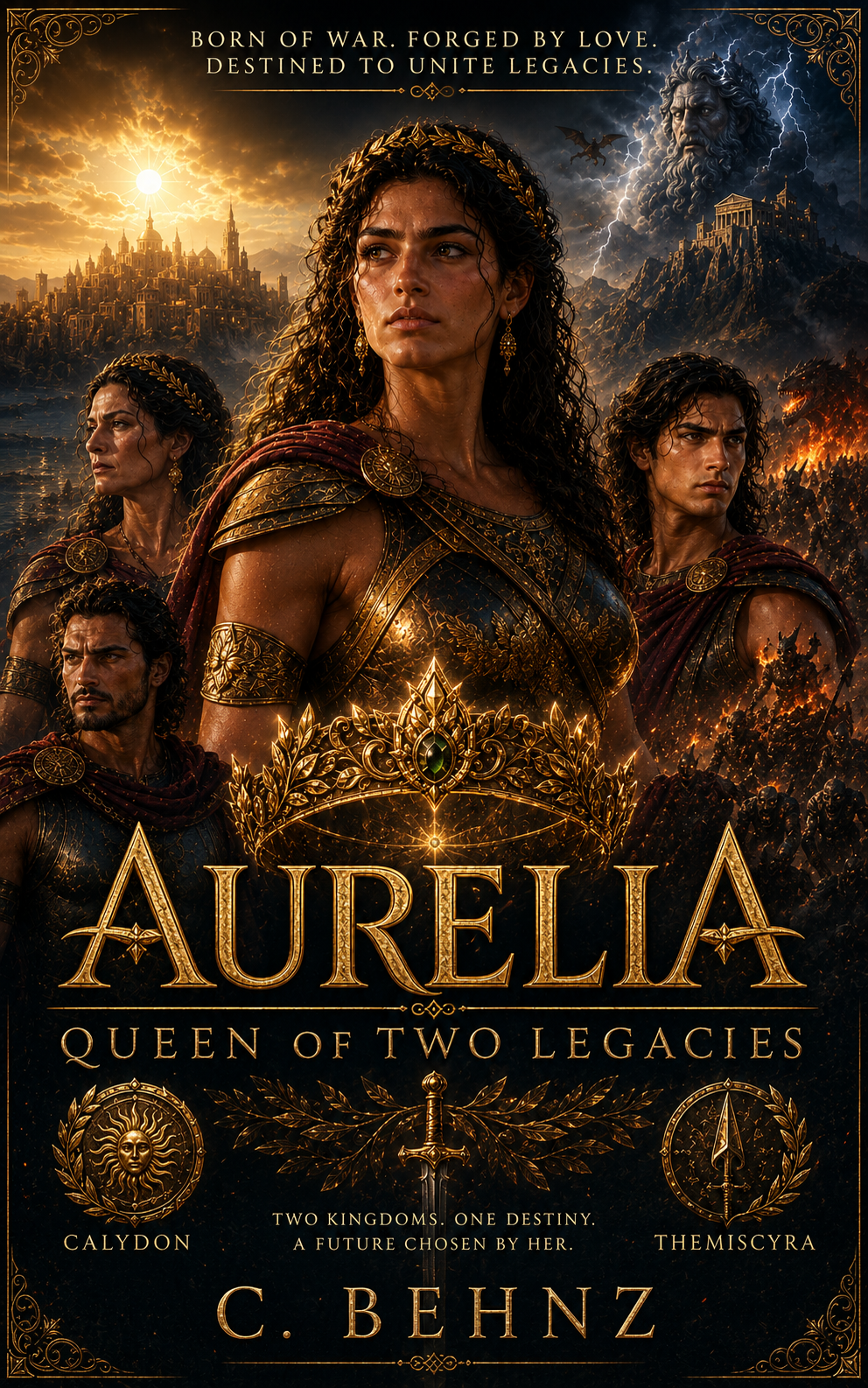
Aurelia: Queen of Two Legacies
A prophecy born in fire, a crown forged in defiance
by Christine Behnz
Seventeen years of uneasy peace teeter on the edge of war. Princess Aurelia, the golden heir of Themiscyra and Calydon, carries the blood of Apollo, Ares, and Hercules. But when the gods proclaim she will either kneel before Olympus or bring it to ruin, her parents defy the heavens themselves. In retaliation, the Children of Echidna rise—monsters thought long extinct. As cities burn, Aurelia must seek the legendary Crown of Unity, the only weapon that can bind divine power. At her side stands Prince Leonidas of Sparta, once her rival, now her reluctant partner. Their search leads them into the Underworld and beyond, where ancient Titans whisper forgotten truths. Their alliance ignites into something deeper, a bond that could reshape mortal and immortal realms alike. Aurelia must decide: fulfill the prophecy of destruction, or forge a new destiny where gods kneel not by force, but by choice. A tale of power, passion, and rebellion against destiny.
- Fantasy
- Adventure
- Romance
- Erotica
- Mythological
- Epic Fantasy
The Golden Shadow
The morning trial had been running for two hours before Aurelia drew blood.
It was not intentional. Thessaly was the best of the elite guard, a warrior fifteen years her senior with hands that moved faster than most opponents could track, and she had pressed Aurelia across the full width of the training ground without yielding an inch. The other Amazons had formed a loose ring around the perimeter, watching in the careful silence of women who had seen enough to know when something significant was happening. The sand was churned dark with the effort of it. Aurelia's shoulders ached. Her lungs had found the deep, burning rhythm that came only at the edge of a fighter's limit, and still Thessaly came forward.
She parried a blow that should have disarmed her, turned the momentum, and drove her elbow toward Thessaly's guard. The counter was clean. The technique was sound. What happened next was neither.
The light came from inside her skin.
It started in her palms, a warm pressure that she felt before she saw it, like sunlight caught beneath water. Then it flooded outward through her veins in lines of gold that traced the length of her arms and disappeared beneath her bracers. The strike landed harder than she had thrown it. Thessaly flew back three full paces, hit the ground rolling, and came up with a shallow cut above her brow where the edge of Aurelia's bracer had caught her on the way down.
The ring of observers went absolutely still.
Aurelia stood with her hands open at her sides, watching the last traces of light fade from her skin. The warmth retreated slowly, like a tide pulling back from the shore, leaving her fingers cold and her pulse loud in her ears. Thessaly touched the cut above her eye, looked at the blood on her fingers, and said nothing. Her expression was not fear. It was something closer to recognition, and that was worse.
"Trial concluded," said the training captain from the edge of the ring, her voice carrying the particular flatness of someone choosing words with care. "You are dismissed."
Aurelia wrapped her hands in silence and did not look at the faces around her as she left the ground.
The high terrace caught the full heat of late morning, its stones pale and warm above the Aegean. Amara was already there when Aurelia arrived, standing with her back to the stairs, her arms crossed and her gaze on the water below. Asterion stood beside her, his posture carrying that particular stillness he adopted when he was holding something in reserve. They had been speaking before she came up the steps. The conversation had stopped.
"You saw it," Aurelia said.
"We were told," Amara said. She turned from the view. Her eyes moved over her daughter with the thorough attention of a woman who had spent a lifetime reading damage in the people she loved. "How long has it been happening?"
"Months. Small flares during heavy exertion. This was the first time it struck another person." Aurelia sat on the low wall at the terrace's edge, her wrapped hands resting on her knees. "I couldn't feel it building. It moved too fast."
Asterion set his hand on the back of his wife's shoulder. "We'll find someone who can train it. There are methods."
"We'll need time to find them," Amara said. The words carried something beneath them that she did not finish. Aurelia watched her mother's jaw tighten and then release, the small control of a woman accustomed to swallowing the things that worried her most.
The light struck without warning.
It came from directly above, a single shaft of radiance that punched through the open air above the terrace with the force of something deliberate. It did not spread. It did not waver. It fell in one clean column to the center of the stone floor and held there, and then the god stepped out of it as though descending a stair.
Apollo was exactly what she had always been told a god would be, and somehow that made him worse. His height was wrong for a mortal man, slightly too tall in a way that only registered after a moment of looking. His face carried no age and no doubt. His hair caught the light the way fire does, from within, and his robes moved without wind. He looked at Aurelia with the unhurried attention of someone examining a possession they have come to reclaim.
"She has grown well," he said. He was not speaking to her. He was speaking to her parents, about her, with the easy possessiveness of a craftsman appraising his own work.
Amara's sword was in her hand before the sentence was finished. The sound of it clearing the scabbard was the sharpest thing on the terrace.
"You will speak to her directly," Amara said, "or you will not speak at all."
Apollo's gaze moved to the blade with a faint, patient amusement, the expression of a man who had not been afraid of a weapon in several thousand years. "Queen Amara. You've kept your fire." He looked at Asterion next. "And you. The boy from the ash citadel. Loyal to the last. Your mentor would have admired it, if you hadn't abandoned him."
"Apollo." Asterion's voice was flat and even. "State your purpose."
The god turned back to Aurelia. She held his gaze and did not look away, though the light around him pressed at the edges of her vision like staring into open sky. The warmth in her palms returned. Faint, but present. She pressed her hands flat against her knees and kept her face still.
"The Fates have spoken," Apollo said. "There is a prophecy known now to every seat on Olympus. Your daughter is a catalyst. The weight of what she carries will unmake the gods or unmake the world. We are offering her safety. Sanctification. A place within Olympus where her power can be contained before she destroys what she does not yet understand."
"You are offering a cage," Aurelia said.
His eyes moved to her with something that shifted behind them, interest sharpening into something colder. "I am offering survival. There are those on Olympus who would prefer a cleaner solution."
"She belongs to no god." Amara stepped forward until she stood between Aurelia and the column of light, her blade level and her shoulders straight. "Not to you. Not to any of them. She is ours."
"She is a prophecy with a heartbeat," Apollo said. The patience in his voice had thinned. "And you are two mortals with drawn steel. Choose carefully."
Asterion moved to stand beside his wife, his hand finding her shoulder in a gesture that was not restraint but alignment, two people taking the same ground. "We have made our choice," he said. "She stays."
Apollo looked at them both for a long moment. The column of light around him intensified until the shadows on the terrace shrank to nothing. Then he smiled, and the smile was the most dangerous thing he had done since arriving.
"Pride," he said, almost gently. "You were always proud, both of you. You taught her well." He glanced at Aurelia one final time. "The price of that pride will be paid in blood and shadow. Remember that I gave you the chance to avoid it."
He stepped back into the light and was gone.
The terrace was ordinary again, its stones warm and its air salt-edged. Aurelia exhaled slowly and became aware that her hands had been shaking. She pressed them flat against her knees until the trembling stopped. Below the terrace walls, the Aegean had changed color. The deep blue had shifted toward something bruised and wrong, a purple that had no place in any sky she had seen before, spreading outward from the horizon in a slow tide. Then the stone beneath her feet shuddered. A low, sustained tremor moved through the palace from the foundations upward, rattling the water in the basins along the wall and sending a long crack across the corner of the terrace floor.
Amara sheathed her sword without looking at it. Her eyes were on the sea.
Aurelia looked at the color spreading across the water and felt the pull in her gut again, the same sensation she had noticed when Apollo's gaze first landed on her. It was not fear. It was something more complicated than that, a connection she had not asked for and did not want, pulling taut like a wire strung between her and a god who had just promised her suffering.
The earthquake stilled. The purple deepened on the horizon.
Amara turned from the railing and looked at her daughter with the expression of a woman who had fought gods before and survived, and who had never once believed that surviving was the same as winning. She said nothing. She did not need to. The three of them stood on the cracked stone while the sea changed below them, and the silence was the kind that comes after a declaration of war.
The Children of Echidna
The northern shore lay quiet beneath a sky the color of old iron. Aurelia walked beside her mother through the coarse sand, her boots sinking with each step. The sea stretched gray and heavy in front of them, the waves rolling in thick and slow. Amara kept one hand near the hilt of her sword, her gaze fixed on the waterline where the first reports …