

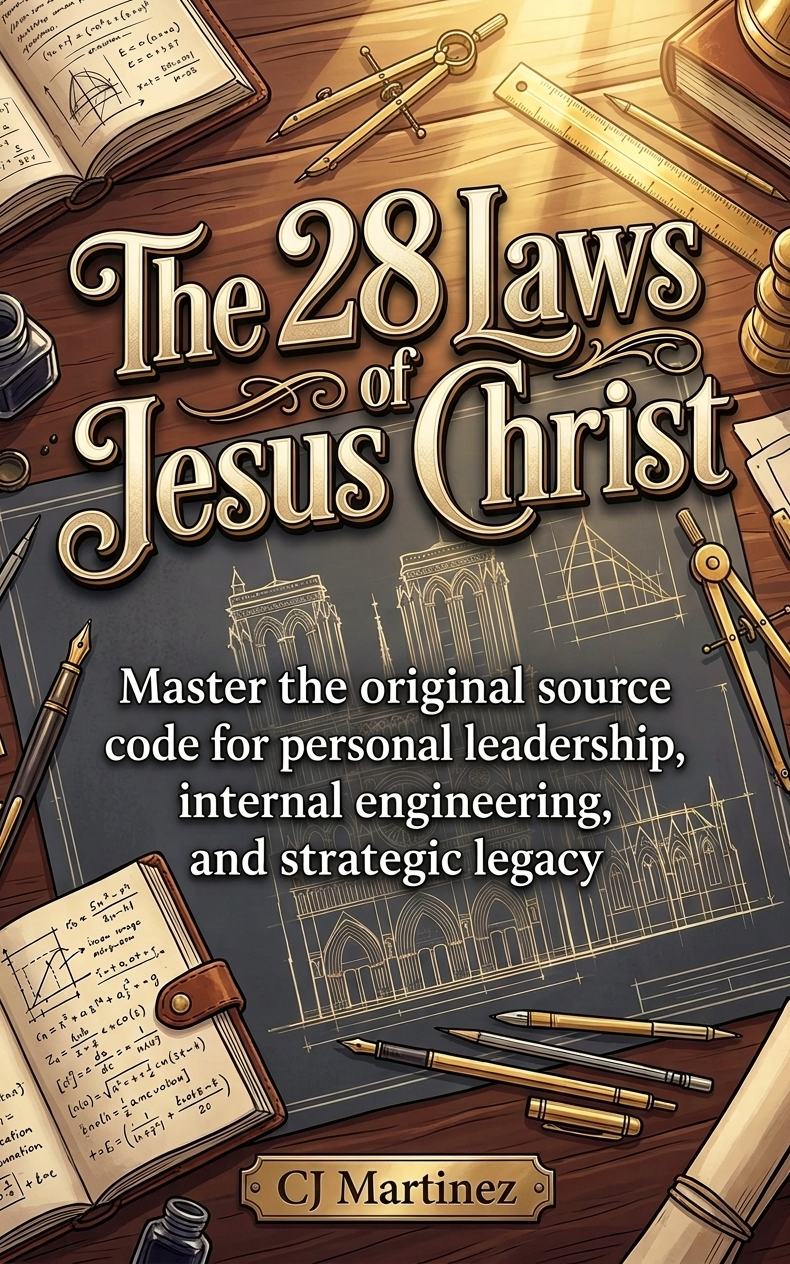
The 28 Laws of Jesus Christ
Master the original source code for personal leadership, internal engineering, and strategic legacy
by Christopher Jesus Martinez
Unlock the ultimate operational manual for the human experience. In 'The 28 Laws of Jesus Christ,' CJ Martinez strips away modern religious fluff to reveal a high-agency architectural blueprint hidden within the Gospels. This isn't just a book about faith; it's a rigorous framework for optimizing your internal operating system through universal laws that govern leadership, social interaction, and spiritual dominance. Divided into four tactical execution phases, this guide takes you on a journey from Sovereign Alignment to the construction of a Strategic Legacy. You will learn to master the baseline algorithms of human relationships, solve the hidden variables of internal character purity, and navigate the dual jurisdictions of the physical and spiritual realms. Whether you are a leader seeking to build enduring structures or an individual tired of low-friction living, these twenty-eight laws offer a path of absolute candor and disciplined mastery. It is time to reject mediocrity and embrace the total integration of power and wisdom. Are you ready to execute the Kingdom protocol and transform your life into a sovereign masterpiece?
- Non-fiction
- Religion & Spirituality
- Self-Help
- Christianity
- Personal Leadership
- Philosophy
The Law of Supreme Integration
The architecture of a high-agency life begins with a single, uncompromising point of origin. In the world of systems engineering, if you have multiple competing root commands, the system crashes. In the world of architecture, if you have two foundations competing for the same weight, the structure shears. In the human experience, we call this internal conflict. We call it stress, burnout, or a lack of purpose. But the reality is much simpler: it is a violation of the Law of Supreme Integration. This is the first and greatest commandment because it is the fundamental law of coherence. Without it, you are not a sovereign individual; you are a collection of competing impulses, social masks, and reactive habits.
The Law of Supreme Integration is derived from the core instruction of Jesus Christ: Love the Lord your God with all your heart, soul, mind, and strength. While often relegated to the realm of religious sentiment, this is actually a rigorous operational directive for total alignment. It demands the synchronization of every internal resource—emotional (heart), spiritual (soul), intellectual (mind), and physical (strength)—toward a single, supreme apex priority. When your internal world is integrated, your external world becomes a theater of precise execution. When you are fragmented, you are easily conquered by circumstance.
The Law Defined: The Apex Priority
To understand this law, we must look at it through the lens of systemic optimization. Most people live life in a state of horizontal drift. They have a career goal, a family goal, a fitness goal, and perhaps a spiritual goal. These goals sit side-by-side like separate tabs in a browser. Because they are not integrated under a single vertical hierarchy, they constantly compete for resources. When your career demands more time, your family suffers. When your fitness demands more energy, your work lags. This is the result of living without an apex priority.
The Law of Supreme Integration states that any system without a single, supreme apex priority will eventually collapse under the weight of its own internal conflicts. Jesus was not merely asking for affection; He was demanding a total reorganization of the human operating system. By placing the "Source"—the Divine, the Truth, the Kingdom—at the absolute top of the hierarchy, every other element of life is forced to align beneath it. This is not about adding a religious hobby to your schedule. It is about establishing the primary logic that governs every minor decision you make.
When you love God with all your heart, soul, mind, and strength, you are eliminating the possibility of a "side hustle" for your soul. You are declaring that there is no part of your life that is off-limits to your core values. This is the Apex-Down decision matrix. Instead of asking, "Will this make me money?" or "Will this make me popular?" the integrated leader asks, "Does this align with the Supreme Source?" If the answer is no, the decision is already made. The friction of choice is removed by the weight of the hierarchy.
The Internal Engineering: Eliminating Fragmentation
Most modern suffering is the direct result of fragmentation. We have become experts at building silos within our own identities. We have a "professional persona" that is aggressive and perhaps ethically flexible. We have a "family persona" that is passive and tired. We have a "spiritual persona" that shows up for an hour on the weekend. This division of the self is an energy leak of massive proportions. It takes an incredible amount of psychological fuel to maintain three or four different versions of yourself.
To master the Law of Supreme Integration, you must perform a radical audit of these silos. You cannot have a professional identity that contradicts your spiritual identity and expect to maintain high performance. Eventually, the cognitive dissonance will create a "system failure" in the form of a mid-life crisis, a moral collapse, or chronic health issues. Integration means that who you are in the boardroom is who you are in the bedroom, which is who you are in the prayer closet. It is the pursuit of singular integrity.
The engineering of the self requires we address the four quadrants mentioned in the Great Commandment:
- Heart (Emotional Integration): Your desires must be ordered. If you claim to value truth but your heart craves the cheap validation of social media, you are fragmented. You must train your emotions to find satisfaction in the execution of your higher purpose.
- Soul (Spiritual Integration): This is your core identity. It is the "I am" behind the masks. Spiritual integration means knowing who you are apart from your titles, bank account, or achievements. It is the anchor that prevents you from being swept away by the winds of market trends or social pressure.
- Mind (Intellectual Integration): This is where many high-performers fail. They treat their faith as an emotional experience but leave their intellect in the hands of secular frameworks. Supreme integration requires you to use your mind to deconstruct reality through the lens of the Gospels. It is the application of rigorous logic to spiritual truth.
- Strength (Physical Integration): Your body is the hardware that runs the software. If your physical habits—your sleep, your diet, your discipline—are in rebellion against your spiritual goals, your deployment will be weak. Strength is the capacity to execute.
When these four quadrants are aimed at the same target, you become a force of nature. You move with a level of intentionality that others find intimidating. This is not because you are more talented, but because you are not fighting yourself. You have stopped the internal civil war.
Operational Mechanics: The 5-Why Analysis and Daily Recalibration
How do we move from the theory of integration to the daily reality of it? It requires a specific set of operational mechanics. The first is the 5-Why Root Cause Analysis for Spiritual Misalignment. In manufacturing, when a part fails, engineers ask "why" five times to get past the symptoms and find the source. You must do the same with your life. If you find yourself stressed about a business deal, do not just address the stress. Ask why.
"I am stressed about this deal."
1. Why? "Because I might lose the commission."
2. Why does that matter? "Because I need that money to maintain my lifestyle."
3. Why is that lifestyle necessary? "Because I want my peers to see me as successful."
4. Why is their opinion so heavy? "Because I have tied my worth to my status."
5. Why have I tied my worth to status? "Because I have stopped seeking my validation from the Source."
The fifth "why" usually reveals a violation of the Law of Supreme Integration. You have allowed a secondary priority (status) to take the apex position. Once the root cause is identified, the solution is not a better "stress management" technique; it is a recalibration of your hierarchy of values.
The second mechanic is the Morning Recalibration Ritual. High-agency individuals do not drift into their day. They calibrate their instruments. Think of this as a daily "First Principles" audit. Before the world can bombard you with its demands, you spend fifteen minutes in absolute silence, re-establishing your connection to the Source. You strip away the secondary distractions—the emails, the headlines, the notifications—and you focus on the primary. You ask: "What is the one thing today that aligns with my supreme mission?" Everything else is noise.
This ritual is not a suggestion; it is a requirement for anyone who wants to lead. If you do not calibrate your own mind, the world will calibrate it for you. Most people spend their first waking hour reacting to other people's agendas. They check their phones and immediately surrender their mental sovereignty. An integrated leader spends that first hour reinforcing their own internal infrastructure.
Strategic Application: Avoiding Mission Creep
In the world of business and leadership, the Law of Supreme Integration is the ultimate defense against mission creep. Mission creep occurs when an organization begins to pursue secondary objectives at the expense of its core purpose. A tech company starts making furniture because it seems profitable; a non-profit starts chasing government grants that require it to change its message. In every case, the expansion leads to the dilution of power.
Jesus was the master of avoiding mission creep. He was constantly pressured by the crowds to become a political leader, a miracle-vending machine, or a social revolutionary. He refused every one of these roles because they did not align with His supreme mission: the proclamation of the Kingdom and the redemption of humanity. He was so integrated that He could turn away thousands of people if their needs did not fit the "Apex-Down" logic of His Father's will.
For the modern leader, this means ensuring that every decision made by your organization is a direct reflection of its core mission. If you are a founder, your company is an extension of your own integration. If you are fragmented, your company will be fragmented. There will be "politics" in the office because there is "politics" in your soul. There will be a lack of clarity in your marketing because there is a lack of clarity in your convictions.
High-performers use this law to maintain a Strategic Focus. They understand that "No" is a more powerful word than "Yes." To say "Yes" to the supreme priority, you must say "No" to a thousand good, but distracting, opportunities. Integration is as much about what you exclude as what you include. It is a process of subtraction. You subtract the "good" so that you can occupy the "best."
The Outcome: The ROI of Integration
The return on investment for following the Law of Supreme Integration is two-fold: internal peace and external authority. Internally, the result is a state of Flow. Flow is only possible when there is no internal resistance. When your heart, soul, mind, and strength are all pulling in the same direction, you stop wasting energy on "should I?" and start spending it on "how can I?" You move from a state of constant deliberation to a state of decisive action. This is the "unshakable peace" that Christ promised—a peace that is not the absence of trouble, but the presence of total internal order.
Externally, the ROI is a reputation for Unwavering Consistency. In a world of chameleons, the integrated person is a rare and valuable asset. People know exactly where you stand. You are not a different person on Friday night than you are on Sunday morning. You are not a different person when the market is up than when it is crashing. This consistency is the ultimate currency in leadership. It builds a level of trust that cannot be bought with marketing or PR. People follow integrated leaders because they represent a fixed point in a turning world.
Furthermore, when you are integrated, you become antifragile. Because your apex priority is the Source—which is eternal and unchanging—external fluctuations cannot destroy you. If your apex priority is your bank account, a market crash is a soul-death. If your apex priority is your reputation, a single scandal is a total collapse. But if your apex priority is Supreme Integration with the Divine, then even failure, loss, and persecution become data points in your development. They are simply obstacles to be navigated on the path to the primary goal.
Common Mistakes and the Priority Audit
The most common mistake people make with this law is treating their spiritual life as a separate silo. They think of "God" as a compartment of their life, like "Hobbies" or "Career." But the Law of Supreme Integration does not allow for compartments. God is not a slice of the pie; God is the plate that holds the pie. If your spiritual life does not inform your investment strategy, your hiring practices, and your fitness routine, then it is not an integrated faith. It is just a cultural accessory.
Another mistake is confusing busy-ness with purpose. Many people think that because they are doing "good things," they are integrated. But if those good things are not aligned with your specific apex priority, they are just sophisticated distractions. You can be very busy and still be completely fragmented. In fact, busy-ness is often a tool we use to avoid the silence required for integration. We stay busy so we don't have to face the fact that our lives don't make sense.
To fix this, you must perform a Priority Audit. This is a cold, hard look at where your resources are actually going. We often lie to ourselves about our priorities, but our calendars and bank statements do not lie. To perform this audit:
- List your top 5 commitments: These are the things that take up the most of your time and mental energy. Be honest. If you spend 3 hours a day on Netflix, "Entertainment" is one of your top 5.
- Rank them: Which of these is truly your apex? If you had to lose four of them to keep one, which one would it be?
- Identify the Contradictions: Look at where your actions contradict your stated values. If you say "Family" is your priority but you haven't been home for dinner in a month, your system is in conflict.
- Execute a "Fix Today" Item: Identify one area where you are out of alignment and fix it immediately. Don't wait for a new year's resolution. Do it now.
Reframing the Mind: Intellectual Mastery
The "mind" portion of the Law of Supreme Integration is often the most neglected. We are told to "have the mind of Christ," but what does that look like in a 21st-century context? It means building a Worldview Infrastructure that is based on the logic of the Gospels rather than the logic of the world. The world operates on a logic of scarcity, competition, and temporary gain. The Kingdom operates on a logic of abundance, service, and eternal value.
Intellectual integration requires you to be a gatekeeper of your own consciousness. You must be rigorous about what you allow into your mind. If you feed your mind a constant diet of fear-based news, consumerist advertising, and cynical social media, you cannot expect it to produce an integrated, peaceful life. You are what you process. To love God with all your mind is to dedicate your cognitive faculties to the pursuit of truth and the mastery of your craft as an act of worship.
This means your professional excellence is not just about making money; it is a manifestation of your spiritual alignment. If you are a coder, you write the best code possible because your work is an offering to the Source of all order. If you are a surgeon, you operate with total presence because you are a steward of the Source of life. This reframing removes the divide between the "secular" and the "sacred." In an integrated life, everything is sacred.
Conclusion: The Path to Absolute Sovereignty
The Law of Supreme Integration is the foundation upon which all the other 27 laws are built. Without it, you are trying to build a skyscraper on a swamp. You might get a few stories up, but as soon as the wind blows, the cracks will appear. Integration is the process of turning that swamp into solid bedrock.
It is not an easy path. It requires a level of honesty and discipline that most people are unwilling to endure. It requires you to slay your own ego and surrender your competing desires. But the reward is a life of absolute sovereignty. When you are integrated, you are no longer a slave to your moods, your appetites, or the opinions of others. You are a person under authority, and therefore, you are a person who has authority.
As you move forward through this framework, remember that integration is a practice, not a destination. You will find new areas of fragmentation as you grow. You will discover new silos that you didn't know existed. The work is to constantly bring those areas back into the hierarchy, to constantly recalibrate to the Source. This is the "Narrow Gate" that leads to life—a life of power, peace, and unshakable purpose.
Chapter 1 Action Steps: The Integration Blueprint
- Schedule 15 Minutes of Silent Alignment: Every morning for the next seven days, sit in absolute silence before checking any device. Use this time to recalibrate your mind to your apex priority.
- Perform the 5-Why Audit: Take the biggest source of stress in your life right now and ask "why" five times. Trace it back to the root misalignment.
- The Singular Sacrifice: Identify one habit, commitment, or relationship that is currently causing fragmentation in your life. Eliminate it or radically restructure it to fit your apex hierarchy today.
The first law is simple to state but requires a lifetime to master. It is the law of the "One Thing." As Jesus said to Martha, "You are worried and upset about many things, but only one thing is necessary." Find that one thing. Integrate everything else around it. This is the source code for a sovereign life.
The Law of the Narrow Gate
The transition from a state of integration to a state of execution requires the passage through a specific, high-resistance filter. In the architectural blueprint of a sovereign life, this is known as the Law of the Narrow Gate. Most individuals spend their lives looking for the path of least resistance. They seek the low-friction exit, the shortcu…