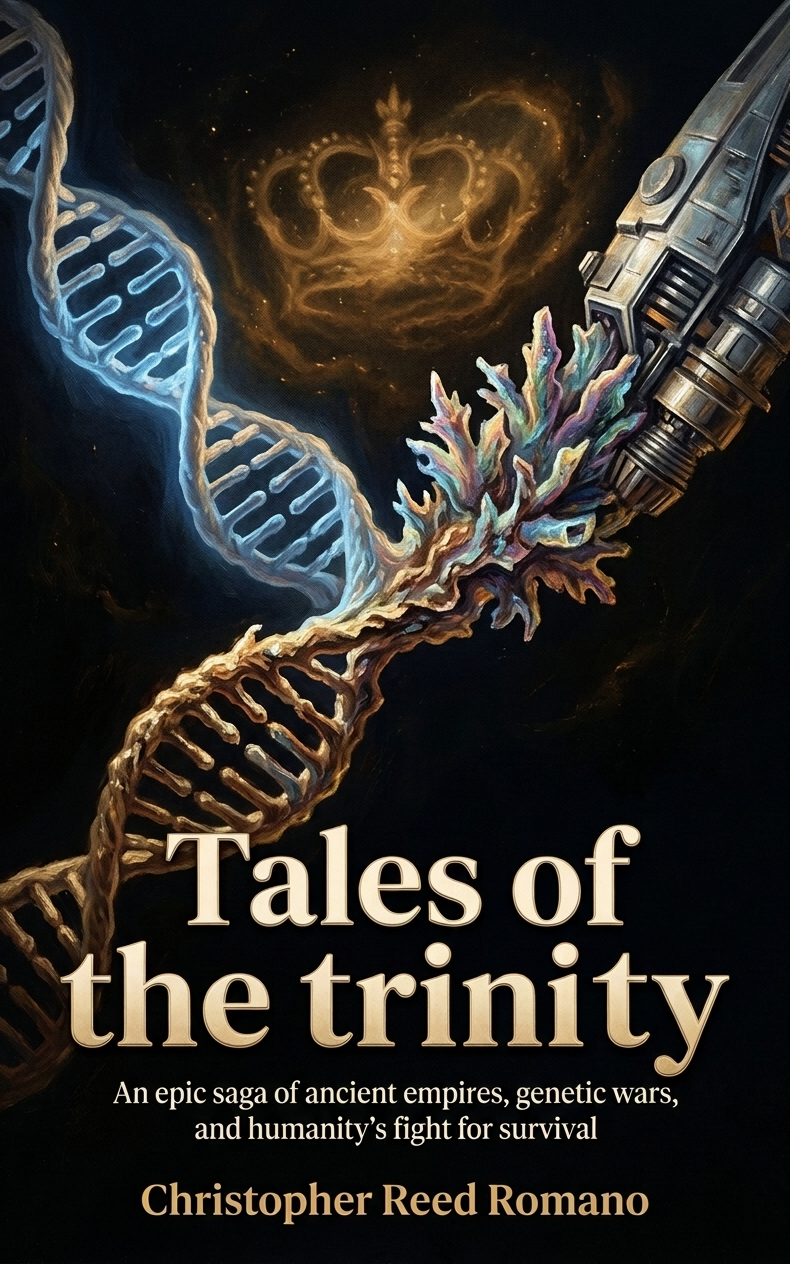
Tales of the trinity
An epic saga of ancient empires, genetic wars, and humanity's fight for survival
by Christopher Romano
Twelve millennia ago, the Centurion Infinite Empire vanished, leaving behind a galaxy scarred by civil war and a terrifying xenos plague. Now, in the year 9,667 A.D., humanity has risen from the ashes to form the Trinity Empire, but the ghosts of the past are waking up. Rear Admiral Sigar Kronsien is a man out of time and out of luck. Assigned to the remote Kaytev Voy system with a skeletal fleet, he stands as the only line of defense against the Blood-Tide—a savage warband of the reptilian Deathspawn. These warriors pilot living city-ships made of organic coral, and they are hungry for the minerals hidden beneath the colony of Hesperia. But the Deathspawn are not the only threat. Deep within Hesperia’s crust, ancient Centurion ruins pulse with a dark energy, and General Korra Admund is stirring from a twelve-thousand-year stasis. As King Macromis Dartur I deploys a secret army of genetically engineered clones to tighten his grip on the throne, Kronsien must navigate a web of imperial corruption and alien resurrection. From the birth of the first self-aware clone to the revelation of a galactic extinction event, the Trinity Empire stands on the precipice of a new dark age. To save the future, Kronsien may have to betray the very crown he swore to protect.
- Science Fiction
- Space Opera
- Military Sci-Fi
- Genetic Engineering
- Colony Worlds
- Apocalyptic
Low Priority
Trinity Imperial Space, Kaytev Voy Binary Star System, Imperial Military Base of Fort Argus on the surface of the colony of Hesperia, 9,667 A.D.
The holographic recording ended the same way it always did. With silence.
Rear Admiral Sigar Kronsien sat back in his chair and let the dim blue light of the empty projection field wash over his face for a long moment before he finally reached forward and switched the holocomputer off. The room went darker for it. Fort Argus was never a well-lit place to begin with. The base had been constructed during the first wave of territorial expansion, back when the Empire had been young and reckless with its ambitions, and the years since had not been kind to it. The ceiling panels above his desk flickered every few minutes with the kind of rhythm that suggested the wiring behind them had given up caring some time ago. The ventilation unit in the corner wheezed on its fourth hour of making a sound that reminded him of a man with fluid in his lungs.
He pressed two fingers to the bridge of his nose and held them there.
Sixty-six ships. The Grand Admiral's voice was still rattling around somewhere in the back of his skull, that slow and measured delivery. It carried the weight of an empire that had decided, somewhere in the depths of its high command chambers, that the Kaytev Voy system was worth defending in principle but not in practice. The promotion felt like a man being handed a medal and a coffin at the same time. Congratulations, John. You are now responsible for everything. Here are not enough ships to accomplish any of it. Good luck.
Kronsien rose from his chair and moved to the tactical display table at the center of the room. The flat surface projected a three-dimensional map of the Kaytev Voy system, the twin suns of Kaytev and Voy burning in soft amber and pale white at the center, their gravitational relationship pulling at each other across a distance of roughly four astronomical units. Around them, the system's eight planetary bodies rotated in their assigned orbits, and among them Hesperia sat in the habitable band of Kaytev's light, a thin-atmosphered world of rust-colored rock and deep mineral veins that made it worth dying over. At least according to the people who would not be doing the dying.
He studied the ship positions. Sixty-six icons, each one representing a warship and a crew, scattered across patrol routes that covered roughly a third of what they needed to cover. He'd been over the numbers enough times that he no longer needed to run them through the tactical calculator. The math was simple and ugly. Against a Deathspawn warband of any meaningful size, sixty-six aging ships in a binary star system was not a defense. It was a delay. And a short one.
The scar along his jaw tightened the way it always did when he was turning a problem over and not finding a good side to it. He'd gotten that scar during the Shattered Moon incident, though not from enemy fire. He'd walked into a bulkhead corner in the dark after the lights went out on his bridge during the aftermath, after the civilian transport had already gone silent on the comms, after he'd made the only decision available to him and still managed to hate himself thoroughly for making it. He sometimes thought the scar was appropriate. A reminder in the wrong place for the wrong reasons.
He pulled up the sector map and expanded the view outward, past the system's edge, into the broader expanse of frontier space that the King's orders so cheerfully described as needing to be defended. The Kaytev Voy system sat at the far end of a long, poorly charted stretch of colonial territory that the Empire had planted flags in without ever fully committing the resources to hold. Stage one colonies dotted the display like seeds thrown into bad soil. He was expected to cover all of it.
A knock at the door pulled him back.
"Come in," he said, without turning around.
The door opened with the kind of grinding protest that suggested it needed new hydraulics about six months ago. The footsteps that followed were quick and light, with the particular rhythm of someone who moved fast because they were perpetually worried about being in the wrong place at the wrong time. He turned before she spoke.
Operator Elara Stromon had her headset pushed down around her neck and was carrying a data-slate clutched to her chest with both arms, the way a person holds something they are genuinely afraid of dropping. She was young, somewhere in her mid-twenties, but she held herself with a stiff, fragile posture, her eyes momentarily losing focus on the doorframe before she blinked and forced herself to look at him. The oversized eyeglasses she wore to compensate for the radiation damage to her eyes sat slightly crooked on her face, and her fingers slipped slightly against the smooth casing of the slate, her grip tightening in a sudden, jerky correction. She had been rubbing at her eyes again without realizing it, leaving faint smudges of grease on the lenses.
"Admiral," she said, and her voice carried that particular high-pitched edge it got when she had something to say that she was not entirely certain she wanted to say. "I'm sorry to come at this hour, sir. I know it's late and I know the duty roster has Sergeant Valk on monitoring—"
"Stromon. What did you find?"
She held the data-slate out to him. He took it and looked down at the readout. The sensor logs from the outer perimeter arrays were displayed in columns of raw data, and in among the baseline interference patterns of the binary system, there were anomalies. Small ones. Scattered. The kind of readings that a less experienced operator might have flagged as instrument noise and moved on from.
"I've been calling them ghosts," she said. "Which I know isn't very technical. But the signature profile isn't matching anything in the standard contact library, and the intervals between appearances are too regular to be system interference. I ran the baseline suppression filter twice and they're still there. They're faint, sir. But they're consistent." She paused. "They're moving."
Kronsien looked at the display for a long time without speaking. He traced the pattern of the anomalies with one finger, not touching the screen, just following the implied trajectory. His jaw tightened again.
"How long have you been tracking these?" he asked.
"Thirty-one hours," she said. "I wanted to be sure before I brought it up. I didn't want to waste your time with instrument noise." She hesitated. "I don't think it's instrument noise, sir."
"No," he said. "Neither do I." He handed the slate back to her and looked at the system map again, then at the outer edge readings she had marked. The positioning was too deliberate. Whatever was out there, it had not dropped into the system at a transit point. It had come in quiet, from an angle that kept it outside the primary sensor cone of the outer patrol routes. That kind of approach was not accidental. It was calculated. It was the kind of move made by something that had been watching the patrol patterns long enough to understand them.
He felt a cold, flat certainty settle into his chest.
"Cross-reference the movement vectors with the known approach corridors used by the Blood-Tide warband in their last three confirmed incursions along this sector of the frontier," he said. "And do not run that query through the base network. Run it through your personal terminal and bring me the results directly."
Stromon's expression shifted. She understood what he was not saying. Running the query through the base network meant it got logged. It meant it went into the automated reporting system that forwarded priority assessments to High Command's communications relay. And a confirmed Deathspawn contact in-system, even a tentative one, would trigger a response from High Command that Kronsien did not want to deal with until he had a clearer picture. Because High Command's response would be to remind him that his orders were to push the offensive, and right now what his sensors were suggesting was that the offensive had already arrived.
"Yes, sir," she said quietly. "I'll have results within the hour."
"Good work, Stromon," he said. "Go."
She went, pulling the door shut behind her with the same grinding protest it had made on the way in. He stood in the quiet for a moment after she left, listening to the ventilation unit wheeze and the ceiling panels flicker, and thought about what sixty-six ships looked like against a warband that had the patience to slip scouts into a system undetected and map patrol routes before making a move.
He moved to the narrow window cut into the far wall of his office and looked out. Fort Argus sat on a plateau in the northern hemisphere of Hesperia, and from this height the terrain spread out in every direction in rolling waves of dark rust-red stone, broken by the angular shapes of the colony's outer hab-blocks and the distant flicker of the mining operation lights working the night shift in the deep crust. Above all of it, the sky was a deep, bruised purple at this hour, the thin atmosphere of Hesperia doing very little to soften the stars. And there, low on the horizon, the twin suns of the Kaytev Voy system had both set, leaving the sky to the cold light of everything beyond them.
He had stood in front of enough windows on enough colony worlds to know that the frontier always looked the same after dark. Empty and vast and entirely indifferent to the fact that people were living and dying on the small rocks scattered through it.
Sixty-six ships and a King's order to push the offensive. The thought moved through him like cold water. He had been a naval officer for over two decades, serving on destroyers and frigates and a cruiser during the border skirmishes on the Ezarium Corridor, and looking at the current tactical map, he saw that same pattern of desperation repeating itself. He had learned in those years that there was a specific kind of institutional blindness that descended on high command when the maps started making them nervous. They stopped seeing the ships as ships and the crews as crews and started seeing them as numbers in a projection model. And projection models did not bleed out on a flight deck or call out for a medic through a ruptured hull.
He turned back to the tactical display and stood over it for a long time, his hands flat on the edge of the table, his eyes moving across the ship positions and the patrol routes and the vast stretches of undefended space between them.
He needed a plan. Not the plan High Command had sent him. Something of his own making, built from what he actually had rather than what he was supposed to have. Something built on deception and patience and a very careful understanding of how a warband moved and what it needed. Because a warband that was moving along the frontier raiding for minerals was not a strategic force. It was a hungry one. And hungry forces made different kinds of mistakes than disciplined ones.
He pulled up the mining asset records for the system and laid them over the tactical map. The mineral concentration data from the deep crust surveys glowed in orange and yellow across Hesperia's surface, and similar readings pulsed from the two asteroid belts and the mining platforms in the outer system. He studied the distribution carefully. If Zur-Khan's Blood-Tide warband was here for the minerals, and the intelligence reports strongly suggested they were, then the high-value extraction sites were the bait. The question was how to use that bait without losing everything attached to it.
He began to draft the outline of a defense plan in the back of his mind, layering contingencies against each other the way a man lays stones when he is not sure where the ground is solid. It was slow work. It was also the only work available to him at this hour, on this world, with what he had. So he kept at it.
An hour passed. The ventilation unit continued its labored rhythm. The ceiling panels flickered twice more and then held steady for a while, as though the wiring had decided to make a temporary effort.
He was still at the table when Stromon came back.
She knocked twice and entered without waiting for his answer, which told him something about the urgency of what she was carrying. Her face was paler than it had been, and the data-slate in her hands was displaying a comparison readout that she had already pulled up before she arrived, which told him something else. She turned the slate to face him when she was close enough for him to read it clearly.
"The movement vectors match," she said. The stutter in her voice was barely there, just a ghost of it. "Seventy-three percent correlation with the Blood-Tide's documented approach profile from the Verun IV incursion and the Harkon Station raid. The intervals, the angle of insertion, the way they're holding position at the system's edge rather than pressing in. It's the same pattern." She paused and her throat moved. "There's more than one contact cluster, sir. I isolated four distinct anomaly signatures in the outer zone. They're not bunched together. They're spread across different entry angles."
Kronsien looked at the readout. Four separate clusters. Each one positioned to cover a different quadrant of the outer system.
"They're not scouting," he said. He kept his voice flat and even, the way he always did when what he wanted to do was something else entirely. "They're surrounding."
Stromon said nothing. There was nothing useful to say to that.
"How many contacts in each cluster?" he asked.
"I can't get an accurate count at this range," she said. "The sensor arrays on the outer perimeter are running at about sixty percent efficiency. The scrubbers on arrays seven and eleven have been red-flagging for two weeks and we haven't had the parts to repair them." She looked at the slate. "Best estimate based on the signal density is between eight and twenty contacts per cluster. But if they're running full stealth protocol and only letting me see the edge of their formation, the actual number could be significantly higher."
Kronsien straightened up from the table. He stood very still for a moment, the kind of stillness that came from spending years learning how to keep the cold mathematics of a tactical situation from showing on your face when people were watching you and needed something to hold onto.
Between eight and twenty contacts per cluster. Four clusters. Even at the low end of that estimate, he was looking at a force that had the system's entry points covered. Even at the low end, that was more than his sixty-six ships could absorb in a straight engagement and expect to hold the colony. And that was before accounting for the fact that a warband that had the patience to position four separate flanking clusters without being detected for thirty-one hours was not the kind of opponent that made the kinds of mistakes he could exploit without a great deal of time and planning.
Time, he suspected, was not something he was going to have a great deal of.
"Stromon," he said. "I want continuous monitoring on all four contact clusters. Minimum update interval of twenty minutes. If any of them move, I want to know before they've finished moving. And I want a full diagnostic on every outer array we have, tonight. Flag every piece of equipment that is running below eighty percent and get me a list of what we would need to bring them back up."
"Yes, sir." She was already writing on the slate. "What about the automated reporting system? High Command's next scheduled relay window is in four hours."
He thought about that for a moment. The relay window. Four hours from now, the base's automated system would bundle its sensor reports and status updates and fire them off to High Command on the next available tachyon link. And those reports would include the anomaly data that Stromon had been logging for the past thirty-one hours, even if she had been careful about how she ran her cross-reference queries. The raw data would be there.
"Let the window run," he said. "Don't alter the reports and don't flag the anomalies for priority attention. If High Command asks, we are monitoring what appears to be sensor interference in the outer arrays and we are investigating." He met her eyes. "We are not in a position to report a confirmed contact because we do not yet have a confirmed contact. We have sensor ghosts. Is that understood?"
Stromon held his gaze for a moment. She was young enough that the weight of what he had just asked her to do was visible on her face, but she was sharp enough to understand why he had asked it. If High Command received a preliminary contact report indicating a significant Deathspawn force was already in-system, their response would not be to send reinforcements. Their response would be to issue an updated operational directive that would tie his hands in ways that would get people killed faster. He needed time to work with what he had. He needed that four-hour window to be quiet.
"Understood, sir," she said.
"Good." He turned back to the window. "Get some rest after the diagnostics are done. You'll be no good to me running on empty."
She left without further argument, pulling the door shut behind her. The grinding protest was softer this time, as though even the hydraulics had decided to make an effort at discretion.
Kronsien stood at the window for a long time after she was gone.
The stars were very clear over Hesperia tonight. The thin atmosphere that made the oxygen scrubbers work so hard also meant that the sky offered very little interference, and from where he stood he could see the arm of the galaxy stretching across the upper horizon like a smear of cold fire. He had spent a lot of years looking at sky like this. It had a way of making everything feel very small and very large at the same time, which was either comforting or terrifying depending on the day. Tonight it was neither. Tonight it was just a sky full of stars, some of which had Deathspawn warships hiding behind them.
He thought about the Shattered Moon. He thought about it the way he always thought about it when the math of a situation was forcing him toward a choice between two things he did not want to choose between. The civilian transport had been the Arras, a mid-capacity colony ferry carrying three hundred and fourteen people on a scheduled run between Hesperia and the outer station. The refinery at Shattered Moon processed sixty percent of the system's fuel output. He had two ships close enough to help when the Deathspawn raider hit the transit lane. Not enough ships for both. The choice had taken him four minutes to make and the rest of his life to carry.
He had saved the refinery. The Arras had gone dark twelve minutes later.
He had written three hundred and fourteen letters afterward. He had written them all himself, by hand, on actual paper, because he could not make himself use a form template for something like that. The letters had taken him two weeks. His hand had cramped on the forty-seventh one and he had kept writing anyway. He still did not know if that was discipline or punishment. He suspected both.
The colony below the plateau was lit in scattered clusters at this hour, the hab-blocks and the processing facilities and the deep crust mining heads all contributing their small share of light to the dark surface of Hesperia. He could not see the faces of the people living down there. He did not need to. He knew the population figures. He knew the census breakdown. He knew how many families had followed the mineral surveys out to this particular fold of frontier space and built their lives here on the promise that the Empire would protect what they had made.
Sixty-six ships. Four contact clusters at the system's edge. A King who wanted an offensive push. A High Command that had filed the reinforcement request under low priority and moved on.
He pulled a chair over to the window and sat down in it, facing the stars and the twin dark spaces where the binary suns had set, and he started working the problem from the beginning. Not from the orders. From the terrain. From the assets. From the actual shape of what he had to work with and the actual nature of what he was facing.
Deception rather than strength. That was the spine of it. He could not match the Blood-Tide in numbers, not even close, and if the contact clusters represented the forward elements of the full warband, the disparity was going to be worse than anything his tactical models had projected three months ago when he had first taken command of this posting. But a warband that had crossed frontier space to reach a specific mineral-rich system was not a force that had unlimited time and unlimited resources. It had specific needs. Organic technology needed feeding. Khalsoonin coral needed mineral input to grow, to sustain itself, to build new ships. That was the weakness buried in the Blood-Tide's greatest strength. Their ships were alive. And living things could be starved.
He began to build the plan around that idea. Not a plan to fight the warband in open space, where the weight of numbers would simply grind his fleet to nothing over the course of days. A plan to deny them. To make the system's resources expensive to reach. To use the asteroid belts and the binary star's gravitational interference and the complex orbital mechanics of a two-sun system as terrain features that his smaller, more maneuverable ships could exploit against a heavier force. To make every extraction attempt cost more than it yielded until the warband's logistics forced it to make a choice between pressing on and bleeding out or pulling back.
It was not a plan that would win the war. It was a plan that would buy time. Time for reinforcements that High Command had already told him were not coming. Time for circumstances to change in ways he could not yet predict but had learned over two decades of service to leave space for in any plan worth calling one.
He worked at it for three more hours, pulling up charts and running numbers on the tactical display and making notes on a physical pad with an actual pen because he had spent enough years in the Navy to know that digital records had a way of being found by people who were not supposed to find them. The pen scratched quietly in the dark of the office. Outside, the stars moved in their slow arcs above the rust-colored plateau.
By the time the first pale light of Kaytev's dawn began to touch the eastern horizon, he had the skeleton of something he could work with. It was a lean and dangerous plan built on bluff and misdirection and the calculated exploitation of an enemy's hunger. It was the kind of plan that could go wrong in more ways than he could count, and it required every one of his sixty-six ships to be exactly where he needed them at exactly the right moment, which meant it also required a level of coordination from a fleet that had been running on reduced maintenance cycles and reduced crew rotations for three months of frontier deployment.
He set the pen down and looked at what he had written.
It was not a good plan. It was the best plan available, which was a different thing entirely. He had made his peace with that distinction a long time ago, somewhere around the forty-seventh letter.
He rose from the chair and stretched his back, feeling the accumulated weight of the night in every joint. He moved to the tactical display one more time and stood over it, looking at the sixty-six ship icons and the vast stretch of system they were meant to cover, and then he looked at the outer edge where four clusters of sensor ghosts were holding their positions in the cold dark, patient and quiet and already inside his perimeter.
The oxygen scrubber in the corner chose that moment to shift from its labored wheeze to a sharper, higher sound, almost like a cough, before settling back into its usual rhythm. Kronsien glanced at it. Red indicator light on the housing. He would need to flag that for maintenance. He added it to the mental list that had been growing since he arrived at Fort Argus and showed no sign of stopping.
He looked back at the display. Then he looked at the window and the stars beyond it.
Thousands of lives. The colony below the plateau. The crews aboard sixty-six ships that the Empire had decided were sufficient for the work of defending a system that was insufficient for the work of being defended. All of it resting on a plan built out of deception and mathematics and the thin hope that hungry things made mistakes.
He had been a naval officer for over two decades. He had learned in those years that hope was not a tactical asset. But he had also learned that the absence of it was a kind of death that happened before the battle did, and he had made himself a promise somewhere around the time he was writing those letters that he would not let that particular death take hold of him.
He put his hands flat on the edge of the tactical table and looked at the display for a long, quiet moment.
Then he began to issue the first of the repositioning orders that would start turning his skeleton fleet into something that might, if the math held and the bluff landed and the Blood-Tide made the kinds of mistakes that hungry things eventually made, look like more than it was.
Outside, Kaytev's dawn continued its slow climb over the rust-colored plateau, and the stars faded one by one into the thin light of morning. The twin suns of the binary system rose on opposite horizons, as they always did, casting double shadows across the colony below. In the deep crust beneath the surface, the mining heads turned and turned, pulling the minerals from the rock that had made this place worth dying over.
And at the system's edge, four clusters of shadows held their positions in the dark, patient as stones, and waited.
The Glass Cradle
Imperial Research Station X-1, Classified Orbit Above the Dead Star Designation Null-Karath, Trinity Imperial Space, 9,667 A.D. The dead star offered nothing. No light worth measuring, no warmth, no radiation signature that would draw the attention of a passing survey vessel. It was the color of a bruise that had gone cold, a collapsed remnant of …