

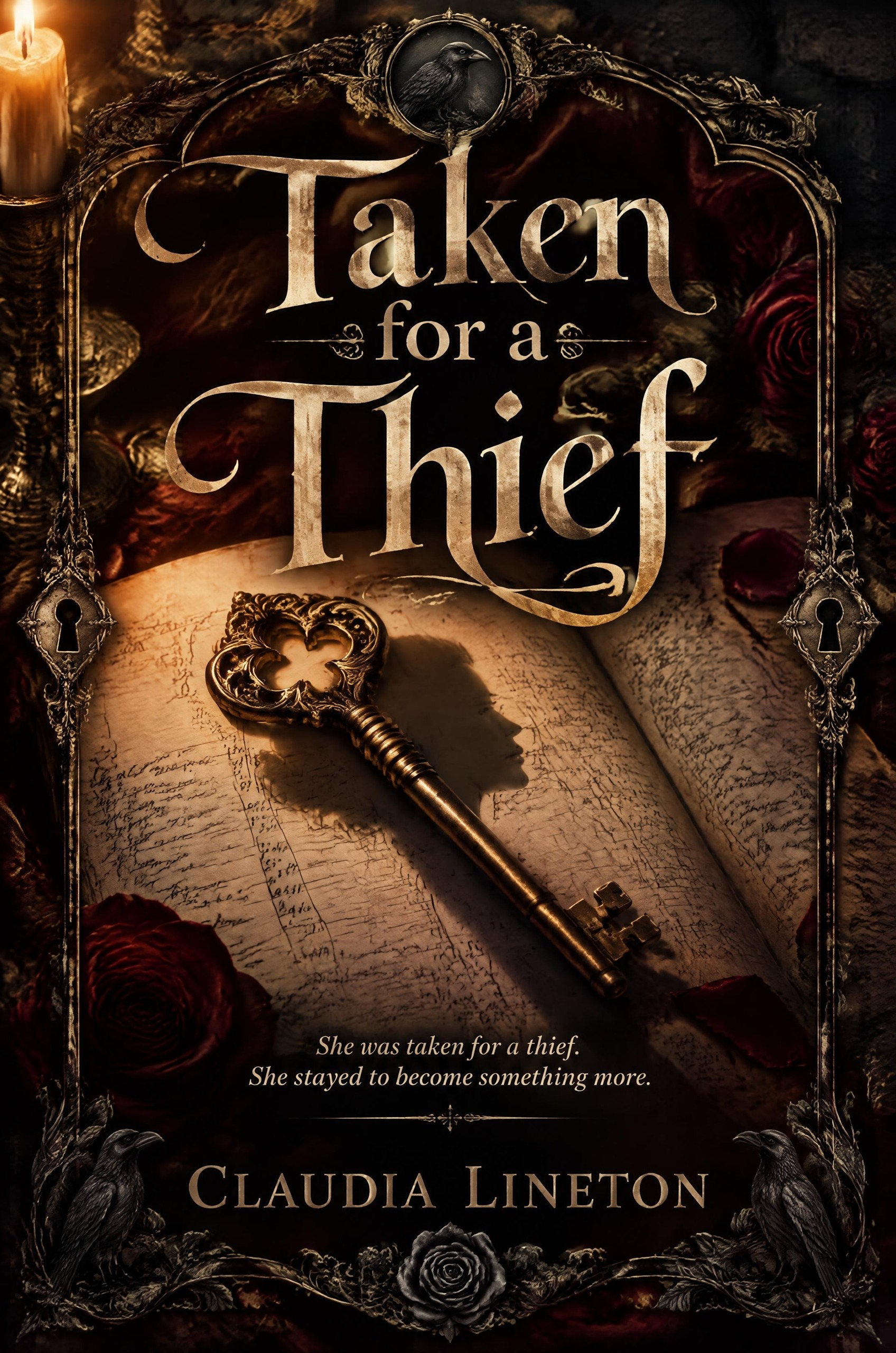
Taken for a Thief
She was captured at the boundary line. Now she must cross it.
by Claudia Lineton
Ashling Winters knows the boundary meadow better than anyone. She walks it alone every day, tracing the line between her father's land and Lord Connor Blackwood's territory. She has never crossed it. But when border scouts capture her and accuse her of raiding supply caches, no one believes her. Confined to a tower room in Connor's cold stone castle, she faces hostile interrogations from a lord who sees only a thief, and open contempt from his scout captain. Then her father arrives. Not to rescue her. To bargain. Ashling leaves the tower a betrothed woman, bound to the same lord who imprisoned her. Returning to the castle as Connor's intended bride, she is determined to prove herself useful. But when records vanish and a valuable brooch goes missing, every finger points at her. Someone inside these walls has been stealing for years, and they have chosen Ashling as the perfect scapegoat. To clear her name, she must trace the thefts to their source using the only weapons she has: sharp eyes, steady ledgers and a patient mind that notices what others overlook. The trail leads deeper than she imagined, into a conspiracy that threatens the border itself. And the cold lord she was forced to marry may be the only person she can trust.
- Romance
- Fantasy
- Slow Burn Romance
- Romantic Fantasy
- Enemies to Lovers
The Boundary Meadow
The meadow was silver with dew when Ashling slipped through the garden gate. She carried the heel of yesterday’s bread wrapped in a cloth and her journal pressed flat against her ribs. No one saw her go. They never did.
She walked the path she knew by habit. Past the orchard where the apples hung small and green. Through the gap in the hedgerow where the thorns caught at her skirt. The forest edge rose dark before her, pine and shadow, and the boundary meadow stretched between like a held breath. She had been walking this line since she was old enough to slip her nurse’s watch, and it had never once felt like trespass.
A kestrel sat on a dead snag at the meadow’s far side. Ashling stopped. She opened her journal and began to sketch, quick strokes with a nub of charcoal she kept tucked in the spine. The bird tilted its head, watching her, and she drew the curve of its beak, the barring on its tail feathers. Below the sketch she noted the date and added a line about the fungal rot she had seen spreading through the western stand of elm. She pressed the charcoal hard enough to leave a smudge on her thumb.
She heard nothing before the hand closed on her arm.
‘Don’t move.’
Three men had come out of the trees. The one who held her was broad and compact, with iron-gray hair at his temples and a jaw darkened by stubble. His eyes were the color of winter water. He wore a scout’s tunic and a cap pulled low, and his grip did not loosen when she tried to pull free.
‘Let go of me.’
‘Captain,’ one of the others said. He had her journal. He had taken it from her hands while she was still registering the first man’s face. ‘She’s got maps. The boundary line, the forest edge.’
The captain took the journal and looked at it. He did not look long. He closed it and tucked it into his own belt. ‘Ashling Winters,’ he said. It was not a question.
Her blood went cold. ‘How do you know my name?’
‘You’re a long way from your father’s land.’ He nodded at the scout who held her, and the grip on her arm tightened. ‘Lord Connor will want to see you.’
‘I have done nothing.’
‘You were found fifty yards from a rifled cache,’ the captain said. ‘With maps of the boundary in your hand.’
‘They are not maps. They are sketches. Birds. Trees. Fungal rot in the elms. I walk here every week.’
He looked at her as though she had confessed to something worse than theft. ‘Then you have been trespassing every week.’
They marched her along the forest road. The scouts said nothing. Ashling said nothing. She kept her spine straight because her mother had taught her that a woman’s posture was her first and last defense. The castle rose ahead of them, gray stone and narrow windows, and the gates opened without anyone calling out. They had been expected.
The man at the table straightened as they approached, and Ashling watched him take her in the way she had taken in the kestrel: head to foot, without hurry, cataloguing. He was tall enough that the maps on the table seemed small beside him, his shoulders filling the space between the ledgers as though he had been built into the room rather than brought to it. When he lifted his head, the torchlight caught his eyes before it caught anything else. Intense blue. She had the unsettling sense that he had already drawn his conclusions and was only waiting for the rest of them to catch up.
The captain stopped three paces from the table. ‘Lord Connor. We found her at the boundary meadow, near the western cache.’
Connor Blackwood looked at Ashling. He did not speak immediately. He studied her the way she had studied the kestrel, taking in every detail, and she understood that this man did not require haste to make his authority felt.
‘Your name,’ he said.
‘Ashling Winters.’
‘Edmund Winters’ daughter.’
‘Yes.’
‘You were found on my land without travel papers. Near a supply cache that was broken open three nights ago. You carried a journal containing detailed maps of my boundary line.’ His voice was low and even. He might have been reading from a ledger. ‘What were you doing there?’
‘Walking.’
‘Walking.’
‘I walk the meadow every week. I have done so for years. I sketch birds. I note the health of the trees. I took nothing from your cache.’
‘Captain Hale.’ Connor did not look away from her. ‘The journal.’
The captain handed it over. Connor opened it and turned the pages slowly. She watched his eyes move across her sketches, her notes, the careful lines she had drawn of the boundary meadow and the forest edge. His expression did not change.
‘You draw well,’ he said.
She did not thank him. She waited.
‘These marks here.’ He turned the journal to face her. ‘Along the tree line. They could be troop positions.’
‘They are elms. The ones with fungal rot. I marked them because I have been tracking the spread.’
He looked at the page again. Closed the journal. Set it on the table beside his maps. ‘You carry no papers. You walk alone along a contested boundary. You are the daughter of a landholder who has been less than friendly with this house.’
‘My father’s politics are not mine.’
‘And yet they follow you.’ He folded his arms. ‘I will send word to Edmund Winters. Until your identity is confirmed, you will be confined here.’
‘You mean imprisoned.’
‘I mean kept safe until I know what you are.’ He said it without cruelty. Without warmth. It was simply a fact, and she understood that facts were the only currency this man dealt in.
‘I am not a thief,’ she said.
‘Then you have nothing to fear. A thief may be punished by service or by fine, but a liar I am less tolerant of.’ His eyes held hers as he spoke, and she understood the words for what they were: not a threat, not quite, but a line drawn in stone.
She did not flinch. She squared her shoulders and met his gaze. 'I took nothing that belonged to you.'
He watched her for a long moment. Then he nodded to the guards. ‘The tower room. See that she has a fire and food.’
The captain took her arm again. She did not resist. She walked with them across the hall, past the torches, past the maps and ledgers, and at the door she stopped and looked back. Connor Blackwood was still watching her. His face was unreadable. He had not picked up her journal. He had not moved at all.
The stairs were narrow and wound upward in the dark. The tower room was small but clean. A bed. A chair. A window that looked out over the boundary meadow where she had been standing an hour ago. The door closed behind her. The lock turned.
She stood at the window and watched the kestrel lift from the snag and wheel into the trees. Her hands were shaking. She pressed them flat against the cold stone sill and waited for them to still.
She had told him the truth. She had not wept. She had not begged. And still she was locked in a tower, and still he had not given back her journal, and still she did not know whether Edmund Winters would come for his daughter or leave her to the mercy of a man who dealt only in facts.
Below her, the meadow was empty. The forest was dark. The kestrel was gone.
The Housekeeper's Keys
The first day passed in silence. Lady Meriel Tavick brought the morning meal on a wooden tray and set it on the table beside the bed without speaking. Her hair was scraped into a knot so tight the skin at her temples shone, and the ring of keys at her waist clicked with every step she took. She looked at Ashling the way a housekeeper looks at a sp…