

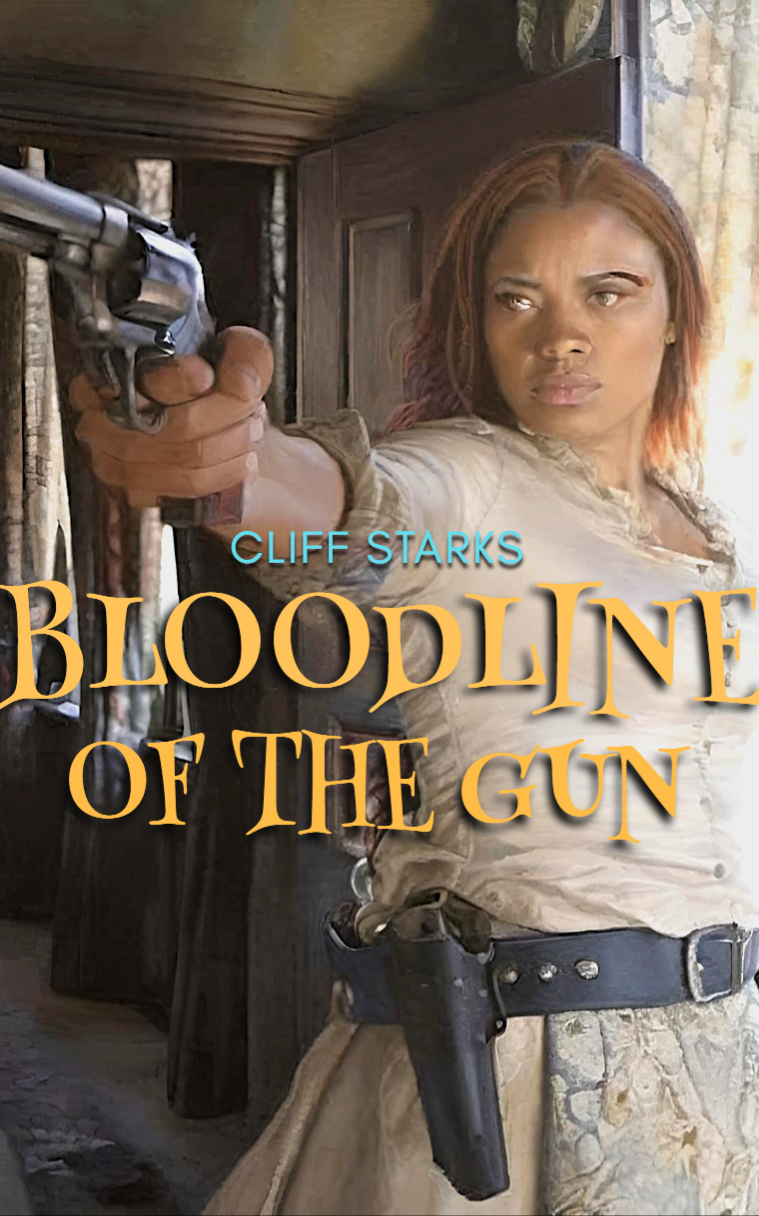
Bloodline of the Gun
A dangerous wild west legacy written in blood, bullets, and iron-willed revenge
by Cliff Starks
Born into slavery on an Alabama plantation, Beatrice Stryker survived the cold cruelty of her father and his vengeful wife. But when the Civil War ends and her mother is brutally murdered to erase all claims to the family estate, Beatrice flees into the lawless western frontier. Armed with dead-shot marksmanship, twin Colt revolvers, and an unyielding intellect, she casts off her slave name to become a legendary outlaw on her own terms. But she isn't just running—she's searching for her fugitive half-brother, a framed Union veteran hunted by ruthless bounty hunters. Close on her trail is Gideon Hawkins, a bloodthirsty mercenary hired by her father's widow to wipe out the family's illegitimate bloodline forever. To survive, Beatrice must navigate treacherous boomtowns, form uneasy alliances, and transform from hunted prey into a relentless force of justice. In a wild, unforgiving land, breaking her chains means confronting the dark past that created her. Cliff Starks delivers an explosive historical Western about identity, survival, and the ultimate reckoning.
- Western
- Historical Fiction
- Gunslinger
- Frontier
- Outlaws
- Revenge Western
The Dust of Alabama
The mud flats stretched flat and cracked beneath a sky gone the color of a healing bruise, and Beatrice Stryker rode through them at a slow walk, letting her horse pick its own path across the baked earth. Three days of hard travel had worn the shine off her boots and painted her duster the color of the land itself, a pale rust-brown that no amount of brushing would lift. The Red River lay behind her now, its muddy water down to a trickle this late in the season, and ahead of her the Brazos basin opened wide and empty, the kind of empty that made a person feel watched even when nothing moved for miles.
She kept her hat brim low and her eyes moving, the way she always did, scanning the tree line where the land buckled up from the flats into scrub oak and mesquite. Her horse, a lean gray gelding she'd named Ash for the color of him and the color of everything she'd left behind, flicked his ears at some sound she couldn't hear. She reached down without thinking and rested her palm against the cool metal of the revolver on her right hip.
Three days back, at a dry creek bed choked with cottonwood, two men had stepped out from behind a deadfall with pistols already drawn and a piece of yellowed paper folded in one man's coat pocket. She hadn't needed to read it to know what it said. She'd read enough of them by then, tacked to fence posts and nailed to the doors of trading posts from Louisiana clear into Texas. Five hundred dollars. Dead or alive. The name on it wasn't the one her mother had given her, but the description underneath left no room for confusion, not for anybody who'd ever laid eyes on her.
The taller of the two had said something about not wanting trouble, the way men always did right before they made trouble, and his partner had gone for his gun a half-second after the words left his mouth. Beatrice had put a bullet through his chest before he cleared leather, and turned the second Colt on the tall one before his own pistol came level. He'd looked surprised, right up until he wasn't looking at anything at all. She'd left them both in the mud, the vultures already circling by the time she rode off, and she hadn't looked back.
What she had done was go through their saddlebags first, same as she always did, because dead men couldn't spend money and she could use whatever they carried a good deal more than the worms could. In the tall one's bag she'd found forty dollars in scrip, a tin of chewing tobacco, and a folded map creased soft with handling, the kind of map a man consults so many times the paper starts to give at the folds like cloth.
Now, with the sun dropping low and orange over the basin, Beatrice made her camp in a shallow wash where the ground dipped enough to hide a fire's glow from anyone riding the flats above. She built it small, just enough to boil coffee and warm a strip of jerky, and she sat with her back against her saddle and her rifle across her knees while the light went from orange to purple to the deep blue-black that swallowed the whole sky out here, thick with more stars than she'd ever seen back in Alabama.
She worked the cylinder of her Navy Colt loose and cleaned it by feel more than sight, running an oiled rag through each chamber, checking the action, the same ritual she performed every night whether the gun needed it or not. It settled her hands. It gave her mind something to hold onto besides the things she'd rather not think about, though those things came anyway, the way they always did once the fire burned down and the dark pressed in close.
Her fingers found the scar along her collarbone without her telling them to, the raised ridge of skin puckered and pale against her darker flesh, and she pressed her thumb into it the way another woman might worry a locket. The fire that made that scar had taken her mother's cabin down to its foundation stones, and it had taken her mother with it, though not the way the flames alone would have done it. Lucinda Parrish had seen to that part personal, with her own hands and her own hate, in the days right after the surrender when the whole world was supposed to be turning over into something new.
Beatrice had held her mother while the breath went out of her, in a slave quarters cabin two doors down from the one that burned, and she had listened to the last words her mother had strength enough to give her. Not words of comfort. Her mother hadn't been a woman who wasted breath on comfort when there was something more useful to say. She had spoken of a boy, born some years before Beatrice, taken north during the war by a colored regiment that marched through Cuba, Alabama, and never came back for him. Jeremiah. Same father, different mother, but blood all the same. Last her mother had heard, secondhand through a network of whispers that ran between plantations the way water finds its way downhill, the boy had made it north and west, and word had drifted back that he was somewhere along a Kansas rail line, a man grown now, going by a name that wasn't the one he was born with either.
Beatrice had carried that scrap of knowledge across a thousand miles of hard country like a coal wrapped in cloth, careful not to let it go out.
She unfolded the dead man's map now, angling it toward the firelight, and studied the marks scratched into the margins in a cramped, careless hand. Most of it was nothing, trail routes and river crossings any bounty man might carry, distances noted in pencil between towns she'd never heard of. But down in the corner, near a rail spur marked Ellsworth, somebody had written a name in tighter letters than the rest, underlined twice. Clifton. Beside it, a date some three weeks past, and the words last seen, cattle yards. The coffee had gone bitter and cold in the tin cup at her elbow, but she didn't notice. Her mother had died with a name on her lips and a direction pointed north. Now a dead bounty hunter's careless notation gave her something her mother never could have, a place. Kansas. A rail town. Cattle yards where a man might work honest and still keep half an eye on the road behind him.
She folded the map back along its creases and tucked it inside her coat, close to where the burn scar sat beneath her shirt, as if the two things belonged in the same place now.
The other paper she'd taken off the tall man troubled her more. It was a second handbill, newer than the one describing her, stamped from a printing office in Fort Worth, and it named a bounty not just for her but referenced two others posted under the same signature, one out of the Indian Territory and one clear up into Kansas itself. Lucinda Parrish's name sat at the bottom of all three, small and precise, the kind of signature a woman used when she wanted folks to know exactly who was paying and exactly how serious she meant it. Three territories. Beatrice had known the widow would come after her with money since money was the only weapon a woman like that had left once the war took the whip and the law both out of her hands. She hadn't understood, until she held that paper close to the fire and read the fine print twice, just how wide Lucinda had cast the net, or how much of her fortune she was willing to burn to see it pulled tight.
It meant the men at the creek bed weren't a stroke of bad luck. It meant they were the first of many, and every mile she rode north from here, she'd be riding through country where somebody, somewhere, had already been told her face was worth five hundred dollars and a clean conscience.
Beatrice sat with that a long while, the fire popping low, Ash shifting his weight somewhere in the dark beyond the light's reach. She thought of the Indian Territory that lay between her and Kansas, wild country by every account she'd heard, thin on law and thick on men who made their own. She thought of the marshals who'd be watching the rail towns for a man matching Jeremiah's description, and the mercenaries who'd be watching those same towns for her. Two fugitives with the same blood, converging on the same stretch of track, and half the frontier looking to collect on both of them.
She finished the last of the cold coffee anyway, because waste was a habit she'd never learned, and she banked the fire down to embers before she rolled into her blanket with a Colt within reach of her hand. Sleep came thin and watchful, the way it always did anymore, but before it took her she turned the name over once more in her mind, Ellsworth, cattle yards, and let herself hold, for just a moment, something close to hope.
Morning would bring the Territory, and whatever waited in it. She meant to be moving before first light, north, toward Kansas, toward whatever was left of her brother, before Lucinda Parrish's money found her first.
Whiskey and Iron
Sanora announced itself long before Beatrice saw it, a smear of coal smoke staining the northern sky and a low grinding hum that carried across the flats like something alive. Ash caught the smell of other horses on the wind and picked up his pace without being asked, and Beatrice let him, because three days of hard riding had left her wanting a fl…