

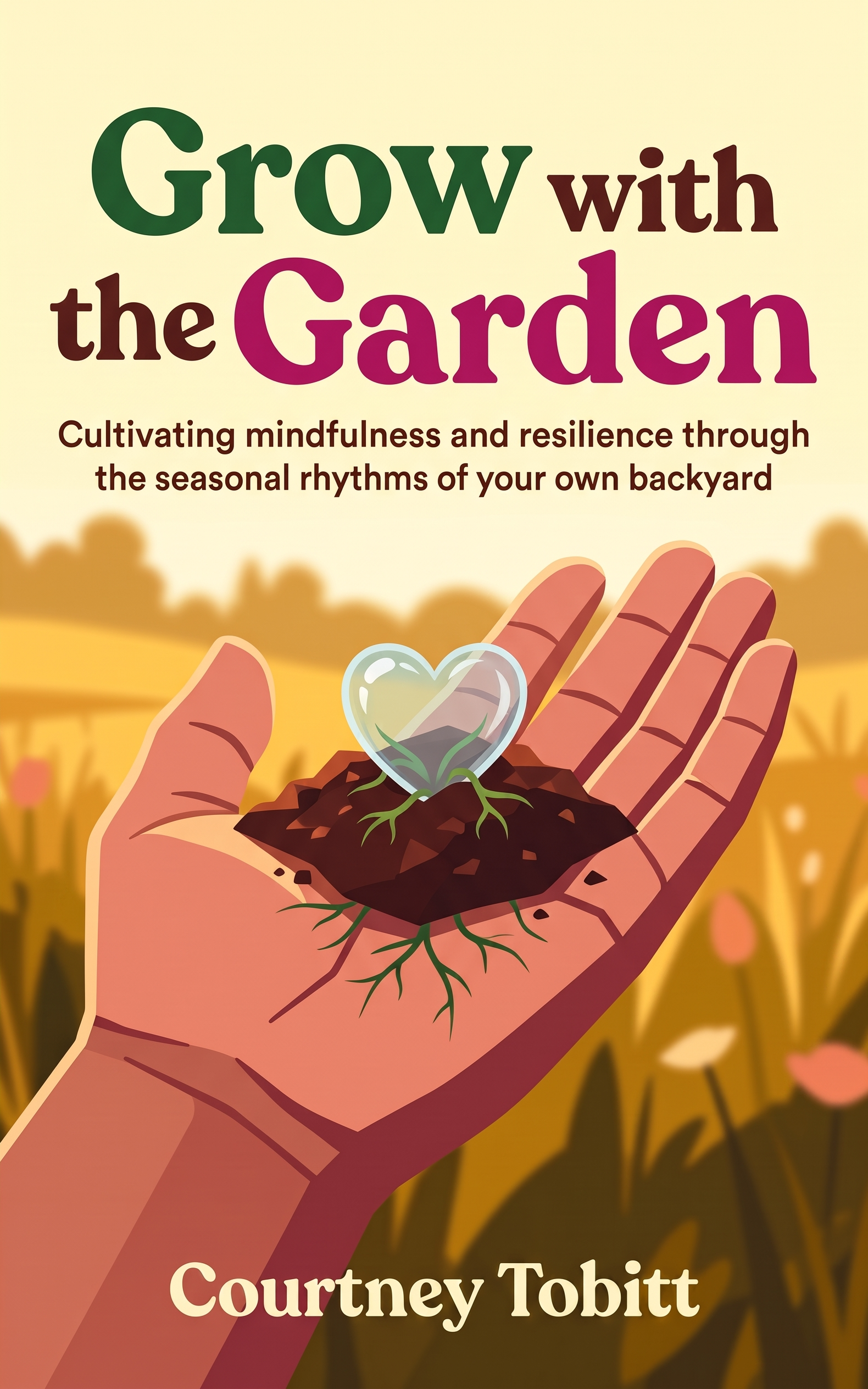
Grow with the Garden
Mindful Gardening for Beginners: Practical Gardening Advice, Nature's Wisdom and Gentle Lessons for Everyday Life
by Courtney Tobitt
Nature doesn't rush, yet everything gets accomplished. In a world that demands constant speed, Grow with the Garden invites you to set down your phone, pick up a trowel, and rediscover the slow, healing rhythm of the earth. More than a mere instructional guide, this book is a gentle companion for the soul. Courtney Tobitt masterfully weaves practical gardening lessons—from the alchemy of composting to the precision of seasonal pruning—with profound insights into personal well-being. Whether you are tending to your first window box or a sprawling backyard sanctuary, you will learn that the same patience required to sprout a seed is the patience you need to nurture yourself. Organized by the seasons, this journey guides you through the courage of Spring, the resilience of Summer, the release of Autumn, and the restorative rest of Winter. You will discover how to manage anxiety through horticultural therapy and find stability in life’s transitions by mirroring the steadfast cycles of nature. It is time to stop striving and start growing. Discover how the simple act of tending a garden can become the most transformative practice of your life.
- Self-Help
- Instructional Guide
- Educational & Academic
- Stress & Anxiety Management
- Life Transitions
- Personal Growth & Habits
Chapter One: Starting from the Ground Up
I stood in my backyard on a brisk Saturday morning with a rusty shovel, a pair of oversized cotton work gloves, and absolutely no plan. The lawn behind my house was not a lawn at all. It was a patchy, neglected expanse of weeds, stubborn dandelions, and hard-packed earth that had not seen a drop of deliberate water or a spade in at least a decade. The sky above was a pale, noncommittal gray, casting a flat light over my ambitious, albeit completely uneducated, attempt at transformation. I drove the tip of the spade into the ground, expecting it to slide in with the satisfying, silent ease I had seen in television programs. Instead, the metal blade hit the surface with a dull, metallic clang, sending a jarring vibration straight up my wrists and into my shoulders. The earth did not yield. It did not even dent. It was as solid as a concrete sidewalk.
That jarring vibration felt incredibly familiar. Just three months earlier, I had walked out of a corporate office building carrying a cardboard box filled with my desk plants, a coffee mug, and ten years of professional identity. After a decade in the exact same department, navigating the predictable rhythms of a stable career, my position had been eliminated in a sudden corporate restructuring. The shock of that transition was a physical sensation, a heavy, immovable weight in my chest. In the weeks that followed, every attempt I made to start over, to write a new resume, or to imagine a fresh professional path felt exactly like that shovel hitting the compacted dirt. The ground was hard, and the task of rebuilding my life felt completely impossible. Starting is always the hardest part of any journey. The physical resistance of the earth beneath my feet was a perfect, stubborn mirror of the mental resistance I felt toward my own unwanted, terrifying change.
I remember leaning on the wooden handle of that shovel, catching my breath, and looking at the tiny packet of tomato seeds I had purchased on a whim at the local hardware store. The packet showed vibrant, heavy fruits hanging from lush green vines. Looking down at the gray, stony dirt beneath my boots, the distance between that picture and my reality felt comical. How could something as fragile as a seed ever find a home in a place so hostile? I realized then that my approach was entirely wrong. I was trying to force a result without doing the quiet, unglamorous work of preparation. I wanted the harvest without the dig. This realization was the beginning of my relationship with the soil, a journey that eventually taught me how to rebuild my life from the ground up.
The Wisdom of the Soil
It is easy to look at a barren, weed-choked patch of ground and see only failure. We live in a culture that celebrates the bloom, the harvest, and the final, polished product. We want the thriving career, the restored relationship, or the peaceful mind, and we want it immediately. Yet, the natural world operates on a completely different timeline. In the economy of nature, potential is almost always hidden beneath a rough, unattractive surface. The soil is not just dirt; it is a complex, living system that requires care, attention, and preparation before it can ever support new life. When we ignore this foundation, we set ourselves up for disappointment.
Think about what happens when you try to plant a delicate flower seed directly into compacted, uncared-for dirt. The seed might germinate, but its tiny, fragile roots will quickly run into an impenetrable wall of hard clay or dense rocks. Unable to find oxygen, water, or nutrients, the young plant will wither and die before it ever has a chance to reach the sunlight. The exact same principle applies to our personal lives. You cannot start a brand-new, healthy chapter of your life while your internal landscape is still cluttered with the compacted emotional debris of your past. If you try to build a new career, start a new relationship, or adopt a new habit without first clearing out the old, hardened patterns of thought, your efforts will struggle to take root.
This process of clearing and preparing is what gardeners call cultivating the soil, and it mirrors the mental preparation we need for big life changes. When we clear away the physical rocks, weeds, and dead roots from a garden bed, we are performing an act of hope. We are declaring that this space is valuable and that it has a future. In our personal lives, this translates to identifying and removing the emotional clutter that keeps us stuck. This might mean setting boundaries with people who drain our energy, letting go of old resentments, or acknowledging the grief of a lost opportunity. It is quiet, heavy, and often invisible work. No one applauds you for pulling weeds or carting away rocks, yet without this stage, no future growth is possible.
In traditional agriculture, there is a beautiful term used to describe the ideal condition of soil: tilth. Tilth refers to the physical condition of the soil in relation to its suitability for planting. Soil with good tilth is crumbly, loose, and porous. It is easy to dig, allows water to penetrate deeply without pooling, and contains plenty of tiny air pockets that let roots breathe. When you hold a handful of soil with excellent tilth, it feels light and alive, crumbling effortlessly between your fingers. It is a perfect balance of structure and openness.
As a mental metaphor, tilth represents an open, receptive mind. When our minds are hardened by chronic stress, anxiety, or the shock of a sudden life transition, our internal tilth is poor. We become rigid, resistant to new ideas, and closed off to the possibility of change. We hold our breath, clench our jaws, and try to force our way through obstacles. Cultivating mental tilth means learning how to soften. It involves creating space in our daily lives for reflection, curiosity, and rest. By breaking up the hard, compacted habits of worry and self-doubt, we make ourselves receptive to new opportunities and fresh perspectives. We prepare our minds to receive the seeds of future joy.
In the Dirt
To truly understand your soil, you must get your hands dirty. You cannot assess the health of your garden by looking at it from a window, just as you cannot heal your mind by ignoring your physical body. Before you add any fertilizer, plant any seeds, or build any beds, you need to know exactly what you are working with. The first step is to evaluate your soil texture. Soil is composed of three primary mineral particles: sand, silt, and clay. The ratio of these three elements determines how your soil behaves, how well it holds water, and how easy it is for roots to grow.
- Sand: The largest particles. Sandy soil feels gritty. It drains water very quickly and does not hold onto nutrients well, but it provides excellent drainage and is easy to dig.
- Silt: Medium-sized particles. Silty soil feels smooth and powdery when dry, and slippery when wet. It holds water and nutrients better than sand, but can easily become compacted.
- Clay: The smallest particles. Clay soil feels sticky when wet and rock-hard when dry. It holds nutrients and water incredibly well, but drains poorly and is highly prone to compaction, making it difficult for roots to penetrate.
To find out where your soil stands, you can perform a simple, fascinating scientific experiment right in your kitchen. This is known as The Mason Jar Soil Test. It is a highly visual way to see the literal building blocks of your garden, and it requires only a few household items.
The Mason Jar Soil Test
To begin, gather a clean, straight-sided quart mason jar with a tight-fitting lid, some water, a teaspoon of liquid dish soap, and a small shovel. Go out to your garden area and dig down about six inches, bypassing the surface mulch or grass. Scoop up enough soil to fill your mason jar halfway. Remove any large rocks, twigs, or visible roots from the sample.
Once your jar is half-filled with soil, pour in clean water until the jar is nearly full, leaving about an inch of air space at the top. Add one teaspoon of liquid dish soap. The soap acts as a surfactant, helping to separate the individual particles of sand, silt, and clay so they can settle independently. Screw the lid on tightly, make sure it is sealed, and shake the jar vigorously for three to five minutes. You want to make sure all the clumps of dirt are completely broken up and suspended in the water.
Set the jar on a flat, level surface where it will not be disturbed, and begin your observations:
- After 1 minute: Watch the jar closely. The largest, heaviest particles will settle to the bottom almost immediately. This bottom layer is the sand. Mark the height of this layer on the side of the jar with a permanent marker or a piece of tape.
- After 2 hours: The medium-sized particles will begin to settle on top of the sand. This middle layer is the silt. It is typically a slightly different color and texture than the sand layer beneath it. Mark the top of this second layer.
- After 24 hours: The finest particles, the clay, will slowly settle out of the water, forming a distinct, tight top layer. The water above this layer should now be relatively clear, though it may still have a slight amber tint. Mark the top of this final layer.
Now, look at the three distinct bands of sediment in your jar. By measuring the thickness of each layer relative to the total height of all the settled soil, you can estimate your soil's composition. For example, if you have roughly equal parts sand, silt, and clay, you have what gardeners call loam. Loam is the holy grail of gardening soil because it combines the drainage of sand with the moisture and nutrient retention of clay and silt. If your jar is eighty percent sand, you will need to add plenty of organic matter to help it retain moisture. If your jar is mostly clay, you will need to add organic matter to loosen the structure and improve drainage.
Once you understand your soil's physical texture, the next step is to understand its chemical environment by testing its pH. The pH scale runs from 0 to 14, with 7.0 being completely neutral. Anything below 7.0 is acidic, and anything above is alkaline. Most garden vegetables and flowers prefer a slightly acidic to neutral pH, typically between 6.0 and 7.0. In this sweet spot, essential nutrients like nitrogen, phosphorus, and potassium are highly soluble and easily absorbed by plant roots. If your soil is too acidic (low pH) or too alkaline (high pH), those same nutrients become chemically locked up in the soil, leaving your plants starving even if the nutrients are physically present.
You can purchase a simple, inexpensive pH testing kit at any local nursery or garden center. These kits usually involve mixing a small spoonful of your soil with a provided testing powder and distilled water in a plastic vial. After a few minutes, the liquid changes color, and you compare the color to a chart to determine your pH level. If your soil is too acidic, you can raise the pH by adding garden lime (calcium carbonate). If your soil is too alkaline, you can lower the pH by adding elemental sulfur. Adjusting pH is a slow, chemical process, reminding us that true systemic change takes time and cannot be rushed.
If your native backyard soil is incredibly rocky, heavily compacted, or contaminated with lead or other urban pollutants, do not despair. You do not have to battle the native earth to have a thriving garden. Building a raised garden bed is an elegant, practical solution that allows you to bypass poor soil entirely by creating a perfect, customized growing environment right on top of the ground. It is an incredibly empowering weekend project that provides immediate, tangible results.
Building a Simple 4x4 Raised Bed
A four-foot by four-foot square is the perfect size for a beginner's raised bed. It is large enough to grow a respectable variety of vegetables or flowers, yet small enough that you can easily reach the center from any side without ever stepping on the soil and compacting it. To build this classic bed, you will need a few basic materials from your local home improvement store:
- Two 2-inch by 6-inch cedar boards, each 8 feet long (cedar is naturally rot-resistant and does not contain harmful chemical preservatives)
- One 2-inch by 2-inch wood stake, at least 3 feet long (for corner supports)
- A box of 3-inch exterior-grade galvanized wood screws
- A circular saw or hand saw (many lumber yards will cut the boards for you if you ask)
- A cordless drill and drill bits
- A staple gun and heavy-duty landscape fabric (optional)
- Several large, flattened cardboard boxes (no colored ink or plastic tape)
To assemble your bed, begin by cutting your two 8-foot cedar boards exactly in half, giving you four pieces that are 4 feet long. Next, cut your 2x2 wood stake into four pieces, each about 11 inches long. These will serve as your corner posts, helping to keep the bed perfectly square and structurally sound.
Choose a flat, sunny spot in your yard that receives at least six to eight hours of direct sunlight daily. Lay your four cedar boards on the ground to form a square. Position one of your 2x2 corner posts in the inside corner where two boards meet. Using your drill, pre-drill two holes through the outside of one cedar board and into the corner post, then secure them with your galvanized screws. Repeat this process for the adjacent board, fastening it to the same corner post. Work your way around the square until all four corners are securely fastened to their posts. You now have a sturdy, beautiful wooden frame.
Before you fill your new bed with soil, you must address the weeds and grass underneath. Instead of spending hours digging up the sod and straining your back, you can use a simple, highly effective ecological method: sheet mulching. Lay your flattened cardboard boxes directly onto the grass inside the wooden frame of your bed. Make sure the cardboard pieces overlap by at least six inches so no light can slip through the seams. Thoroughly soak the cardboard with a garden hose until it is completely wet. This heavy, dark layer will smother the existing grass and weeds naturally, cutting off their light source. Over the coming months, earthworms and soil microbes will slowly digest the wet cardboard, turning it into rich organic matter while leaving your garden bed completely weed-free.
Finally, fill your raised bed with a premium soil mixture. A fantastic, time-tested recipe for raised bed soil is a blend of one-third high-quality compost (for nutrients and microbes), one-third peat moss or coconut coir (for moisture retention), and one-third coarse vermiculite or perlite (for aeration and drainage). This mixture provides an incredibly light, nutrient-rich environment that will make any plant thrive. As you rake the soil level inside your new bed, take a moment to appreciate what you have built. You have created a safe, nurturing space where life can begin again.
Tending Your Inner Garden
While you are working with the physical earth, something remarkable is happening to your body and mind. The physical act of gardening is not just a chore; it is a powerful form of active meditation that has a profound impact on our nervous system. In our modern, highly digitized lives, we spend hours staring at glowing screens, processing abstract information, and living entirely in our heads. We are constantly bombarded with notifications, emails, and alerts, keeping our bodies in a state of low-grade, chronic alertness. We become disconnected from our physical bodies and the physical world around us.
One of the simplest and most powerful ways to break this cycle of mental exhaustion is through a practice known as earthing or grounding. Earthing is the simple act of making direct, bare-skin contact with the surface of the Earth. This can be as simple as taking off your shoes and socks and standing barefoot on a patch of grass, or sitting directly on the ground and running your bare hands through the loose soil. While this might sound like a purely sentimental or New Age practice, there is a growing body of scientific research that explains why physical contact with the earth feels so restorative.
Our bodies are electrical beings. Every nerve impulse, heartbeat, and muscle contraction relies on electrical signals. When we make direct contact with the ground, our bodies absorb free electrons from the Earth's surface, which carry a natural, subtle negative charge. These electrons act as natural antioxidants, helping to neutralize free radicals in our bodies, reduce systemic inflammation, and regulate our circadian rhythms. When you place your bare hands or feet in the dirt, you are quite literally plugging yourself back into the earth's natural electrical grid, helping to restore balance to your nervous system.
Beyond the electrical benefits, the soil itself contains microscopic allies that work directly on our brain chemistry. When you dig in healthy, organic soil, you are inhaling and absorbing a harmless, soil-dwelling bacterium called Mycobacterium vaccae. In groundbreaking studies conducted by researchers at the University of Bristol and the University of Colorado Boulder, mice exposed to this specific soil bacterium showed a dramatic increase in cognitive function and a significant reduction in anxiety-like behaviors. The researchers discovered that Mycobacterium vaccae stimulates a specific group of neurons in the brain that produce serotonin, the chemical messenger responsible for regulating mood, sleep, and emotional stability.
In other words, healthy soil contains a natural, organic antidepressant. When we get our hands dirty, we are not just cleaning up our gardens; we are actively dosing ourselves with a microscopic compound that lowers our cortisol levels, boosts our mood, and helps us feel more resilient in the face of life's challenges. Nature has designed a system where the very act of tending the earth rewards our bodies with peace and emotional balance.
To help you cultivate this physical connection to the present moment, I want to introduce a practical mindfulness tool called The Five-Senses Grounding Walk. You can practice this exercise in your garden, a local park, or even in a small green space in your neighborhood. It is designed to pull you out of the repetitive loop of anxious thoughts and anchor you firmly in the physical reality of the present moment.
The Five-Senses Grounding Walk
Begin by standing quietly in your garden space or on a patch of grass. Take three slow, deep breaths, letting your shoulders drop away from your ears with each exhale. Feel the weight of your body pressing down through your feet into the solid earth beneath you. When you are ready, slowly walk through the space, focusing your attention entirely on your physical senses, one by one:
1. See: Identify five distinct things you can see around you. Look closely at the details. Notice the specific shape of a leaf, the texture of the bark on a nearby tree, the delicate veins running through a weed, the color of the soil, or the tiny movements of an insect crawling across a stone. Allow yourself to observe without judging or labeling things as good or bad; simply notice their visual presence.
2. Feel: Identify four things you can physically feel. This might be the cool breeze brushing against your cheeks, the warmth of the sun on your bare arms, the rough texture of a wooden garden post, or the cool, crumbly sensation of loose dirt between your fingers. Focus entirely on the physical sensation of touch and the boundary where your body meets the world.
3. Hear: Identify three distinct sounds. Close your eyes for a moment if it helps you focus. Listen to the rustle of leaves overhead, the distant hum of traffic, the chirp of a bird, the buzz of a bee, or even the sound of your own steady breathing. Let the sounds wash over you without trying to analyze where they are coming from.
4. Smell: Identify two things you can smell. Lean down close to the ground and take a deep breath. Can you smell the rich, damp, earthy scent of the soil? Can you smell the sharp, green fragrance of crushed mint or pine needles? The sense of smell is wired directly into the emotional centers of our brain, and focusing on natural scents can instantly soothe a racing mind.
5. Taste: Identify one thing you can taste, or one specific thing you are deeply grateful for in this exact moment. If you have fresh herbs growing, you might pluck a single leaf of basil or rosemary and chew it slowly, focusing on the sharp burst of flavor. If not, simply close your eyes and focus on one simple truth: you are here, you are breathing, and you are taking active steps to care for yourself.
When you complete this walk, you will likely find that the mental chatter that seemed so loud and urgent just a few minutes ago has quieted down. You have shifted your nervous system out of a state of reaction and into a state of presence. You are learning to exist in the current moment, which is the only place where growth can actually occur.
The Harvest
When we look at a beautiful garden, we are looking at the result of weeks, months, and sometimes years of invisible preparation. The spectacular blooms of summer are entirely dependent on the quiet, unglamorous work of spring. If you skip the step of clearing the rocks, breaking up the compacted clay, and balancing the pH, even the most expensive seeds and fertilizer will not save your garden. A good foundation is the only way to support future growth.
This is perhaps the most vital lesson the garden teaches us about our own lives: preparation is not a waste of time. When you are in a period of transition, it is easy to feel like you are falling behind. When you lose a job, end a relationship, or face a major health challenge, there is a powerful urge to rush into the next thing. We want to plant new seeds immediately, to prove to ourselves and the world that we are moving forward, that we are successful, and that we are okay. We want to skip the dark, quiet, muddy phase of clearing and preparing.
Yet, rushing the planting process almost always leads to weak roots. If you do not take the time to process your grief, understand your patterns, and heal your spirit, you will carry the same compacted, rocky soil into your next venture. The work we do when nothing is growing yet—the digging, the weeding, the testing, and the waiting—is actually the most important work of all. It is the work that determines the ultimate health and yield of our future harvest.
If you are currently standing in your own backyard, looking at a hard-packed, difficult life situation with a rusty shovel in your hands, take a deep breath. Do not worry about the harvest yet. Do not worry about how you will grow tomatoes or roses when the ground looks like concrete. Your only task right now is to clear a small space. Turn over one spadeful of dirt. Test your soil. Build a single, simple frame. Get your hands dirty, feel the earth beneath your feet, and trust that this quiet preparation is the first, essential step toward a beautiful, resilient future.
To help you integrate the lessons of this chapter, take some time to reflect on these questions or write down your thoughts in a journal:
- Reflection Question 1: What "rocks" or debris in your current life are making your internal soil feel too hard to plant something new? Are there old habits, resentments, or obligations that you need to physically clear away before you can begin a new chapter?
- Reflection Question 2: If you were a plant, what kind of soil environment would make you feel most secure? Do you need more structure and stability (like a bit of clay), or do you need more freedom and room to breathe (like sand and organic matter)? How can you begin to build that supportive environment for yourself today?
The Courage of a Seed
I sat at my kitchen table with a single radish seed resting in the center of my palm. If you have ever looked closely at a radish seed, you know how utterly unimpressive it is. It is a tiny, dusty-brown speck, small enough to lose under a fingernail and light enough to be swept away by the gentlest draft from an open window. Yet, within that minusc…