


White Fang
WHITE FANG the prophecy begins
by craft creations
In a quiet Icelandic valley, the White Fang clan lives by moonlight, oath, and the long memory of wolves. Alpha Robert Thorn keeps the old rhythms: dawn walks, council, and the patient work of leading a people who still believe the gods watch the snow. When his wife Leatha bears twins marked by glowing blue runes and circling ravens, an ancient promise stirs awake. Years later, eldest son Anthony comes home with his mates, Mayum and Otis, after blood on the border. The clan builds them a longhouse and opens its doors. Under a full moon, five-year-old Michael and Jessika take their First Shift—midnight black and moon white, sapphire runes and moonstones bright on their brows. They are called Odin's Blessed. Then ships arrive from India. An envoy of the Singh family carries a fifteen-year-old betrothal that names Jessika for Major Veer Pratap Singh. Michael will not let his twin sail alone. Robert must honor an oath that tears his children from the valley. White Fang is a mythic family saga of belonging, duty, and the sea that waits beyond the fjord.
- Fantasy
- Paranormal
- Erotica
- Shifter
- Cozy Fantasy
- Mythological
Morning in White Fang
The first golden rays of the Icelandic summer sun draped over the snow-capped mountains, turning their frozen peaks to molten gold. Shadows stretched and retreated across the valley as the light crept down the slopes, chasing away the last remnants of night. Morning haze drifted slowly across the great lake at the valley's heart, softening the reflections of dragon-prowed longships resting quietly along the weathered wooden docks. Occasionally, a ripple disturbed the mirrored surface—a curious otter vanishing beneath the water, or the lazy rise of a fish drawn to the warmth above. High above, a waterfall thundered endlessly down sheer black volcanic cliffs, its crystal waters catching the morning light in fractured rainbows as they fed the river that slithered through fields of wild purple lupine before disappearing into the waiting arms of the North Atlantic. The sound of rushing water was both a lullaby and a summons, echoing faintly over the valley’s awakening hush. The air shimmered with the mingled scents of cold stone, blooming heather, and distant sea salt—the world waking with a breath both fresh and ancient. "Now and then, the wind brought the salty smell of the sea or the earthy scent of woods and damp moss, carrying each note into the quiet promise of a new day."
One by one, thin streams of smoke drifted from the sod-roofed longhouses scattered across the valley floor, blurring the pleasant morning air with the warm, familiar perfume of peat and pine. Doors swung open the faint clatter of wooden tools on stone began to echo from the open thresholds. The valley was painted with soft blue wisps that rose and twisted, catching the sunlight as they drifted upward and vanished. Chickens clucked quietly in the distance, and somewhere, the mournful bleating of a goat answered the call of a waking child.
Not because alarms had sounded.
Not because danger threatened.
Simply because another ordinary day had begun.
White Fang woke slowly.
The heavy oak door of the Alpha's longhouse opened with a familiar moan..
Robert Thorn stepped into the cool early morning air carrying four carved wooden mugs filled with steaming spruce-tip tea.
The crisp scent of pine trees and sea salt drifted across the valley as he paused on the porch, letting the crisp cool air settle on his skin. For a moment, Robert simply stood, mug warming his hands, and let himself fully breathe it in. How many mornings like this had there been? Hundreds, perhaps. And yet, each one felt like a small blessing—a reminder that the world could still be peaceful, even if only for an hour. The light breeze carried the distant cry of seabirds and the crashing rush of the waterfall, layering the morning with a wild serenity that belonged only to White Fang. Far off, the muffled shouts of fishermen preparing their nets blended with the low hypnotic hum of voices inside the longhouse. He glanced at the three mugs nestled in his hands, thinking of the sons who would soon step out and join him. How quickly they had grown. Was he making the most of these quiet peaceful moments before the day’s demands returned? Did they notice how proud he was, or understand the quiet hope he carried for each of them?
Every breath tasted of home—earth, salt, and the promise of a brand new day. The world seemed suspended between sleep and waking, as if the valley itself were drawing a deep, contented breath before the day began in earnest.
A heartbeat later, Anthony ducked beneath the doorway, accepting one of the mugs with an appreciative nod.
"Morning, Father." His voice was still soft with sleep, but his smile was genuine and warm.
"Morning," Robert replied, letting the word linger. He took a quiet moment to watch his eldest, noticing the lines of boyhood slowly fading from Anthony’s face.
The porch creaked. Another figure appeared—Alex, fastening a leather bracer around his forearm, eyes flicking between his family as if wondering whether to join their quiet. At sixteen, he was nearly as tall as Anthony, but his posture still betrayed the restless energy of youth.
Anthony grinned at his brother. "You're late."
Alex rolled his eyes, but the corners of his mouth twitched. "I was eating."
"You were hiding," Anthony teased, nudging him lightly.
Alex shrugged, mock-defensive. "I was avoiding Matthew."
Robert raised an eyebrow, a smile tugging at his lips. "What did he do now?"
Alex gave a grand sigh. "He wanted to know if a wooden sword could kill a dragon."
Anthony’s laughter resonated off the porch beams.
"And?"
"I told him only if he hit it often enough."
Robert chuckled, warmth blooming in his chest. "A perfectly reasonable answer."
The three shared an easy laugh, the sound gentle in the morning hush. For a moment, Robert let himself simply stand and watch his sons—one nearly grown, the other still finding his edges. These were the mornings he cherished most.
He waited until the laughter faded, until the silence felt companionable, then finally stepped from the porch. His sons fell into place beside him, steps syncing on the dew-damp path. For a few breaths, the world seemed to slow with them.
They had barely reached the gate before a familiar voice rang out.
"Wait!"
All three turned.
Donald came sprinting from the longhouse, one boot half fastened, hair wild, mug clutched in both hands. His cheeks were flushed from the run, breath puffing in the cool air.
"You forgot me!"
Anthony laughed. "We wondered how long it'd take."
Donald skidded to a stop between Robert and Anthony, breathing hard. "You started without me."
Robert steadied his youngest with a hand on his shoulder, smiling. "We thought we'd let you sleep."
Donald's eyes widened. "On walking day?"
Alex folded his arms, feigning seriousness. "I said the same thing."
Donald's gaze darted suspiciously between his brothers. "You almost left."
Anthony pressed a hand to his chest. "I deny everything."
"You walked away!"
"We were testing your speed," Anthony said, grinning.
Donald considered, lips pursed. "...I passed."
"You certainly did."
Satisfied, Donald took his place between Robert and Anthony, sipping his tea as if reclaiming a throne.
"There."
He nodded once, looking up for approval.
Robert handed him the last cup of tea and smiled, letting the sense of wholeness settle over him. "Now we can start."
He let the moment linger, holding his sons close in his thoughts before the day carried them on.
Donald had only been joining them for a few months, yet he already spoke as though the tradition had existed entirely for his benefit.
In a way...
Perhaps it had.
The morning walk had begun long before Anthony could remember.
When Robert first became Alpha, he had walked the village alone every sunrise.
Before the fishermen sailed.
Before the forge fire was lit.
Before the council gathered.
He greeted fishermen before they cast off.
He inspected fences damaged during the night.
He checked on repairs.
He listened to craftsmen.
He stopped wherever someone wished to bend the Alpha's ear before the day's work truly began.
An Alpha who remained inside the Great Hall, Robert often said, only knew half his clan.
Then one winter morning, five-year-old Anthony had wandered sleepily out the front door wrapped in little more than a fur blanket and determination.
Leatha had leaned out after them.
"Robert Thorn!"
"He needs his sleep!"
Robert had only smiled.
"I'll bring him back before breakfast."
Anthony had followed him again the next morning.
And the morning after that.
Eventually Robert had simply poured a second mug of spruce-tip tea.
Neither of them had questioned it again.
Five years later, another pair of tiny boots had appeared beside the front door.
Alex.
He had marched proudly between his father and older brother every morning, refusing to admit when his little legs struggled to match their longer strides.
Anthony still remembered those mornings when Alex, much smaller then, would quietly grab the back of his cloak to keep from falling behind. He’d always pretended not to notice, slowing his stride just enough, letting his brother’s small hand anchor him to the moment.
Donald, walking just ahead, glanced over his shoulder, curiosity lighting his face.
"You really did that?"
Alex sighed, but there was a trace of a smile tugging at his lips. "I was little."
Anthony grinned, catching Alex’s eye. "You were stubborn."
Alex raised his chin. "I still am."
"That much hasn’t changed," Anthony said, and the playful challenge in his voice was met by a spark in Alex’s eyes.
They fell into easy laughter, the sound rising with the morning breeze. For a moment, time seemed to hesitate, letting them savor the memory—past and present woven together beneath the endless Icelandic sky.
But the seasons turned, whether they noticed or not.
Years slipped by, marked by the steady cadence of work and the subtle shifting of roles. Anthony remembered the day he first walked to the forge instead of the fields, the weight of Bjorn Ironhide’s apprentice hammer settling into his palm. He could still see Alex’s proud but nervous smile when he began learning the leatherworker’s craft, the smell of tanned hides and beeswax clinging to his clothes.
Responsibility crept into their mornings, quiet but insistent, reshaping the way they moved through the world.
Now, at sixteen, Alex’s hands bore the faint marks of his trade. He knew his place was as much in the workshop as it was beside his father on these walks—a boy caught between the echo of childhood and the pull of what waited for him just beyond the valley.
He joked that he would miss these sunrise walks more than he would miss sleeping late.
Donald had overheard him.
The very next morning, Donald had quietly slipped out the front door, cradling his own wooden mug in both hands. He’d fallen into step beside Robert and Anthony, not saying a word—just matching their pace, as though he had always belonged there.
Robert had simply glanced down, a hint of pride in his eyes, but hadn’t said a thing.
The following morning, without fuss, Robert poured another cup of tea. The routine, once unspoken, had shifted to make room for one more.
Donald puffed out his chest, walking a little taller between his father and brother. The warmth of belonging radiated from him, his small hands wrapped tightly around his mug.
"I think this is my place now," he declared, glancing up at Robert and Anthony. There was a new certainty in his voice, the kind that comes with having found something important.
Anthony snorted, barely hiding his grin. He let the words hang in the morning air before answering, relishing the moment.
"Your place?"
Robert watched his eldest with quiet pride. Even at nineteen, Anthony carried himself with a steadiness that belied his years—a broad-shouldered young man, already filling out with the muscle of a blacksmith and the easy confidence of someone used to leading others. There was a spark of humor in his blue eyes, a gentleness that softened the powerful frame he would one day inherit from his ancestors. People sometimes forgot how young he truly was, mistaking his calm for age, his quiet strength for something earned over decades instead of just nineteen winters. Yet, to Robert, he was still the boy who had once clung to his father’s hand on these same morning walks, even if now he was just as likely to be the one others depended on.
Donald nodded, confidence radiating from every inch of him.
"Alex gave it to me."
Alex, walking just ahead, paused and glanced over his shoulder with a laugh. "I distinctly remember no such conversation."
Donald shrugged, as if the technicalities didn’t matter. He looked straight ahead, chin lifted.
"You didn’t stop me."
Alex shook his head, still smiling.
"That’s not the same thing," he said, but his voice was gentle, teasing rather than challenging.
Robert’s laughter was low and warm, the kind that lingered in the quiet morning. He slowed his steps just a little, savoring the sight of his sons together.
"Be careful," he said, his tone soft—part warning, part amusement.
Donald looked up at him, suddenly wary, the bravado slipping just a little.
"Why?"
Robert leaned in a bit, his voice a mock whisper.
"When Matthew turns five, he may decide it’s his place."
For a heartbeat, Donald’s eyes grew wide, the idea landing with all the force of a new and terrible possibility. He looked between his father and brothers, searching their faces for reassurance.
"He can’t," he blurted at last, the words bursting out with genuine horror.
"Why not?" Robert asked, the corners of his mouth twitching.
Donald scanned the narrow path, as if sizing up the available space.
"There isn’t room," he insisted.
Anthony burst out laughing.
"We’ll make room," he promised, reaching over to ruffle Donald’s hair.
Donald pulled away, determined.
"I’m keeping my place."
Robert’s smile was touched with something bittersweet.
"One day," he said quietly, "you’ll all be too busy with your own apprentices and families."
Donald folded his arms, stubbornness etched in every line of his small frame.
"I’m never missing these walks."
Anthony caught Robert’s eye over Donald’s head, amusement and memory mingling in his expression.
"That’s exactly what we used to say," he murmured, and for a moment, the future and the past seemed to walk together down the quiet morning road.
The four continued down the gently worn path toward the harbor as White Fang slowly awakened around them. Dew clung to the wild grasses at their feet, sparkling like scattered gems in the growing light. Birds flitted from rooftop to rooftop, their wings bright against the pale sky, as the chorus of morning grew steadily louder. The soft thud of distant axe strokes and the creak of leather harnesses drifted on the breeze—a gentle reminder that the valley’s peace was always underpinned by the steady rhythm of work and care.
Behind them, the Alpha's longhouse disappeared among the morning mist.
Ahead, dragon-prowed longships waited patiently against the docks.
Another ordinary day had only just begun.
SECTION 2
The Longhouse
The longhouse grew noticeably quieter when the front door closed behind Robert and the boys. For a while, the world shrank to the slow crackle of the hearth and the gentle hiss of breakfast on the fire. The familiar warmth of stone and wood, the faint scent of peat smoke, and the comfort of old wool filled the great room.
Leatha let her gaze wander over the sunlit floorboards, soaking in the rare hush. She treasured these quiet moments before the day gathered its usual momentum—moments when she could almost forget the weight and worry that came with carrying twins.
“They’re loud,” she said quietly, almost to herself.
Astrid glanced up from the hearth, where she was turning thick rounds of rye bread. She smiled, a knowing look in her eyes.
“They’re men.”
Sometimes Astrid wondered how the house could be so full of noise one moment and so peaceful the next. She’d spent years learning how to find calm in the chaos, to hold onto these gentle mornings before the clan’s demands came knocking.
Leatha grinned, the lines at the corners of her eyes softening. “I suppose that’s the same thing.”
She did love that noise—most days—but there was something precious about these intervals of peace, a chance to be simply herself and not the Alpha’s mate or the mother of the next generation.
Astrid laughed, her voice low and warm. “I’ve spent fifteen years trying to convince Robert otherwise.”
Astrid often thought Robert’s stubbornness was as much a comfort as it was a trial. Some things, she supposed, never changed.
“And?” Leatha asked, her tone light, as if she already knew the answer.
“He remains unconvinced,” Astrid replied, shaking her head. For a moment, the two women let the humor stretch between them, a thread of shared history.
Astrid felt a surge of affection for Leatha—how easily she fit into this rhythm, how she never tried to take up more space than she needed, even now with twins on the way.
Leatha’s hand drifted toward a woven basket by the doorway. The movement was slow, as if savoring the act itself. But Astrid, moving with quiet purpose, reached it first.
“I need that,” Leatha protested, but there was no real bite behind her words.
She hated how helpless she sometimes felt—how even the smallest tasks could provoke gentle rebuke. She wanted to be useful, not watched over like precious glass.
“You need to sit down,” Astrid answered, her voice gentle but firm.
It was easier to fuss than to admit worry. Astrid had seen too many pregnancies end in sorrow, and this one carried more hope—and more risk—than most.
Leatha hesitated, then gave a small shrug. “I’ve been sitting.”
“You slept.”
“That counts.”
“It doesn’t.”
Leatha sighed dramatically, settling back in her chair. “I don’t remember you being this bossy.”
But she was grateful, truly. It was easier to surrender to Astrid’s care than to argue, especially when she was tired.
Astrid carried the basket to the far side of the room, her steps measured and deliberate. She set it down, just out of reach, then looked back over her shoulder.
“I wasn’t.”
Leatha raised an eyebrow. “What changed?”
“You decided to carry twins.”
Astrid’s heart squeezed a little, thinking of the weeks ahead. She prayed every night for safe arrivals, for Leatha’s strength to hold.
Leatha’s hand found the gentle curve of her stomach, fingers tracing absent circles. “I don’t remember being consulted.”
She tried to make light, but there was truth beneath the joke—carrying these children felt less like a choice and more like destiny pulling her along, ready or not.
“No…” Astrid’s smile softened around the edges. “I suppose Robert deserves at least part of the blame.”
She thought of Robert, of the way he fretted silently and pretended he didn’t.
“Only part?”
“Oh, most of it.”
Their laughter mingled with the soft morning light, filling the space between words.
From one of the alcoves, a sleepy voice drifted out.
“Mother?”
Eight-year-old Sarah shuffled into the room, her braid a hopeless tangle, eyes still heavy with sleep. She rubbed one fist across her cheek, blinking at the two women.
“What did Father do?”
Astrid answered before Leatha could, her tone teasing. “Exist.”
She winked at Leatha—Sarah was clever, and it wouldn’t be long before she saw through their jokes.
Sarah nodded, as if this explained everything. “I thought so.”
Leatha laughed, her voice brighter now. “You’ve been spending far too much time with your Aunt Astrid.”
She was grateful for the bond between her daughter and her oldest friend; it felt like passing on a small legacy.
“I like Aunt Astrid,” Sarah replied, with the honest conviction of children.
“So do I.”
Astrid knelt, hands gentle as she smoothed Sarah’s hair. “Your mother was just about to ignore every healer in White Fang.”
She tried to keep her tone light, but inside she watched Leatha’s every movement, searching for signs of fatigue she might try to hide.
“I was going to carry one basket,” Leatha said, feigning innocence.
She wanted to laugh, but she could feel the edges of exhaustion creeping in.
“One very heavy basket,” Astrid countered.
Sarah crossed the room, determination in her step. “I can carry it.”
Leatha’s smile softened. “You’ve only just woken up.”
She marveled at Sarah’s eagerness to help, at how quickly her little girl was growing up.
“I know.”
“But you’ve been carrying babies all night,” Sarah said, her voice suddenly thoughtful.
Leatha blinked, surprised by her daughter’s insight. “That’s surprisingly thoughtful.”
She felt a rush of pride—her children were already looking after her, just as she did for them.
Sarah shrugged, looking down. “They’re heavy.”
“They are.”
“And they’re making you tired.”
Leatha leaned forward, brushing her thumb across Sarah’s cheek. “They’re worth every bit of it.”
She meant it with her whole heart, even on the hardest mornings.
Sarah beamed. “I know.”
She reached for the basket, but Leatha’s gentle protest was cut short by a sudden, slow tightening across her lower back.
Leatha stilled, her breath catching. Not pain, just surprise. She rested her hand on the table, steadying herself. Is this it? No, not yet. Just the body’s way of reminding her that things were changing, that the day would come soon enough.
The room hushed. She felt both babies shift inside her—one nudging beneath her ribs, the other pressing low.
It was always strange, the way her body felt both wholly hers and not at all. She closed her eyes, focusing on the sensation. With a slow breath, it faded as quietly as it had come.
When Leatha opened her eyes, Astrid was already at her side, concern shadowing her features.
Astrid felt her heart leap—every small change made her anxious, even after all the births she’d attended. She steadied her voice.
“They’re awake,” Leatha said, forcing a reassuring smile.
Astrid’s gaze was sharp. “That wasn’t one of their kicks.”
She watched Leatha’s face carefully, reading beneath the surface. Had she missed something?
“No.” Leatha rubbed her stomach, searching for the right words. “It felt… different.”
She hated not knowing. She’d been through this before, but every pregnancy was its own mystery, especially with twins.
Sarah looked from one woman to the other, worry flickering across her face. “Different how?”
Leatha hesitated, then smiled to reassure her. “I don’t know. Just… a cramp.”
She didn’t want to frighten her daughter. She needed to believe, for all their sakes, that everything was still all right.
Astrid folded her arms. “You stopped talking.”
“I was thinking.”
“And then you stopped smiling.”
“I was concentrating.”
Astrid raised an eyebrow, lips twitching. “You’re a terrible liar.”
She tried to keep the mood light but made a mental note to watch Leatha even more closely today.
Leatha laughed, shaking her head. “I’ve never been very good at pretending around you.”
She was grateful for Astrid’s honesty, for the way she never let Leatha hide behind false cheer.
“No,” Astrid agreed softly. “You haven’t.”
Sarah’s brow furrowed. “Should I go get Father?”
Leatha squeezed her daughter’s hand. “No, sweetheart.”
She knew if Robert came back now, he’d hover and fret, and she wanted this one morning to feel normal.
“But—”
“These two have been reminding me they’re almost ready for days.” She stroked her stomach, her voice gentle. “I think they simply wanted to say good morning.”
It was easier to pretend everything was fine, to keep fear at bay with small reassurances.
Almost as if on cue, a small foot—or maybe an elbow—pressed against her palm, insistent and alive.
Leatha laughed, the sound easing the tension in the room. “There. You see? They heard me.”
For a moment, she allowed herself to believe it was all just as it should be.
Sarah’s eyes went wide. “They can hear us?”
“Oh yes. They’ve been listening to this family for months.”
Astrid finally smiled, some of the worry easing from her face. “Which means they’re already accustomed to noise.”
She tried to picture the house even louder, filled with the new cries and laughter of babies.
Leatha grinned, glancing at Sarah. “They’ll need to be.” She squeezed her daughter’s hand one more time. “Your father deserves one peaceful morning.”
She thought of Robert’s quiet exhaustion, the way he tried to shield them all from his own worry.
Astrid snorted, her eyes dancing. “I believe that ship sailed the day Anthony learned to talk.”
She remembered those days, and the memory made her smile.
Leatha laughed softly. “Probably.”
She met Sarah’s gaze, her voice steady. “If anything truly changes, I promise you’ll be the first to know.”
Even if it scares me, she thought, I won’t keep you in the dark.
Astrid watched her a moment longer, then nodded, satisfied. “I’ll hold you to that.”
And I will, she promised herself.
“I know you will.”
Sarah lifted the basket with both hands, face scrunched with effort. “It’s heavier than I thought.”
Leatha reached out on instinct, but Astrid and Sarah both said, “No,” in perfect unison.
Leatha blinked, a smile breaking through. “You’ve been practicing.”
Astrid grinned. “We’ve had an excellent teacher.”
She looked at Leatha, pride and affection mingling in her gaze.
Sarah nodded, pride brightening her face. “The best.”
Leatha looked at them both, laughter escaping her lips in surrender. “It seems I’ve been thoroughly outnumbered.”
It was a comfort, she realized, to be surrounded by strong women—her daughter, her friend—carrying her through the waiting.
Astrid slipped her arm through Leatha’s, gentle and familiar. “You always were.”
Astrid felt the old certainty settle in her chest—together, they could weather anything.
Together, the three women stepped out into the cool Icelandic morning, the air crisp and bright against their faces.
Behind them, the longhouse settled into a softer quiet. Ahead, the waking clan stirred beneath the summer sun.
None of them noticed old Marta watching from the bakery doorway. The elderly baker smiled to herself. She’d helped deliver more babies than anyone could remember, and she recognized that look. But she wasn’t about to spoil the surprise.
SECTION 3
The Village Awakens
The cool morning air carried the scent of saltwater as Robert led his sons farther down the gently worn path. Each breath was crisp, tinged with the promise of a new day.
Behind them, the Alpha’s longhouse faded into the green hillside, its turf-covered roof nearly invisible now. The sounds of their family’s laughter lingered in Robert’s mind, even as the village of White Fang stretched out before them, bathed in soft sunlight. One by one, the longhouses stirred awake—thin ribbons of smoke curling from stone chimneys, doors swinging open, voices drifting between homes.
Wolves stretched languidly in patches of morning light before flowing effortlessly into human form, dew scattering from their hair as naturally as another might shrug on a cloak. The transformation was as ordinary here as the rising sun.
Donald took another sip of spruce-tip tea, cradling his mug in both hands, and smiled into its warmth.
“I still think this is the best part of the day.”
Robert glanced down at him, taking a slow breath.
“So do I.”
Anthony smiled, watching the way the village shimmered in the early light.
“It wasn’t always four mugs.”
Donald looked from his eldest brother to his father, curiosity flickering in his eyes.
“No?”
Robert chuckled softly, savoring the memory.
“For many years, there was only one.”
Donald’s eyebrows lifted.
“You walked alone?”
“I did.”
“Every morning?”
“Every morning,” Robert repeated, the words gentle, not regretful.
Donald seemed troubled by the idea, his small face creased with thought.
“Wasn’t that lonely?”
Robert considered the question as they continued down the path, listening to the slow chorus of village life awakening around them—the clatter of buckets, the low hum of greetings, the distant barking of a dog.
“No,” he said at last, his gaze lingering on the rooftops. “White Fang was always waiting for me.”
Anthony looked across the waking village, recalling the countless mornings spent following in his father’s footsteps, shoes growing larger each year until they nearly matched.
“Father always said an Alpha shouldn’t learn about his people from reports.”
Robert nodded.
“You can’t smell fresh bread from a council table.”
Donald laughed, the sound light and bright as birdsong.
“I suppose not.”
“You can’t see a loose roof tile,” Robert continued, “or notice someone favoring an injured leg.”
“Or hear Old Marta shouting at the bakers,” Anthony added, grinning.
As though summoned, a burst of laughter drifted from somewhere near the bakery, the sound carrying on the morning air.
Robert smiled, letting the village’s energy settle into his bones.
“Exactly.”
Alex adjusted the leather bracer around his wrist, watching a group of children chase each other past the well.
“The shouting usually means someone has stolen a loaf.”
All three brothers looked toward Anthony, expectant.
Anthony placed a hand over his heart.
“I’m wounded by the accusation.”
“You’ll recover,” Alex assured him, his voice teasing.
Robert’s smile deepened as he rested a hand briefly on Donald’s shoulder, feeling the boy’s warmth through the wool.
“An Alpha who stays inside the Great Hall only knows half his clan.”
Donald mulled that over, eyes wandering from the fishermen hauling nets to the women sweeping out their thresholds.
“So you walk to see everyone.”
Robert looked at the villagers beginning their work—faces he’d known since childhood, voices that had greeted him across decades.
“I walk so they know they can see me.”
Donald fell silent, absorbing the lesson. He watched the fishermen crossing the lower path, the women opening shutters to let the morning in, and the older wolves returning from a night beneath the trees. He seemed to tuck Robert’s words away, as if storing them for later. Anthony had once done the same. Perhaps Alex had too. Some lessons, Robert thought, were never spoken outright but carried slowly through the village, one morning at a time.
As the brothers walked, Donald grinned, thinking of the noise that always filled the longhouse. With so many brothers and sisters—old and young, all under the same roof—there was never a quiet morning, and he wouldn’t have it any other way. To the Thorn children, there were no half-siblings or steps: only family, a single, sprawling pack.
The path curved toward the lake. Morning mist drifted across the harbor below, wrapping itself around the dragon-prowed longships as though reluctant to let them leave. Their carved wooden figureheads—wolves, ravens, dragons, and sea serpents—rose proudly above the calm water, watching over the docks as they had for generations.
Donald breathed deeply, letting the scent of brine and tar and fresh-cut wood fill his lungs.
“I love it here.”
Anthony glanced toward the ships, the memories softening his expression.
“So do I.”
Robert rested his forearms against the weathered railing overlooking the harbor, feeling the sun warm the old wood.
“We always begin here.”
As they passed a neighbor’s doorway, a woman called out with a wave, “How’s your Leatha, Robert? Ready for the next little Thorn?” Her eyes twinkled with good-natured teasing.
Robert smiled, well used to such questions. “We’re all ready—just waiting on the twins now.”
The woman laughed. “You’ll soon have the whole village calling you ‘Father Thorn’!”
Anthony exchanged a knowing look with his brothers. He glanced back toward the longhouse, knowing that, for their family, there was no such thing as ‘step’—just siblings, one loud, sprawling pack. And soon, the noise and love would only grow.
Donald looked up, curiosity shining.
“Because the fishermen wake first?”
Anthony grinned, remembering.
“I asked that when I was his age.”
Robert’s eyes sparkled as they moved across the waiting fleet, the memory bright.
“The sea feeds us before the forge arms us.”
Donald followed his gaze, studying the boats, the nets, the barrels being rolled along the piers, the fishermen moving with practiced purpose.
“I like that.”
“You’ll understand it better as you grow,” Robert said gently.
Several crews were already preparing their longships for the day’s fishing. Nets were inspected cord by cord for breaks. Heavy ropes were coiled neatly across the decks. Barrels of drinking water, smoked meat, and spare line were passed from hand to hand with a steady efficiency that spoke of years working together. Every movement had purpose. No one shouted. No one hurried. They had done this thousands of mornings before.
A broad-shouldered fisherman raised one hand in greeting.
“Morning, Alpha.”
Robert smiled.
“Morning, Erik.”
Another man looked up from repairing a net.
“Morning, Anthony.”
“Morning.”
“Alex.”
Alex inclined his head in answer.
Donald leaned forward eagerly, wanting to be part of the ritual.
“Morning!”
The fishermen laughed. One of them reached over and ruffled his already unruly hair.
“Growing again?”
Donald spread his hands several inches apart, grinning.
“At least this much.”
The fisherman studied him gravely.
“I’d better make your bunk longer.”
“You should.”
The laughter followed them farther down the pier, the sound lingering even as they moved on.
Robert greeted every person they passed by name, pausing to ask after a fisherman’s aching shoulder, to congratulate another whose daughter had taken her first deer with a bow, to promise a visit to an elderly grandmother recovering from fever, and to assure a shipwright that the council would discuss timber for a damaged mast before the autumn storms arrived. He never hurried anyone. When he asked a question, he waited for the answer, listening with the patience that had earned his people’s trust.
Donald watched him for several minutes, curiosity building.
“How do you remember everyone?”
Robert looked genuinely puzzled, as though the answer should be obvious.
“They’re my people.”
Anthony laughed softly.
“I asked him that years ago.”
Donald turned toward him, eyes wide.
“And?”
“He gave me the same answer.”
Robert shrugged.
“It has always seemed enough.”
Near the far end of the pier, a lanky boy stood watching the preparations with his arms folded tightly across his chest. He couldn’t have been older than fourteen, and his disappointment was impossible to miss. Every few moments, his gaze returned to one of the waiting longships before dropping again to the stack of fishing nets beside him.
Robert changed direction, his steps unhurried.
“Morning, Einar.”
The boy straightened immediately.
“Morning, Alpha.”
“You look troubled.”
Einar sighed.
“They still won’t let me sail.”
One of the older fishermen called from the nearest boat.
“Next summer.”
“You’ve been saying that since winter!” Einar protested.
The crew laughed, and Einar folded his arms tighter across his chest.
“I’m ready.”
Anthony smiled knowingly, remembering his own impatience at that age.
“So was I.”
Einar looked toward him.
“When did they let you go?”
“When I was old enough.”
“That isn’t an answer.”
“It wasn’t when I asked it either.”
That earned a reluctant smile from the boy.
Robert stopped beside him and rested a hand on his shoulder, his grip steady and warm.
“Perhaps you are ready,” he said. “But being ready isn’t always the same as being old enough.”
The hope faded from Einar’s face.
“I could help more.”
Robert pointed toward the nets resting beside the pier.
“Who repaired those?”
Einar glanced down.
“I did.”
Robert lifted one edge and examined the tight, even knots.
“They’re good work.”
The boy’s shoulders rose slightly in pride.
“And who carved the replacement oars?”
“My father and I.”
Robert nodded toward the longship.
“Without those nets, the fishermen return with nothing. Without those, the boat never leaves the harbor.”
Einar looked from the nets to the ship, thinking it over.
“I never thought of it that way.”
“The sea asks every person to do their part,” Robert said. “Not all of that work happens aboard a ship.”
Einar gazed out at the calm water, longing written plainly on his face.
“But I will sail someday?”
“Of course.”
“When?”
Robert smiled, remembering the first time he’d asked the same question.
“When the men responsible for bringing you home believe you are ready to face what lies beyond the harbor.”
The boy frowned.
“I already know the sea.”
“You know it from the shore.” Robert’s voice was gentle. “The sea looks very different when the land disappears behind you.”
One of the fishermen aboard the longship nodded in agreement.
“It does.”
Robert squeezed Einar’s shoulder once before letting go.
“Your turn will come. And when it does, you’ll be ready because you spent years serving your crew before ever stepping aboard.”
Einar looked again at the work beneath his hands. This time, there was pride in his expression rather than resentment.
“Thank you, Alpha.”
Robert inclined his head.
“I’ll expect those nets to be just as well repaired tomorrow.”
“They will be.”
As they continued along the pier, Donald glanced back. Einar had already sat beside the nets again, his fingers working with renewed purpose.
“I think he’ll be a good fisherman,” Donald said quietly.
“So do I,” Robert replied.
“He already knows how to work.”
Anthony looked toward the boy.
“And now he’s learning patience.”
Donald considered that.
“Which is harder?”
Anthony smiled.
“Patience.”
Robert laughed.
“Definitely patience.”
The four Thorns continued toward the eastern end of the harbor, where the wooden docks gave way to a narrow bridge leading toward the ancient pine forest. Behind them, the fishermen made ready to sail. Ahead, a deep chorus of howls rolled beneath the trees.
Donald’s face brightened.
“The hunters.”
Moments later, six enormous wolves emerged from the forest. Two carried a young stag suspended carefully between them; another pair bore bundles of freshly gathered herbs secured with leather straps. The remaining wolves carried nothing at all—their task had been watching White Fang’s borders through the night.
Halfway across the bridge, they flowed effortlessly into human form. The stag never touched the ground; one hunter caught the weight against his shoulder as naturally as another man might lift a sack of grain. Another untied the bundles of herbs and handed them directly to a passing healer without ever breaking stride.
No one applauded. No one stared. No one even glanced at the shifting. The hunters had simply come home from work.
“Good hunting?” Robert asked.
The huntmaster smiled.
“A generous night. The northern herd has moved lower into the valley.”
“And the borders?”
“Quiet. No rogue scent. No strangers.”
Robert nodded once.
“Good.”
Donald’s gaze remained fixed on the stag.
“How many families will that feed?”
The huntmaster considered.
“Five. Perhaps six, once the stew is made.”
Donald smiled.
“I like stew.”
The hunters laughed.
“So do we.”
The four resumed their walk. For several minutes, no one spoke. The sounds of the harbor slowly faded behind them, replaced by the comfortable rhythm of White Fang beginning another ordinary day. Children darted laughing between the longhouses. Two elderly women sat outside spinning wool and quietly debating whose grandson had climbed more rooftops that summer. The smell of fresh bread drifted lazily across the village square.
Anthony breathed deeply, savoring the air.
“I don't think I'll ever get tired of that smell.”
“You say that every morning,” Alex replied.
“And every morning I'm right.”
Robert smiled.
“Old Marta would be pleased to hear that.”
Anthony chuckled, warmth in his voice.
“Bjorn says I'll begin forging spearheads this week.”
Robert looked over.
“Does he?”
Anthony nodded proudly.
“He says my hammer finally lands where I'm aiming instead of where I'm hoping.”
Robert laughed.
“High praise.”
“I thought so.”
“He hasn't shouted at you today?”
“Not yet.”
“Then he's probably ill.”
Alex laughed so hard, he nearly spilled his tea.
Anthony grinned.
“I'll fix that before breakfast.”
The laughter settled into another easy silence, the kind that comes only with years of shared mornings.
Robert glanced sideways at his eldest son, the words lingering on his tongue.
“So…”
Anthony sighed dramatically.
“There it is.”
Alex smirked.
“I wondered how long you'd wait.”
Donald looked from one face to another, puzzled.
“What?”
Anthony pointed toward his father.
“He's been thinking.”
Donald nodded solemnly.
“That's usually dangerous.”
Robert laughed, the sound rolling across the square.
“Your mother asked me a question this morning.”
Anthony groaned.
“Of course she did.”
Robert took another sip of tea.
“She wondered when you planned on finding a nice girl and settling down.”
Donald's eyebrows rose.
“She asked me that too.”
Anthony stopped walking.
“Donald… you're twelve.”
“I know. She said it was never too early to think about the future.”
Alex burst into laughter.
Anthony rubbed both hands across his face.
“I'm surrounded.”
Robert smiled.
“You are twenty.”
“I'm apprenticed.”
“You are.”
“I've barely begun learning.”
“You have.”
“So we're in agreement.”
Robert shook his head.
“I don't recall agreeing.”
Anthony laughed.
“Father…”
“I'm serious.”
“So am I.”
For a moment, Robert simply watched the village around them. An elderly fisherman reached over to straighten the scarf around his wife's shoulders before she even noticed the morning breeze. She smiled without looking up from the basket she was weaving.
Robert nodded toward them.
“You know what I notice when I look at those two?”
Anthony glanced across the square.
“They've been together forever.”
Robert smiled.
“I don't notice where they met. I don't notice who courted whom. I don't notice what anyone thought when they married.”
Anthony listened quietly.
“I notice that after all these years… he still notices she's cold before she does.”
Anthony followed the old couple with his eyes.
Robert's voice softened.
“There isn't a right age.”
“There isn't?”
“No. There isn't a perfect person either.”
Anthony looked surprised.
“There isn't?”
Robert smiled.
“No. There are only good people, kind people, people who make you want to become a better man.”
He looked directly at his eldest son.
“When you choose someone… I won't ask whether they're beautiful. I won't ask whether they're wealthy. I won't ask where they were born. I'll ask one question.”
Anthony waited.
Robert smiled.
“Do they make you smile the way your mother makes me smile?”
Silence settled over the four of them, stretching warm and long.
Donald's nose wrinkled.
“That's disgustingly romantic.”
Alex laughed so hard he nearly dropped his mug.
Robert shrugged.
“It worked.”
Anthony smiled despite himself.
“I'll remember that.”
The leather workshop came into view. Fresh hides hung from heavy wooden beams while strips of leather stretched neatly across drying racks in the morning sun. The rich scent of tanned leather mixed with pine smoke drifting across the village.
Alex slowed his pace.
“This is me.”
Robert rested a hand briefly on his shoulder.
“The village is stronger because of your work.”
Alex nodded, pride and shyness mingling in his eyes.
“I hope so.”
Anthony bumped him lightly with one shoulder.
“We'll save you some honey bread.”
Alex snorted.
“You mean half.”
“Depending how hungry I am.”
Donald grinned.
“So… none.”
The brothers laughed together.
Alex lifted a hand.
“See you at supper.”
“At supper,” Robert replied.
The younger man disappeared into the workshop, where the leathermaster was already waiting.
For a moment, the walk felt different. Quieter. Robert noticed Donald looking back.
“You miss him already?”
Donald shrugged.
“It doesn't feel the same.”
Robert smiled gently.
“That's part of growing up.” He looked toward the workshop. “Every child reaches the day they stop walking beside their father… because the clan needs them somewhere else.”
Donald's expression grew thoughtful.
“But they still come home.”
Robert smiled.
“They always come home.”
Together, Robert, Anthony, and Donald continued toward the bakery.
Before they reached it, a familiar voice called from inside.
“If you three keep talking out there…”
Old Marta leaned through the bakery doorway, flour dusting both arms.
“…there won't be enough honey bread left.”
Anthony placed a hand over his heart.
“I've never stolen a loaf in my life.”
Old Marta narrowed her eyes.
“You've stolen three.”
“I returned compliments.”
“You returned crumbs.”
Donald's laughter echoed across the square.
Then—
CLANG!
The first hammer strike rang across the valley. Every conversation paused for just a heartbeat.
Anthony smiled.
“Bjorn's awake.”
The forge doors stood open. Bjorn Ironhide didn't wave. He didn't smile. He simply laid a glowing bar of steel across the anvil and brought his hammer down again.
CLANG!
The sound rolled across White Fang like the village's own heartbeat.
Anthony looked toward the forge.
“My turn.”
Robert nodded.
“Don't keep him waiting.”
Anthony smiled.
“I'd rather wrestle a bear.”
Robert laughed.
“So would Bjorn.”
Anthony finished the last of his tea before handing the mug to Donald.
“Take this home for me?”
Donald nodded proudly.
“I will.”
Anthony clapped him once on the shoulder before heading toward the forge.
Robert watched his eldest disappear through the great wooden doors. Then he looked down at Donald.
“Ready to finish the walk?”
Donald smiled.
“Always.”
Together, they continued through the awakening village, moving at an unhurried pace. The day had only just begun
SECTION 4 THE COUNCIL
The Council
Anthony disappeared into the forge as another ringing hammer blow echoed across the valley.
CLANG!
SECTION 4
The Council
Anthony disappeared into the forge, the echo of his hammer ringing out—
CLANG!
—forging a rhythm that seemed to pulse through the valley.
Robert stood for a moment outside the great wooden doors, letting the sound settle in his bones. He glanced down at the carved mug still warm in his hand, feeling the marks worn smooth by years of use. He turned it over, tracing the familiar grooves with his thumb, as if weighing the memories held in every cup of morning tea.
Donald stood beside him, shifting the weight of the mugs he already carried—Anthony’s, then Alex’s, the wood polished by countless hands.
Robert watched him, noticing how careful his youngest son was, how grown he seemed in the soft morning light. He held out his own mug, and Donald accepted it without a word, tucking it gently beneath his arm.
For a moment, they just stood together in the quiet. Robert found himself reluctant to move on, wanting to hold this small, ordinary moment a little longer.
Donald broke the silence, glancing at the mugs in his arms.
“What about the mugs?” he asked softly, uncertain whether he should head home.
Robert smiled, the corners of his eyes creasing. “I was hoping you might be on mug duty today.”
Donald grinned, pride flickering in his eyes. “I've got Anthony's. And Alex's. And now yours.” He looked at the collection, then up at his father. “I suppose one more won't hurt.”
“You’ll take them home?” Robert asked, voice gentle.
Donald nodded, hugging the mugs closer. “I’ll wash them too.”
Robert chuckled, the sound low and warm. “I was only going to ask you to leave them in the kitchen.”
Donald’s smile widened. “I know. But Mother will appreciate not having to.”
Robert rested a hand on Donald’s shoulder, letting the gratitude linger in his touch. “Thank you.”
“I like helping,” Donald said, almost shy.
“I know you do,” Robert replied, pride welling in his chest.
For a second, Donald hesitated, looking out across the village square, then at the circle gathering beneath the ancient oak. He took a half-step away, already preparing to head home—then stopped, torn between the pull of duty and the quiet hope that maybe, just maybe, he might be allowed to stay.
Robert caught the look. “Wait.” He nodded toward the council. “You’ve earned your place on the morning walk. If you want, you may listen.”
Donald blinked, hope flaring in his eyes. “Really?”
Robert pointed to a stool near the edge of the gathering. “Find a seat. Just listen today.”
Donald sat quickly, careful not to clatter the mugs. Several elders smiled, remembering their own first mornings in the council’s presence.
Robert took the final empty seat, folding his hands in his lap, letting the hush and sunlight settle around the circle. The air was sweet with grass and the lingering aroma of honey bread from the bakery.
The Great Hall loomed behind them, its timber beams blackened by centuries of smoke and salt air, carved with wolves and runes. The doors stood wide, no guards needed—only the open invitation of trust.
Council members carried their wooden stools into the shade of the ancient oak, moving slowly, their motions easy with the patience of people who had seen many seasons pass.
The sky above was cloudless, impossibly blue, the kind of day that made even serious business feel lighter.
Bjorn Ironhide arrived last from the forge, the heavy leather apron still tied around his waist. Soot dusted his arms and beard, and his blacksmith’s hammer hung at his belt, as much a part of him as his own hands.
Donald watched him, curiosity brightening his face.
“Do you ever put that hammer down?”
Bjorn looked down, considering.
“I must.”
“When?”
“Sometimes while sleeping.” His eyes crinkled with amusement.
Donald grinned, unconvinced, and returned his attention to the gathering.
Old Marta arrived from the bakery, a basket balanced on her hip, the scent of warm honey bread drifting with her. She set it on the table, then fixed Bjorn with a look.
“You get one.”
Bjorn sighed.
“I was hoping for two.”
“You always hope for two.”
“It has worked before.”
“It has never worked.”
Bjorn considered.
“It might someday.”
Old Marta’s sternness melted into a smile. “Not today.”
Laughter drifted around the circle as everyone settled, taking their time, the business of the day unfolding as naturally as the dawn.
Robert greeted them.
“Good morning.”
The phrase was met by a chorus of familiar voices, each one woven deep into the fabric of White Fang.
He let the silence linger before folding his hands.
“Let’s begin.”
The shipwright spoke first, unrolling a charcoal sketch across his knees.
“The Sea Wolf still needs a new mainmast. The winter storms split the old one nearly to the heartwood.”
Bjorn leaned forward, studying the lines.
“I can reinforce the iron bands.”
“It’ll help,” the shipwright admitted. “But not enough.”
“We’ll need another pine.”
The words fell with quiet weight. Everyone understood the price: old-growth trees were not cut lightly.
Robert looked to the forester, who nodded.
“Two are ready. But only one should be taken this year.”
Robert considered, listening to the hush beneath the oak.
“And if we wait until autumn?”
The forester shook his head.
“The timber will season too late.”
The shipwright spoke, urgency in his tone.
“We risk losing the spring fishing season.”
Robert nodded once, the decision spreading through the circle.
“Then we cut one. And plant three.”
Every head nodded. The matter was settled—not with argument, but with shared understanding.
Old Marta passed honey bread around the circle, her hands gentle, her eyes kind. Each person accepted their loaf with quiet gratitude before sitting again.
Next, the huntmaster cleared his throat.
“We should begin storing more meat for winter. The herds are healthy, but July passes quickly. If the weather turns, we may have a lean autumn.”
An elder nodded. “We can salt more venison and dry herbs for stew. The hunters will need extra salt and more barrels set aside.”
Robert turned to the council scribe. “Make sure the stores are checked—no one should go short this winter. Let’s have a tally by the next meeting.”
The teacher, a wiry woman with a gentle voice, raised her hand.
“I have a proposal,” she said. “The neighboring village sent word—they need a blacksmith to help rebuild their forge and teach their apprentices. They asked if we’d send someone who can also teach in English.”
A low murmur ran through the council. Old Norse was the clan’s tongue; English was only spoken well by a few.
The teacher continued, “Some of our younger folk—like Anthony and Alex—speak English well enough, but most of the older generation do not. If we want to keep good ties with our neighbors, we should think about teaching English to more of our people, especially those who travel or trade.”
Robert nodded, considering. “You’re right. The world is changing. We’ll need to prepare. Perhaps Anthony can help with the forge and with teaching, and Alex too when he’s ready. But let’s also begin lessons for anyone who wishes to learn.”
The teacher smiled. “I’ll organize the first group.”
Robert smiled back. “Let’s make sure no one is left behind.”
Old Marta cleared her throat, looking directly at Robert, a mischievous spark in her eye.
“By the way, Robert, I know Leatha isn’t resting the way you promised. I saw her out delivering herbs just this morning!”
The entire council turned to Robert expectantly, a few grins breaking out among the elders.
Robert sighed, unable to hide a smile.
“I was hoping no one would notice.”
Bjorn folded his arms.
“So… that’s a no.”
Laughter rolled through the council, warm and familiar.
“No. It is most definitely a no,” Robert admitted, shaking his head.
Old Marta shook her finger, but her voice was fond.
“Well, when the twins arrive, we’ll see if she listens to any of us.”
The mood shifted gently as Old Marta unrolled another parchment.
“The Eriksons.”
A ripple of smiles moved through the elders.
“So it’s finally happening,” Bjorn grunted.
“They’ve only been planning the wedding for a year,” Old Marta teased.
One of the fishermen shook his head, lips twitching.
“I’ve never seen a groom so nervous.”
Another added,
“Sven cried during the rehearsal.”
“He cried choosing the flowers.”
“He cried proposing.”
Robert laughed softly.
“Leave the poor boy alone. He loves her.”
Bjorn nodded, face softening.
“As he should.”
Old Marta read from the parchment, her voice gentle and clear.
“Friday. The ceremony begins at sunset. The dancing afterward. The feast should last well into the night.”
She looked toward the fishermen.
“We’ll need another two barrels of herring.”
A council member made a careful note.
“The brewers?”
“Finished.”
“The musicians?”
“Practicing.”
“The seamstresses?”
“Almost done.”
Robert nodded, content.
“Good.”
The mood shifted again as Old Marta folded the parchment.
“Gunnar.”
A hush fell, deeper and heavier than before. Donald felt the change, looking quietly to his father.
Robert turned to the healer.
“The House of Rest?”
“Prepared.”
The shipwright looked toward the harbor.
“The winds are wrong. The waves are too rough. The funeral ship wouldn’t burn properly.”
An older fisherman nodded, sorrow in his voice.
“The sea would take him before the fire could.”
Silence stretched, each person feeling the weight of loss.
Bjorn finally spoke.
“The wedding is Friday. So is the best tide.”
A council member asked the question no one wanted to voice.
“Do we bury him before the wedding... or after?”
The healer answered, her voice soft as a prayer.
“We’ve preserved him well. The mountain cave remains cold. He can wait.”
Robert rested his hands on the table, closing his eyes for a breath.
“What would Gunnar tell us?”
Bjorn snorted, breaking the tension.
“He’d tell us to stop talking so much.”
Laughter eased the grief for a moment.
Robert nodded.
“I believe he would. Then we celebrate the living first. And afterward... we honor the man who spent eighty-three years teaching us how to live.”
No one argued. Heads bowed, the decision sinking in like sunlight on the old oak’s branches.
Donald looked thoughtfully at his father.
“Will everyone come?”
Robert’s expression softened.
“To the wedding?”
Donald shook his head.
“To both.”
“Of course,” Robert said quietly.
Donald nodded slowly, understanding.
“So first... we celebrate together. And then... we grieve together.”
Robert rested a hand on his son’s shoulder, holding the moment.
“That’s what families do.”
A comfortable silence settled, the air between them gentle and full of memory.
Far across the village, a church bell would have marked the passing of another peaceful morning. White Fang had no church bell. Instead—
CLANG!
Anthony’s hammer rang out once more, Bjorn already turning back toward the forge, the sound echoing through the valley like the heartbeat of the village itself.
For one brief, perfect morning, White Fang was exactly as it had always been.
The Longest Night Begins – Supper
By evening, the Alpha’s longhouse was the noisiest place in all of White Fang. The sun still lingered, casting long golden rays through the open shutters. Its warmth clung to the wooden walls, painting them with shifting stripes of light and shadow as the day slipped toward dusk. The mountains out west glowed with the last of summer’s brightness, and a gentle breeze drifted in, stirring the mingled scents of roasted venison, fresh rye bread, root vegetables, and thick barley stew.
The day’s work was finished. For now.
For Robert, it was always this moment—this swirl of voices and laughter, the clatter of plates and the scrape of benches—that made every burden worth carrying. He let his gaze move slowly around the crowded table, drinking in the faces of his children, wives, and kin. Here, in the heart of the longhouse, he found the reason for everything he did.
Anthony arrived first, ducking beneath the lintel, still smelling of smoke and steel. Soot clung to his forearms and a streak of black cut across one cheek, evidence of a long day at the forge and a careless swipe of his hand.
Leatha, already seated, caught his eye and smiled. “You missed a spot.”
Anthony rubbed his face, squinting in the glow from the hearth. “This one?”
She shook her head, pointing. “The other one.”
He tried again, missing it entirely.
Robert chuckled, the sound rumbling softly. “Leave it.”
Anthony looked puzzled, lowering his hand. “Why?”
“It reminds Bjorn you’ve been working.”
Anthony grinned, tossing himself onto a bench. “I think he’d notice the burns first.”
Moments later, Alex entered, the familiar scent of leather, pine oil, and fresh hide trailing behind him. He flexed his hand, a narrow strip of cloth wrapped around one knuckle.
Donald’s eyes narrowed, sharp as ever. “What happened?”
Alex looked down, sheepish. “I forgot leather knives are sharp.”
Anthony snorted. “No, you forgot where your fingers were.”
Alex tried to scowl, but the corners of his mouth twitched. “Details.”
Amber appeared next, brushing flour from her sleeves. A dusting of white still decorated one side of her dark hair—Old Marta had clearly worked her hard.
Sarah leaned in, her voice eager. “You’ve still got flour.”
Amber brushed at it, checking her reflection in the side of a wooden bowl. “Now?”
“A little.”
She brushed harder, frowning. “Now?”
Matthew nodded with too much enthusiasm. “Worse!”
The table erupted in laughter. Amber rolled her eyes, placing a platter of flatbread in the center. “I’m eating with bakers. I’ve accepted my fate.”
Robert smiled, eyes twinkling. “It suits you.”
She shook her head. “It does not.”
“It makes you look trustworthy.”
Anthony nodded solemnly. “I trust anyone carrying fresh bread.”
Amber reached over and smacked his shoulder, but her smile lingered. “You’re impossible.”
“So I’ve been told.”
The laughter swelled, flowing up to the rafters. Robert let it wash over him, closing his eyes for a moment. He listened—not for trouble this time, but for the music of his family: the rise and fall of voices, the easy way they interrupted each other, the clink of mugs and the scraping of spoons.
Donald, always eager, launched into his own story. “Father let me stay for the whole council meeting.”
Matthew’s eyes widened. “Really?”
Donald nodded, proud. “I even got to sit down.”
“What did they talk about?”
“The Sea Wolf needs a new mast.”
Matthew frowned, confusion wrinkling his nose. “What’s a mast?”
“The really tall stick.”
“Oh.” Matthew considered that, then shrugged. “Couldn’t they just find another stick?”
Anthony laughed, reaching for the bread. “It’s a little more complicated than that.”
Matthew shrugged again. “I’d still start with a stick.”
Alex smiled, voice gentle. “That’s not the worst idea I’ve heard.”
Sarah turned to Robert, her voice soft. “They’re having the wedding first.”
He nodded, his thoughts already drifting to the coming days. “They are.”
“And then Gunnar’s funeral.”
A hush settled, gentle but profound, as if the longhouse itself bowed its head.
Leatha spoke, her voice barely above a whisper. “I think Gunnar would approve.”
Robert reached for her hand beneath the table, squeezing gently. “So do I.”
The quiet lasted only a heartbeat before Mark, ever the jester, held his spoon aloft.
“I’m a warrior!”
Anthony grinned. “No, you’re about to wear your stew.”
Mark ignored him, swinging the spoon with gusto. A single carrot sailed through the air, landing squarely in Donald’s cup.
The table roared with laughter.
Donald stared into his drink, feigning outrage. “My tea has vegetables.”
Matthew giggled until he hiccupped.
Mark looked extremely pleased with himself. “I did that.”
“We noticed,” Alex replied, still laughing.
Virgil clapped, delighted by the spectacle, and Victoria clapped because he did.
Astrid smiled across the table. “I think they’re encouraging him.”
Robert shook his head affectionately. “They usually are.”
Conversation returned, flowing like the tide. Anthony talked about Bjorn finally trusting him to forge spearheads. Alex described repairing a hunter’s saddle that had nearly fallen apart during the winter. Amber proudly announced that Old Marta had allowed her to braid the ceremonial wedding bread herself. Donald interrupted everyone at least three times to explain how important the council meeting had been. Sarah quietly told Leatha about the new herbs growing behind the healer’s hall. Matthew asked whether babies learned to walk before they learned to howl. Mark wanted to know whether babies could eat pie.
No one had an answer.
Robert simply listened. Every voice, every laugh, every interruption. He committed moments like these to memory without even realizing it, knowing how quickly they slipped away.
Across the table, Leatha smiled often. She laughed, and reached for everyone’s bowls before they could ask, as she’d done for years. No one noticed that she never once served herself. The bowl of stew before her remained almost untouched. The bread on her plate lay exactly where she had set it.
She felt the quiet shifting of the babies, the weight of the long day, the hum of her family’s voices—a tapestry of love and noise she never wanted to lose.
Only Sarah frowned, her young eyes sharp. “You aren’t eating.”
Leatha looked down, almost surprised to find the bowl still full. She tried to smile, but it faltered. “I suppose I’m not very hungry.”
Astrid looked up from buttering her bread. “Since when?”
Leatha shrugged lightly. “The babies don’t seem interested in supper.”
Anthony looked over, concern flickering in his eyes. “They’ve been kicking all day.”
Leatha managed a chuckle. “They’ve been practicing wrestling.”
Robert squeezed her hand again. “They’ll fit right in.”
She laughed, but the sound was softer now, thinner. “I hope they wait just a little longer.”
One hand rested unconsciously against her stomach. The babies shifted beneath her palm. She smiled again, but this time, the smile didn’t quite reach her eyes.
Robert didn’t notice. He was listening to Matthew explain why every warrior should carry two wooden swords instead of one.
Neither did Anthony, who was laughing at Donald’s retelling of the council.
Alex was busy teasing Amber. Mark was showing Virgil how peas bounced. Victoria squealed, delighted by the chaos.
The longhouse echoed with laughter, glowing in the golden hush of summer evening. Outside, the light softened, shadows stretching long across the grass. Inside, the ordinary day pressed on, the world spinning gently toward night.
After Supper
Supper lingered long after the last bowls had been emptied. No one hurried to leave the table. That was another White Fang tradition—meals ended only when the conversation did.
Eventually, chairs scraped softly across the floor as the family settled into an easy, familiar rhythm. Anthony gathered empty bowls, stacking them with care.
“I’ll take these.”
Amber was already stacking plates.
“You carried firewood all day.”
“So?”
“You cooked steel all day.”
Anthony smiled. “Fair point.”
Robert chuckled. “I believe you’ve both inherited your mother’s inability to sit still.”
Leatha smiled. “I’ll take that as a compliment.”
Astrid raised an eyebrow. “It wasn’t.”
Leatha’s smile widened. “It absolutely was.”
Alex collected the larger serving pots, Sarah following with a careful stack of wooden cups. Donald, diligent as ever, had gathered every spoon.
“No one leaves until I count them.”
Anthony looked up, feigning alarm. “Should I be worried?”
“You should probably confess now if you lost one.”
“I’ve never lost a spoon.”
Mark immediately hid his behind his back.
Donald narrowed his eyes. “…Mark.”
The three-year-old looked wonderfully innocent. “I don’t have it.”
“You definitely have it.”
“I definitely don’t.”
His hand opened. The spoon clattered to the floor.
Everyone laughed.
“I was saving it.”
“For what?”
Mark thought very hard. “Later.”
Anthony nodded seriously. “A solid plan.”
As laughter faded, Astrid clapped her hands once. “All right. Little wolves. Time for bed.”
Matthew groaned, eyes already half-closed. “I’m not tired.”
“You yawned halfway through saying that.”
“I was practicing.”
“What?”
“Yawning.”
Astrid smiled. “I’m impressed.”
Matthew yawned again, this one stretching as long as a wolf’s howl.
Anthony couldn’t help but laugh. “You almost swallowed your own nose.”
Matthew protested, “I did not!”
“You nearly dislocated your jaw.”
“I don’t even know what that means.”
“Exactly.”
Virgil had already climbed into Leatha’s lap, rubbing his eyes. Victoria lasted another ten seconds before curling up beside her brother, thumb in her mouth. She was asleep before Astrid finished lifting her.
“That was quick,” Donald whispered.
Astrid smiled. “They’ve been asleep since dessert.”
Virgil mumbled something, completely unintelligible.
Robert nodded. “I believe he agrees.”
Mark, however, had other plans. Before anyone could reach him, he shifted—a ripple of fur, and the three-year-old was replaced by an impossibly fluffy black wolf pup.
He wagged his tail. Then bolted.
Anthony laughed, kneeling. “There he goes.”
The wolf pup darted beneath the table, then flopped dramatically under Robert’s chair.
Sarah called gently, “Mark.”
The pup peeked at her, then tucked his nose under one paw.
Astrid folded her arms. “Bed.”
Mark yawned, long and slow.
Anthony crouched beside the chair. “You know… wolves sleep on furs too.”
One eye peeked open. The tail wagged.
Alex shook his head. “He’s committed.”
Robert leaned down. “I suppose we’ll just leave him there. …Until breakfast.”
The tail stopped. Mark’s head popped up.
Anthony grinned. “I thought that might work.”
With a sigh worthy of the oldest of wolves, Mark stood and let Anthony scoop him up, resting his chin on his brother’s shoulder with the air of someone greatly wronged.
“I know,” Anthony whispered. “Life is unfair.”
The little wolf huffed. Sarah giggled.
Donald watched as Mark and the others disappeared toward the sleeping alcoves. He turned hopefully toward Robert.
“So—”
“No.”
“I didn’t ask anything.”
“You were about to.”
Donald sighed. “I wanted to stay up.”
Robert smiled. “I know.”
“I’m almost thirteen.”
“You are twelve.”
“Only technically.”
Anthony’s voice floated in from the hallway. “I’ve tried that argument.”
“It didn’t work?”
“No.”
Donald looked disappointed. “I thought it might.”
Robert rested a hand on his shoulder. “There will be many nights you stay up with us. But not tonight.”
Donald looked toward Leatha, voice dropping. “I just… I wanted to make sure Mother’s all right.”
Robert’s smile softened. “So do I.”
Amber crossed the room and slipped an arm around Donald’s shoulders. “Come on. I’ll tuck everyone in.”
Donald hesitated. “What if she needs us?”
Amber smiled. “If she does… we’ll come get you.”
Donald studied her face. “You promise?”
“I promise.”
Amber smiled at Sarah. “You too.”
Sarah looked at Leatha. “You’ll call if you need anything?”
Leatha smiled, warm and reassuring. “I always do.”
Sarah kissed her mother’s cheek before following Amber down the hallway.
Donald lingered, squeezing Leatha’s hand. “I love you.”
She squeezed back, her voice gentle. “I love you too.”
He disappeared after the others.
The longhouse grew quieter. Only the older children remained now. Anthony returned from settling Mark into his furs.
“He shifted back halfway there.”
Alex smiled. “I assume he complained.”
“For the entire journey.”
Robert laughed softly. “I’d expect nothing less.”
For a few precious moments, the great hall settled into peaceful silence. The fire crackled. Outside, evening birds called across the valley. Leatha leaned back in her chair, one hand resting against the gentle curve of her stomach. She closed her eyes for a heartbeat, letting herself drift.
Astrid noticed. She had watched Leatha all evening—the way she hadn’t finished her supper, the careful way she stood, the pauses between ordinary movements. Now she saw it again: a slow breath, a hand tightening almost imperceptibly against the arm of the chair.
Astrid crossed the room, kneeling beside her. “Another one?”
Leatha kept her eyes closed a moment longer, then nodded. “I thought so.”
“How long?”
“A little longer than the last.”
“How far apart?”
Leatha gave a tiny, apologetic smile. “I stopped counting.”
Astrid’s expression changed. “You stopped counting?”
“I didn’t want to worry anyone.”
Robert looked up, concern sharpening his features. “What aren’t we worrying about?”
Leatha tried to smile, but another tightening stole the expression before it fully formed. Her fingers closed around Astrid’s hand. She drew one slow, careful breath. Then another. The room fell silent.
Anthony was the first to stand. Alex was already moving. Robert crossed the room in three strides. “Leatha?”
She looked up at him—this time, she didn’t say she was fine.
“I think…”
A contraction swept through her. She gripped the edge of the chair. “…it’s time.”
No one moved. For the briefest heartbeat, the world seemed to hold its breath.
Then Astrid looked at Amber. “Go.”
Amber didn’t hesitate. She looked toward the hallway where Donald, Sarah, Matthew, Mark, Virgil, and Victoria had just disappeared.
“I’ll get everyone settled. Then I’ll come back.”
Astrid nodded once. “I’ll need you.”
Amber smiled. “I’m already on my way.”
And the quiet rhythm of an ordinary evening changed, forever.
Anthony hesitated, glancing at his mother.
I wish I could do something. Anything to help.
Astrid met his gaze, gave the tiniest shake of her head.
Not now, my son. Stand strong for your siblings.
Anthony understood and stepped back, swallowing his protest.
Let Amber go. I’d only be in the way.
Amber tied her apron, hands trembling just a little.
Don’t let them see you’re nervous. Just move. Just help. Just breathe.
She pulled open the heavy oak door and vanished into the cool air, her heart racing.
Please let Eira be home. Please let everything go right. Please let me remember what to do.
Inside, the longhouse fell into an even deeper quiet.
Leatha rested her head back, eyes closed.
Robert knelt beside her, helpless.
If I could trade places with you, I would. I am the Alpha, but here I can do nothing.
“I’m sorry.”
She looked at him, surprised. “For what?”
He struggled for words. “I should have noticed.”
I should never miss the shadows in your face. Never be too busy. Not for this.
She smiled faintly, brushing soot from his sleeve with gentle fingers. “You always look after everyone.”
He shook his head. “I should have been looking after you.”
You are the heart of this family. Please, gods, keep her safe.
“You were,” she whispered.
Another contraction tightened her features, coming harder and longer. Leatha’s grip on Robert’s hand grew fierce.
Astrid moved to her side, murmuring, “Breathe.”
Count for her. Keep your fear hidden. You’ve done this before, Astrid. Show her how to be brave, even if you’re scared too.
Leatha nodded, voice strained. “I know. I’m not trying to be brave every second.”
She managed a soft laugh, even through the pain.
When it passed, Robert helped her stand.
She’s lighter than she should be. Hold her steady. Don’t let her see your worry.
“I’ll take you to the birthing room.”
Astrid slipped beneath Leatha’s arm.
“Slowly.”
One step at a time. If I falter, she’ll know. I won’t let her see my fear. Not tonight.
They crossed the longhouse together, every child watching in silence—even the youngest, sensing the change.
Anthony watched, heart pounding.
This can’t be more than an ordinary night. Please, let her be all right. I’m not ready for loss, not again.
He glanced at Alex, looking for reassurance, but Alex’s eyes were on Donald, whose back had straightened with the burden of new responsibility.
Alex stood near the hearth, arms folded tight.
Everyone’s pretending to be calm. I wish I could believe it. I wish I could make myself useful.
Donald stood up. “What can I do?”
Robert looked at him, pride and sorrow mingling.
Brave boy. You remind me of myself, but I never had to face this at your age.
But Leatha answered first, her voice warm but tired.
“Take care of your brothers and sisters.”
Donald straightened, shoulders set. “I can do that.”
She squeezed his hand. “I know.”
Donald swallowed, voice wobbling. “So can I stay up?”
Leatha smiled despite herself. “We’ll see.”
That was enough. Donald turned to Matthew. “You heard Mother. We’re helping.”
Matthew puffed out his chest. “Right.”
Mark looked puzzled. “What are we helping?”
Donald considered. “…being quiet.”
Mark frowned, unconvinced, but said nothing more.
Just then, the front door burst open. Amber hurried in, Eira at her side. Amber’s heart skipped when she saw Leatha’s face.
Don’t freeze. Move. You’re here to help. Just do what needs to be done.
The healer’s leather satchel bumped against her hip as she crossed the room, rolling up her sleeves.
“Let’s have a look at you,” Eira said to Leatha.
Amber crossed to the hearth, adding wood to the fire.
Don’t forget anything, Amber. Water. Blankets. Towels. Keep busy. Don’t let nerves show.
“We’ll need more hot water.”
Sarah was there in an instant. “I’ll fetch another bucket.”
Amber smiled. “I was hoping you’d say that.”
Thank the gods for Sarah. She always knows when to help.
Eira glanced at Astrid. “How many?”
“Twins.”
Of course it’s twins. Of course it’s tonight. Please, Frigg, let them both arrive safely.
Eira nodded. “I thought so. We’ll need clean linens.”
Amber said, “They’re already folded.”
Did I remember enough? Did I check the stacks?
“Good. Extra blankets.”
“I’ll get them.”
Don’t run, Amber. Move steady. Don’t let them see you’re scared.
“And tell Marta…”
Amber smiled. “She already knows.”
Marta always knows. No one needs to send for her. She’ll be here.
Eira’s eyes flicked to the open doorway. “How?”
Amber’s answer was simple. “Because this is White Fang.”
Because we’re never alone. Not for something like this.
White Fang Responds
As if called by those words, footsteps began to sound outside. Not hurried—steady and sure.
Amber paused, heart swelling with relief as she heard the village answering the call.
We are never alone—no matter how afraid I get, the clan is here.
Astrid stood by Leatha, watching the hall fill.
Every time, it feels like a miracle. They come. They know what to do. This is our strength, the one that never fails.
Old Marta was the first, carrying her well-worn basket: fresh bread, honey, clean linen, small comforts for a long night. Ingrid the herbalist followed, bundles of yarrow and meadowsweet scenting the air. Solveig cradled warmed river stones in thick wool. Others arrived with water, blankets, rushes, candles.
No one had been summoned. No one needed permission. They simply arrived, each with something to offer.
Across the village, the same pattern repeated. Grandmothers gathered linens and stones. Mothers kissed their husbands, slipped out into the twilight. Girls hurried after them with arms full of towels.
The fishermen stepped aside to clear the path. Hunters brought extra firewood. Blacksmith’s apprentices carried buckets from the well. Even the wolves lay quietly by the door, alert and waiting.
Inside, the women moved with calm purpose. One tended the fire. Another heated water. Someone folded linens. Another laid out herbs. A grandmother hung a Thor’s hammer pendant above the birthing bed, not for the Alpha’s children—but for every child born under that roof.
Amber watched in wonder as the hall filled—mothers, daughters, grandmothers, healers, bakers, herbalists—each knowing where to go, what to do.
No one hesitates. No one waits to be told. This is what it means to belong. This is what it means to be home.
Astrid came to stand beside her.
“They all came,” Amber whispered, awe and relief mingling in her voice.
If I ever doubted, I never will again.
Astrid smiled, gaze moving from face to face.
This is why we endure. This is our legacy. We do this together, always.
“They always do.”
The birthing room was warm and dim, lit by oil lamps and the glow from the hearth. The scent of boiling water, wild herbs, and smoke hung in the air. Leatha lay on a thick bed of furs and woven blankets, her hair damp with sweat, her breath coming in short, controlled bursts between contractions.
Astrid knelt at her side, wiping Leatha’s brow with a linen cloth steeped in cool river water and yarrow.
Stay with her. Don’t let her see your hands shake. Remember what the healer taught you. Remember your own children’s births.
Eira, the clan’s elder healer, worked quietly at Leatha’s feet, her hands steady as she checked the progress. She murmured in Old Norse, a prayer for safe passage, then looked up and met Astrid’s eyes. “The first is close.”
Leatha gritted her teeth as another contraction seized her. She tried to keep her cries quiet, but the pain was deep and sharp, radiating through her hips and down her spine.
Breathe, Leatha. You’ve done this before. You’re strong. They need you strong.
Amber passed Eira a fresh cloth, her own breath shallow with nerves.
Don’t drop anything. Watch what Eira does. Remember—clean hands, clean linens, keep the fire hot and the water ready.
Outside, women’s voices moved in a low, purposeful hum—preparing more water, steeping raspberry leaf tea for strength and to ease pain, laying out heated stones wrapped in wool to warm Leatha’s feet. Marta, the baker, set honey and bread within reach for when the ordeal was over. The air was thick with tension and hope.
Another contraction. Leatha gripped Astrid’s hand so tightly Astrid’s knuckles blanched.
Astrid leaned in, her voice steady. “You’re almost there. One more breath, just like that. Good, Leatha. Good.”
Eira nodded. “Push now, with the next one.”
Leatha closed her eyes, focusing on the rhythm of her breath, the weight of Astrid’s hand, the murmured encouragement from Amber and the others. The pain crested—she cried out, raw and unguarded, the sound absorbed by the thick stone and timber walls.
Outside, the men waited, hearing only occasional cries and the low voices of the women. Robert gripped his hammer pendant, praying in silence.
Give her strength. Give me patience.
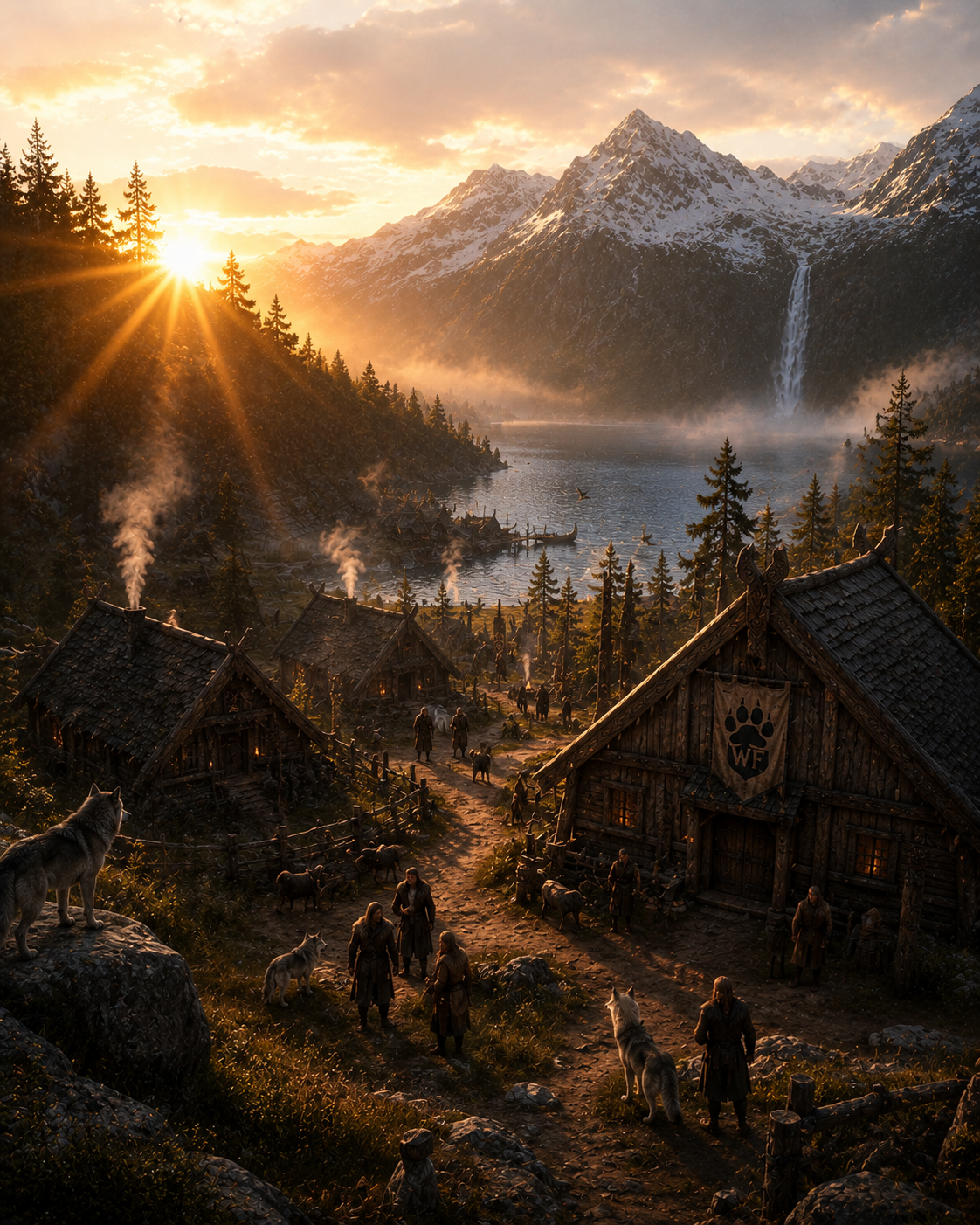
CHAPTER 2
Robert couldn't stop pacing.From one end of the longhouse porch to the other, he walked with the restless determination of a man searching for something that could not be found. His boots rose and fell against the weathered pine boards in a steady rhythm that had become almost hypnotic over the last hour. At the end of the porch he would pause only…