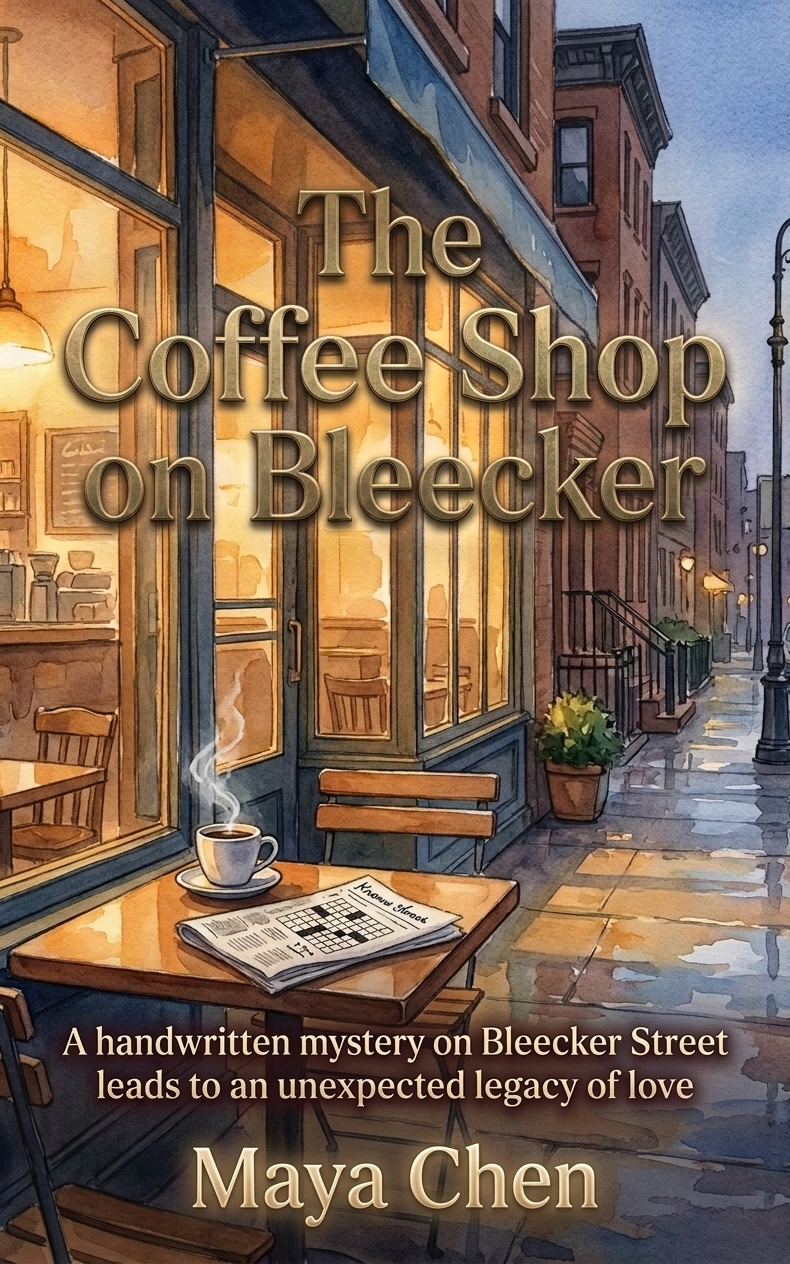
The Coffee Shop on Bleecker
A handwritten mystery on Bleecker Street leads to an unexpected legacy of love
by AIWriteBook
Maya Reyes is barely staying afloat in the digital rush of New York City. To escape the chill of her apartment and the heavy silence of grief following her father’s death, she spends her mornings in a cozy Greenwich Village cafe. But her predictable routine is shattered when she discovers a handwritten crossword puzzle left at her table—with clues that reference her most private conversations. The cafe’s owner reveals a secret: an anonymous benefactor has been paying for Maya's coffee for months, with one condition—she must solve the puzzles. As Maya follows the trail through the historic streets of the Village, every clue brings her closer to Alastair Finch, a reclusive archivist who guards the past as fiercely as Maya avoids it. Between the slow-burn attraction and the mysterious connection Alastair seems to have with her father’s history, Maya finds herself at a crossroads. Is this scavenger hunt a path to healing, or is she being manipulated by a stranger? To find the truth, Maya must step away from her screen and embrace a tangible legacy she never knew existed. In the heart of Bleecker Street, she might just discover that the best things in life can’t be programmed—they have to be felt.
- Contemporary Romance
Low Resolution Mornings
The radiator in my apartment didn’t just clank; it wheezed with the rhythmic, wet cough of something dying. It was a miserable, gray Tuesday in Manhattan, the kind of morning where the sky looked like an unwashed window and the draft coming through the floorboards felt like a personal insult. I pulled the duvet tighter, but the cold was persistent, a creeping dampness that settled into my bones and reminded me that my bank balance was currently as precarious as the heating system in this walk-up.
I rolled over and squinted at my phone. Two new emails from freelance clients, both likely asking for "just one more tiny revision" on logos I’d already redesigned three times. I felt like a low-resolution version of myself today, barely at 72 dpi, blurry and lacking the sharp edges required to survive a New York winter. The digital world was supposed to be efficient and clean, but lately, it just felt like a void that swallowed my time without giving anything back. I missed the weight of things. I missed the way my father used to say that if you couldn't touch it, it wasn't quite real yet.
By eight o’clock, the cold became unbearable enough to drive me out. I stuffed my laptop into its messenger bag, the strap digging into my shoulder like a physical manifestation of my guilt over the unfinished projects inside. I wrapped a thick, oversized wool scarf around my neck twice, tucked my auburn hair behind my ears, and headed out toward Bleecker Street. The walk was short, but the wind whipped through the canyons of the Village, stinging my cheeks until I finally pulled open the heavy wooden door of Priya’s coffee shop.
The bell above the door gave a familiar, muffled chime. Inside, the air was a thick, delicious blanket of roasted beans and steaming milk. It was the only place in the neighborhood that still felt like it belonged to the people who lived there rather than the tourists who photographed it. Priya was behind the counter, her silver hair clipped back and her flour-dusted apron tied tightly around her waist. She didn't even look up from the espresso machine as I approached my usual small table in the corner, the one tucked away from the drafty window.
“You’re late, Maya,” Priya called out over the hiss of the milk steamer. Her voice was rough and warm, a sound that always reminded me of home. “I was starting to think you’d frozen solid in that shoebox you call an apartment.”
“Almost,” I admitted, sliding into the chair and setting my bag on the floor. I rubbed my hands together, trying to coax the circulation back into my fingers. “The radiator is officially on strike. I think it’s joined a union.”
Priya chuckled, a deep sound that shook her shoulders. She walked over a moment later, carrying a ceramic mug topped with a perfect swirl of foam. She set it down in front of me with a soft clatter. I reached for my purse, but she held up a hand, palm out, stopping me before I could even unzip the pocket.
“Save your pennies, kid,” she said, wiping a stray drop of coffee from the table with the dishrag she kept over her shoulder. “The regular was in early. He already took care of it.”
I froze, my fingers hovering near my bag. “The regular? You mean the same one from last week? Priya, I’ve told you, I can’t just keep accepting free coffee from a stranger. It feels... weird.”
“He’s not a stranger to me,” she countered, her expression turning uncharacteristically guarded. “And he was very specific. He said you look like you need the caffeine more than he needs the five dollars. Don't overthink it. Just sit, drink, and do your work.”
“But who is he?” I pressed, leaning forward. “Is it that guy in the corduroy jacket? Or the one who always reads the Times in the back?”
Priya just winked and started walking back toward the counter. “The answers aren't gonna find themselves, Maya. Maybe you should look at the table instead of looking at me.”
I frowned and looked down. Next to my latte sat a small, torn square of paper. It looked like it had been ripped from a high-quality sketchbook—the paper was thick, slightly cream-colored, with a tooth that suggested it was meant for more than just grocery lists. On it was a hand-drawn crossword grid. The lines were precise, inked with a fountain pen that had left behind the faintest scent of cedar and old library books. There were only a few clues scribbled at the bottom in a cramped, elegant script.
My heart gave a strange, erratic little thud. Crosswords were my father’s obsession. Every Sunday, we used to sit at the kitchen table, the air smelling of ink and breakfast, and he would let me fill in the easy ones while he tackled the cryptic puns. Since he passed away a year ago, I hadn't touched a puzzle. It felt too much like an open wound.
I picked up my pen, my hand trembling slightly. I told myself it was just a coincidence. New York was full of people who liked puzzles. But as I scanned the clues, my breath hitched. Most were standard—3-Down: A bird of prey (4 letters)—but then I saw it. 14-Across: The scent of Saturday mornings (10 letters).
I stared at the empty white boxes. My mind didn't even have to search for the word; it was etched into my DNA. My father’s print shop had been a sanctuary of heavy iron presses and lead type. He refused to use the modern, odorless solvents. He stuck to the old ways, the tactile ways. Every Saturday, he would let me help him clean the rollers, and the air would be thick with that sharp, earthy aroma.
I leaned over the paper and carefully wrote: L-I-N-S-E-E-D-O-I-L.
It fit perfectly. A cold shiver that had nothing to do with the winter air ran down my spine. This wasn't just a random game left behind by a bored patron. It was a direct message. Someone knew about the shop. Someone knew about the specific smell of my childhood, a detail so private I’d never even mentioned it to Priya.
I looked up, scanning the cafe with a sudden, sharp intensity. There were only three other people in the shop: an elderly woman knitting a scarf, a student buried in a textbook, and a man in the far corner whose face was obscured by a newspaper. None of them looked like they were watching me. None of them looked like they held the keys to my father’s memory.
I looked back at the grid, my fingers tracing the ink lines. The fountain pen ink was still dark, not yet faded by the sun. This benefactor, this anonymous ghost, had sat in this very chair only an hour ago. He had been thinking of me—or at least, thinking of the girl I used to be before I started hiding behind a glowing screen and a pile of debt.
“Priya,” I called out, my voice sounding thin even to my own ears. She was busy with a customer, but she glanced over her shoulder. “The man who left this... did he say anything else?”
She paused, her hand on the handle of the espresso machine. For a second, I thought she might actually tell me. But then she just shook her head and gave me a soft, sad smile. “He just said you were a girl who lived in high resolution once, and he hoped you’d find your focus again.”
I sank back into my chair, the steam from my latte warming my face. The digital projects in my bag felt heavier than ever, their artificial perfection suddenly repulsive. I looked at the hand-drawn grid, the imperfections in the ink, the way the paper felt under my thumb. It was real. It was tangible. And for the first time in a year, I felt a spark of something that wasn't grief. It was curiosity, sharp and bright, cutting through the gray fog of my life like a needle through fabric. I didn't know who was playing this game, but I knew I had to finish the puzzle. I had to know how a stranger could possibly know the scent of my father's hands.
The Archivist in Charcoal
The final clue in the first puzzle had been a simple one, almost insultingly so once I worked it out: Where the lions keep their secrets. Five letters. I'd stared at it over a second latte until the answer arrived with a quiet certainty. NYPL. The New York Public Library. Of course it was. I arrived on a Wednesday afternoon, when the pale winter su…