


RED HORIZON
A Mars Odyssey
by Daniel Dash
Before dawn on her final morning on Earth, Commander Lena Vasquez presses her palm into the cool, wet soil of the launch perimeter, whispering goodbye to the world she has known. Ahead lies a journey no human has ever made: seven months across the silent gulf between worlds aboard the HELIX Ares, traveling toward an outpost raised by six machines in the quiet dust of Mars. There are no battles here, no saboteurs, and no hostile forces waiting in the dark. There is only the unyielding discipline of physics, the unpredictable fury of Martian weather, and the twenty light-minutes of cold space that separate the crew from every voice they have ever loved. From Lena's first step into the rust-red regolith to the birth of the first child beneath a dome, and spanning three centuries to the first Martian rain and the outward voyage toward the stars, Red Horizon chronicles the fragile, magnificent arc of humanity taking root. It is an enduring portrait of patience, quiet wonder, and our deepest instinct to reach beyond the dark.
- Science Fiction
- Space Exploration
- Near Future
- Colony Worlds
Goodbye, Earth
The floodlights on the pad never went out, so the night at the HELIX launch facility was never fully dark. From the perimeter road the rocket looked like something left on by mistake: a white column standing in its own light two miles away, breathing vapor into air that had not yet decided to be morning.
Lena Vasquez had been awake since three.
Nobody had told her to sleep and nobody had told her not to, which was one of the things she valued about Sarah Chen. The schedule for the crew’s last day on Earth began at seven with a medical check and ended at nine in the evening with lights out. The hours before seven belonged to no one. Lena had decided weeks ago what she would do with them, and she had told nobody, because saying it aloud would have made it sound like a ceremony, and it was not a ceremony. It was only something she needed to do with her hands.
She went out through the east doors. They were glass, twice her height, with the HELIX double helix etched across both panels, so that the spiral split down the middle as the doors opened and became one piece again when they closed behind her. The night guard looked up from his desk, saw who it was, and looked back down at his screen. He did not ask where she was going. She was grateful for that too.
Outside, the air was cool and wet and smelled of cut grass and pine. She stood on the concrete apron for a moment and let it reach her. For three years she had breathed mostly conditioned air: simulators, centrifuges, clean rooms, the sealed mock-up of a ship’s corridor where the four of them had learned to live in each other’s pockets. They had managed it. That had been the easy discovery. The hard one, which no simulator had been built to test, was this. Whether she could walk away from all of it.
She stepped off the concrete onto the grass.
It was long here, past the last mown strip, and heavy with dew. Within ten steps her boots were dark with it. Within thirty the cuffs of her flight suit were soaked and clinging to her ankles. She did not hurry. Somewhere to her left a generator hummed, and under the hum the small sounds of a field before dawn went on as they always had, frogs and insects and one early bird that kept trying the same three notes, as if nothing unusual were planned for tomorrow.
Seven months, she thought. Seven months to cross, and then a planet where six machines had spent two years building a house for people they had never met. She had looked at the pictures so many times that she could have drawn the outpost from memory: the pale modules, the swept landing pad, the dark plain running flat to the horizon in every direction. She knew the color of that ground. She knew its chemistry, its temperature at noon and at midnight, the weight her body would have when she stood on it.
She did not know what it would smell like. Nothing, probably. Nothing she would ever be allowed to find out, behind glass.
The perimeter ended at a line of trees. They were old pines, left standing as a windbreak when the facility was built, and against the grey of the sky they made a wall of deeper dark. Lena stopped a few paces short of them. Behind her the rocket stood in its light. Ahead of her there was only the treeline and the smell of resin and the cold coming up out of the ground.
This was far enough.
She turned her right hand over and looked at it.
It was an ordinary hand. A little square, the nails cut short, a pale scar across the base of the thumb from a bicycle chain when she was eleven. It had signed the forms. It had shaken the hands of people whose names were on buildings. Tomorrow it would close around a harness strap and hold on while something the height of a tower lifted her off the world, and after that, for as long as anyone could promise, it would touch nothing that had not been manufactured, pressurized, filtered or grown under lamps.
She looked at it the way you look at something you are about to give away.
Then she crouched and pressed it flat against the earth.
The grass bent under her palm and the cold came through at once, a clean, deep cold, with the wet soil giving slightly beneath it. She spread her fingers. She could feel single blades between them, and grit, and the thread of a root. She pressed harder, as if the ground might press back, and in a way it did. It held her. It had held her all her life without once being thanked.
Her knees went down without her deciding. The dew soaked through the knees of her flight suit and she did not mind. She stayed there, kneeling, one hand flat on the earth, her head bowed, breathing.
She had expected to think of large things. The mission. The people who had built the machine behind her. The three who would ride it with her. Instead she thought of rain on a car roof. Of a dog she had as a girl that slept on its back. Of the particular sound of a screen door. Small things came up through her hand one after another, as if the ground were returning them, and she let them come.
One tear got away from her. Only one. She felt it leave the corner of her eye and track down beside her nose, and she let it go the whole distance and fall. It seemed fair to leave that here as well.
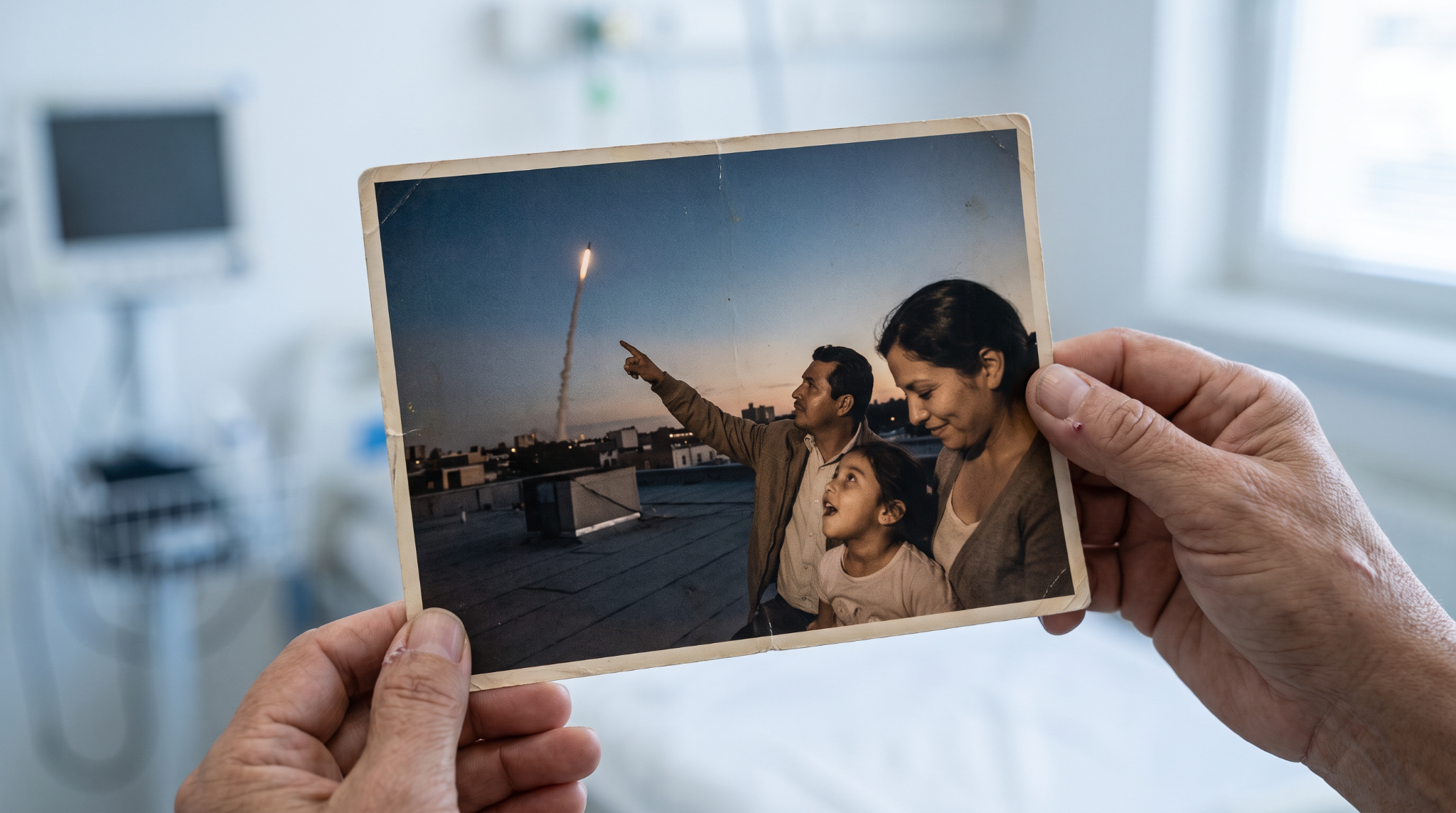
After a while she sat back on her heels and wiped her wet palm on her thigh. With the dry hand she unzipped the chest pocket of her flight suit and took out the photograph.
It had been folded in four for so many years that the creases had gone white and soft as cloth. She opened it carefully, the way she always did, supporting the middle where the folds crossed and the paper was thinnest.
A rooftop. A low wall, a water tank, a line of washing someone had forgotten to take in. Three people standing close together, squinting, because the photographer, a neighbor whose name she had lost, had put the sun behind his own shoulder. Her father on the left with his arm straight out and his finger pointing at something high and far outside the frame. Her mother on the right, one hand shading her eyes. And between them a girl of nine in a yellow shirt, with her mouth open and her head tipped so far back that she looked about to fall over.
There was no rocket in the picture. There never had been. The neighbor had turned his camera on the people instead of the sky, and for years Lena had thought that was a mistake. She knew what had been up there: a bright point climbing on a thread of white, and then the sound, arriving late, rolling across the rooftops long after the light. She remembered that sound in her chest. She remembered her father saying, there, there, do you see, and her own voice saying yes when she did not yet, and then saying it again when she did.
It was only much later that she noticed her mother. In the photograph her mother was not looking at the sky at all. She was looking at the girl.
Lena folded the picture along its old lines and held it flat against her chest with both hands, and closed her eyes.
She did not pray, exactly. She did not make a promise either. She had made her promises already, to the three people who would be strapped in beside her and to the woman who would be watching from a dark room when they went. What she did was simpler. She stayed still, and she let herself be exactly where she was for one more minute, on her knees on the ground of the only world anyone had ever come from.
When she opened her eyes the light had changed.
It began as a thin line of gold along the bottom of the sky, to the east, beyond the pad. Then the line thickened and the grey above it warmed, and the tops of the pines caught the color before anything else did, each one lit at the tip like a match. The rocket’s floodlights began to look pale. The bird with three notes found a fourth.
Lena watched. It was the last sunrise she would see with her feet on the ground, and she watched until the gold reached the grass and every blade around her carried a bead of light.
Then she put the photograph back in its pocket, closed the zip, and stood.
Her knees were stiff and her suit was soaked from the shin down. She looked at the place where she had been. In the long grass there were two shallow hollows, side by side, and in front of them the print of a hand, five fingers spread, pressed so firmly that it had not yet begun to spring back. Dew was already gathering in it.
Two knee impressions and a handprint. By the time the sun was fully up they would be gone, and no one would ever know they had been there. That was all right. She knew.
She turned and walked back the way she had come, along the dark line her own boots had drawn through the wet grass, toward the building and the light. She did not look over her shoulder. Ahead of her the glass doors stood closed, the spiral whole across them, with the sunrise beginning to burn in the panes.
They opened as she reached them. The helix parted. Commander Lena Vasquez went through, and the doors closed behind her and made it one piece again.
The Photograph
The medical bay smelled of rubbing alcohol and the inside of a blood pressure cuff, a smell Lena had come to know the way she knew her own front door. A technician named Dale wrapped the cuff around her arm and did not make conversation, because he had learned months ago that she preferred it that way, on this morning and on every other. "Hold stil…